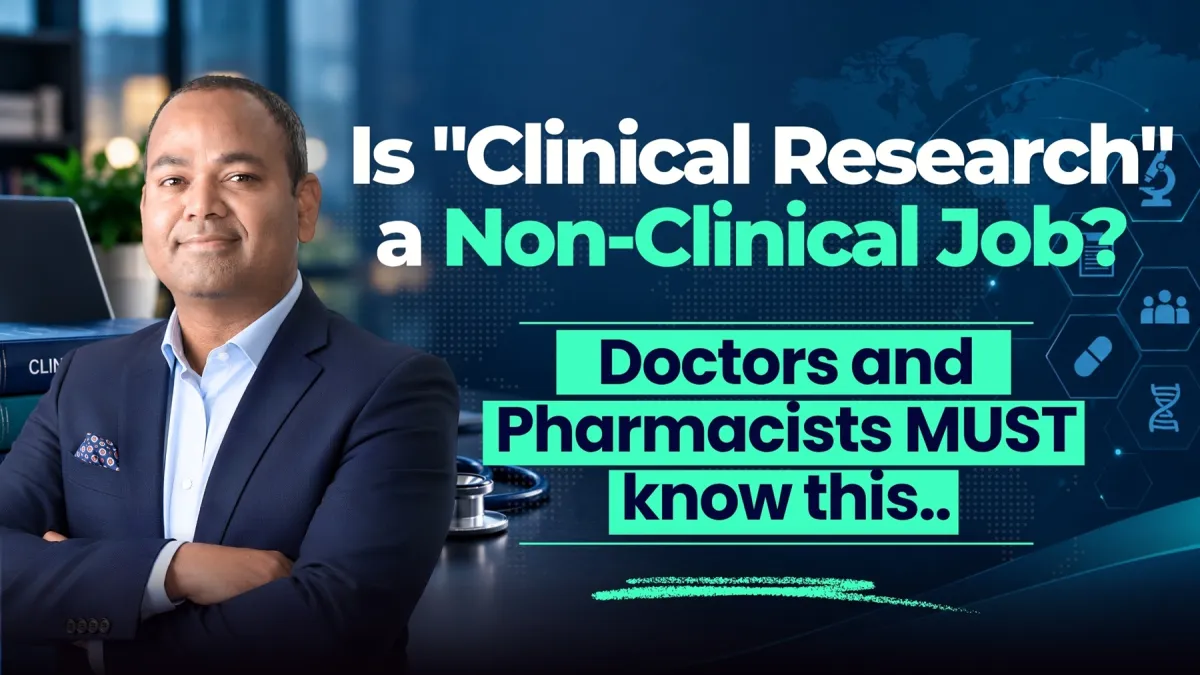
For doctors, pharmacists and other healthcare graduates who are wondering why anyone calls clinical research “non-clinical”.
If you’re a doctor or a pharmacist thinking about life beyond the hospital, you’ve probably had this moment while searching for non-clinical jobs. You open a job portal, see “Clinical Research Associate”, and think:
I want to step away from patient care, so why is this called clinical?
It’s one of the most common mix-ups in healthcare career switches, and it’s easy to clear up. The word “clinical” here has nothing to do with you treating anyone.
Why clinical research counts as a non-clinical career
In clinical research, “clinical” means the study is done in human participants. Before a new medicine or device reaches the market, it has to be tested in real people to see whether it’s safe and whether it works. That testing is the “clinical” part.
It does not mean you are the one examining, diagnosing or treating those participants. Doctors at the trial sites do that. Your work sits around the study: the data, the documents, the safety reports and the quality checks that make the results trustworthy.
The word “clinical” turns up in a few other places, and each one adds to the confusion:
- Clinical trial: a study of a medicine, vaccine or device in human volunteers. Trials run in phases, from small safety studies (Phase I), to larger studies of whether the treatment works (Phase II and III), to monitoring after approval (Phase IV).
- Clinical data: the information a trial collects, such as lab results, vital signs and side effects. Many roles are about checking and managing this data, not collecting it from patients.
- Clinical operations: the team that plans and runs trials. In practice it’s project management, documentation and quality control.
There’s one more trap. In drug development, “non-clinical studies” (also called pre-clinical) means lab and animal work done before a medicine is tried in people. That’s a different use of the word.
When a job portal calls a role “non-clinical”, it simply means the role doesn’t involve direct patient care.
Here’s the difference side by side.
| Clinical practice | Clinical research | |
| Focus | Direct patient care | Research, not routine patient care |
| Where you work | Hospitals and clinics | Pharma companies, CROs or research organisations |
| Day-to-day work | Examine, diagnose and treat patients | Manage data, documentation and study activities |
| Patient contact | Every day | Usually none. You may never meet a participant |
| What it’s for | Clinical decisions for one patient at a time | Safer, more effective medicines for many patients |
Your medical knowledge still matters in non-clinical roles
This is the part people worry about, so let’s say it plainly: you are not throwing away your degree. You still need to understand diseases, how drugs work, what an abnormal lab value means and what a side effect looks like. That’s exactly why companies want doctors and pharmacists in these roles. The difference is that you use that knowledge at a desk (or on a laptop at home) instead of at bedside.
Many of these roles are office-based or hybrid, and a few are fully remote.
Non-clinical roles in clinical research and pharma: what people really do
Clinical Research Associate (CRA)
A Clinical Research Associate (CRA) makes sure a trial is run the way its protocol says it should. You check records at the hospital sites (in person or remotely), compare them with what was entered in the study database, confirm that patient consent forms are in place, note any protocol deviations and stay in touch with the investigators. Some travel is normal.
Notice what’s missing: you’re not treating anyone. You’re checking that the people who do are following the rules, and that the data can be trusted. Fresher Clinical Research Associate (CRA) salaries at roughly ₹4–7 lakh a year, going up to ₹10–18 lakh for senior CRAs.
What it takes: A solid grasp of GCP and the study protocol, sharp attention to detail, and comfort with travel and report writing. Familiarity with EDC systems such as Medidata Rave or Oracle InForm is helpful. It suits people who like checking things properly and don’t mind being on the road.
Clinical Trial Associate or Coordinator (sponsor or CRO side)
Think of this person as the organiser of the study. They keep the trial files complete and up to date, track documents, handle site contracts and amendments, and coordinate between teams. It’s detailed, deadline-driven work.
What it takes: Good organisation, clear written communication and patience with paperwork and tracking. You don’t monitor sites, but you do keep a lot of moving parts straight. It suits people who like keeping a project on schedule, and it can be a way into wider clinical operations work.
One small warning: a site-based clinical research coordinator, working inside a hospital, does deal with participants. The in-house roles at pharma companies and CROs usually don’t.
Clinical Data Manager and Central Monitor
Every trial produces a mountain of data. Data managers help set up the study database, raise queries when something doesn’t add up, and clean the data before it goes for analysis. Central monitors watch data trends from a desk to spot problems early, such as a site entering unusual values. Attention to detail matters more here than anything else.
What it takes: Care with detail, comfort with databases and spreadsheets, and the patience to chase small discrepancies. Some roles expect basic database or programming skills, but many entry-level jobs train you on the system. It suits people who like order and enjoy spotting what doesn’t fit.
Drug Safety and Pharmacovigilance
When a participant (or later, a patient using the marketed drug) has a side effect, it gets reported. Drug safety professionals review those reports, code them using MedDRA, write case narratives and make sure they’re reported to regulators on time. A Drug Safety Physician adds the medical judgement on whether the drug may be responsible.
The usual path runs from Drug Safety Associate to Senior Associate, then signal detection, and later Drug Safety or PV Manager. Freshers typically earn at about ₹3–5 lakh a year, though individual openings, like the drug safety associate role listed below, can start lower.
What it takes: Knowledge of pharmacology and disease, accurate MedDRA coding, and a clear writing style for case narratives. Deadlines are strict, so being organised matters, and ICH E2 guidelines as useful background. It suits people who like structured desk work and take accuracy seriously. Browse pharmacovigilance jobs, or read Jobslly’s guide to pharmacovigilance jobs for doctors.
Medical Science Liaison and Medical Affairs
MSLs have scientific conversations with specialist doctors. They explain clinical data, answer questions from experts and support medical conferences. It isn’t a sales job. Doctors with an MD are often preferred here, and the pay reflects it: Entry-level MSL roles start at ₹12–18 lakh a year.
What it takes: Deep knowledge of a therapeutic area, comfort reading and explaining clinical trials ( PICO, NNT and hazard ratios), and the confidence to talk with senior specialists. Relationship-building matters as much as science. It suits doctors who enjoy scientific discussion and are fine with travel.
Regulatory Affairs
Before a medicine can be sold, authorities such as CDSCO, the FDA or the EMA have to approve it. Regulatory affairs professionals prepare and submit that paperwork and keep the product compliant after launch. Pharmacists fit in naturally because the work builds directly on drug knowledge.
What it takes: Careful reading, an eye for compliance, and knowledge of how submissions are structured (CTD and eCTD, ICH guidelines). Familiarity with CDSCO, FDA and EMA processes helps, especially as you move up. It suits people who prefer precision and documentation over fieldwork.
Medical Writing
Medical writers turn study results into clear documents: clinical study reports, regulatory dossiers, journal manuscripts and patient information material. If you enjoy reading research and explaining it simply, this is one of the more remote-friendly options.
What it takes: Strong written English, the ability to read research critically, tidy reference management and good command of Word. ICH E3 familiarity and AMWA or EMWA certification are useful. It suits people who like working with documents and deadlines, often on their own. Jobslly also has a guide to medical writer jobs in India.
Non-clinical jobs beyond pharma
“Corporate healthcare” is wider than drug companies. Medical device makers hire clinical specialists and clinical research executives. Health-tech startups hire doctors as clinical leads and medical advisors. Consulting firms and public-health organisations hire clinicians for policy and programme work. The common thread is the same: they need people who understand medicine but aren’t seeing patients.
Non-clinical job openings
Jobslly is a healthcare job platform by Academically Global, built for doctors, pharmacists and other healthcare professionals. It says every employer is verified before posting, and it brings together roles from pharma companies, CROs, hospitals and health-tech firms, including a dedicated non-clinical jobs category. Creating a profile and applying is free for job seekers.
To make this less abstract, here are some real openings from Jobslly’s non-clinical listings (as seen on 17 October 2026). Listings change quickly, so treat this as a snapshot.
| Role | Company | City | Listed salary |
| Clinical Research Associate | Flexiple | Delhi, Hyderabad | ₹5–7 lakh |
| Senior Clinical Trial Associate | ICON | Mumbai | ₹7–9 lakh |
| Clinical Trial Associate | Fortrea | Bengaluru | ₹8–12 lakh |
| Central Monitor II (RBQM) | Precision Medicine Group | Bangalore | ₹4–7 lakh |
| Drug Safety Associate | 4C Pharma Solutions | Hyderabad | ₹3.2–5.5 lakh |
| Drug Safety Physician (senior) | IQVIA | Bengaluru | ₹20–25 lakh |
| Medical Liaison Officer | Syneos Health | Hyderabad | ₹14–19 lakh |
| Regulatory Medical Writer | Eurofins | Bengaluru | ₹7–8 lakh |
| Clinical Research Executive | Alcon | Bangalore | ₹16–19 lakh |
Do you need an MD for non-clinical jobs?
Not always. Many entry-level roles in pharmacovigilance, clinical research and medical writing accept MBBS graduates, and pharmacists (B.Pharm or PharmD) are a natural fit for pharmacovigilance, regulatory affairs and medical affairs. Roles like MSL, medical affairs and medical monitor tend to prefer an MD as you move up. The safest habit is to read the qualification line on each listing before you apply.
MD (especially MD Pharmacology) is preferred for MSL and Medical Advisor roles, PharmD and PhD graduates with strong clinical trial knowledge are also frequently hired as MSLs in India.
Which non-clinical role fits you?
- Like organised desk work? Look at pharmacovigilance.
- Enjoy writing? Medical writing.
- Enjoy scientific discussions and some travel? MSL.
- Interested in how trials run on the ground? Clinical research (CRA or CTA).
- Prefer compliance and documentation? Regulatory affairs.
Clinical research terms you’ll see in job descriptions
Job descriptions in this field lean on shorthand, and a handful of terms cover most of it.
| Term | What it means |
| CRO (contract research organisation) | A company that runs all or part of a trial on behalf of a drug company |
| Sponsor | The company or institution that owns and funds the study |
| Protocol | The written plan for the study: who can take part, what is done, and when |
| GCP (Good Clinical Practice) | The international quality and ethics standard for running trials. Many roles ask for GCP training |
| eCRF / EDC | The electronic form and system where trial data is entered |
| TMF (trial master file) | The full set of documents showing a trial was run properly |
| Adverse event (AE) | Any unwanted medical event in a participant, whether the drug caused it. Serious ones are reported quickly. |
Job description for three red-flag words if they want to avoid patient care: "OPD," "ipd/ward rounds," "phlebotomy," or "obtaining informed consent from patients." If a listing has those, it is a hospital site role (CRC), not a corporate desk role.
Same knowledge, different path
Choosing clinical research doesn’t mean you’ve left medicine. It means you’ve moved from treating one patient at a time to helping build the medicines that many patients will eventually take. Your training still counts, and many of these roles are office-based and free of patient-facing duties.
If you want to see what’s open right now, browse the non-clinical jobs and filter by the area that interests you. For more on career options, read Jobslly’s guide to the best non-clinical jobs for doctors