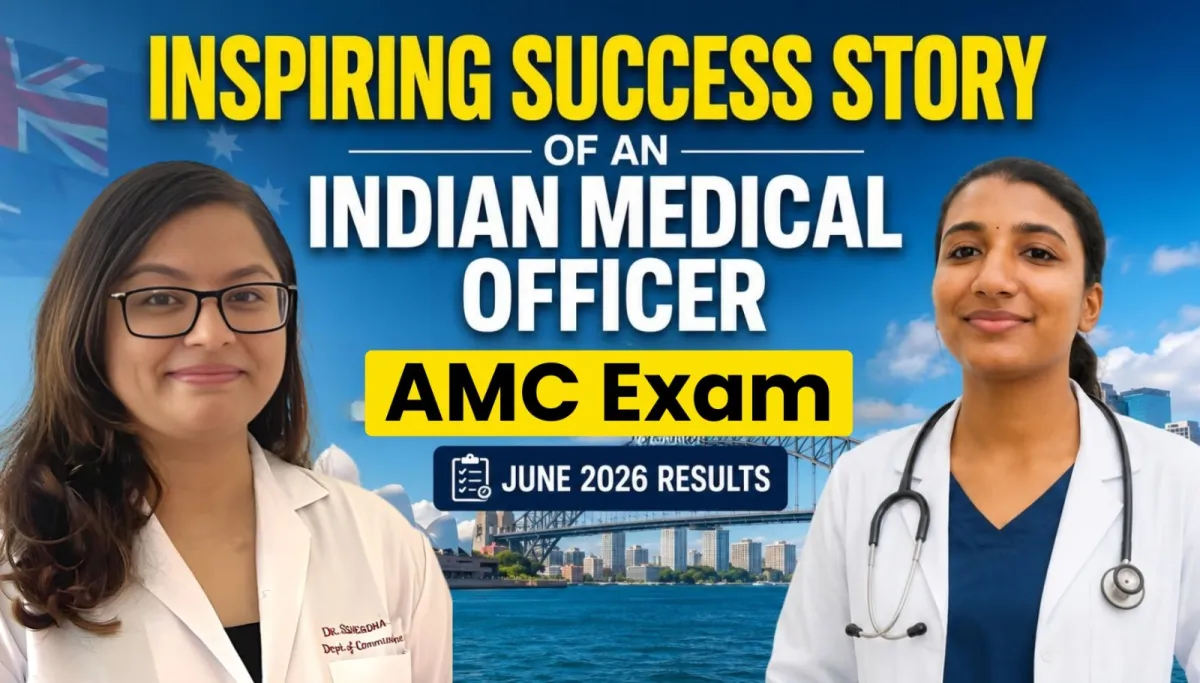
Every AMC result day brings stories of determination, but the June 2026 AMC MCQ results reinforced one truth. The exam is changing, and so must the way candidates prepare. Memorising textbook facts is no longer enough. Today's Australian Medical Council (AMC) exam demands clinical reasoning, confident decision-making, and the ability to identify the next best step in complex patient scenarios.
One such inspiring story comes from Dr. Griva, who successfully cleared the AMC MCQ exam while working full-time as a Medical Officer. In an exclusive conversation with Dr. Ssnegdha Sharma, Academic Head of Medical Courses at Academically, she shared the preparation strategy that helped her succeed despite the increasing difficulty level of the AMC exam.
If you're planning to appear for the AMC MCQ exam in 2026 or beyond, this interview offers practical insights into what actually works, how the exam pattern is evolving, and what you should do differently to maximise your chances of passing.
How the Australian Journey Began for This Indian Medical Officer
Passing the AMC MCQ examination is becoming increasingly competitive. Candidates across recent exam cycles have reported a noticeable shift in question style. Rather than testing straightforward factual recall, the AMC now focuses on clinical reasoning, prioritisation, and evidence-based decision-making.
Dr. Griva experienced this change firsthand. Despite balancing a demanding clinical job, she adapted her preparation strategy around consistent MCQ practice, structured revision, and active doubt clarification, an approach that ultimately led to success.
Unlike many candidates who prepare full-time, Dr. Griva managed her studies alongside her responsibilities as a Medical Officer. Instead of chasing multiple resources, she concentrated on doing a few things exceptionally well:
- Solving high volumes of quality MCQs
- Revising consistently
- Clearing every doubt immediately
- Practising recall-based questions
- Building clinical thinking instead of rote learning
The result? A successful AMC MCQ outcome in the June 2026 session.
AMC Exam Study Strategy: Learn from AMC Exam Passout of June 2026 Cohort
One of the most striking insights from the interview was the sheer volume of practice. During the final two to three months before the examination, Dr. Griva solved approximately:
| Preparation Habit | Strategy |
| Daily MCQs | 300–400 questions/day |
| Revision | 2–3 revisions initially, followed by one final revision |
| Question Source | Structured QBank + recall questions |
| Doubt Solving | Active participation in faculty discussions |
| Final Week | Recall-topic MCQ practice |
This wasn't simply about solving questions quickly. After every large practice session, she reviewed mistakes, revised concepts, and strengthened weak areas before moving ahead. This cycle of practice → analysis → revision → reattempt significantly improved retention.
Why MCQ Practice Matters More Than Ever
Many candidates believe reading textbooks repeatedly is enough. Dr. Griva's experience suggests otherwise. According to her, repeated exposure to clinically oriented questions helped her recognise recurring patterns, improve decision-making, and understand how AMC frames its scenarios. Rather than memorising diseases individually, she became comfortable identifying:
- the most likely diagnosis
- the immediate investigation
- the safest management option
- the next best clinical step
These are precisely the competencies the AMC increasingly evaluates.
The Biggest Change in the AMC MCQ Exam Pattern
One of the most valuable parts of the interview was Dr. Griva's observation about the evolving examination style. Instead of giving classic textbook presentations, the AMC increasingly presents:
- overlapping symptoms
- multiple differential diagnoses
- confusing clinical clues
- situations requiring prioritisation
According to her, psychiatry questions have become particularly challenging. Instead of asking candidates to identify one obvious disorder, the exam often combines symptoms from different psychiatric conditions, forcing candidates to distinguish subtle clinical differences. This reflects the reality of medical practice, where patients rarely present with textbook-perfect symptoms.
Clinical Reasoning Replaces Rote Learning
Perhaps the biggest takeaway from the interview is this. The AMC is no longer rewarding rote learning alone. Today's questions assess whether candidates can think like safe Australian clinicians. When solving any clinical scenario, Dr. Griva recommends asking yourself:
"What is the most appropriate initial step?"
or
"What is the next best management?"
This simple mental habit trains candidates to think exactly the way the AMC expects.
How to Balance Your Full Time Medical Job with AMC Exam Preparation?
Preparing for AMC while working full-time is one of the biggest concerns among International Medical Graduates (IMGs). Dr. Griva proved that success is still achievable with the right structure. Her preparation focused on consistency rather than unrealistic study marathons.
She maintained regular MCQ practice, revised strategically, and used every doubt as an opportunity to strengthen understanding. The lesson is clear. Consistency beats occasional intensive study.
Why Active Doubt Clearing Makes a Difference
Many candidates silently skip difficult concepts. Dr. Griva chose the opposite approach. She actively participated in dedicated discussion channels where she regularly clarified doubts with faculty. This prevented misconceptions from accumulating over time.
Immediate clarification also meant that each revision became more productive because previously confusing concepts were already clear. Interactive learning often accelerates preparation far more than studying alone.
Last-Minute AMC Exam Preparation Tips
Candidates often wonder what they should study during the final week before the exam. Dr. Griva's advice is refreshingly practical. Instead of starting new topics, she focused on:
- recall-based questions
- high-yield revision
- maximum MCQ practice
- reinforcing familiar concepts
Her recommendation is simple. The last week is for consolidation, not experimentation.
AMC Exam Resources That Supported Her Preparation
During the interview, Dr. Griva shared that she prepared using:
- Academically's structured QBank
- recall plans
- faculty guidance
- discussion forums
- revision-based MCQ practice
She also appreciated the continuous support available throughout preparation rather than only classroom teaching.
What Future AMC Aspirants Can Learn From Dr. Griva
Her journey highlights several practical lessons.
| What Worked | Why It Matters |
| High-volume MCQ practice | Builds speed and pattern recognition |
| Multiple revisions | Improves long-term retention |
| Doubt clarification | Prevents repeated mistakes |
| Recall-topic revision | Reinforces exam-oriented concepts |
| Clinical reasoning approach | Matches current AMC question style |
None of these strategies are shortcuts. Together, however, they create a preparation framework that aligns with the current AMC examination standard.
Preparing for the AMC MCQ Exam? Choose Resources That Mirror the Real Exam
As the AMC examination becomes increasingly application-based, candidates benefit most from preparation that reflects actual exam expectations rather than passive reading. The AMC MCQ Exam Preparation Course by Academically has been designed specifically around this evolving pattern. Some of the features include:
- 100+ hours of live and recorded lectures
- Extended course access for flexible learning
- Comprehensive study handouts
- Adaptive AI-driven mock tests
- Exam-focused grand tests
- Mentorship from AMC-qualified experts and AHPRA-registered medical practitioners, settled and working in Australia
- Structured MCQ strategy classes
- Clinical reasoning-based teaching
- Exclusive exam-solving techniques
Rather than simply covering the syllabus, the course focuses on helping candidates develop the decision-making skills increasingly assessed in the AMC MCQ examination.
What's Next After AMC MCQ Exam Part I?
Passing the AMC MCQ exam is only the beginning. After qualifying, candidates move towards the next stages of their Australian medical registration journey, including clinical assessment pathways and career planning. Recognising this, Academically also provides guidance beyond the examination itself, including sessions on:
- CV preparation
- Australian job applications
- career guidance
- interview readiness
This helps candidates transition from exam success to employment with greater confidence. Once candidates clear the AMC MCQ examination, the next milestone is demonstrating real-world clinical competence.
To Conclude with...
Dr. Griva's success story is inspiring not because she discovered a secret formula, but because she relied on disciplined preparation.
She worked full-time. She solved hundreds of MCQs consistently. She revised strategically. She cleared doubts immediately. Most importantly, she adapted to the changing nature of the AMC examination instead of relying on outdated preparation methods. As AMC continues raising its standards, successful candidates will increasingly be those who develop strong clinical reasoning, practise extensively, and prepare systematically.
If there is one message from her journey, it is this. Don't just study medicine. Learn to think like the clinician the AMC wants you to become.