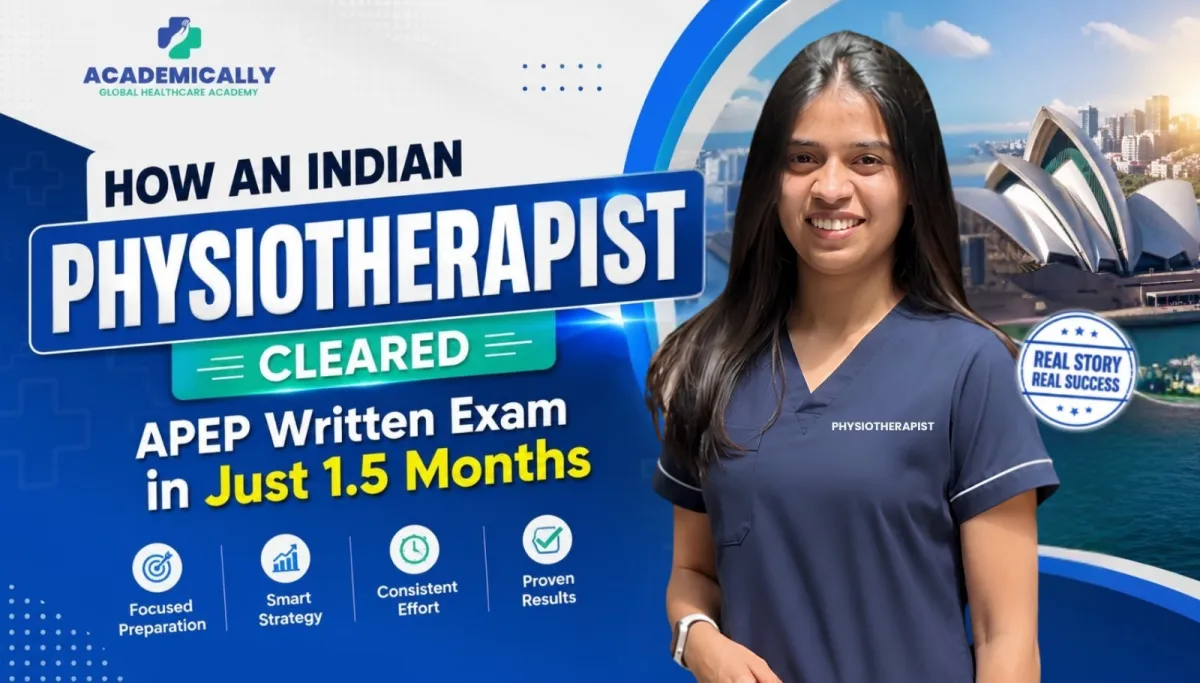
There is no better way to describe Aayushi's journey to becoming a physiotherapy registrant in Australia. In just 1.5 months. This Indian physiotherapist did what most candidates are told to plan six months for. She cleared the Australian Physiotherapy Entry Pathway (APEP) exam, turning a newly arranged marriage, a family loss, and a ticking clock into fuel for one of the fastest licensure exam pass outs, Academically Global has ever seen.
In a tete-a-tete with Dr. Ssnegdha Sharma, Academic Head of Medical Courses at Academically, Aayushi explains every bit about her journey to clear APEP written exam. It is not just inspiring. It is a masterclass in focus, resilience, and smart preparation for every overseas-trained physiotherapist eyeing AHPRA registration.
Challenges Faced by Indian Physiotherapist to Get to Australia
Aayushi's journey began the way many great stories do. Until January, she had no idea the Australian Physiotherapy Entry Pathway (APEP) exam even existed. Her arranged marriage was finalised, her court marriage was done in February, and her husband was already settled in Sydney. The realisation hit fast. Clearing this exam was the only bridge to reuniting with her husband and building a life in Australia.
She enrolled in February and began serious preparation in March, leaving herself roughly 1.5 months before her June exam date. To make matters harder, her grandmother passed away just before the exam, adding an emotional weight that would have derailed many candidates. Instead, Aayushi channelled her grief and urgency into one of the most disciplined preparation sprints imaginable.
This is precisely the kind of high-pressure, time-constrained situation that Academically's APEP written exam preparation course was designed to support. With 100+ hours of intensive live sessions, AHPRA-registered physiotherapists as faculty, community support on Discord, 1:1 consultations, candidates don't have to guess what to prioritise when time is short.
Aayushi effectively compressed months of guided learning into weeks by staying laser-focused on high-yield material rather than spreading herself thin.
Applying for the APEP Written Exam
One of the most important insights Aayushi shared was about the psychology of exam preparation. Before booking the exam, she admits, candidates tend to live in a state of "maybe I'll skip it, maybe I won't." It's human nature to hover in indecision. But the moment you book the exam, everything changes. There is no longer a hypothetical. There is a date, a deadline, and no way out except through.
For Aayushi, that commitment was sharpened by circumstance. Her wedding celebrations were locked in for December, which meant she effectively had only two chances, either to make it in June or September. If she failed in June, she would be back in the same gruelling study cycle for months, something she was determined to avoid. So she treated June as her real attempt and September as a fallback she never wanted to use.
This is a lesson every APEP aspirant can borrow. Commitment creates momentum. Academically's APEP written exam coaching programme is built around this same principle, giving candidates a structured runway toward their exam date so that "maybe later" never has room to take hold.
APEP Written Exam Preparation Strategy 2026: Personalised Insights from Aayushi
Aayushi's preparation strategy was refreshingly practical. She relied heavily on handwritten notes, including notes made from offline lecture recordings, because writing things down helped her internalise dense clinical information rather than simply memorise it. She was especially firm about one thing.
Cramming does not work for content like cranial nerves, dermatomes, and myotomes. These require genuine understanding, not last-minute memorisation, because under exam-day stress, only deeply internalised knowledge holds up.
On the mock exam front, Aayushi didn't try to do everything. Out of the 68 to 70 mock tests available on the Academically portal, she completed close to 60 attempts but focused her real energy on around 40 to 45, prioritising quality of practice over sheer volume. This mirrors exactly what Academically's APEP written exam preparation course is structured to deliver over 4,000 practice questions specifically designed for the written assessment with AI-based mock tests and full-length grand tests that help candidates identify where their preparation is strongest and where it still needs work, rather than randomly attempting question after question.
Her study hours were unconventional too. Aayushi often studied through the night, from midnight to 7 AM, an intense and sacrificial routine that reshaped her entire sleep cycle. It wasn't a schedule she'd recommend to everyone. But it worked because she paired it with ruthless focus.
She attended only one live discussion session throughout her entire preparation. Yet she says that single session added real clarity and was more valuable than she expected. For candidates who can attend more live sessions, she believes the payoff would be even greater.
This is where structured live classes and recorded sessions on Academically's platform genuinely bridge the gap for offline-leaning students. You can revisit any missed live class as many times as needed, so no candidate is penalised for an unconventional schedule like Aayushi's.
APEP Exam Resources to Pass in First Attempt Itself
Perhaps the most valuable piece of advice Aayushi offers future candidates is about resource discipline. At several points during her preparation, she felt the urge to consult more textbooks, more websites, more supplementary material like Physiopedia. She felt like she was "falling behind" and that reading more would close the gap.
In reality, this instinct nearly worked against her. Jumping between too many resources wastes precious time and creates more confusion than clarity, especially on a compressed timeline. Her advice to future APEP candidates preparing for the exam is direct: limit your resources, trust a structured pathway, and go deep rather than wide.
This is exactly the philosophy behind Academically's APEP course design. Instead of leaving students to hunt across scattered sources, the curriculum is organised into focused clinical modules covering Musculoskeletal, Cardiorespiratory, and Neurology, alongside Lifespan, Settings, and Professional Practice content, so that candidates always know they are studying the right material at the right depth.
Key Insights from Ayushi’s APEP Preparation Journey
Aspect | Insights |
| Preparation Timeline | Ayushi started preparing in March and studied for approximately 1.5 months before the June APC exam, although many candidates recommend around 6 months of preparation. |
| Study Materials | She had access to 68–70 mock tests and completed around 40–45 mocks intensively through an academic portal. Handwritten notes were a major part of her revision strategy. |
| Study Schedule | Her primary study hours were from 12 AM to 7 AM. She relied mainly on self-study and offline learning, attending only a limited number of live lectures. |
| High-Yield Subjects | She emphasised anatomy topics such as cranial nerves, dermatomes, and myotomes, along with physiotherapy law and core physiotherapy concepts. |
| Retention Strategy | Ayushi focused on understanding concepts rather than rote memorization and used repeated revision to improve recall under exam pressure. |
| Mindset & Motivation | Booking the APC exam created a strong sense of commitment and shifted her mindset from “maybe I’ll try” to “I must pass.” |
| Time Management | She recommends limiting the number of study resources and prioritizing mock-test questions to avoid wasting time. |
| Personal Challenges | Her preparation coincided with personal loss, a new marriage, and time away from her spouse, making emotional resilience an important factor. |
| Exam Strategy | She viewed the June exam as an initial attempt and kept September as a backup option, using the possibility of an early pass as motivation. |
| Overall Recommendation | Focus on high-yield topics, complete a large number of mocks, revise repeatedly, keep resources limited, and build a strong commitment mindset before the exam. |
Inspiration Behind Achieving Success in Australian Physiotherapy Licensure Examination
When asked how she managed to push through everything, Aayushi didn't credit willpower alone. She was honest that the entire experience was a family journey. Her husband supported her from Sydney, and her wider family rallied around her even through the grief of losing her grandmother mid-preparation. That sense of collective effort, she says, made the impossible feel achievable.
This human dimension is something worth sitting with. Behind every exam success story is rarely just one person's discipline. It is usually a network of support, mentorship, and community. Academically's model reflects this too, connecting candidates with a private community of qualified physiotherapists, mentors, and alumni who have already walked this path, so no one has to prepare in isolation.
Why Choose Australia for Your Physiotherapy Career?
Aayushi's story arrives at a particularly relevant moment. The Australian Physiotherapy Entry Pathway (APEP) replaced the older Standard Assessment Pathway, introducing a more flexible, largely remote process for internationally trained physiotherapists.
Most steps, including the Written Assessment and the Remote Capability Assessment, can now be completed from home, with only one in-person clinical workshop required in Melbourne.
The salary and demand are real motivators for candidates eyeing this pathway. Registered physiotherapists in Australia can earn upwards of AUD 95,000 annually, and the country currently has over 7,000 open roles for the profession, backed by more than 185,000 visas issued for skilled medical workers.
Beyond registration, Australia's evolving skilled migration framework has made physiotherapy one of the country's most attractive healthcare professions for long-term career growth.
Physiotherapist (ANZSCO 252511) is recognised as a Tier 1 priority occupation, placing it among Australia's highest-demand healthcare roles for skilled migration. It is also listed on both the Core Skills Occupation List (CSOL) and the Medium and Long-term Strategic Skills List (MLTSSL), making eligible physiotherapists competitive for employer-sponsored visas such as Subclass 482 (Skills in Demand) and Subclass 186, as well as permanent residency pathways including Subclass 189, 190, and 491.
While visa invitations ultimately depend on factors such as points, state requirements, and government invitation rounds, Tier 1 occupations generally receive higher priority during skilled migration selection, making physiotherapy one of the strongest healthcare careers for professionals seeking to build a long-term future in Australia.
Given this environment, structured, efficient preparation isn't a luxury. It's the difference between chasing an opportunity and actually making the best use of it.
What's Next After Clearing the APEP Written Assessment?
Passing the written assessment is a significant milestone. But it is only one part of the Australian Physiotherapy Entry Pathway (APEP). Candidates who successfully clear the written examination must next progress to the APEP Capability Assessment. The focus shifts from theoretical knowledge to demonstrating safe, evidence-based clinical reasoning and professional decision-making in realistic patient scenarios.
Unlike the written exam, the capability assessment is an online, open-book oral assessment conducted with an Australian physiotherapist assessor. Candidates work through multiple clinical cases, explain their assessment and management plans, justify clinical decisions using current evidence, communicate professionally, and demonstrate that they can practise safely within the Australian healthcare system.
While reference materials are permitted, success depends far more on structured clinical reasoning and clear communication than simply finding the right information. Many candidates discover that the capability assessment requires a different style of preparation. Instead of memorising facts or solving multiple-choice questions, they need repeated practice discussing cases aloud, organising their thought process, applying Australian clinical guidelines, and responding confidently under time pressure.
To support candidates through this next stage, Academically's APEP Capability Assessment Preparation Course is designed specifically around the assessment format. The programme includes live case-based training, simulated oral assessments, feedback from experienced AHPRA-registered physiotherapists, structured clinical reasoning frameworks, Australian documentation standards, communication practice, and recorded sessions for continued revision.
The objective is not only to help candidates pass the assessment but also to prepare them for real-world physiotherapy practice in Australia. For candidates like Aayushi, clearing the Written Assessment opens the door. Preparing effectively for the Capability Assessment is what brings them one step closer to AHPRA registration, employment, and ultimately practising as a physiotherapist in Australia.
To Conclude with...
Aayushi didn't have the ideal six months her peers recommended. She had grief, a wedding, a husband waiting across the ocean, and 1.5 months to make it all count. What she did have was clarity: a commitment to one exam date, a disciplined note-making system, focused mock practice, and the humility to lean on family and mentors instead of trying to do it all alone.
For every overseas-trained physiotherapist wondering whether they have "enough time" to prepare for the APEP, Aayushi's journey offers a clear answer: it is not about how much time you have, but how intentionally you use it. As Mandela reminded us, it only seems impossible until someone does it. Aayushi did.