How a Full Time Indian Doctor Cleared Australian Medical Council (AMC) Exam May 2026 in Just 2 Months: Was it Luck or Hard Work?

Co-Author

Dr. Ssnegdha
Indian Doctor Cleared Australian Medical Council (AMC) Exam May 2026
Created On : Jun 09, 2026 Updated On : Jun 13, 2026 3 min

Key Takeaways

  •  Learn how a full-time MBBS doctor passed the AMC MCQ exam in just 2 months. 
  •  Get to know the exact study strategy that prioritised high-yield subjects and MCQs. 
  •  Receive first-hand insights into the AMC exam pattern, question types, and difficulty level. 
  • Understand why clinical reasoning and answer elimination matter more than memorisation. 
  • What are the career opportunities available after clearing AMC Part 1 and moving to Australia?


"The good physician treats the disease. The great physician treats the patient who has the disease." - Sir William Osler 

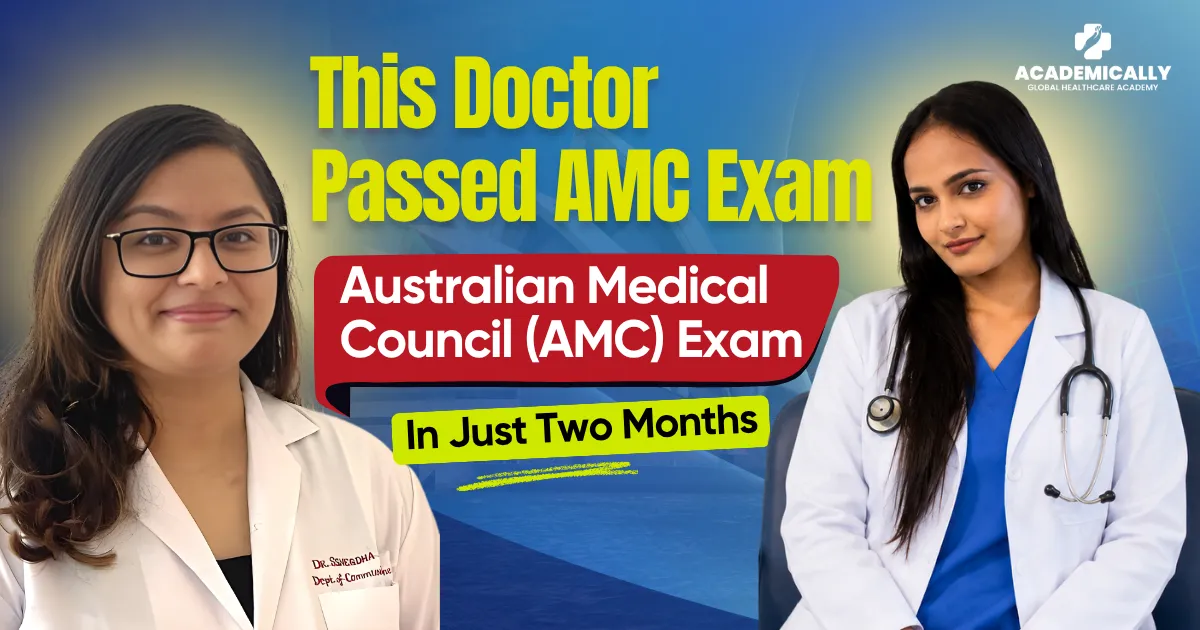
Osler's words have endured for over a century because they capture something essential about medicine. True clinical competence is never just about rote learning books of pathology or pharmacology. It lives in the intersection of knowledge, judgement, and lived experience. When Dr. Priti sat down to face the Australian Medical Council (AMC) MCQ exam in May 2026, it was precisely that intersection that carried her through. She received the results on June 5th, 2026 with a "PASS" remark and a score of 251.

Dr. Ssnegdha Sharma (Academic Head, Medical Courses, Academically) had a tete-a-tete on the AMC exam results declaration day to uncover the strategies Dr. Priti adopted to pass the exam in just 2 months that too, while managing a full time job. Is it sheer luck or hard work? Let's see.

How did the AMC Pathway Start?

Dr. Priti's journey with AMC pathway began in September the previous year. She enrolled into Academically, received her study materials, and started working through the course notes. But life, as it often does, had other plans. Work commitments mounted. The exam date kept getting pushed. May became June. At one point, when a technical glitch on the AMC booking portal prevented her from confirming her slot, she briefly considered requesting a partial refund and walking away entirely.

Her family said no.

"My parents told me: leave your job for two months, give 100% concentration. Just go for it."

She didn't leave her job. But she went for it anyway.

AMC Exam Preparation Strategy for Full Time Doctors

What Dr. Priti built over the next eight weeks was less a study plan and more a clinical triage of her own preparation. She ruthlessly prioritised what would yield the most on exam day, and consciously deprioritising everything else.

 Month One: Theory, But Only the Core 

The first month was dedicated to foundational revision across the high-weightage subjects:

  • Medicine (CVS, rheumatology, orthopaedics, full PDFs)
  • Gynaecology and Obstetrics (complete PDF, one full read-through)
  • Paediatrics
  • Psychiatry

Her approach to theory was deliberate and restrained. She read once, highlighted the essentials, and moved on. No second revision of theory. The goal was to build enough clinical scaffolding to make MCQ practice meaningful, not to achieve encyclopaedic recall.

 Month Two: MCQs, and Nothing But 

The second month was almost entirely MCQ-driven. She started at 200 questions a day and progressively pushed that to 300–400. By the final weeks, she was studying 15 to 16 hours daily.

For shorter subjects, ethics, emergency medicine, ENT, ophthalmology, she skipped deep theory entirely and went straight to MCQ banks. Her logic was sound. These subjects test pattern recognition and clinical judgement rather than dense theoretical recall, and the MCQ format trains both far more efficiently than re-reading notes.

 The Exam Week Recall Rule 

One of the most practically useful pieces of advice she shared: do your exam week recall seriously. Around 80 to 90% of the topics she encountered in the actual exam had come up during that final revision window, not the exact questions, but the clinical scenarios and concepts being tested. The AMC rarely repeats a question stem, but it returns to the same core topics consistently.


What Happens During the AMC Exam? Let's Know it From the Candidate Herself

Dr. Priti's breakdown of her exam experience offers a useful map for aspirants:

Subject AreaWhat to Expect
Paediatrics10–15 questions; high yield, worth thorough preparation
EthicsUnpredictable volume; she got far more than expected; MCQ practice is the only reliable prep
PsychiatryFeatured heavily; clinical scenario-based
Cardiovascular2–3 ECG interpretation questions
Ophthalmology2–3 picture-based questions (conjunctivitis, red eye photographs)
Picture-based overall8–10 image questions across the paper

The dominant lesson is the AMC is a clinician's exam. It tests how you think through a scenario, not how many eponyms you can recall. Learning to eliminate wrong options, especially between two closely-spaced, both-plausible answers, is a skill the MCQ practice actively builds, and it is non-negotiable.

So Is it Luck or Hard Work? What does AMC Exam Reward the Most?

Dr. Priti's own first instinct was to attribute her result to luck. Dr. Ssnegdha Sharma attributed it to her hard work. And she's right. She says:

Being a doctor means you've already cleared some of the most competitive filters in your country's education system. You are the cream of all professionals. Your years of clinical exposure, the ward rounds, the overnight calls, the diagnostic reasoning sharpened by a thousand bedside presentations. That knowledge doesn't switch off when you sit an exam. What the AMC tests is whether you can access that knowledge under structured, time-bound conditions. Dr. Priti could. That's preparation, strategy and definitely not luck. " - Dr. Ssnegdha Sharma

What's Next After AMC CAT MCQ Part I?

With her AMC Part 1 cleared, Dr. Priti is now targeting two parallel tracks. She's now applying for medical jobs in Australia while simultaneously beginning preparation for AMC Part II (the Clinical OSCE). Her plan is to enter the system, get into a hospital, absorb the Australian clinical environment and complete the final step from within it.

We'd call it smart, pragmatic, and exactly the kind of adaptive thinking the Australian healthcare system tends to reward.

Why Choose Academically for AMC Exam Coaching?  

Dr. Priti's success was built on a foundation she started constructing at Academically. The AMC exam preparation course is designed specifically for international medical graduates (IMGs) who want to clear Part 1 on the first attempt and move to Australia with confidence.

What the course includes:

  • 100+ hours of live and recorded AMC video tutorials
  • Study handouts and structured PDFs covering all high-yield subjects
  • Adaptive AI-driven mock tests that mirror the CAT exam format
  • Live classes and recorded sessions for flexible access
  • Feedback sessions with experienced AMC faculty
  • A final AMC grand test for full-exam simulation
  • Exclusive tips on MCQ strategy, including answer elimination, clinical scenario reasoning, and exam week recalls

 Why the AMC pathway makes sense? 

  • No residency match required. You can begin working after clearing both parts
  • 5,000+ active doctor vacancies in Australia right now
  • Average annual salary for registered doctors: AUD $400,000 (which is ₹2 crore+ per year)
  • 185,000+ skilled worker visas issued annually
  • A direct route to Permanent Residency, especially through rural placements
  • Shorter and significantly less expensive than USMLE (3–5+ years, USD $25,000+ + H1B Visa issues)

The AMC MCQ exam is a 150-question, 3.5-hour Computer Adaptive Test. Passing score is above 250 on a 500-point scale. Pearson VUE centres for the exam are available across India, in Bangalore, Chennai, Hyderabad, Mumbai, and New Delhi.


To Conclude with...

Dr. Priti's story isn't about a shortcut. 2 months of 15–16 hour study days, while working, is anything but easy. What her story demonstrates is that the AMC is not difficult as a licensure exam as it is touted to be. The right clinical background, the right strategy, the right materials, and the discipline to crack the exam on the first attempt is needed.

Remember, she didn't wait for the perfect window. She made a two-month window work. If you're an international medical graduate sitting on a deferred AMC booking or still weighing whether to begin, consider this your green flag.

Take the first step toward your Australian medical career. All the best!
 

About Us

Academically is a global Ed-Tech healthcare platform, led by Dr. Akram Ahmad (PhD in Medicine, University of Sydney, Global Healthcare Career Coach) and his expert team, that helps pharmacists, doctors, dentists, physiotherapists, and other allied healthcare professionals to achieve their career goals in India and abroad. We provide complete career guidance, like skill assessment, Visa, PR and coaching for International licensure exams such as AMC, OPRA, APEP, ADC, DHA, SPLE, OCANZ COE and more for countries like Australia, New Zealand, Gulf countries, the US, the UK, and Canada. We have trained more than 8,000 students across 30+ countries, with a 90%+ success rate on international healthcare licensure exams. We are India’s first healthcare Ed-Tech platform to introduce AI-based mock tests, to help students study smarter and track progress effectively. Beyond exam preparation, we also offer job assistance programmes, such as Upskill by Academically, covering clinical drug development and MSL (Medical Science Liaison). To help you land your dream job, we have recently launched our job platform Jobslly by Academically, only for healthcare professionals for both India and abroad.

FAQs

Can I clear the AMC MCQ exam while working full-time?

Yes, it is possible to clear the AMC MCQ exam while working full-time, as demonstrated by Dr. Priti, who passed with a score of 251 in just two months without leaving her job. The key is a structured, time-efficient study strategy. Prioritise high-yield subjects in the first month, shifting to intensive MCQ practice in the second. Progress with increasing daily question volume from 200 to 400. With disciplined time management and the right preparation resources, working doctors can and do clear the AMC MCQ exam on their first attempt.

2. How long does it take to prepare for the AMC MCQ exam?

The preparation timeline for the AMC MCQ exam varies by individual. But most candidates prepare for 3 to 12 months. However, focused preparation of as little as two months is achievable for doctors with strong foundational clinical knowledge who adopt a high-intensity, MCQ-driven strategy. Academically's AMC MCQ Exam Preparation Course is structured to support both timelines, offering 100+ hours of live and recorded tutorials, adaptive AI-driven mock tests, and subject-specific PDFs that allow candidates to compress preparation without compromising quality.

What is the passing score for the AMC MCQ exam?

The passing score for the AMC MCQ Part 1 exam is greater than 250 on a scale of 0 to 500. The exam consists of 150 multiple-choice questions administered over 3.5 hours in a Computer Adaptive Test (CAT) format. There is no negative marking. Dr. Priti scored 251 in her May 2026 attempt, clearing the threshold after just two months of intensive preparation alongside full-time work.

Which subjects are most important for the AMC MCQ exam?

Based on candidate experience and exam patterns, the highest-yield subjects for the AMC MCQ exam are: Paediatrics: typically 10 to 15 questions Psychiatry: clinical scenario-heavy, consistently high volume Ethics: unpredictable in volume but manageable through MCQ practice alone Cardiovascular System: includes 2 to 3 ECG interpretation questions Ophthalmology: 2 to 3 picture-based questions Gynaecology and Obstetrics: core theory revision recommended Medicine: including CVS, rheumatology, and orthopaedics Around 80 to 90% of topics encountered in the actual exam come from high-yield areas covered in structured preparation materials and exam week recall sessions.

What is the best strategy for the AMC MCQ exam?

The most effective AMC MCQ exam strategy, validated by high-scoring candidates, involves three phases: Phase 1 (First Month): Revise core theory once across high-weightage subjects like, medicine, gynaecology, paediatrics, and psychiatry, using structured PDFs and notes. Do not attempt multiple theory revisions. Phase 2 (Second Month): Shift entirely to MCQ practice. Begin with 200 questions per day and scale up to 300 to 400. For shorter subjects like ethics and emergency medicine, skip theory and go directly to MCQ banks. Phase 3 (Exam Week): Focus on recall of high-yield topics covered during preparation. Approximately 80 to 90% of exam topics are drawn from areas flagged in quality preparation courses. The single most important skill to develop is the ability to eliminate wrong answer options and choose between two closely related choices. It is a skill built only through sustained MCQ practice, not theory revision.

Where can I take the AMC MCQ exam in India?

The AMC MCQ exam is administered through Pearson VUE test centres across India. Currently available exam centres in India include: Bangalore Chennai Hyderabad Mumbai New Delhi Candidates can book their preferred centre through the official AMC portal and complete the exam without travelling to Australia, making it highly accessible for international medical graduates based in India.

What is the difference between AMC Part 1 and AMC Part 2?

The AMC exam has two distinct parts: AMC Part 1 (MCQ/CAT Exam): A 150-question, 3.5-hour Computer Adaptive Test assessing medical knowledge across general practice, internal medicine, paediatrics, psychiatry, surgery, obstetrics, and gynaecology. It can be taken at Pearson VUE centres worldwide, including in India. AMC Part 2 (Clinical Exam): An OSCE-based exam consisting of 16 assessed stations and 4 rest stations, each lasting 10 minutes. As of 2026, it is conducted fully in-person at the AMC test centre in Melbourne, Australia. Passing requires clearing 9 out of 14 scored OSCE stations. Passing both parts makes a candidate eligible to apply for medical registration with AHPRA and seek employment in Australia.

How does the AMC exam compare to USMLE for international medical graduates?

The AMC and USMLE serve different geographies and career goals. Here is a direct comparison for international medical graduates: Factor AMC (Australia) USMLE (USA) Number of Parts 2 3 (Steps 1, 2, 3) Total Duration 6 to 18 months 3 to 5+ years including residency Approximate Cost AUD $8,000 to $12,000 USD $15,000 to $25,000+ Residency Required No Yes Job Market Strong, especially in rural Australia Highly competitive match process For IMGs who want to migrate, begin working quickly, and build a pathway to Permanent Residency, the AMC is the more accessible and cost-effective route. The USMLE is better suited to those specifically targeting a career in the United States with long-term residency ambitions.

What are the eligibility criteria for the AMC MCQ exam?

To sit the AMC MCQ exam, candidates must meet the following eligibility criteria: Hold a Bachelor's degree in Medicine (MBBS, MD, or MS) from a recognised institution Have graduated from a university listed in the World Directory of Medical Schools (WDoMS) Complete the AMC document evaluation process, including creating an AMC portfolio and completing EPIC credential verification Work experience is not mandatory but is considered beneficial. Candidates must also demonstrate English language proficiency through IELTS, PTE, or OET at the time of visa processing.

How many hours a day should I study for the AMC MCQ exam?

Study hours should scale with your timeline and proximity to the exam date. Based on the preparation approach of candidates who have cleared the AMC MCQ exam: Early preparation phase: 8 to 10 hours per day is sufficient for theory revision and moderate MCQ practice Final month of preparation: 15 to 16 hours per day, with the majority of time devoted to solving 300 to 400 MCQs daily Candidates balancing full-time work with exam preparation should front-load theory revision during the first month when energy levels are higher, then transition to MCQ-heavy days in the final four to six weeks. Quality of practice, particularly the ability to analyse and learn from wrong answers, matters as much as the number of hours.

What should I do after passing the AMC MCQ exam?

After clearing the AMC Part 1 MCQ exam, the recommended next steps are: Begin AMC Part 2 preparation: Register for the Clinical OSCE exam and start structured preparation for the 16-station assessment Apply for medical jobs in Australia: platforms like Jobslly list active openings, with huge numbers and doctor vacancies currently available, particularly in rural and regional areas Prove English proficiency: ensure valid IELTS, PTE, or OET scores are in place for the visa application stage Explore the Workplace-Based Assessment (WBA) route as an alternative to the clinical exam. WBA allows candidates to work under a registered provider in Australia while completing assessment over 6 to 18 months Apply for AHPRA registration once both AMC parts are cleared, submit your application for medical registration with the Australian Health Practitioner Regulation Agency Candidates like Dr. Priti are pursuing both job applications and AMC Part 2 simultaneously, which is a practical approach to entering the Australian healthcare system as efficiently as possible.

Aritro Chattopadhyay
about the author

Content Lead (Academically), MSc (HNB Central Uni.), Cert. in TESOL (Uni. of Glasgow), Cert. in English Mentorship (Uni. of Southampton). Aritro Chattopadhyay is a seasoned content strategist, SEO copywriter, English teacher, and an eminent food and lifestyle blogger based in Dehradun. Currently heading the content team at Academically Global, he formulates web-based content on international medical licensure pathways, and search-driven digital storytelling for global healthcare professionals. With over 10 years of experience in content marketing, blogging, English language training, and brand communication, Aritro has collaborated with 270+ national and international brands spanning across food, healthcare, edtech, fashion, travel, lifestyle, e-commerce domains. Aritro's work and journey have been featured in prominent media houses like Amar Ujala, Vistara in-flight magazine, and The Dehradun Street. Aritro actively mentors students globally for foundational communication skills and English proficiency exams like IELTS, TOEFL, PTE, CPE, CELPIP.

Build a Successful Global Healthcare Career
Academically

Get Complete Details & Expert Guidance

Our experts will contact you soon

Free guidance • No spam • No obligation

Students
Trusted by 50,000+ healthcare aspirants