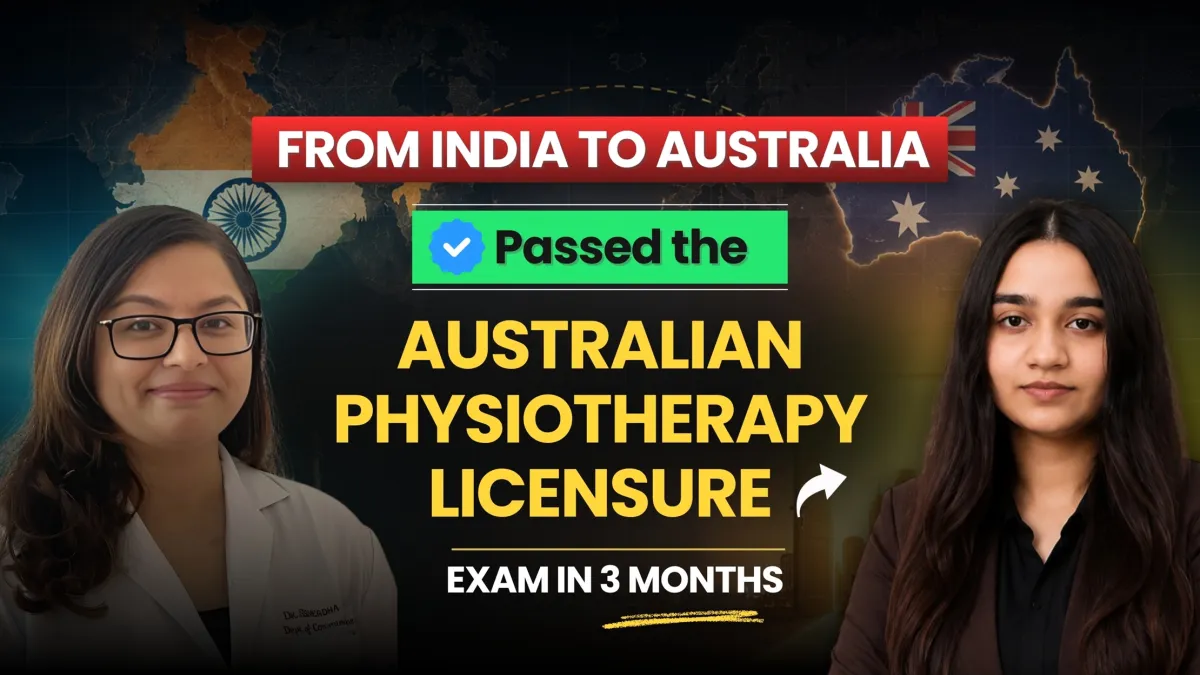
Every overseas-trained physiotherapist dreams of working in Australia, but many are unsure whether they can realistically clear the Australian Physiotherapy Entry Pathway (APEP) while balancing work, family responsibilities, and daily life. Diya's journey answers that question with a reassuring yes.
When she began preparing for the APEP Written Assessment, she wasn't a full-time student with endless hours to dedicate to revision. She was working, managing limited study time, and like most candidates, wondering whether three months would be enough. Today, she's one of the many physiotherapists who successfully cleared the APEP Written Assessment on her first attempt.
In a tete-a-tete with Dr. Ssnegdha Sharma, Academic Head of Medical Courses at Academically, alongside fellow successful candidate Diya shared every aspect of her preparation, from why she chose the APEP pathway over a student visa to the study techniques, mock exams, high-yield topics, and exam-day strategies that helped her succeed.
If you're planning to pursue physiotherapy registration in Australia, this interview goes beyond motivation. It offers practical lessons you can immediately apply to your own preparation. Keep reading.
Why Should You Choose the APEP Pathway Over a Student Visa
The idea of working in Australia for many Indian physiotherapists often begins with a familiar plan. It is about pursuing a Master's degree on a student visa. It is a route that feels safe because it is widely known, and many believe it naturally leads to registration and employment. Diya had a similar plan in mind when she first started exploring opportunities abroad.
However, a conversation with one of her seniors introduced her to a different possibility.
"My senior actually suggested that I look into the Australian Physiotherapy Entry Pathway (APEP) instead of going through the student visa route," she recalled during her conversation with Dr. Ssnegdha.
Curious to understand why, Diya started researching the Australian Physiotherapy Entry Pathway (APEP). She came across Academically, watched testimonials from successful candidates, read reviews, and tried to understand how internationally qualified physiotherapists become eligible for registration in Australia.
As she compared different pathways, she realised that there was a dedicated registration pathway designed specifically for overseas-trained physiotherapists. Rather than making a decision based on what everyone else was doing, she chose to understand which option aligned better with her long-term goal of practising as a registered physiotherapist in Australia.
"After doing my own research, I felt this pathway made much more sense for me," she shared.
That decision became the starting point of her APEP journey. What followed was three months of focused preparation, careful planning, and learning how to make the most of every available hour.
Can You Pass the APEP Written Exam in Just Three Months?
One of the first questions aspiring candidates ask is, "Is three months really enough to prepare for the APEP Written Assessment?" The honest answer is that it depends on your starting point, your consistency, and the quality of your preparation.
Diya's journey proves that three months can be enough, but it also highlights that success doesn't come from simply counting the number of days before the exam. It comes from making every study session purposeful. Unlike candidates who can dedicate their entire day to preparation, Diya began her journey while balancing professional responsibilities. This meant she couldn't afford an unstructured approach or spend weeks figuring out what to study first. Every topic, revision session, and mock test had to contribute towards improving her understanding of the exam.
Instead of trying to master everything at once, she focused on building momentum. She divided her preparation into manageable phases, ensuring she covered the syllabus systematically while continuously revising previously studied concepts. Looking back, she believes consistency mattered far more than chasing unrealistic study targets.
"I never thought about whether three months was enough or not. Once I decided to take the exam, my focus shifted completely to making the best use of the time I had," she shared.
Her experience sends an important message to future candidates: there is no universal preparation timeline for APEP. Some candidates may need six months, while others, particularly those with strong clinical fundamentals and a disciplined study plan, may be able to prepare effectively in a shorter period. What ultimately matters is not how long you study, but how consistently you study.
How Diya Balanced a Full-Time Job While Preparing for APEP Written Exam
Preparing for a professional licensing examination is challenging on its own. Doing it alongside a full-time job adds another layer of complexity. For most of her preparation period, Diya continued working while studying for the APEP Written Assessment. Like many healthcare professionals, she couldn't simply pause her career to prepare full-time. Instead, she had to find a routine that allowed her to stay productive without feeling overwhelmed.
This is where flexibility became one of her biggest advantages. Whenever she couldn't attend live classes because of work commitments, she relied on recorded lectures to stay on track. Rather than treating them as backups, she used them strategically, pausing to make notes, replaying complex concepts, and revisiting challenging topics until she was confident with them.
"I couldn't attend every live session because of work, especially for subjects that were completely new to me. The recordings really helped because I could learn at my own pace," she explained.
As the exam approached, Diya made another important decision. She took leave from work during the final month, allowing herself to focus entirely on revision and practice. Those weeks became her most intensive preparation period, with study days stretching to nearly 15-16 hours.
However, she doesn't attribute her success solely to those long study days. Instead, she believes the consistency she maintained throughout the earlier months made the final revision much more effective. By the time she entered her last month of preparation, she wasn't learning everything from scratch, she was refining concepts she had already built over weeks of disciplined study.
For working professionals preparing for APEP, Diya's journey is a reminder that flexibility, planning, and consistency often matter more than having unlimited hours available everyday.
APEP Exam Preparation Strategy That Helped Diya Clear the Written Assessment in 3 Months
Every successful candidate eventually develops a preparation strategy that works for them. For Diya, success wasn't built on rote learning from textbooks or studying random topics. It came from following a structured approach and trusting the process.
One of the biggest advantages she found was learning through organised classes instead of preparing entirely on her own. Having a structured sequence of topics meant she didn't waste valuable time deciding what to study next. Each session built on the previous one, helping her gradually strengthen her understanding of the syllabus.
Whenever she encountered unfamiliar subjects, particularly in cardiopulmonary physiotherapy, she revisited recorded sessions multiple times until the concepts became clear. Alongside this, she maintained detailed notes that later became her primary revision material during the final weeks before the exam.
Rather than repeatedly reading the same material, she focused on understanding clinical reasoning. She constantly connected theoretical concepts with practical patient scenarios, an approach that proved especially valuable for the case-based nature of the APEP Written Assessment.
Faculty guidance also played an important role in her preparation. AHPRA-registered physiotherapists who are settled and working there in Australia taught her with great precision. She particularly appreciated how complex topics were broken down into simple, clinically relevant explanations, making them easier to remember during revision.
Most importantly, Diya never viewed preparation as a race to finish the syllabus. She believed that revisiting topics, identifying weaker areas, and steadily improving her understanding was far more effective than rushing through every chapter once.
That balanced approach gave her confidence heading into the examination. By the time exam day arrived, she wasn't relying on last-minute revision. She had built a solid conceptual foundation; one that would soon be tested through mock examinations, high-yield clinical scenarios, and the real APEP Written Assessment itself.
High-Yield APEP Written Exam Topics Every Overseas Physiotherapist Should Prioritise
One of the most valuable takeaways from Diya's interview was her recall of the topics that featured prominently in her APEP Written Assessment. While every exam differs and candidates should prepare the complete syllabus, she noticed certain specialities receiving greater emphasis.
| Speciality | High-Yield Topics | Diya's Insights |
| Neurology | Spinal cord injury, Parkinson's disease, Multiple sclerosis | Neurology featured prominently, with questions testing clinical reasoning rather than simple recall. |
| Orthopaedics | Tennis elbow, Golfer's elbow, TFCC injury | Tennis elbow and golfer's elbow were familiar, but TFCC injury proved comparatively more challenging. |
| Cardiopulmonary (CP) | Paediatric respiratory conditions, Chronic bronchitis, COPD | Diya observed several respiratory questions and felt seasonal disease patterns may influence the clinical scenarios seen in some exam cycles. |
While discussing her preparation, Diya also shared an interesting anecdote. A few days before her exam, faculty member Dr. Kushangi Pashuwala had discussed frozen shoulder and how older injuries can resurface as long-term functional problems in clinical practice. During the Written Assessment, Diya encountered a scenario that reminded her of the same discussion.
Although she considers it a coincidence, it reinforced an important lesson: understanding the clinical reasoning behind conditions is far more valuable than trying to memorise recalled questions. The APEP Written Assessment rewards candidates who can apply concepts to patient scenarios rather than simply recognising textbook facts.
Finally, Diya cautioned candidates against overlooking ethics. She found several ethics-based questions surprisingly tricky, particularly those involving professional judgement. The elimination techniques she learnt during preparation helped her narrow down the most appropriate answers with greater confidence.
Don't Ignore Ethics
Although ethics isn't always viewed as a "major subject," Diya believes candidates make a mistake by underestimating it.
Her paper included several ethics-based questions, particularly those requiring careful interpretation of professional conduct and clinical decision-making. Instead of relying on instinct, she applied the elimination techniques taught during dedicated strategy sessions, helping her confidently identify the most appropriate answers.
Her experience serves as a reminder that success in APEP isn't determined by mastering one speciality alone. A balanced preparation strategy that covers clinical subjects alongside ethics gives candidates the best chance of performing well across the entire examination.
How Academically's Physiotherapy Mock Tests Made the Difference on Exam Day
When Diya reflected on the resources that had the greatest impact on her confidence, one stood out above everything else was Academically's mock tests.
Candidates are assessed during their welcome with a mock test by experts and are prepared based on their academic level. Then each subject has got separate mocks that you need to clear. there are comprehensive mocks and centennial mocks as well which you need to appear and clear in the platform.
Like many candidates, she initially viewed mock tests as a way to check her preparation. By the end of her journey, she realised they had prepared her for much more than that.
A few days before the actual examination, she attempted a full-length grand test by Academically that closely resembled the real APEP Written Assessment in terms of structure, difficulty level, and time constraints.
"The grand test was actually very similar to the real exam," she shared. "When I sat for the actual paper, the format already felt familiar."
That familiarity proved invaluable. Instead of spending the first few minutes adjusting to the exam pattern or worrying about time management, she could immediately focus on analysing clinical scenarios and answering questions with confidence.
Mock exams also helped her identify weaker areas before the final exam. Rather than discovering knowledge gaps on exam day, she was able to revisit difficult topics, strengthen concepts, and refine her approach during the last phase of preparation.
Equally important, they helped reduce exam anxiety. Sitting through a complete timed paper before the real assessment made the experience feel far less intimidating.
For candidates preparing for APEP, mock tests should never be treated as an optional extra. They are an opportunity to practise clinical reasoning under realistic conditions, improve pacing, and build the confidence that often separates a good attempt from a successful one.
What's Next After Passing the APEP Written Assessment?
Clearing the Written Assessment is a significant milestone, but it is not the final step towards physiotherapy registration in Australia.
The next stage is the Remote Capability Assessment (RCA), an online, open-book oral assessment where candidates discuss clinical cases with an Australian physiotherapist assessor. Unlike the written examination, which primarily evaluates knowledge and clinical reasoning through multiple-choice questions, the RCA focuses on how candidates apply that knowledge in real-world situations.
During the assessment, candidates are expected to demonstrate sound clinical judgement, patient-centred communication, ethical decision-making, and safe physiotherapy practice while working through a combination of short and long case scenarios.
For many candidates, this transition from written responses to verbal clinical discussions requires a different style of preparation.
Recognising this need, Dr. Ssnegdha Sharma announced during the interview the launch of a dedicated APEP Capability Assessment Preparation Course, designed to help candidates prepare specifically for this stage through structured case discussions, faculty guidance, and oral examination strategies.
Diya was excited to hear the announcement. Having successfully cleared the Written Assessment, she saw it as the natural next step in her journey towards Australian registration.
Beyond the Remote Capability Assessment, candidates also need to complete the mandatory Clinical Workshop in Melbourne and fulfil the remaining registration requirements before becoming eligible to practise as registered physiotherapists in Australia.
For Diya, however, clearing the Written Assessment was more than just another milestone. It was proof that she belonged on this journey.
To Conclude with...
As the conversation drew to a close, Diya was asked what advice she would give physiotherapists preparing for the APEP Written Assessment, especially those hoping to achieve similar results within a short preparation window. Her answer wasn't about secret shortcuts or impossible study schedules. Instead, it centred on consistency.
She encouraged candidates to trust the preparation process, stay disciplined, and avoid becoming overwhelmed by the size of the syllabus. Rather than worrying about covering everything perfectly, she believes candidates should focus on building a strong conceptual foundation and revising it repeatedly.
One practical strategy that worked particularly well for her was exam-day time management. "I tried to answer every question during the first hour," she explained. "The second hour was only for reviewing my answers." That simple approach gave her enough time to revisit questions, identify small mistakes, and avoid losing marks because of rushed decisions.
She also reminded candidates not to ignore subjects they find difficult. Some of the topics she initially struggled with eventually became areas she felt confident about because she kept revisiting them instead of avoiding them. Above all, Diya believes confidence comes from preparation, not from luck.
Her journey demonstrates that clearing the APEP Written Assessment isn't about being the smartest candidate in the room. It's about making consistent progress, learning from every mock test, trusting experienced guidance, and staying committed even when balancing work and personal responsibilities.