You find a promising Medical Affairs or Medical Science Liaison (MSL) opening that fits your background. You hold an advanced healthcare degree, understand complex disease pathology, and routinely communicate clinical research.
You submit your standard clinical resume, expecting a callback. What you receive instead is total silence. It is natural to assume you are underqualified, but the issue is rarely your competence; it is how your background is presented.
Pharma hiring managers are not looking for someone to manage bedside patient care. They are searching for evidence that you can interpret clinical data, communicate scientific insights, build credibility with Key Opinion Leaders, and drive medical strategy within an organization.
Bridging this gap requires a deliberate career translation. You are not downplaying your medical background; you are framing it in a different way. By shifting the focus from daily clinical duties to your scientific communication and stakeholder engagement, you demonstrate exactly how your clinical experience translates into the role you want.
What Are Medical Affairs and MSL?
Before rewriting your resume, you need to understand what you're applying for.
Medical Affairs: The Bigger Function
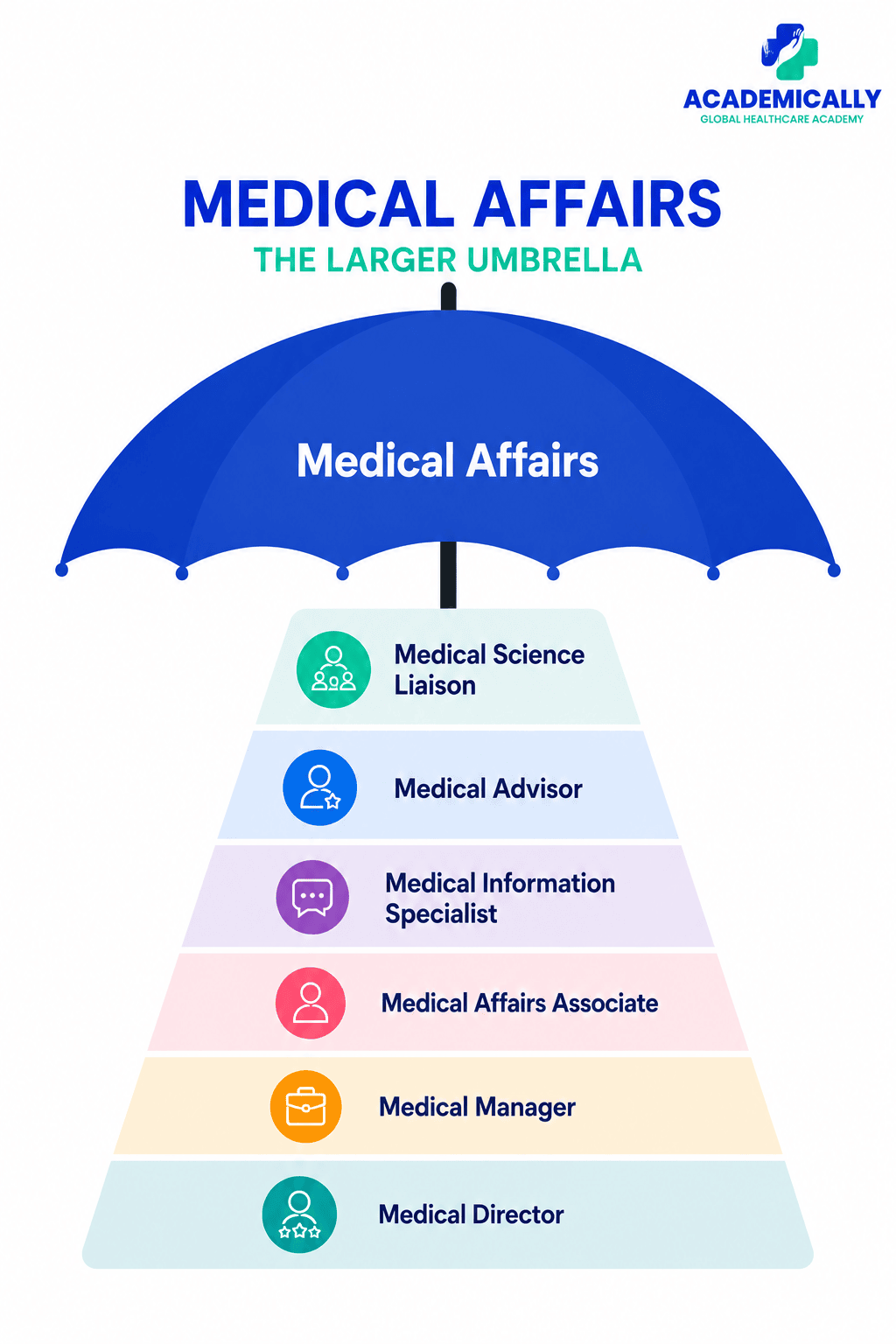
Medical Affairs is a broader team or function within pharmaceutical, biotechnology, medical-device and healthcare organisations.
Its work can include:
- scientific communication,
- clinical research support,
- medical education,
- evidence generation and
- collaboration with healthcare professionals and internal teams.
Think of Medical Affairs as the larger umbrella.
See how healthcare professionals like you are making the switch.
So, What Is An MSL?
A Medical Science Liaison (MSL) is generally a field-based scientific role.
A MSL communicates with doctors, researchers and other healthcare professionals, discusses scientific evidence, gathers insights from the field and supports appropriate scientific exchange. The role is intended to be non-promotional, meaning it is different from a sales representative whose work is focused on selling or promoting products.
The easiest way to remember the difference:
| Medical Affairs = the larger department/function |
| MSL = one role within Medical Affairs |
So if you're applying for either of these positions, your resume needs to demonstrate that you can communicate science professionally and build credible relationships with healthcare experts.
Can You Move Into Medical Affairs or MSL?
You may be thinking:
“I'm an MBBS/BDS/BPT/BPharm graduate. Does my qualification even count?”
The answer depends on the specific company and role, but healthcare and life-science backgrounds can be relevant.
| Background | Potential relevance |
| MBBS / MD / MS | Strong fit for many Medical Affairs roles |
| BDS / MDS | Relevant for Medical Affairs/MSL opportunities |
| PharmD / MPharm | Strong fit for many scientific and Medical Affairs roles |
| BPharm | Relevant depending on role and experience |
| PhD / Life Sciences | Relevant for scientific/MSL roles |
| Biotechnology / Life Sciences | Relevant for selected entry-level roles |
| BAMS / BHMS / BUMS | Can be relevant for selected roles |
| Nursing / allied healthcare | Role-dependent |
Your qualification gets you into the conversation. Your skills get you shortlisted.
The High-Demand Industry Skills You Already Have
Here's where your existing clinical experience becomes useful.
| What you know | Why it matters in Medical Affairs/MSL |
| Disease knowledge | Helps you understand scientific discussions |
| Treatment knowledge | Helps you interpret therapeutic information |
| Clinical reasoning | Helps you evaluate medical information |
| Medical terminology | Makes scientific material easier to understand |
| Patient communication | Builds a foundation for professional communication |
| Teamwork | Useful for cross-functional collaboration |
| Research exposure | Relevant to evidence-based discussion |
| Documentation | Shows attention to accuracy |
| Presentations | Can transfer into scientific communication |
| Clinical decision-making | Shows analytical thinking |
The problem is that your resume may describe these skills using clinical language that a non-clinical recruiter cannot immediately connect to the job.
That's where the rewrite begins. Explore MSL Salaries.
What Skills Do You Need to Build?
You need to add another layer to your clinical identity.
| Current Expertise | Skills to Add |
| Medical knowledge | Pharmaceutical industry knowledge |
| Clinical reasoning | Evidence interpretation |
| Patient communication | Professional stakeholder communication |
| Clinical presentations | Scientific presentation skills |
| Medical research | Structured literature review |
| Healthcare teamwork | Cross-functional collaboration |
| Medical documentation | Professional documentation |
| Treatment knowledge | Therapy-area expertise |
| Clinical experience | Medical Affairs understanding |
| Academic knowledge | Business and industry awareness |
That's what your resume needs to demonstrate.
Your Career Path
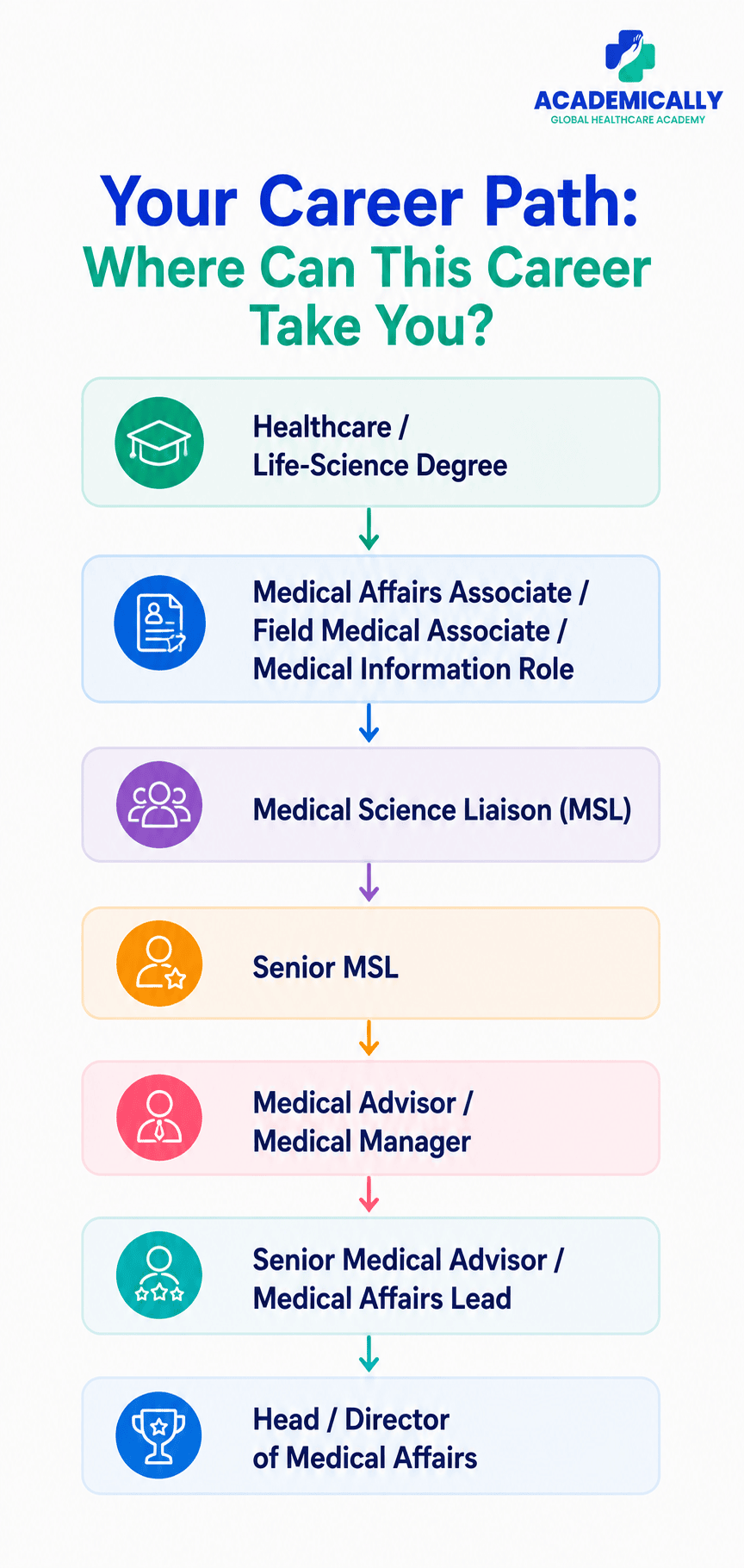
The exact order and your role on the job varies by company.
When you write your resume, don't think only about the job you're applying for. Think about the career direction you're signaling as well. HOW TO BECOME AN MSL.
Now Let's Fix Your Resume
The biggest mistake you can make is trying to put everything you've ever done into one document.
Your resume isn't your autobiography!
It is a short answer to one question: “Why should we interview you for this particular job?”
It is recommended that resumes are clear, factual, concise, easy to scan, tailored to the role and focused on demonstrated results.
What Should Actually Go on Your Resume?
Think of your resume as a short, targeted story.
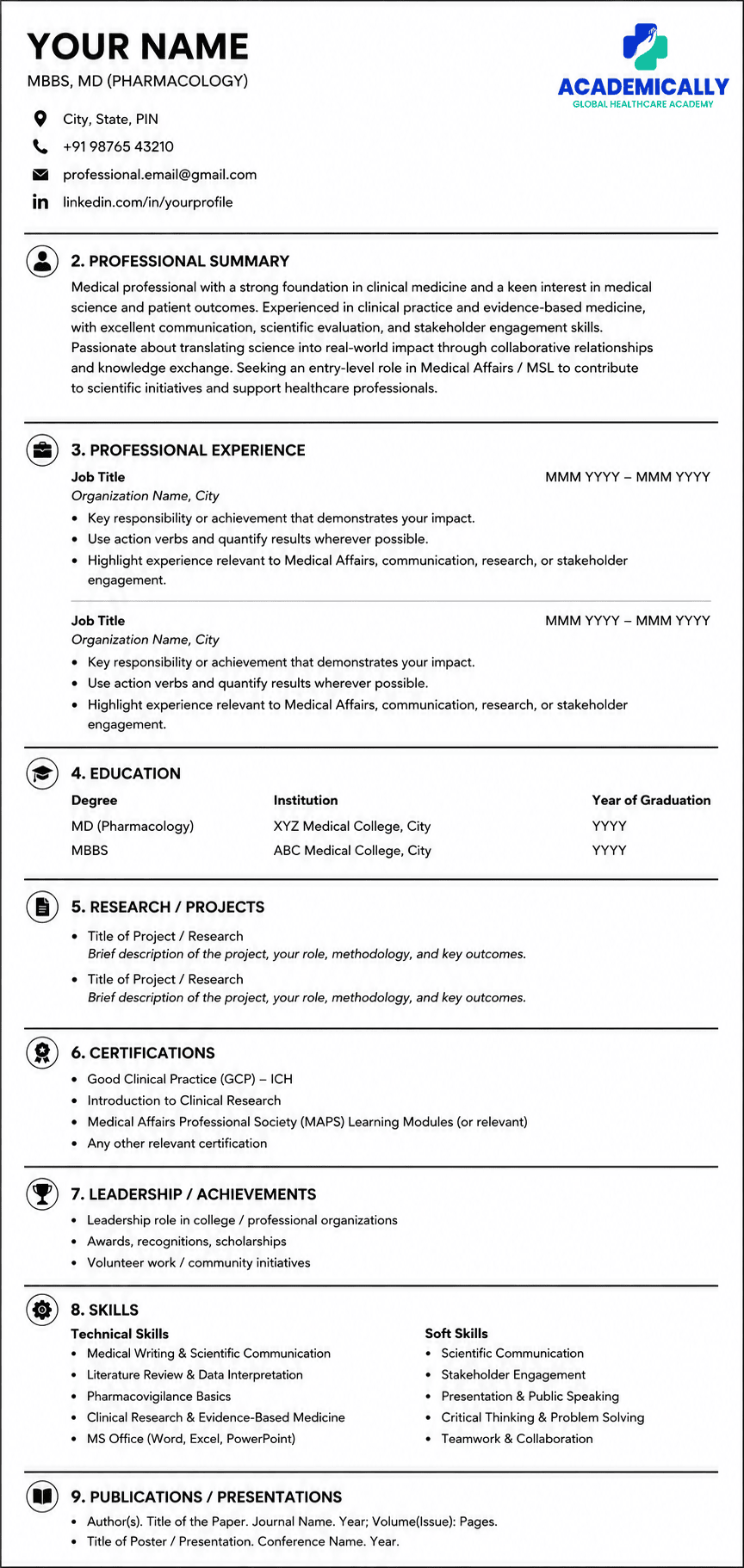
A practical structure is:
1. Header
Name, qualification, city, phone, professional email, LinkedIn.
2. Professional Summary
Three to four sentences explaining:
- Your background
- Your relevant experience
- Your key transferable strengths
- The type of Medical Affairs/MSL role you're targeting
3. Professional Experience
Most recent first.
4. Education
Relevant degrees and institutions.
5. Research / Projects
Especially useful for freshers or career changers.
6. Certifications
Only relevant certifications.
7. Leadership / Achievements
Use selectively.
8. Skills
Only role-relevant technical and soft skills.
9. Publications / Presentations
Include these when relevant to scientific roles.
| There should be clear headings and reverse chronological ordering to make resumes easier to scan. |
Here's a resume sample to give you a clearer picture:
Keep the Format Simple: Your Resume Is Not a Design Competition
(A) Use a clean font such as:
| Arial | Calibri | Times New Roman | Helvetica |
(B) Use consistent headings and spacing.
(C) Avoid:
- Photos
- Skill bars
- Decorative graphics
- Multiple text boxes
- Complicated columns
- Excessive colour
- Huge design elements
Resume length :
For most early and mid-career applicants: 1 page is a practical target.
Use two pages when your relevant experience genuinely needs two pages.
Do not add irrelevant college activities to fill space.
Tailor Your Resume to the Exact Job
There is no single “perfect Medical Affairs/MSL resume.”
A resume for an Oncology MSL should not look exactly like a resume for a Rare Disease MSL.
Before applying, study the job description.
Look for recurring terms such as:
- Scientific communication
- Stakeholder engagement
- KOL engagement
- Clinical research
- Evidence interpretation
- Presentation
- Medical education
- Therapy-area expertise
- Cross-functional collaboration
- Field-based scientific exchange
Then naturally reflect the relevant language in your resume only where it truthfully describes your experience.
It is recommended to tailor your resume to the position and avoiding generic applications.
The Most Important Part: Write Achievement-Focused Bullets
| Instead of This | Try This |
| Managed patients. | Managed 80+ daily patient consultations while prioritising cases and maintaining accurate clinical documentation. |
| Gave presentations. | Delivered 12 clinical case presentations to multidisciplinary teams, translating complex findings into clear treatment discussions. |
| Did research. | Reviewed 40+ peer-reviewed studies to synthesise evidence on diabetes management and presented findings to faculty and peers. |
These bullets communicate what you did + scale + transferable skill.
Use the XYZ Formula
A useful way to structure strong resume bullets is:
| Accomplished X as measured by Y by doing Z. |
X = Achievement |
| Start with a strong action word: Analysed | Led | Coordinated | Evaluated | Presented | Developed | Reviewed | Managed | Improved |
Y = Evidence |
Use real numbers whenever possible: 50 patients | 20 research papers | 4 interns | 10 presentations | 500 records Never invent metrics. |
Z = Skill or method |
| Explain how you achieved the result. |
For transition, translate clinical work into transferable skills.
| Clinical task | Resume-friendly transferable skill |
| High patient volume | Prioritisation and time management |
| Diagnosis and treatment planning | Analytical thinking |
| Patient counselling | Communication and education |
| Case presentations | Scientific presentation |
| Literature review | Research and evidence interpretation |
| Coordinating with departments | Cross-functional collaboration |
| Managing records | Documentation and attention to detail |
The exact order does not matter.
XYZ, ZXY or YZX can all work.
What matters is that the bullet shows impact + evidence + how you achieved it.
What To Prioritize In Your Resume: Fresher vs Experienced
| Fresher | Experienced |
| Education | Experience |
| Internships | Leadership roles |
| Research / Projects | Achievements |
| Volunteer or Leadership Experience | Research / Projects |
| Awards | Education |
| Relevant Certifications | Certifications |
| Skills | Skills |
A research project or scientific presentation can be valuable evidence if you don't have industry experience and can also make you interview ready.
Build a Portfolio
You might be thinking: “How can I show MSL experience when I've never worked as an MSL?”
You don't fabricate experience.
Instead, create genuine practice projects.
Build three to five samples such as:
1. Scientific evidence brief
Choose a therapeutic topic and summarise five to ten peer-reviewed papers.
2. Mock KOL presentation
Choose a medical topic and create a 5–7 slide scientific presentation as though you're preparing to discuss the subject with a healthcare expert.
3. Clinical-trial summary
Take a publicly available trial and explain its objective, design, results and limitations.
4. Medical communication sample
Turn complex research findings into a clear educational document for a healthcare audience.
5. Literature review
Create a structured summary of current evidence in a therapeutic area.
Where do you get the material?
Use publicly available sources such as:
- PubMed
- Clinical Trials
- FDA publications
- Peer-reviewed journals
- Clinical guidelines
Clearly label your work as academic, independent or simulated work.
The point is not to pretend you've been employed by a pharmaceutical company.
The point is to show: “Here is what I can actually do.”
Don't Forget the Cover Letter
Your resume tells the recruiter what you've done.
A cover letter can explain why you're making the transition.
For a career changer, that can be particularly useful.
Keep it to one page.
Explain:
- Why this company/role interests you.
- Which parts of your background are relevant.
- What you can bring to the role.
- Why you're moving from clinical work into Medical Affairs/MSL.
Use the letter to explain the story behind the transition.
Your LinkedIn Profile Should Tell the Same Story
If your resume says: “Aspiring Medical Science Liaison”
but your LinkedIn headline says: “Resident Doctor | Clinical Practice | OPD” the recruiter sees two different stories.
Your resume, LinkedIn and portfolio should communicate the same direction.
Only use claims that accurately represent your current position.
Your Resume + Portfolio = A Stronger Story
Think of the two documents differently.
| Resume | Portfolio |
| Tells the recruiter what you've done. | Shows the recruiter what you can do. |
You don't need a 30-page portfolio.
Three to five high-quality, relevant samples can be more useful than 20 random certificates.
Where Do You Find the Right Jobs?
Searching for “MSL jobs” on generic boards usually leads to the same frustrating loop:
- Sifting through thousands of unrelated listings across random industries.
- Wasting hours trying to figure out whether a role actually matches your background.
- Wondering why finding a niche healthcare position has to be this hard.
The Fix: Jobslly
Jobslly cuts out the clutter with a platform built specifically for healthcare talent. It gives you a targeted ecosystem:
- Curated Healthcare Roles: Direct access to opportunities in Medical Affairs, clinical research, medical writing, pharmacovigilance, and regulatory affairs.
- Specialized Career Tools: Healthcare-focused resume optimization, expert profile reviews, and skill-aligned job matching.
- Streamlined Tracking: One centralized hub to manage applications.
Skip the generic search. Match with roles built for your pedigree on Jobslly.
Bridging the Experience Gap
Knowing where to apply is only half the battle. Landing the role requires translating clinical knowledge into industry value:
- You know medicine — now turn it into field-ready scientific communication.
- You have clinical experience — now position it strategically for Medical Affairs.
- You understand research — now apply it to real-world industry case studies.
Academically’s MSL & Medical Affairs Course provide the blueprint to bridge that divide. It covers pharmaceutical industry dynamics, KOL engagement strategies, clinical trial foundations, and hands-on career prep.
Turn your clinical expertise into an industry advantage.
How Structured Career Support Can Help
A career transition involves more than completing a certificate.
You may need help with:
Career direction
Which Medical Affairs role fits your background?
Skills
What do you need to learn?
Resume
How should your clinical experience be repositioned?
Portfolio
What can you show if you have no industry experience?
Interview preparation
Can you explain your transition confidently?
Job search
Where should you actually apply?
That is why Academically combines non-clinical upskilling with career guidance and job-search support.
Still on the fence about Medical Affairs or an MSL role?
You don’t have to figure out a major career pivot from a single article.
The goal isn't to force your clinical background into a predefined box. Identifying where your specific expertise creates the strongest, highest-impact next step.
Talk through your background, target goals, and high-growth non-clinical pathways with Academically before making the leap.
Final Resume Checklist
Before submitting your resume, check the following:
| Check | Ready? |
| Contact details are at the top | ✓ |
| Professional email included | ✓ |
| LinkedIn is linked | ✓ |
| No photograph | ✓ |
| No full home address | ✓ |
| Simple, readable formatting | ✓ |
| Standard headings used | ✓ |
| Most recent experience appears first | ✓ |
| Resume is concise | ✓ |
| Clinical experience has been translated into transferable skills | ✓ |
| Achievement-focused bullets used | ✓ |
| Numbers are included where truthful | ✓ |
| Job-description keywords are reflected naturally | ✓ |
| Relevant projects included | ✓ |
| Portfolio link included where useful | ✓ |
| No irrelevant school/college details | ✓ |
| No “I”, “me” or “my” | ✓ |
| Spelling and grammar checked | ✓ |
Before you press Apply, read your resume once more and ask:
“If I were the recruiter, could I understand in 20 seconds why this person could work in Medical Affairs?”
If the answer is yes, you're on the right track.