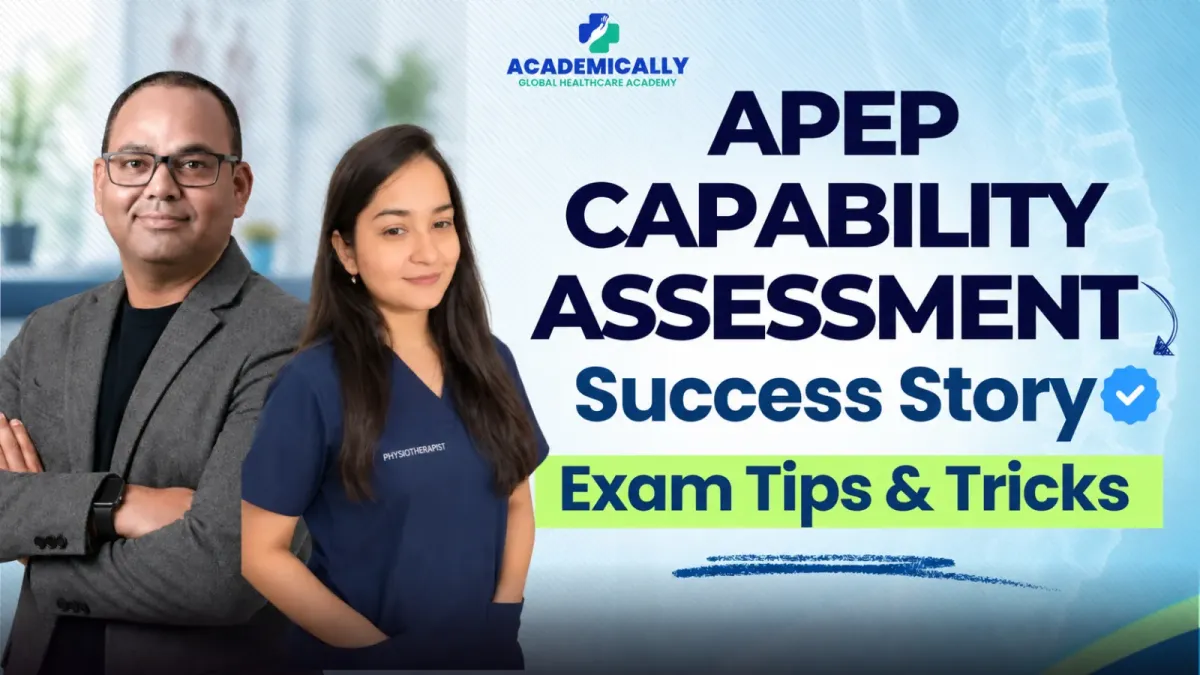
How to Pass the APEP Capability Assessment: An Overseas Physiotherapist’s Success Story

Written by

Dr. Rukhsar Jabbar

Reviewed by

Tahreem Mirza
How to Pass the APEP Capability Assessment: An Overseas Physiotherapist’s Success Story
2 min read

Summary:

Every success story requires stepping out of one's comfort zone. With over 12 years of clinical experience strictly in orthopaedic physiotherapy, Mamta realised a crucial gap in her professional growth, a lack of exposure to neurology and cardiorespiratory cases. Driven to expand her horizons, she pursued the Australian Physiotherapy Entry Pathway (APEP) to transition her career to Australia. Navigating the rigorous Australian Physiotherapy Council (APC) exams was daunting, especially facing her first viva in over a decade. After clearing the Written Assessment in June 2026, the October Capability Assessment felt overwhelming. However, guided by structured mentorship at Academically, she mastered clinical reasoning, strict time management for short cases, and open-book strategies for the long case study. Today, she celebrates her incredible success and looks forward to the final Clinical Workshop, proving that with the right direction and dedication, conquering the APEP exam is entirely achievable.

Key Takeaways

  • Transitioning from a 12-year Ortho-exclusive practice to mastering comprehensive APEP clinical scenarios.
  • Conquering the anxiety of facing a one-on-one oral assessment for the first time since completing a Master's degree.
  • Answering exactly what the examiner asks to efficiently manage the strict 10-minute limit per short case.
  • Utilizing the "open-book" preparation time effectively using sticky notes and targeted Google searches for outcome measures like the FIM scale.
  • Shifting clinical reasoning to strictly adhere to Australian healthcare guidelines and assessment protocols.

Not every success story begins with absolute clarity; many start with a simple realization that something is missing. Earning a Bachelor of Physiotherapy in 2013 and a Master’s degree in 2017, Mamta built a solid foundation in clinical practice over 12 years. However, her daily caseload was strictly limited to orthopaedic patients. Without exposure to cardiorespiratory or neurological cases, she began to feel a gap in her overall clinical competence.

Seeking growth, she consulted with her senior colleagues. These discussions led to a definitive conclusion: pursuing the Australian Physiotherapy Entry Pathway (APEP) was the right next step for her career. Moving to Australia would not only challenge her clinical boundaries but also offer a globally recognized standard of practice.

Finding the Right Direction: Overcoming the "Viva" Gap  

Starting preparation after a long gap in broad-spectrum academic studying is intimidating. A friend recommended Academically, and it proved to be the turning point in her journey. The APEP Capability Assessment is an online, verbal clinical examination administered directly by the Australian Physiotherapy Council (APC) that evaluates clinical reasoning and communication in real-life patient scenarios.

She successfully cleared her Written Assessment in June 2026. However, as the October Capability Assessment approached, she found herself battling severe anxiety. A major source of this fear was a 12-year gap since her last viva (oral exam). Transitioning from a senior practitioner who evaluates others back into the "student" seat was incredibly daunting. During this critical phase, the structured, step-by-step guidance from her mentors at Academically became her anchor, helping her rebuild her confidence to face an examiner one-on-one.

Cracking the Code: Smart Communication and Strict Time Management  

One of the biggest hurdles overseas-trained physiotherapists face is unlearning old exam habits. The Capability Assessment looks for physiotherapists who think clearly, make safe choices, and can explain things without jargon. Her mentor drilled a vital concept into her preparation: listen to what the question is actually asking.

She learned that starting an answer with a generic textbook definition is a flawed approach. Examiners know the definitions; they want to see clinical application. This direct answering style is especially crucial for the short cases. The exam features exactly three short cases, with only 10 minutes allocated for each (30 minutes total). Because the assessor actively tracks and reminds candidates of the remaining time, sticking strictly to the question asked without rambling is the only way to finish within the time limit.
 

Alongside the short cases, the Capability Assessment features one long case study. A highly practical aspect of this exam that candidates often misunderstand is that the APEP preparation time provided for the long case operates somewhat like an open-book assessment.

When the long case scenario is presented, candidates are given dedicated time to prep their answers before speaking to the examiner. Her mentor strongly advised using this time strategically by keeping objective assessments, management charts, and probable questions organized with subject-specific sticky notes. She found that while flipping through physical notes can be time-consuming, performing targeted searches on Google was incredibly efficient. For instance, if she couldn't instantly recall the primary clinical use of the FIM (Functional Independence Measure) scale under pressure, a quick online search provided the shortlisted points in seconds, allowing her to formulate a comprehensive, evidence-based answer.

Achieving Success and Next Steps  

When the October results were announced, the candidate was completely overwhelmed with joy. Despite feeling unready going into the test, her sheer dedication and strict adherence to her mentor's structural formats carried her through.

Her journey proves that passing the APEP Capability Assessment does not require flawless memory; it requires strategic preparation, effective time management, and a willingness to follow established Australian guidelines. Having conquered this massive hurdle, she now looks forward to tackling her final milestone: the APEP Clinical Workshop.

If this story has you thinking about your own APEP journey, you don't have to figure out the Capability Assessment on your own. Academically's APEP Capability Assessment Preparation Course is built around the same skills this candidate leaned on: over 60 hours of live sessions and roleplay on clinical cases, mentored by registered physiotherapists from Australia, plus weekly practice questions and AI-based mock tests that help you turn what you know into clear, time-bound answers.

About Us

Academically is a global Ed-Tech healthcare platform, led by Dr. Akram Ahmad (PhD in Medicine, University of Sydney, Global Healthcare Career Coach) and his expert team, that helps pharmacists, doctors, dentists, physiotherapists, and other allied healthcare professionals to achieve their career goals in India and abroad. We provide complete career guidance, like skill assessment, Visa, PR and coaching for International licensure exams such as AMC, Overseas Pharmacist Readiness Assessment, APEP, ADC, DHA, SPLE, OCANZ COE and more for countries like Australia, New Zealand, Gulf countries, the US, the UK, and Canada. We have trained more than 10,000+ students across 88+ countries, with a 90%+ success rate on international healthcare licensure exams. We are India’s first healthcare Ed-Tech platform to introduce AI-based mock tests, to help students study smarter and track progress effectively. Beyond exam preparation, we also offer job assistance programmes, such as Upskill by Academically, covering clinical drug development and medical affairs. To help you land your dream job, we have recently launched our job platform Jobslly by Academically, only for healthcare professionals for both India and abroad.

FAQs

What is the APEP Capability Assessment?

The Capability Assessment is an online oral examination conducted by the Australian Physiotherapy Council (APC). It evaluates a candidate's clinical reasoning, communication, risk management, and alignment with Australian healthcare standards.

How long are the short cases in the Capability Assessment?

The exam includes exactly three short cases. Candidates are given 10 minutes for each case, totaling 30 minutes. Assessors will actively remind you of the time you have left.

Can a physiotherapist with only Orthopaedic experience clear the APEP exam?

Yes. Candidates with exclusive Ortho experience can successfully clear the exam. Focused preparation and expert mentorship can bridge the knowledge gap in cardiorespiratory and neurological topics.

How does Academically help candidates prepare for the viva?

Academically provides clear directions on Australian guidelines, teaches candidates how to format answers for strict time limits, and helps manage the anxiety of facing a viva after a long gap in academia.

Is the APEP Capability Assessment an open-book exam?

While the actual verbal interview is not open-book, the preparation time provided specifically for the long case study allows candidates to reference their notes, textbooks, and online resources before presenting.

Are candidates allowed to search Google during the Capability Assessment?

Yes, during the dedicated preparation time for the long case study, candidates can utilize resources like Google. For example, doing a quick search to recall the specific uses of an outcome measure like the FIM scale can be faster than flipping through physical notes.

How should candidates organize their notes for the long case study?

Experts recommend using sticky notes to categorize physical notebooks by subject, ensuring that objective assessments, management charts, and outcome measures are instantly accessible.

Should I start my answers with textbook definitions?

No. Examiners want to see applied clinical reasoning. Starting with rehearsed textbook definitions wastes valuable time, especially during the strict 10-minute short cases.

How much time does it take to progress from the Written to the Capability Assessment?

Timelines vary by candidate, but it is entirely possible to clear the Written Assessment in June and successfully pass the Capability Assessment in the October session of the same year.

What is the next step after passing the Capability Assessment?

After successfully clearing both the Written and Capability Assessments, the final step in the APEP journey is to qualify in the Clinical Workshop.

Dr. Rukhsar Jabbar
Dr. Rukhsar Jabbar

Medical Content Writer Intern

MPT Physiotherapy (Neurology)

about the author

Rukhsar Jabbar  is a dedicated medical writer and clinical researcher specializing in neurological rehabilitation and evidence-based healthcare communication. She formulates research-driven digital content, educational articles, and patient-centric literature aimed at translating complex clinical evidence into accessible health insights. With clinical expertise in Physiotherapy  and health content creation, Rukhsar has published across international digital health platforms, including Datelinehealth Africa

(DLHA) and Klarity Health. Her work focuses on bridging the gap between scientific literature  

and public health literacy, empowering readers through actionable healthcare knowledge.

Tahreem Mirza
Tahreem Mirza

Programme Manager, Physiotherapy Licensure Courses

MBA in Healthcare and Hospital Management, BPT (Jamia Millia Islamia)

about the reviewer

Tahreem Mirza is a Program Manager at Academically Global with a multidisciplinary background in healthcare, management, research, and education.

A Bachelor of Physiotherapy (BPT) graduate from Jamia Millia Islamia, Tahreem gained clinical experience at LNJP Hospital and St. Stephen’s Hospital, Delhi, before pursuing an MBA in Healthcare and Hospital Management from Jamia Millia Islamia. She also has public health research experience at The INCLEN Trust International, working on a project associated with the Government of India’s LaQshya – Labour Room Quality Improvement Initiative, aimed at strengthening maternal and newborn healthcare.

Beyond healthcare, Tahreem is certified in the French language and is the Founder of Le Monde Français, a tutoring initiative helping young learners begin their French language journey.

At Academically Global, Tahreem brings together clinical understanding, healthcare management, research, and education to support programs that help healthcare professionals advance their learning and careers.

Build a Successful Global Healthcare Career

100% secure & confidential.

Academically

Get Complete Details & Expert Guidance

Our experts will contact you soon

Free guidance • No spam • No obligation

Students
Trusted by 50,000+ healthcare aspirants