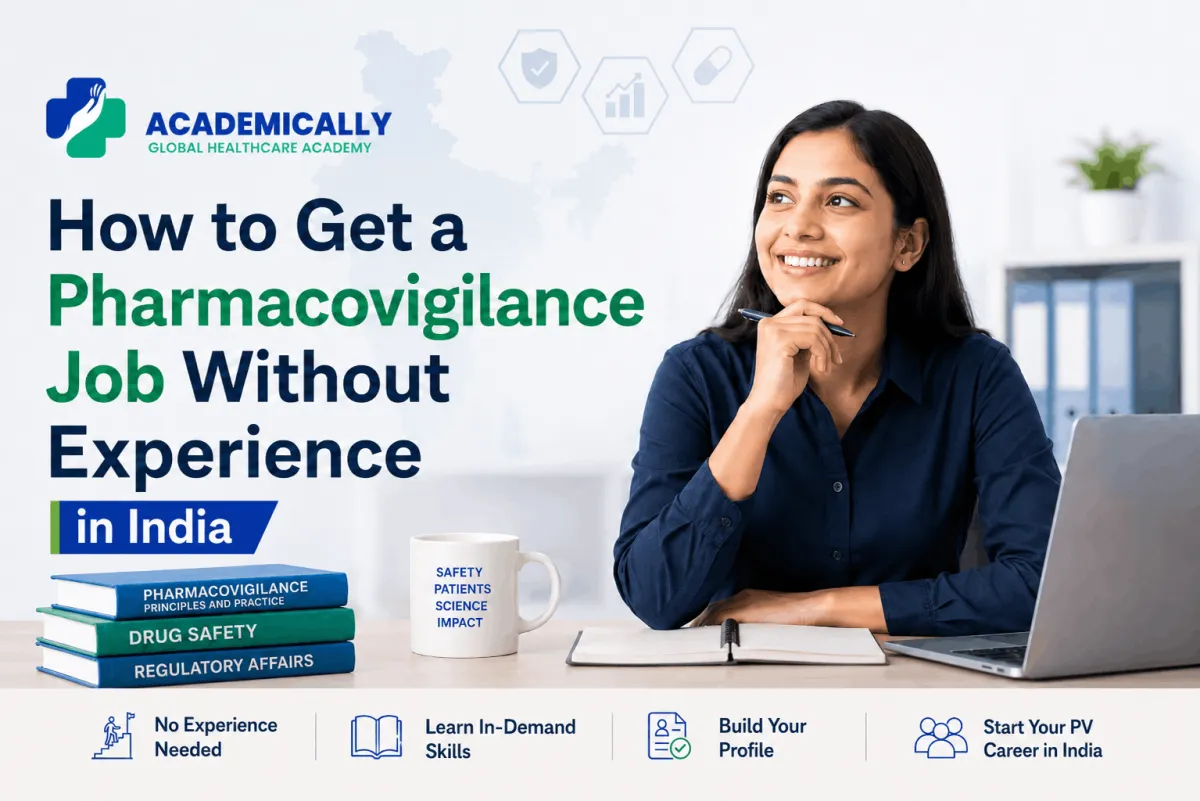
How to Get a Pharmacovigilance Job Without Experience in India

How to Get a Pharmacovigilance Job Without Experience in India
Created On : Jul 03, 2026 Updated On : Jul 03, 2026 4 min

Key Takeaways  

  • Pharmacovigilance hires freshers more readily than most pharma functions because entry-level Drug Safety Associate roles are built around trainable, process-driven skills.
  • A B.Pharm, M.Pharm, Pharm.D, MBBS, BDS, or life-sciences degree already qualifies you; what's missing is usually industry exposure, not eligibility.
  • Certification programmes with live case studies and mock interviews can compress the "experience gap" into weeks instead of years.
  • Salaries, hiring hubs, and required tools have shifted meaningfully in 2026, this guide reflects the current landscape.
  • Real graduates who had zero pharmacovigilance experience have been placed into paying roles; their exact paths are broken down below.

Breaking into pharmacovigilance without prior experience is achievable for pharmacy, medical, dental, AYUSH, and life sciences graduates because most entry-level drug safety roles are designed to train fresh talent. Recruiters prioritise practical knowledge of ICSR processing, MedDRA coding, pharmacovigilance regulations, and documentation skills over previous employment. Industry-relevant certification programmes, capstone projects, mock interviews, and targeted resumes significantly improve employability. With India's pharmacovigilance sector continuing to expand in 2026, freshers can secure Drug Safety Associate roles offering competitive salaries and strong long-term career growth by developing job-ready skills and applying strategically to CROs, pharmaceutical companies, and global capability centres.

Every year, lakhs of pharmacy and medical graduates in India ask the same question after graduation, "I have the degree, so where's the job?" Pharmacovigilance (PV), the science of drug safety monitoring, is one of the few non-clinical healthcare careers where this gap can actually be closed quickly. Unlike clinical research associate roles that often demand two to three years of site experience, or regulatory affairs positions that expect dossier-filing exposure, entry-level PV roles are structured around teachable, process-heavy skills. That's why the field consistently absorbs freshers, career switchers, and even doctors and dentists moving out of clinical practice.

Why Pharmacovigilance Hires Freshers More Than Other Pharma Roles  

Pharmacovigilance is fundamentally about documentation, classification, and timeline-bound reporting. When a patient experiences an adverse drug reaction, someone has to receive that report, code it using MedDRA terminology, assess causality, and submit it to databases like EudraVigilance or the FDA's FAERS within regulated timeframes.

This is high-volume, high-precision work. Global CROs (Contract Research Organisations) such as IQVIA, Parexel, ICON, Syneos Health, and Indian-origin firms like Oviya Medsafe and Sciformix run large Drug Safety Associate teams in Bengaluru, Hyderabad, Pune, and Chennai specifically because case volumes are rising faster than experienced hires can fill seats.

Industry hiring commentary through 2026 continues to point to the same driver: pharmacovigilance and drug safety functions in India are expanding capacity to serve global pharma clients, and entry-level "Associate" and "Safety Specialist" openings remain the most frequently posted roles in this segment, ahead of senior scientist or physician-level PV positions.

That structural gap between rising case volume and available trained talent is precisely what makes this field accessible to someone without direct experience, provided they can demonstrate the right foundational skills at the interview stage.

What Recruiters Actually Look For Instead of "Experience"  

When a hiring manager reviews a fresher's profile for a Drug Safety Associate role, they are rarely checking for prior PV job titles. They're checking for:

  • Working knowledge of ICSR processing (Individual Case Safety Reports): how a case moves from intake to submission
  • Familiarity with MedDRA coding and basic causality assessment frameworks (WHO-UMC, Naranjo scale)
  • Exposure to safety databases like ArisG, Argus Safety, or EudraVigilance, even at a conceptual level
  • Regulatory awareness: ICH E2 guidelines, GVP modules, and timelines for expedited vs. periodic reporting
  • Communication and documentation precision, since a single miscoded case can trigger regulatory consequences

None of this requires a job title. It requires structured training, a capstone project, and the ability to talk through a mock case confidently in an interview. This is exactly the gap that upskilling programmes are designed to close.

Step-by-Step Roadmap to Your First Pharmacovigilance Job  

1. Confirm your eligibility. B.Pharm, M.Pharm, Pharm.D, MBBS, BDS, BSc Life Sciences, and even BAMS/BHMS graduates are eligible for entry-level drug safety roles in India. Clinical background is a bonus, not a requirement.

2. Get certified through an industry-relevant, not purely academic, programme. A postgraduate certification in Drug Safety and Pharmacovigilance that includes live ICSR processing, MedDRA coding practice, and guest sessions with working professionals carries far more interview weight than a generic diploma. Recruiters in 2026 are explicitly filtering for candidates who can discuss real case scenarios, not just definitions.

3. Build a capstone project. A worked example, a mock ICSR narrative, a signal detection summary, or a causality assessment writeup, becomes your portfolio piece in the absence of a resume line that says "PV experience."

4. Practise structured mock interviews. PV interviews test how you think through a case, not how many years you've clocked. Mock interviews that simulate real recruiter questions (timelines, coding logic, regulatory basics) make the biggest measurable difference in offer conversion.

5. Target the right employers. CROs, pharmacovigilance-focused KPOs, and pharma companies with in-house safety teams in Bengaluru, Hyderabad, Mumbai, and Pune are the highest-volume hirers for entry-level PV roles in 2026.

6. Apply with a PV-specific resume, not a generic pharmacy or MBBS resume. Lead with certification, capstone project, and any coding/database familiarity.

Pharmacovigilance Salary 2026

Based on current entry-level offers reported by 2026 graduates and industry job postings, freshers with a recognised drug safety certification are being placed at:

  • Drug Safety Associate (entry-level): ₹6.5 LPA - ₹12 LPA,
  • Pharmacovigilance Associate with certification + capstone (like Salman's placement at Oviya Medsafe): ₹8 LPA in India. Experienced ones withdraw up to 16-20 LPA
  • Clinical Safety Physician (for MBBS/MD holders after upskilling): ₹28–32 LPA

Salaries scale quickly once you clear the first 12–18 months, since PV experience compounds fast case volume and complexity handled matters more than tenure alone.

Note: These figures will vary with industry trends from time to time.

Getting Hired in Pharmacovigilance Without Prior Experience  

Salman, a clinical pharmacist with years of hospital and clinical-research exposure but zero formal pharmacovigilance experience, struggled to translate his background into a PV-specific offer on his own. After structured counselling, mock interviews, and a capstone project through Academically, he was placed as a Pharmacovigilance Associate at Oviya Medsafe with an 8 LPA package, in under 30 days from starting the programme.

Shazia, a fresh B.Pharm graduate who felt trapped in the "B.Pharm → M.Pharm → Pharm.D → PhD" cycle without any industry exposure, pivoted directly into Drug Safety and Pharmacovigilance after certification. Concepts like ICSR processing, MedDRA coding, and EudraVigilance, previously just words in textbooks, became job-ready skills taught by working professionals, and she graduated with Golden Honours.

Rose, a BDS graduate whose dental career had stalled due to frequent relocation as an Indian Army spouse, discovered that pharmacovigilance was one of the few high-paying non-clinical domains genuinely open to remote work, despite having no prior drug safety background at all.

These aren't isolated cases. They reflect a consistent pattern. Candidates without direct PV experience close the gap through certification, applied practice, and interview readiness rather than waiting years for an "in."

How to Get Yourself Upskilled, Certified and Ready for a PV Job?

Academically's non-clinical courses are built specifically around this fresher-to-hired gap. It features ICSR case processing, MedDRA coding, EudraVigilance exposure, mock interviews, a capstone project, and guest sessions with industry leaders from companies like Pfizer, Cipla, and Eversana.

For candidates whose long-term interest leans toward global drug development strategy rather than case processing alone, the Executive Programme in Clinical Drug Development offers a broader route into pharma project and regulatory functions.

For those drawn to physician-facing, stakeholder-heavy roles instead of desk-based case work, the Executive Programme in Medical Affairs, the same track that helped candidates transition into Medical Science Liaison roles, is worth exploring alongside pharmacovigilance as a parallel option.

And the best part... You get access to India's first healthcare based job platform, Jobslly and apply to only verified jobs that are apparently high paying and offering great stability.

About Us

Academically is a global Ed-Tech healthcare platform, led by Dr. Akram Ahmad (PhD in Medicine, University of Sydney, Global Healthcare Career Coach) and his expert team, that helps pharmacists, doctors, dentists, physiotherapists, and other allied healthcare professionals to achieve their career goals in India and abroad. We provide complete career guidance, like skill assessment, Visa, PR and coaching for International licensure exams such as AMC, OPRA, APEP, ADC, DHA, SPLE, OCANZ COE and more for countries like Australia, New Zealand, Gulf countries, the US, the UK, and Canada. We have trained more than 8,000 students across 30+ countries, with a 90%+ success rate on international healthcare licensure exams. We are India’s first healthcare Ed-Tech platform to introduce AI-based mock tests, to help students study smarter and track progress effectively. Beyond exam preparation, we also offer job assistance programmes, such as Upskill by Academically, covering clinical drug development and MSL (Medical Science Liaison). To help you land your dream job, we have recently launched our job platform Jobslly by Academically, only for healthcare professionals for both India and abroad.

FAQs

Can I get a pharmacovigilance job without any experience?

Yes. Pharmacovigilance is one of the few pharmaceutical sectors where prior industry experience is not mandatory for entry-level hiring. Most employers recruit graduates based on their understanding of drug safety concepts, adverse event reporting, MedDRA coding, ICSR processing, and regulatory guidelines rather than previous employment. Candidates who complete an industry-oriented pharmacovigilance certification, practise mock case processing, and prepare for interviews often compete successfully with experienced applicants because recruiters expect freshers to be trained after joining.

Who is eligible for pharmacovigilance jobs in India?

A wide range of healthcare and life sciences graduates are eligible for pharmacovigilance roles. Common qualifications include B.Pharm, M.Pharm, Pharm.D, MBBS, BDS, BAMS, BHMS, BSc Life Sciences, MSc Life Sciences, Biotechnology, Microbiology, Biochemistry, Nursing, and other allied healthcare degrees. While eligibility gets you through the initial screening, recruiters ultimately evaluate your practical understanding of pharmacovigilance workflows, documentation accuracy, regulatory awareness, and communication skills before making a hiring decision.

Which skills should I learn before applying for pharmacovigilance jobs?

Before applying, you should understand Individual Case Safety Report (ICSR) processing, adverse event reporting workflows, MedDRA coding, causality assessment methods such as WHO-UMC and Naranjo Scale, pharmacovigilance regulations including ICH E2 guidelines and Good Pharmacovigilance Practices (GVP), and basic exposure to safety databases like Argus Safety or ArisG.Strong documentation, analytical thinking, attention to detail, and professional communication are equally important because pharmacovigilance revolves around accurate reporting and regulatory compliance.

Is a pharmacovigilance certification necessary to get hired?

Although it is not legally mandatory, an industry-recognised pharmacovigilance certification greatly improves your chances of getting shortlisted. Recruiters increasingly prefer candidates who have completed hands-on training involving live case studies, MedDRA coding exercises, capstone projects, regulatory documentation, and mock interviews. Certifications demonstrate commitment to the field and reduce the amount of onboarding required by employers, making certified candidates more competitive than applicants who only possess academic qualifications.

What is the salary of a pharmacovigilance fresher in India in 2026?

Entry-level Drug Safety Associate salaries generally range between ₹6.5 lakh and ₹12 lakh per annum depending on your qualifications, certification, employer, city, interview performance, and practical skills. Candidates with strong portfolios, recognised pharmacovigilance training, and successful capstone projects often receive higher starting packages. As professionals gain experience handling larger case volumes, complex safety reporting, and regulatory responsibilities, salaries typically increase significantly within the first two years of employment.

Which companies hire freshers in pharmacovigilance?

Many Contract Research Organisations (CROs), pharmaceutical companies, and drug safety service providers actively recruit fresh graduates. Some of the major employers include IQVIA, Parexel, ICON, Syneos Health, Oviya Medsafe, Sciformix, Accenture, Cognizant, Wipro, Pfizer, Novartis, and several multinational pharmaceutical companies operating Global Capability Centres in India. Hiring demand is particularly high in Bengaluru, Hyderabad, Pune, Mumbai, Chennai, and other pharmaceutical hubs where global drug safety operations are expanding.

How can I make my resume stand out without pharmacovigilance experience?

Instead of focusing on unrelated internships or academic achievements, build a pharmacovigilance-focused resume. Highlight your certification, MedDRA knowledge, ICSR processing practice, regulatory understanding, capstone project, mock case studies, software exposure, and any research or documentation experience. Quantify achievements wherever possible and customise your resume for every application. Demonstrating practical drug safety skills often has a much greater impact than simply listing educational qualifications or generic pharmaceutical knowledge.

Is pharmacovigilance a good long-term career option?

Yes. Pharmacovigilance offers stable employment, global career opportunities, and continuous demand because every approved medicine requires ongoing safety monitoring. Professionals can progress from Drug Safety Associate to Senior Associate, Team Lead, Safety Scientist, Signal Detection Specialist, Pharmacovigilance Manager, Risk Management Expert, or even transition into Regulatory Affairs, Medical Writing, Medical Affairs, Quality Assurance, and Clinical Research. International opportunities also become accessible as experience with global regulatory systems increases.

How long does it take to become job-ready for pharmacovigilance?

The timeline depends on your background and learning approach. Candidates who undergo structured pharmacovigilance training with practical assignments, live case studies, capstone projects, and interview preparation can become job-ready within a few weeks to a few months. Those relying only on self-study may take considerably longer because employers expect candidates to confidently explain real-world pharmacovigilance workflows, regulatory timelines, and safety reporting processes during interviews rather than theoretical concepts alone.

What is the fastest way to get a pharmacovigilance job as a fresher?

The quickest route is to combine industry-focused training with practical experience that can be demonstrated during interviews. Learn ICSR processing, MedDRA coding, causality assessment, and pharmacovigilance regulations through a recognised certification programme, complete a capstone project, build a tailored resume, participate in mock interviews, and apply strategically to CROs and pharmaceutical companies hiring entry-level Drug Safety Associates. Candidates who follow this structured approach generally achieve better interview conversion rates than those relying solely on their academic degrees.

Aritro Chattopadhyay
about the author

Content Lead (Academically), MSc (HNB Central Uni.), Cert. in TESOL (Uni. of Glasgow), Cert. in English Mentorship (Uni. of Southampton). Aritro Chattopadhyay is a seasoned content strategist, SEO copywriter, English teacher, and an eminent food and lifestyle blogger based in Dehradun. Currently heading the content team at Academically Global, he formulates web-based content on international medical licensure pathways, and search-driven digital storytelling for global healthcare professionals. With over 10 years of experience in content marketing, blogging, English language training, and brand communication, Aritro has collaborated with 270+ national and international brands spanning across food, healthcare, edtech, fashion, travel, lifestyle, e-commerce domains. Aritro's work and journey have been featured in prominent media houses like Amar Ujala, Vistara in-flight magazine, and The Dehradun Street. Aritro actively mentors students globally for foundational communication skills and English proficiency exams like IELTS, TOEFL, PTE, CPE, CELPIP.

Build a Successful Global Healthcare Career
Academically

Get Complete Details & Expert Guidance

Our experts will contact you soon

Free guidance • No spam • No obligation

Students
Trusted by 50,000+ healthcare aspirants