The global healthcare landscape is experiencing a massive shift. Aging populations, an increased focus on preventative care, and the rising prevalence of chronic musculoskeletal and neurological conditions have created an unprecedented demand for skilled physiotherapists worldwide. Countries like Australia, Canada, the UK, and the USA are actively sourcing overseas-trained professionals to fill critical workforce shortages.
For an internationally qualified physiotherapist, this represents a golden opportunity. Working abroad offers access to advanced clinical technologies, world-class research facilities, diverse patient demographics, exceptional work-life balance, and significantly higher remuneration. However, patient safety and clinical standards are paramount, meaning your local Bachelor of Physiotherapy (BPT) or Master of Physiotherapy (MPT) must be meticulously assessed, verified, and converted to meet the host country's exacting standards.
This blog is your definitive blueprint. We will dissect the licensing processes for the world's most popular destinations, outline exactly how to prepare, and provide the latest 2026 fee updates to help you secure your dream job.
Australia: The Australian Physiotherapy Council (APC) & APEP
Australia is arguably the most sought-after destination for physiotherapists due to its fantastic weather, high standard of living, and an incredibly respected physiotherapy profession. To practice here, you must be assessed by the Australian Physiotherapy Council (APC) and subsequently registered with the Australian Health Practitioner Regulation Agency (AHPRA).
For the vast majority of international candidates, the required route is the Australian Physiotherapy Entry Pathway (APEP).
(Note: If you hold a qualification from the UK, Ireland, Canada, South Africa, or Hong Kong, you may be eligible for the Express FLYR Pathway, which fast-tracks the process by bypassing the written and clinical exams).
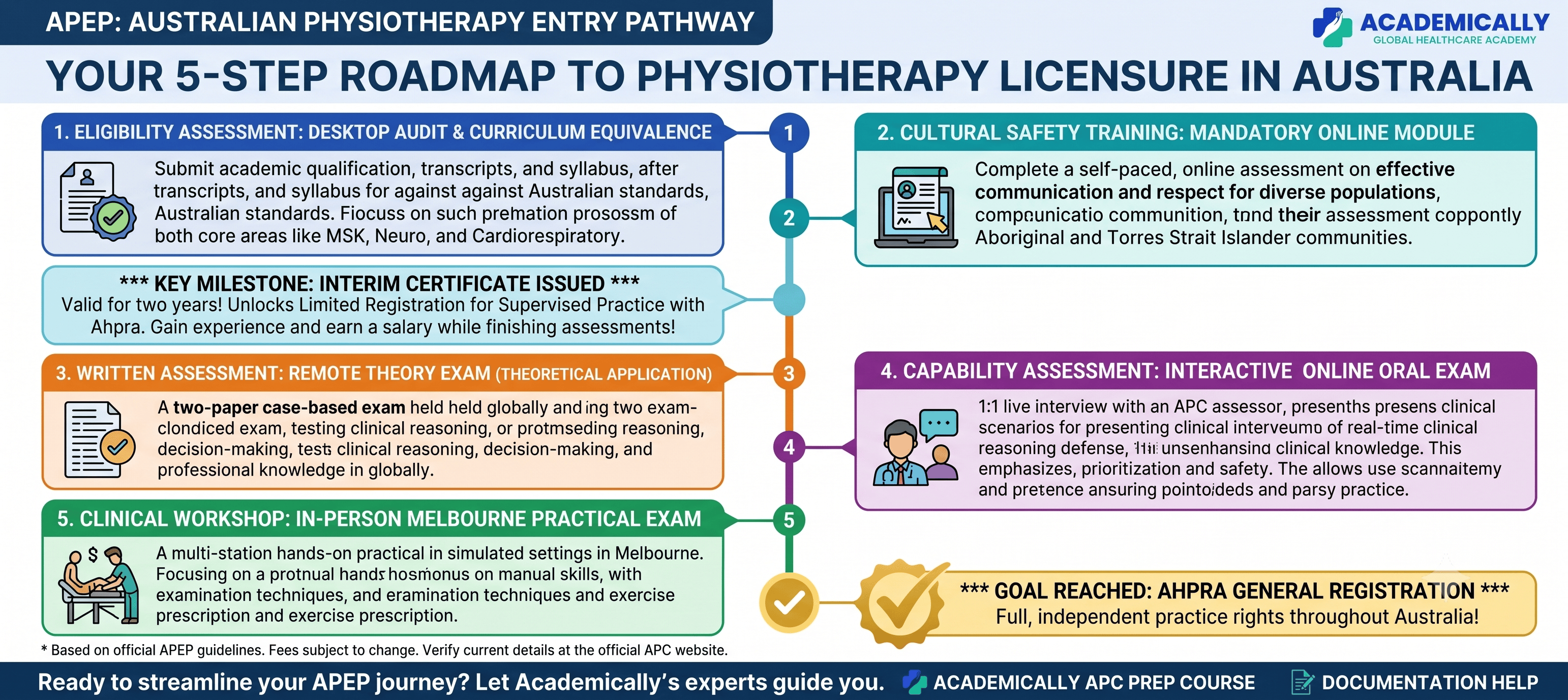
The 5 Stages of the APEP
The APC has streamlined the APEP into a 5-stage process. Here is exactly what you need to do:
1.Eligibility Assessment:Document-heavy desktop review.
This is the foundational desktop review. You must submit your degree certificate, detailed academic transcripts, a comprehensive syllabus detailing the hours spent on core areas (Musculoskeletal, Neurology, Cardio-respiratory), and proof of clinical placements. The APC compares your curriculum against Australian entry-level competencies.
2.Cultural Safety Training:Mandatory online module.
Once deemed eligible, you must complete an online, self-paced module. This training ensures you understand how to work respectfully and effectively with Aboriginal and Torres Strait Islander communities, aligning with Australia's core healthcare values.
3.Written Assessment:Unlocks the Interim Certificate.
Conducted remotely, this is a rigorous two-paper multiple-choice exam assessing your clinical reasoning, patient management, and decision-making against Australian standards. It comprises 120 case-based questions. Passing this grants you an Interim Certificate, allowing you to apply for Limited Registration with AHPRA to work under supervision in Australia!
4.Capability Assessment:1:1 online oral exam.
Capability assessment is an online oral examination with an Australian assessor. It features three short cases and one long case, evaluating your ability to apply clinical reasoning in real-time, focusing heavily on patient safety and communication.
5.Clinical Workshop: Requires travel to Melbourne, Australia.
The final hurdle requires physical attendance in Melbourne, Australia. Over a full day in small groups, you will participate in a hands-on practical workshop, demonstrating physical examination skills, manual handling, and treatment techniques in simulated clinical environments.
The biggest delay candidates face during the Eligibility Assessment is providing insufficient detail about their curriculum. The APC needs to see a breakdown of lecture hours versus practical clinical hours. If your university doesn't provide a detailed syllabus, you may need to write a statutory declaration combined with whatever official documentation you can acquire.
Updated 2026 APEP Fee Structure (AUD to INR)
Budgeting accurately is critical. The APC has announced a fee increase scheduled for October 21, 2026. (Note: Conversions are approximate based on current 2026 exchange rates: 1 AUD ≈ ₹67 INR).
| Assessment Stage | Current 2026 Price | Price after Oct 21, 2026 |
| Eligibility Assessment | $1,170 AUD (~₹78,390) | $1,170 AUD (~₹78,390) |
| Cultural Safety Training | $235 AUD (~₹15,745) | $242 AUD (~₹16,215) |
| Written Assessment | $2,017 AUD (~₹135,140) | $2,078 AUD (~₹139,225) |
| Capability Assessment | $2,928 AUD (~₹196,175) | $2,928 AUD (~₹196,175) |
| Clinical Workshop | $1,464 AUD (~₹98,090) | $1,903 AUD (~₹127,500) |
| Total APEP Fees | $7,814 AUD (~₹5,23,540) | $8,321 AUD (~₹5,57,500) |
Additional Australian Costs to Budget For:
- AHPRA Registration: ~$211 AUD (~₹14,135) per year.
- Skills Assessment (for Migration/Visas): ~$1,674 AUD (~₹112,160).
- Travel/Accommodation: Budget for a ~5-day trip to Melbourne for the final workshop.
Maximize your first-attempt success and safeguard against the financial and professional delays of examination retakes.
Academically’s Australian Physiotherapy Entry Pathway (APEP) Preparation Program delivers over 100 hours of live clinical instruction, access to an extensive repository of 4,000+ case-based practice questions, and individualized 1:1 Capability Assessment coaching led by certified, AHPRA-registered physiotherapy specialists.
United States: The FCCPT and the NPTE
The United States offers incredibly lucrative salaries and a highly autonomous scope of practice. However, it also features the most academically rigorous conversion process. The US standard for entry-level practice is a Doctor of Physical Therapy (DPT).
If you hold a BPT from your home country, you will almost certainly face a credit deficit when your education is evaluated. (Note: 1 USD ≈ ₹96 INR).
The USA Credentialing Process & Costs
- Credential Evaluation via FCCPT: You will apply for the Type 1 Review, covering both credentialing and the VisaScreen required for immigration. Cost: ~$1,200 - $1,400 USD (~₹1.15 Lakh - ₹1.34 Lakh).
- Bridging the Gap (tDPT / Top-up Credits): If the FCCPT finds your BPT falls short of required credits, you must complete online transitional DPT (tDPT) programs to bridge this gap. Cost: Highly variable, ranging from $3,000 to $15,000 USD (~₹2.8 Lakh to ₹14.4 Lakh).
- State Board Application: You apply to the specific state board where you intend to practice (e.g., New York, Texas). Cost: $100 - $300 USD (~₹9,600 - ₹28,800).
- The NPTE (National Physical Therapy Examination): A grueling 5-hour, 250-question computer-based exam. Cost: $485 USD exam fee + $100 USD Prometric seating fee (~₹56,160 total).
- Jurisprudence Exam: Most states require a short exam on the specific legal rules of practicing in that state. Cost: $50 - $100 USD (~₹4,800 - ₹9,600).
United Kingdom: The HCPC Route
The UK is highly attractive due to the National Health Service (NHS), which frequently sponsors visas for international healthcare workers. The UK’s regulator is theHealth and Care Professions Council (HCPC).
Unlike Australia and the USA, the UK does not have a centralized written examination for physiotherapists. The assessment is entirely portfolio-based, making it significantly cheaper upfront. (Note: 1 GBP ≈ ₹127 INR).
The HCPC Registration Steps & Costs
- The Scrutiny Process: You submit a massive dossier to the HCPC (degree, transcripts, highly detailed syllabus, English language scores, and detailed references). Cost: £639.98 (~₹81,275).
- Demonstrating Equivalence: The HCPC assessors compare your syllabus to the UK standards of proficiency to ensure you have adequate clinical placement hours across Musculoskeletal, Neurological, and Respiratory care.
- Adaptation Period or Test of Competence: If assessors find minor shortfalls, they may ask you to undergo a period of adaptation (working under supervision in the UK) or take a specific Test of Competence.
- Full Registration: If accepted, you pay your registration fee and are placed on the HCPC register. Cost: £232.72 (~₹29,555) for a standard two-year cycle.
Warning on Processing Times: The UK HCPC scrutiny process can take anywhere from 3 to 6 months just to review your application.
The Middle East: Prometric Exams (UAE, Saudi Arabia, Qatar)
The Gulf region is a magnet for physiotherapists seeking high, tax-free salaries and excellent expatriate lifestyles. Licensing authorities include the DHA (Dubai), DOH/HAAD (Abu Dhabi), and SCFHS (Saudi Arabia).
The Prometric Process & Costs
1.Meet the Experience Requirement:
Unlike the UK or Australia, Gulf countries strictly require a minimum of 2 years of post-graduate clinical experience to be eligible.
2.DataFlow Verification:Cost: ~$250 - $350 USD (~₹24,000 - ₹33,600).
You must submit your degree, transcripts, and experience certificates to DataFlow, which physically contacts your university and past employers to verify your documents.
3.The Prometric Exam:Cost: ~$200 - $280 USD (~₹19,200 - ₹26,880).
You sit for a computer-based multiple-choice exam at a Prometric test center. The exam tests general physiotherapy knowledge, anatomy, and standard treatments.
4.Eligibility Letter & Job Search:Cost: ~$150 - $300 USD (~₹14,400 - ₹28,800).
Upon passing, you receive an eligibility letter to apply for jobs. Once hired, the hospital converts your letter into a full, active practice license.
Essential Tips for Acing Your International Exams
Regardless of whether you are tackling the APEP, the NPTE, or a Prometric exam, the transition from local knowledge to global standards requires a major shift in thinking.
- Master Clinical Reasoning: Exams in Australia, Canada, and the US do not test raw memorization. They test how you apply knowledge to a patient scenario. You need to know not just what to do, but why you are doing it, and what to do if the patient's condition unexpectedly changes.
- Focus on Safety First: In every international exam, choosing an answer that compromises patient safety is an instant fail. Always prioritize red flags, contraindications, and safe manual handling.
- Understand Cultural Nuances: The way you communicate with a patient in India might differ significantly from the patient-centered, shared-decision-making models expected in Australia or the UK.
- Choose the Right English Test: While IELTS is standard (~₹17,000 INR), the Occupational English Test (OET) (~$587 AUD / ~₹39,300 INR) is highly recommended for physiotherapists because it uses medical terminology and clinical scenarios.
How Academically Ensures Your Global Success
Attempting to navigate these complex pathways alone is risky. A single rejected document or a failed exam attempt can cost you thousands and delay your career by a year.
At Academically, we offer comprehensive, end-to-end support for international physiotherapists. Our APEP Written Assessment Preparation Course is specifically designed to help you crack the APEP on your first attempt:
- 100+ Hours of Structured Learning: Covering the full APEP syllabus across Musculoskeletal, Cardiorespiratory, Neurology, and Professional Practice.
- Massive Question Bank: Access to 4,000+ practice questions and AI-based mock exams.
- Expert Faculty: 14 weeks of intensive live sessions led by highly trained, AHPRA-registered physiotherapy faculty.
- Flawless Document Preparation: We guide you on exactly how to format your syllabus and academic transcripts so they pass the strict scrutiny of the APC, FCCPT, or HCPC on the first try.
Passing your exams and getting registered is an incredible achievement but the goal is landing a high-paying clinical role abroad.
Academically's exclusive global healthcare job portal, bridges that gap. We connect pre-screened healthcare professionals directly with verified employers in Australia, the UK, the Gulf, and beyond. Whether you are looking for roles under Limited Registration in Melbourne or a job in Dubai, Jobslly matches your specific skills with top-tier international clinics.