"Arise, awake, and stop not till the goal is reached" – Swami Vivekananda
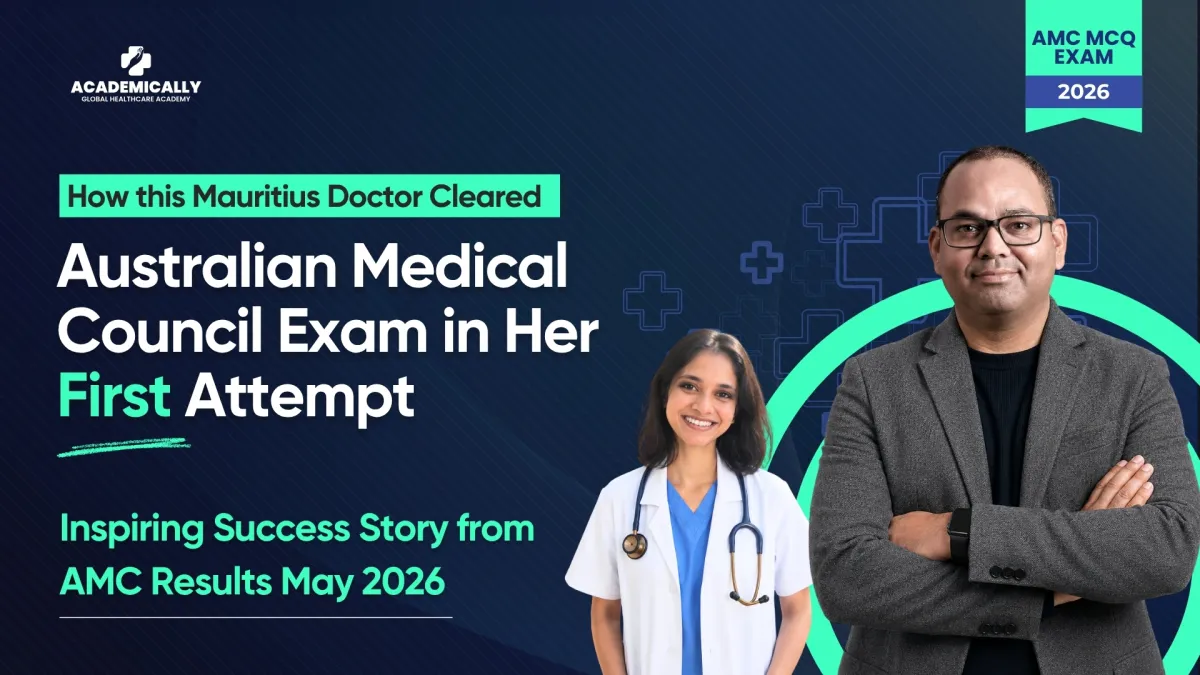
The AMC exam results of May 2026 are out and we are ecstatic about the success stories that are going to inspire generations of medical professionals. This story of a young doctor from Mauritius is still creating reverberations and rightfully so! Between 36-hour hospital shifts and the weight of daily clinical responsibility, quietly, stubbornly, she got started. She didn't stop until she passed the Australian Medical Council (AMC) Exam on her very first attempt. Her results came out in 5th June 2026. One word. PASS. How did she do it?
Dr. Akram Ahmad (PhD in Medicine from University of Sydney, Founder & CEO, Academically) sat down with Dr. Toshta where she spoke about everything she worked on, to clear the AMC exam in her first attempt itself, that too while working full time. Come, let's get inspired.
Why Australia all the way from Mauritius for Medical Practice?
"I Wanted to Be Part of Something Greater"
"- Dr. Toshta (AMC Qualified Candidate from Mauritius)"
Dr. Toshta grew up in Mauritius and earned her medical degree from the SSL Medical College. For five years after graduation, she worked as a doctor in the public hospital system. A world of early morning rounds, back-to-back consultations, and rosters that could stretch a 24-hour duty into 36 hours without warning, especially on weekends.
She was good at what she did. But she wanted more.
"I think they'll have better opportunities," she said. "The way they practice, the guidelines, the resources they have. I have a better chance to develop as a doctor there."
Australia wasn't just an idea to her. She had visited. What struck her most wasn't the skyline or the beaches. It was a defibrillator on a train platform. A piece of emergency equipment, placed on a public footpath, available to anyone who might need it.
"We don't have that in my country," she said simply.
In that small observation lives the pulse of an enormous ambition, to practice medicine in a system that values every life enough to place life-saving equipment in a train station. That image stayed with her. It carried her through eight months of the hardest preparation of her career.
How does the AMC Exam Preparation look like for a Full Time Doctor?
Here is what Dr. Toshta's days looked like during AMC preparation:
- Wake up, work an 8 AM to 4 PM shift.
- On rostered 24-hour duty days, stay until 8 PM, or longer, if sessions needed covering.
- On Saturdays, sometimes 36 hours straight, a pattern familiar to doctors trained in South Asia and the Indian Ocean region alike.
In the margins of all this, she studied.
"I did my MCQs when I could find some time, even during work," she recalled. "The live sessions on Academically were most of the time when I was working, so I had to plan to be there, because I wanted to ask questions."
She didn't just watch recorded lectures passively. She showed up on live sessions, even from a hospital corridor, because she wanted the interaction, the ability to raise her hand (metaphorically), ask about a guideline she wasn't sure of, and receive a clear, personalised explanation.
She built five dedicated study hours into every day off. She followed the structured plan provided by Academically. Eight months later, she sat the exam on her first attempt.
AMC Exam vs Mauritius Medical Registration Examination (MRE): What's the Difference?
Many doctors from Mauritius ask an important question before beginning their migration journey: If I am already eligible to practise in Mauritius, why do I need to clear the AMC exam for Australia? The answer lies in the purpose of the two examinations. While both are licensing assessments, they are designed for very different healthcare systems and career outcomes.
| Feature | Australian Medical Council (AMC) Exam | Mauritius Medical Registration Examination (MRE) |
| Regulatory Body | Australian Medical Council (AMC) and Medical Board of Australia | Medical Council of Mauritius (MCM) |
| Primary Purpose | Assessment for international medical graduates seeking registration in Australia | Licensing examination for medical registration in Mauritius |
| Eligibility | International Medical Graduates (IMGs) pursuing Australian registration pathways | Graduates meeting MCM eligibility requirements, including completion of pre-registration training |
| Exam Structure | AMC MCQ Examination followed by AMC Clinical Examination or approved workplace-based assessment pathway | Single examination consisting of 150 multiple-choice questions |
| Duration | AMC MCQ: 3.5 hours; Clinical assessment conducted separately | 3 hours |
| Number of Questions | 150 MCQs in AMC CAT examination | 150 MCQs |
| Passing Requirement | Standard set by AMC using criterion-referenced assessment methods | Minimum 75 marks out of 150 required to pass |
| Clinical Skills Assessment | Yes, through AMC Clinical Exam or accredited workplace-based assessment | No separate clinical examination component |
| Recognition | Australia-wide registration pathway leading to AHPRA registration | Registration to practise within Mauritius |
| Career Scope After Licensure | Access to Australian healthcare system, specialist training pathways, rural and metropolitan employment opportunities, and long-term migration pathways | Primarily practice opportunities within Mauritius under MCM registration |
| Typical Candidate Goal | Medical career development, specialist training, higher earning potential, migration and long-term settlement | Local medical registration and clinical practice in Mauritius |
Why More Mauritian Doctors Are Choosing Australia?
The decision is not about leaving home for many doctors in Mauritius. It is about expanding possibilities.

Australia offers one of the world's most structured postgraduate medical training systems, internationally recognised specialist pathways, modern healthcare infrastructure, competitive doctor salaries, and strong long-term career progress.
General practitioners commonly earn at an average of AUD 400,000 annually which is 13473081 MUR, while many specialist fields command significantly higher remuneration. Australia also continues to recruit international medical graduates across multiple states, particularly in regional and rural areas where demand remains strong.
For doctors like Dr. Toshta, the attraction goes beyond salary. It is the opportunity to work in a healthcare system known for evidence-based practice, advanced clinical resources, patient-centred care, and globally recognised training standards. The AMC exam is not merely a licensing exam. It is a gateway to practising medicine in one of the world's most respected healthcare systems.
AMC Exam 2026 Preparation Strategy: Customised Plan for Doctors Working Full Time
When asked what approach actually worked, Dr. Toshta's answer was refreshingly honest and precise. She didn't start with theory. She started with questions.
"What really helped me was doing the questions first," she explained. "I could see what they were trying to test and what my weak spots were. When I was revising, I knew exactly where to focus."
This is a clinically intelligent approach. Essentially a diagnostic workup of her own knowledge gaps. Rather than ingesting chapters sequentially and hoping retention would follow, she used the MCQ bank as a stethoscope, listening for the weak pulse in her preparation, then treating it directly.
The mock tests reinforced this. Academically's grand mock tests simulated real exam conditions, mixed topics, variable difficulty, timed pressure, forcing her to develop the kind of in-exam decision-making that written notes can never teach.
"If I know the answer, I work it out. If I'm not sure, I give myself a set amount of time. If I still don't know, I answer something and move forward," she said.
Time management, she noted, was one of the most underestimated skills in AMC preparation. The grand mock tests gave her a space to fail, learn, and calibrate, before it counted.
Important Subjects to Focus Maximum for AMC Exam 2026
Dr. Toshta's subject breakdown for future AMC candidates is worth paying close attention to:
- Ethics: "We tend to neglect it, but it was quite present in my exam," she said. It's the most commonly underestimated section.
- Medicine (General): broad and variable; expect a range of presentations.
- Gastrointestinal (GI) System: heavily represented, consistently tested.
- Respiratory System: a core medicine pillar; know it thoroughly.
- Surgery, including Vascular Surgery: don't treat surgery as secondary.
- Haematology: often overlooked, but a meaningful presence on exam day.
The pattern here is worth noting. The AMC tests the breadth of a competent general practitioner, not the depth of a specialist. Ethics is the connective tissue of every clinical decision. It deserves the same rigour as pathophysiology.
How Academically Helps Full Time Doctors to Clear the AMC Exam in First Attempt Itself?
Dr. Toshta was forthright about how incredible Academically's support had been as an active learning environment.
"The live sessions were really helpful because we could ask questions," she said. "They provided new guidelines, we didn't have to go looking for them on our own all the time. They explained things in a way that we understand. If I missed a live session, I could always reach out through the app."
This is precisely what Academically's AMC MCQ Exam Preparation Course is designed to deliver:
- 100+ hours of live and recorded tutorials
- India's first adaptive AI-driven mock test engine
- AMC-qualified, USMLE-qualified, PLAB(UKMLA)-qualified and AHPRA registered faculty members mentoring candidates from day 1
- 1-on-1 doubt clearing sessions
- Recall sessions, PDF handouts, grand tests and community support on Discord
We are always-on communication channel for candidates managing the impossible juggle of full-time work and exam preparation. The curriculum covers every major domain tested in the AMC, from clinical reasoning and medical knowledge to the GI cases and ethics scenarios that caught even prepared candidates off guard.
The guidance doesn't stop at content for international medical graduates navigating a new system. Academically also supports candidates through visa pathways and the details of migration, because passing the AMC MCQ Part I is only the beginning of the journey.
Can You Work in Australia After Passing AMC MCQ Part 1?
Yes and this is one of the biggest advantages of clearing the AMC MCQ Part I examination.
Many international medical graduates assume they must first complete the AMC Clinical Exam before seeking employment in Australia. In reality, passing AMC MCQ Part 1 can make you eligible for certain supervised medical positions and limited registration pathways, depending on your experience, employer sponsorship, and Medical Board approval.
While preparing for AMC Clinical Exam (Part II) or a Workplace-Based Assessment (WBA), many IMGs successfully work in roles such as:
- Resident Medical Officer (RMO)
- Hospital Medical Officer (HMO)
- Junior Medical Officer (JMO)
- Service Registrar positions
- Rural and regional hospital doctor roles
- Non-VR GP (Non-Vocationally Registered General Practitioner) positions under supervision, subject to employer requirements, registration conditions, and pathways such as PESCI where applicable.
In fact, the AMC's Workplace-Based Assessment pathway specifically requires candidates to be employed in an approved clinical position while being assessed in real-world practice settings.
This creates a significant advantage for many IMGs. Instead of spending months preparing for AMC Clinical without clinical exposure, they can earn an income, gain Australian healthcare experience, strengthen their CV, and continue progressing toward full registration simultaneously.
Several IMGs report securing supervised hospital positions after AMC MCQ and then preparing for AMC Clinical while working in Australia. In other words, passing AMC MCQ Part 1 doesn't just move you closer to registration. It can also open the door to your first Australian medical job while you continue working toward full registration and long-term career opportunities.
To Conclude with...
Dr. Toshta's journey is a reminder that success in the AMC examination is not reserved for candidates with unlimited study time or ideal circumstances. She had a demanding hospital shifts, weekend duties that stretched beyond 24 hours, and the responsibilities of everyday clinical practice in Mauritius. Inspite of all the responsibilities, she abided by a structured AMC preparation strategy and trusted the process.
Her first-attempt AMC success demonstrates what many international medical graduates often overlook: consistency matters more than intensity.
The Australian Medical Council examination remains one of the most important gateways for doctors seeking registration and career opportunities in Australia. Beyond the exam itself lies access to a healthcare system known for evidence-based practice, world-class training pathways, competitive salaries, and long-term professional growth.
Dr. Toshta's story offers more than inspiration for doctors in Mauritius and across the globe. It provides a roadmap. Start early, study strategically, seek expert guidance, and remain committed to your goal. The next AMC success story could very well be yours.