For international medical graduates (IMGs), understanding how healthcare is delivered in Australia is an important part of preparing for a medical career. An observership provides an opportunity to observe clinical teams, learn about local workflows, and become more familiar with the Australian healthcare environment.

You do not necessarily need to wait until you have passed the AMC exams to start exploring observership opportunities. Depending on the provider's eligibility criteria, fresh graduates, doctors, candidates currently preparing for AMC examinations, and doctors who have passed the AMC exams may all be able to enquire.
What is a clinical observership?
A clinical observership in Australia for IMGs is a structured or informal opportunity for a doctor to observe healthcare professionals in a clinical setting. Depending on the hospital or clinic, an observer may attend ward rounds, observe consultations where permitted, learn how teams communicate, and become familiar with documentation and patient-care pathways.
The observer generally does not provide patient care or perform clinical duties. The exact boundaries are set by the host organisation and must be followed at all times, including confidentiality, consent, infection-control, and workplace-safety requirements.
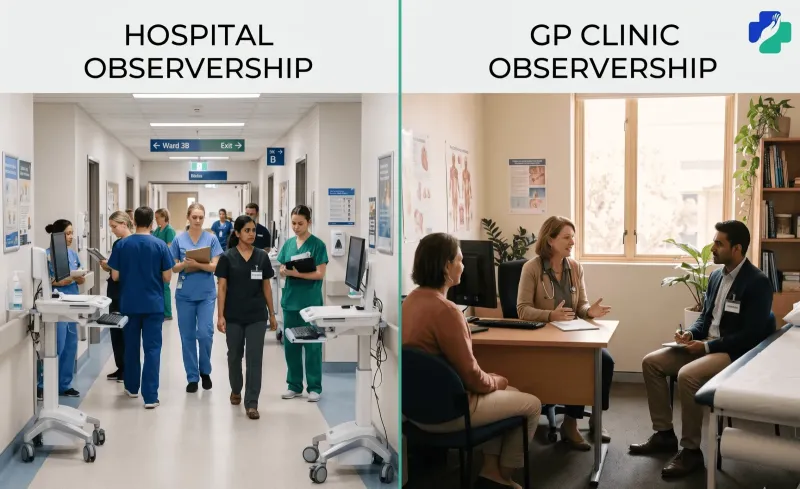
Hospital observerships: what can you learn?
A hospital observership in Australia is particularly relevant if you are interested in applying for junior medical officer (JMO), resident medical officer (RMO), or other hospital-based roles. The experience may help you become more familiar with:
- Ward rounds and multidisciplinary team discussions.
- Clinical handovers, escalation processes, and communication between teams.
- How clinical notes, discharge summaries, and referrals are structured.
- Hospital policies, patient-safety processes, and infection-control practices.
- The roles of consultants, registrars, JMOs, nurses, and allied health professionals.
- The general rhythm and expectations of a hospital working environment.
Observing these activities can help you understand the environment you may later work in, though it does not demonstrate that you can independently perform the duties of a hospital doctor.
GP clinic observerships: what can you learn?
A GP clinic observership in Australia can help IMGs understand primary care. Subject to the clinic's approval and patient consent, you may observe how GPs conduct consultations and coordinate ongoing care, including:
- The structure of a typical GP consultation.
- Preventive care, health assessments, and chronic disease management.
- Clinical documentation, follow-up plans, and patient communication.
- Referrals to specialists, pathology, imaging, and other services.
- Continuity of care and coordination with community health providers.
GP observerships may be useful for doctors exploring primary care. However, it does not itself qualify an IMG for independent or supervised GP practice, nor does it replace any required PESCI assessment or registration.
Hospital vs GP observership: which should you choose?
| Feature | Hospital observership | GP observership |
| Main setting | Public or private hospital | General practice clinic |
| Useful exposure | Ward rounds, handovers, inpatient workflows | Consultations, primary care, follow-up |
| Potential relevance | Hospital JMO jobs Australia & RMO jobs Australia | Understanding Australian primary care |
| What it cannot replace | Registration, clinical employment or hands-on experience | Registration, required assessments or supervised practice |
How can an observership help with securing a medical job?
An observership may strengthen your preparation for the Australian medical job market in several practical ways. It is best viewed as one part of a broader career plan:
- Understand local expectations: Become familiar with how Australian clinical teams communicate, document care, and work across disciplines.
- Prepare stronger interview examples: Discuss what you observed regarding teamwork and patient safety. Be clear that you were observing, not providing care.
- Build professional awareness: Learn about local departments, recruitment cycles, role titles, and the skills commonly expected of junior doctors.
- Develop professional connections: Meet clinicians and administrators. (Note: Any reference is entirely at the host's discretion.)
- Identify learning gaps: Seeing local workflows may help you identify areas to study before interviews or future clinical work.
Important: Observerships do not guarantee a job, interview, reference, or registration. Employers make their own decisions based on eligibility, experience, and recruitment requirements.
Does an observership count as Australian clinical experience?
Usually, an observership should be described accurately on your CV as observational exposure or professional development—not as clinical employment or hands-on IMG clinical exposure Australia. Do not list it as a paid medical position, claim patient-care responsibilities you did not have, or imply that you practised medicine. It also does not automatically satisfy Medical Board of Australia recency-of-practice requirements.
When should you explore an observership: before, during or after AMC preparation?
- Before starting AMC preparation: A fresh graduate or an IMG planning the AMC pathway may explore whether an observership is available. It can offer early insight into the Australian healthcare environment, but it is not a prerequisite.
- While preparing for the AMC exams: You may use observational learning to understand local terminology and workflows. Keep your AMC exam preparation and clinical knowledge development as priorities.
- After passing an AMC examination: An observership may help you continue learning about local practice while researching suitable vacancies and preparing applications.
- While applying for jobs: If you are eligible for a particular role, an observership may help you prepare for interviews and understand the workplace.
For a comprehensive look at the next steps in your career journey, be sure to read our related article:Observerships After AMC in Australia: The Ultimate IMG Job Guide.
Passing the AMC exams is your first major step toward securing a medical job in Australia. Join thousands of successful IMGs who have cleared their exams with Academically Global’s expert-led coaching.
AMC exams, registration, and JMO/RMO jobs: understand the difference
The AMC Standard Pathway generally involves the relevant AMC examination requirements, which may include the AMC CAT MCQ examination and the AMC Clinical Examination. An AMC certificate is not the same as medical registration. Registration is handled by the Medical Board of Australia through Ahpra. JMO and RMO vacancies have employer-specific eligibility criteria. Before applying, check the position description, registration requirements, required experience, work rights, and any state recruitment rules.
What about GP jobs and PESCI?
Some international medical graduates seeking certain general practice positions may need a Pre-Employment Structured Clinical Interview (PESCI), depending on the role and applicable registration requirements. PESCI is role- and circumstance-specific. A GP observership does not replace a required PESCI, registration requirement, examination, or supervised practice requirement.
How can you find an observership in Australia?
- Contact hospital medical workforce units, medical education departments, or relevant clinical departments to ask if they accept IMG observers.
- Approach GP clinics directly to ask about formal observer processes.
- Check eligibility before making plans. Requirements may include being in Australia, an appropriate visa, identity and qualification checks, police checks, immunisation evidence, and confidentiality training.
- Never attend a clinical site without formal, written permission.
Sample email to request an observership
Subject: Enquiry About a Clinical Observership Opportunity
Dear Medical Workforce / Practice Manager,
I am an international medical graduate currently [planning my AMC pathway / preparing for the AMC examinations / having completed the relevant AMC examination]. I am writing to enquire whether your hospital or practice offers clinical observership opportunities for international medical graduates.
I understand that an observership is an observational opportunity and that I would not undertake patient care or clinical duties. I would be happy to comply with your organisation's requirements relating to confidentiality, patient consent, immunisation, insurance, police checks, and onboarding.
Could you please let me know whether your organisation accepts observers and, if so, the eligibility criteria, application process, duration, and any associated fees?
Thank you for your time and consideration.
Kind regards, [Full name] [Contact details]
CPD and professional development: what should IMGs know?
Some education providers advertise courses with Continuing Professional Development (CPD) points. Before enrolling, check who accredits or recognises the activity, the exact number and type of points, the certificate wording, and whether the activity is relevant to your professional circumstances. Do not assume that course points automatically satisfy the Medical Board of Australia's CPD requirements or replace clinical practice, employment, or registration obligations.
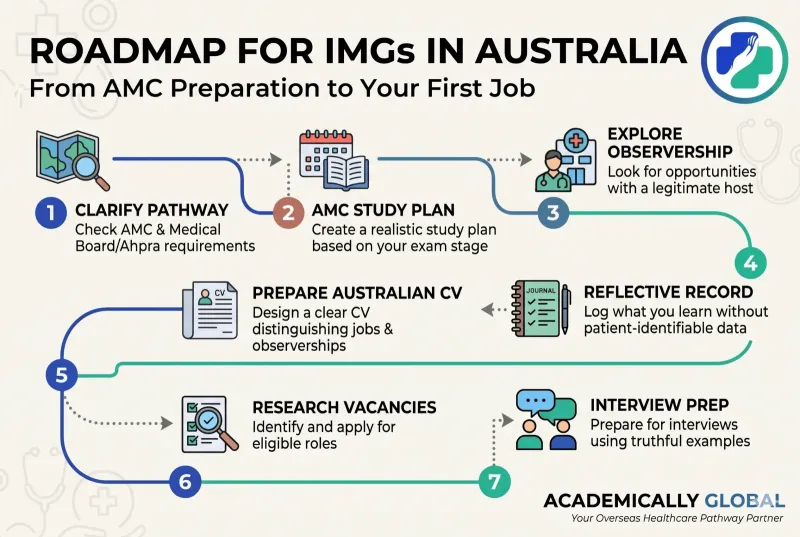
A practical roadmap for IMGs
- Clarify your medical registration pathway and check current AMC and Medical Board/Ahpra requirements.
- Build a realistic AMC study plan based on your current knowledge and exam stage.
- Explore an observership only through a legitimate host and follow all site rules.
- Keep a reflective learning record of what you observed, without recording identifiable patient information.
- Prepare a clear Australian-style CV that accurately distinguishes employment, clinical experience, observerships, and courses.
- Research vacancies and apply only where you meet the stated eligibility requirements.
- Prepare for interviews using truthful examples from your actual work and learning experiences.
How Academically Global can support your journey
Academically Global supports international healthcare professionals with structured preparation and career guidance for overseas pathways. For doctors considering Australia, support may include AMC pathway information, exam preparation, study planning, CV guidance, interview preparation, and general job-application support. Any observership opportunity, where available, is subject to the host organisation's eligibility criteria, approval, and availability.
From building a bulletproof AMC study plan to crafting an Australian-style CV and preparing for interviews, our comprehensive AMC programs support you at every stage of your journey. Don't navigate the IMG pathway alone.