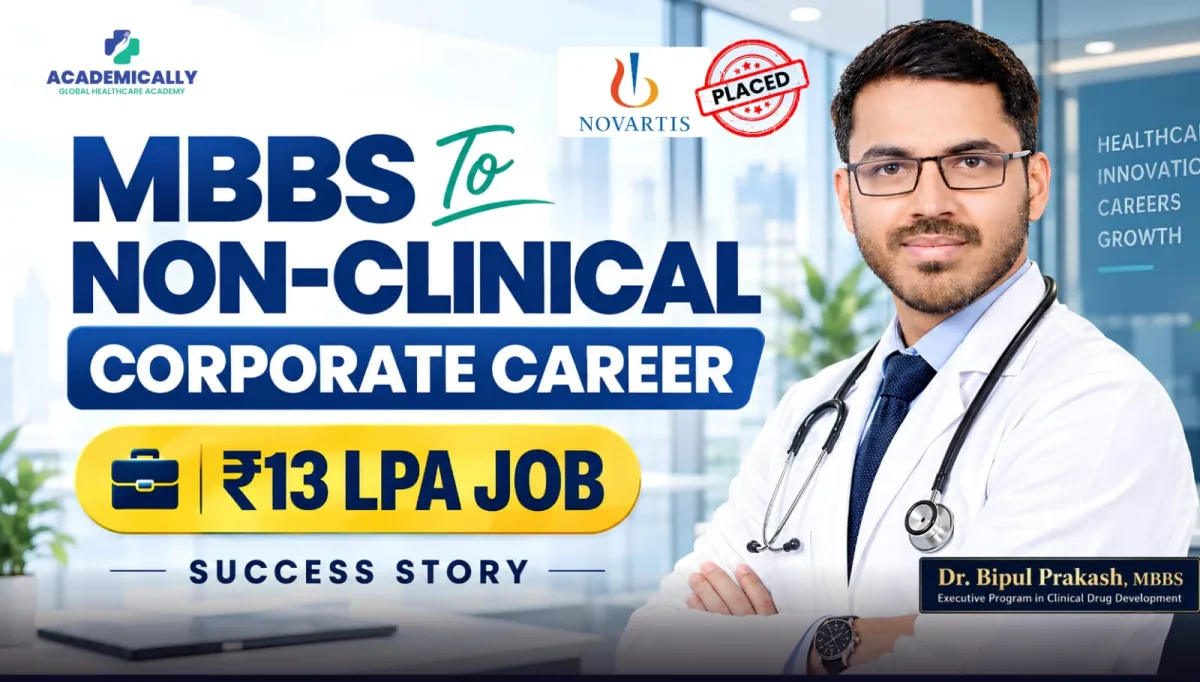
Many MBBS doctors feel stepping away from clinical practice can feel like stepping away from medicine itself. The years of medical school, residency, long shifts and patient care can create the impression that the only worthwhile next step is another clinical qualification. Dr. Bipul Prakash’s success story challenges that assumption.
After working as a Junior Resident and experiencing the demands of a hospital-based career, Dr. Bipul began exploring non-clinical jobs for MBBS doctors. His search eventually led him to Clinical Drug Development and, with focused upskilling, practical training and intensive interview preparation, he secured a ₹13 LPA corporate job as a Clinical Scientific Expert with Novartis in Hyderabad.
His journey is not about abandoning medicine. It is about discovering another place where medical knowledge can create impact.
In an exclusive conversation with Aritro Chattopadhyay, Content Lead, Academically Global, Dr. Bipul explains why he started looking beyond clinical practice, what he learned about the pharmaceutical industry, how Academically Global helped him become interview-ready and why his MBBS background became an advantage rather than a limitation.
How MBBS Doctors Can Transition from Clinical to Non Clinical Roles
A career transition usually begins long before the new job offer. For Dr. Bipul, it started with a practical concern: work-life balance. During his time as a Junior Resident in a neuro-focused department, his working hours were unpredictable. Being on call meant that professional responsibilities could extend well beyond a conventional shift. The patient load was also substantial, with days involving dozens of patients and at times considerably more.
For a doctor who had already developed an interest in the pharmaceutical sector, these experiences prompted an important question:
Could he use his medical knowledge in a different environment without losing its value?
The answer came through exploration. Dr. Bipul discovered Academically Global through YouTube and began learning about non-clinical career options for doctors. What initially looked like a broad collection of possibilities gradually became a clearer career direction.
He was particularly interested in the pharmaceutical industry. The problem was not a lack of interest. It was a lack of awareness about how an MBBS degree could translate into actual industry roles.
“I was interested in the pharma aspect from my second or third year itself,” Dr. Bipul explained. “But I did not know about the career aspect of it.”
That distinction is important.
Medical education teaches doctors how to think clinically, understand disease, interpret symptoms, prescribe appropriately and make patient-centred decisions. It does not necessarily teach them how those capabilities map to clinical trials, pharmacovigilance, medical affairs, regulatory documentation or pharmaceutical operations.
That was the gap Dr. Bipul set out to close.
Why are more MBBS Doctors Looking for Non-Clinical Jobs?
An MBBS degree provides a strong scientific and clinical foundation. Yet the pharmaceutical industry operates through a different set of workflows, terminology, documentation standards and cross-functional processes.
Clinical Drug Development sits at the intersection of medicine, research, regulation, safety and scientific evidence. Professionals may work across areas including clinical trials, pharmacovigilance, regulatory affairs, medical affairs, clinical data management and scientific communication. That makes doctors particularly valuable because their clinical understanding can be applied beyond the consultation room.
Dr. Bipul recognised this early. He did not want to discard his clinical expertise. He wanted to combine it with pharmaceutical knowledge. That became the central idea behind his transition.
Learnings from Non Clinical Career Success Story- Interview Excerpts
What made you consider a non-clinical career?
Dr. Bipul Prakash: The major challenge was work-life balance. My working hours were not fixed. I could be called at any time and was effectively on a 24-hour call. There was also a very large patient load.
At the same time, I had an interest in pharma. When I realised that there were non-clinical areas within pharma where I could still use my clinical expertise, I thought I should explore that option.
How did you discover these career opportunities?
Dr. Bipul Prakash: I came across Academically through YouTube. That was when I first understood that there were different career options beyond traditional clinical practice.
I started researching the possibilities and, after joining, I became much clearer about the different career domains and their prospects.
What was the biggest difference between medical education and industry-oriented learning?
Dr. Bipul Prakash: In medical college, especially when we study pharmacology, we learn the theoretical aspects. We learn what drugs are and their mechanisms of action.
We are not usually taught how to apply our clinical knowledge inside the pharmaceutical industry. That was different during my course. I started learning about clinical trials, pharmacovigilance, protocols, case reports, investigational documents and other technical areas that I had not worked with before.
That learning helped me understand how clinical knowledge fits into the pharma environment.
How does the shift from Clinical Practice to Non Clinical Job Look like?
One of the strongest themes in Dr. Bipul’s interview is the shift from medical knowledge to industry-ready knowledge. Knowing medicine is one thing.
Knowing how medicine is documented, evaluated, monitored and communicated within the pharmaceutical industry is another. Modern Good Clinical Practice frameworks emphasise areas such as protocol compliance, informed consent, participant safety, oversight, essential records and reliable clinical-trial data. For doctors entering the field, these can initially feel unfamiliar. That is why practical exposure matters.
Academically Global’s current Executive Programme in Clinical Drug Development is structured around this exact transition. Its 12-module curriculum covers the drug development lifecycle, clinical trial phases, regulatory affairs, pharmacovigilance and drug safety, medical affairs, clinical data management, biostatistics, medical writing, GCP and ethics, real-world evidence and a final capstone project.
For someone like Dr. Bipul, this kind of structured exposure helped convert unfamiliar terminology into usable professional knowledge.
How to Search Non Clinical Jobs Online: A Training Programme
Perhaps the most revealing part of Dr. Bipul’s journey is that he did not simply complete a course and wait for recruiters to find him. He applied. A lot. According to his interview, the program management team began sharing relevant job links even before the classes started. During his initial three months, he applied to around 800 to 900 job openings.
Most applications did not receive a response. That is normal in a competitive corporate job market, but it also reveals something many candidates misunderstand about career transitions. A new qualification is not the finish line. It is the starting point for a disciplined job search.
Dr. Bipul kept applying even when many recruiters did not respond. The process gave him exposure to real job descriptions, skill requirements and the language companies use to describe roles.
The programme’s current structure similarly combines training with job assistance, resume support, interview preparation, mentorship and access to healthcare-focused job opportunities through India's first and leading healthcare job platform called, Jobslly. That combination matters because a candidate can know the subject yet still struggle to present that knowledge in a hiring environment. Dr. Bipul’s experience shows how important the transition from learner to applicant can be.
How to Crack Interview for Non Clinical Jobs: Expert's Perspective
There was another challenge Dr. Bipul had to overcome: confidence. He described himself as an average student when it came to interviews. The technical knowledge was developing, but answering questions aloud in a professional interview setting was initially uncomfortable.
That changed through repeated practice. During training, learners were asked to answer questions in front of a large group. Dr. Bipul deliberately made it a habit to participate, even when he was unsure of an answer. Over time, that repetition improved his confidence. The difference became especially visible when he received an actual interview opportunity.
According to Dr. Bipul, when he informed his mentor about the scheduled interview, a dedicated preparation session was arranged with a faculty member just a few days before the interview. The preparation was role-specific.
That is significant because technical interviews rarely stop at generic questions such as “Tell me about yourself.” Candidates may be expected to explain clinical trial concepts, understand documents, interpret responsibilities and connect theoretical knowledge to real-world scenarios.
Academically’s non clinical courses includes dedicated job-readiness training, mock interviews, one-to-one feedback, CV and LinkedIn building, professional communication and interview training. For Dr. Bipul, those skills were not simply additional features. They became part of his employability.
One of the most striking moments from the interview came when Dr. Bipul described his actual corporate interview. The first technical question focused on clinical trials. It was an area he had encountered early in his training.
He remembered being taught the clinical trial framework during the first few lectures and could therefore approach the interview question with familiarity rather than uncertainty. He was also asked about protocol documents and investigational documentation. Again, the topics had already been covered in the training.
His takeaway was simple: much of what the recruiter asked had already been introduced to him through structured learning.
This is where job-oriented education becomes more valuable than certificate-oriented education. A certificate may demonstrate that someone completed training. Practical knowledge demonstrates whether someone can use it.
Job Responsibilities of a Clinical Scientific Expert at Novartis
At the time of the interview, Dr. Bipul had not yet formally joined and expected to start within roughly one to ten days. His role is Clinical Scientific Expert at Novartis in Hyderabad, with responsibilities centred on clinical trial review, patient safety and data integrity.
His expected work includes reviewing clinical trial protocols to ensure alignment with regulatory expectations, monitoring informed-consent processes, identifying potential patient risks and raising professional queries where clarification is required.
He will also work with clinical trial data and help ensure that the integrity of trial information is maintained. These responsibilities demonstrate why a doctor’s clinical background can be valuable in a corporate setting.
Patient safety does not stop being important simply because the doctor is no longer working inside a hospital. The environment changes. The responsibility remains.
The ICH E6(R3) Good Clinical Practice framework specifically places emphasis on participant rights, safety and well-being, as well as the reliability of clinical-trial data and appropriate oversight. For Dr. Bipul, that is where his clinical training and new industry knowledge meet.
Key Highlights of the Non-Clinical Career Success Story
| Key Takeaway | What Dr. Bipul’s Journey Shows | Why It Matters for MBBS Doctors |
| 1. MBBS opens multiple career paths | An MBBS degree can lead beyond clinical practice into clinical research, pharmacovigilance, medical affairs, clinical development and other pharmaceutical careers. | Doctors can use their medical knowledge in non-clinical and corporate healthcare jobs without completely leaving the healthcare sector. |
| 2. Clinical knowledge needs industry skills | Pharmaceutical roles may require knowledge of clinical trials, protocols, regulatory documentation, patient safety, compliance and scientific communication. | Additional Clinical Drug Development training can help MBBS doctors bridge the gap between medical education and pharma industry requirements. |
| 3. Interview preparation can influence career outcomes | Dr. Bipul strengthened his confidence through repeated interview practice, technical questions and role-specific preparation before his corporate interview. | Knowing the subject is important, but doctors also need to communicate their skills confidently during pharma job interviews. |
| 4. Persistence is essential in a career transition | Dr. Bipul applied to 800–900 jobs in approximately three months despite receiving limited responses from recruiters. | Moving from clinical practice to a non-clinical job after MBBS can take persistence, consistent applications and continuous improvement. |
| 5. Medical expertise can be transferred to corporate healthcare | His new role as a Clinical Scientific Expert at Novartis allows him to apply clinical knowledge to clinical trial protocols, patient safety and data integrity. | A non-clinical career does not mean abandoning medicine. It can mean using medical expertise in a different healthcare setting. |
| 6. Career repositioning can create new opportunities | Dr. Bipul moved from uncertainty about pharma careers to a ₹13 LPA corporate opportunity after developing relevant industry knowledge and job-readiness skills. | MBBS doctors can strategically combine their clinical background + industry skills + interview readiness to explore alternative career paths. |
Why Clinical Drug Development Is Emerging as a Career Option for Doctors
Clinical Drug Development offers doctors a way to remain closely connected to medicine while moving into a corporate environment.
The work can involve clinical research jobs after MBBS, trial operations, patient safety, evidence generation, regulatory processes and scientific communication.
Academically Global positions its Executive Programme in Clinical Drug Development as a four-month industry-focused programme designed to bridge academic knowledge with pharmaceutical-industry expectations. The programme combines practical coursework, mentor-guided capstone work and structured job assistance rather than focusing only on classroom theory.
Its practical portfolio components include real-world case studies, clinical trial simulations, pharmacovigilance workflow exercises and industry scenario-based assignments.
For a doctor considering a transition, that can make the difference between saying “I want to enter pharma” and demonstrating “I understand how pharma works.”
To Conclude with...
There can be considerable emotional pressure around leaving conventional clinical pathways. Doctors may worry about what colleagues will say. Families may ask why years of medical education are not being used in a hospital.
Candidates themselves may wonder whether choosing a corporate role means they have somehow failed to become the doctor they originally imagined. Dr. Bipul’s story offers a different perspective.
He did not stop being a doctor. He simply expanded where his medical knowledge could take him. His upcoming work in clinical trial oversight and patient safety demonstrates that medicine can influence healthcare at a much larger scale than one consultation at a time. For doctors who enjoy science, evidence, research and problem-solving but want an alternative to the demands of hospital practice, Clinical Drug Development can be a career path worth exploring.
And for Dr. Bipul Prakash, exploration became a result:
MBBS → Clinical Drug Development upskilling → intensive interview preparation → ₹13 LPA corporate opportunity at Novartis.
That is the real takeaway. Sometimes the next chapter of a medical career does not begin with another hospital. It begins with recognising that your medical degree has more possibilities than you were shown.
Apply to the Executive Programme in Clinical Drug Development
Academically Global’s current programme combines a 12-module curriculum with practical projects, mentorship, interview preparation, resume and LinkedIn support, Jobslly access and structured job assistance for healthcare professionals seeking pharmaceutical and non-clinical careers.
For MBBS doctors looking to understand Clinical Drug Development, clinical trials, pharmacovigilance, regulatory affairs careers and corporate healthcare careers, it offers a structured way to build the missing industry skills before entering the job market.
Course: Executive Programme in Clinical Drug Development
Mode: Online
Duration: Four months
Focus: Industry skills, practical learning, portfolio building and job readiness