
Every pharmacy graduate in Australia reaches the same fork in the road: hospital or community internship. Both count toward the same 12-month, 1,575-hour supervised training requirement set by the Pharmacy Board of Australia, and both end with registration as a pharmacist. But the daily reality, pay structure, and skills you build along the way look quite different. A hospital internship immerses you in acute and specialised clinical care within a multidisciplinary team. A community internship puts you at the frontline of patient care, dispensing, counselling, and increasingly, prescribing for minor ailments and delivering vaccinations. This guide compares both pathways so you can choose the one that fits your career goals.
What Is a Hospital Pharmacy Internship?
A hospital pharmacy internship places you inside a public or private hospital pharmacy department, usually as a "Pharmacist Unregistered (Intern)" employed under a state or territory health service enterprise agreement. You rotate through wards such as general medicine, surgery, oncology, paediatrics, or intensive care, working alongside doctors, nurses, and allied health teams.
Typical hospital intern responsibilities include:
- Reviewing medication charts and reconciling patient medication histories on admission.
- Attending ward rounds and contributing to treatment decisions.
- Counselling patients before discharge on new or changed medications.
- Preparing and checking complex or high-risk medications, including chemotherapy in some rotations.
- Supporting medication safety audits and clinical governance activities.
Because hospital training programs are structured around rotations, interns are usually exposed to a broader range of clinical specialties within a single year than they would see in a single community pharmacy.
What Is a Community Pharmacy Internship?
A community pharmacy internship is completed in a retail or independent pharmacy setting and is covered by the Pharmacy Industry Award. This is the more common pathway, since community pharmacy remains Australia's largest employer of pharmacists.
Typical community intern responsibilities include:
- Dispensing prescriptions and checking for interactions, dosing errors, and contraindications
- Counselling patients on prescription and over-the-counter medicines
- Delivering vaccination services and screening for minor ailments under expanded scope-of-practice rules
- Supporting chronic disease management programs, such as blood pressure or diabetes checks
- Learning the retail and business side of pharmacy, including stock management and compliance.
Hospital vs Community Internship: Side-by-Side Comparison
Factor | Hospital Pharmacy Internship | Community Pharmacy Internship |
| Governing instrument | State/territory health enterprise agreement | Pharmacy Industry Award 2020 |
| Typical pay structure | Fixed annual salary | Hourly award rate |
| Work setting | Public or private hospital, ward-based | Retail or independent pharmacy |
| Supervision | Senior hospital pharmacists, clinical pharmacy teams | Pharmacist-in-charge or pharmacy owner |
| Core skills built | Clinical reasoning, medication reconciliation, multidisciplinary teamwork | Patient counselling, dispensing accuracy, vaccination, business operations |
| Rotation structure | Often rotates across wards/specialties | Usually based in one or two pharmacies |
| Hours | Rostered shifts, may include evenings/weekends | Often extended trading hours, some weekend work |
| Competitiveness | Highly competitive, limited positions | More widely available, easier entry point |
| Career progression | Structured, award-based promotion into clinical pharmacist and specialist roles | Progression into pharmacist-in-charge, pharmacy manager, or ownership |
AUSTRALIAN PHARMACIST INTERNSHIP
┌───────────┴───────────┐
↓ ↓
HOSPITAL COMMUNITY
↓ ↓
Acute/Specialist Care Patient-Facing Care
↓ ↓
Ward Rotations Dispensing
Clinical Teams Counselling
Medication Safety Vaccination
↓ ↓
Clinical/Specialist Management/Ownership
Career Path Pathway: Which Skills Does Each Pathway Build?
Hospital internships tend to sharpen clinical judgement. You learn to interpret pathology results, manage complex multi-drug regimens, and communicate with a treating team under time pressure. This pathway suits graduates aiming for clinical, oncology, critical care, or specialist hospital pharmacist roles later in their career.
Community internships tend to sharpen patient communication and commercial awareness. You learn to explain medication use clearly to a wide range of patients, manage a high volume of prescriptions accurately, and understand how a pharmacy operates as a small business. This pathway suits graduates who want strong day-one patient contact and who may want to manage or eventually own a pharmacy.
Neither skill set is "better" — they are simply different toolkits, and many pharmacists move between hospital and community settings across their careers.
Your Australian Pharmacist Journey Starts Here!
Crack your Intern Written & Oral Exams with structured preparation, expert guidance, mock tests, and personalised feedback.
Train with confidence. Prepare with Academically.
Workforce Demand: What the Occupation Shortage List Tells Us
According to Jobs and Skills Australia's Occupation Shortage List, pharmacists sit among the health occupations experiencing shortage, with at least one occupation in the pharmacist unit group currently rated in national shortage and others rated in regional shortage. Regional and rural hospitals and community pharmacies report the most persistent difficulty filling vacancies, which is translating into higher salaries, relocation incentives, and faster progression into senior or management roles for pharmacists willing to work outside major metropolitan areas.
Pharmacist Demand by Area: Community Pharmacy vs Hospital Pharmacy
The Occupation Shortage List rates each occupation as No Shortage (NS), Regional Shortage (R), Metropolitan Shortage (M) or Shortage (S). S means the shortage applies in both metro and regional areas. The ratings are given nationally and for each state and territory. For pharmacists, the two roles have different patterns.
Area type | Community pharmacist (S) | Hospital pharmacist (R, except ACT) |
| Major metro (Sydney, Melbourne, Brisbane, Perth, Adelaide, Hobart, Darwin) | Shortage. Community pharmacies struggle to recruit even in capital cities. | No shortage rated, except in the ACT. Hospital positions are more competitive. |
| Regional cities and hubs (e.g. Newcastle, Geelong, Townsville, Bunbury) | Shortage | Shortage. This is where hospital pharmacist demand is concentrated. |
| Rural and remote areas | Shortage, and likely the most acute | Shortage, and likely the most acute |
What this means for interns
- Community placements: These are in demand in every state and territory, including capital cities, so metro-based interns should find opportunities.
- Hospital placements: Metro hospital positions are more competitive because the shortage is regional. A regional health district gives a better chance of a hospital role, and the ACT is the exception where demand is strong in the city.
- Regional experience: It can make you more competitive for permanent roles in both settings. For overseas-trained graduates it may also help with skilled migration pathways, but confirm the rules for your specific visa, since programs define "regional" differently.
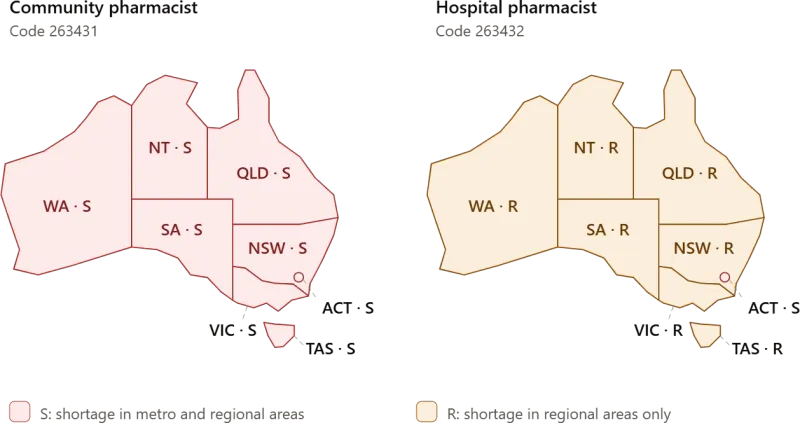
- WA — Western Australia
- NT — Northern Territory
- SA — South Australia
- QLD — Queensland
- NSW — New South Wales
- VIC — Victoria
- TAS — Tasmania
- ACT — Australian Capital Territory
This pattern holds for both internship pathways: a hospital internship in a regional health district and a community internship in a regional pharmacy both tend to face less competition and more employer incentive than the equivalent role in a capital city. Because ratings are reviewed annually and vary by state, always check the current Occupation Shortage List for the most up-to-date rating in the location you are considering.
How to Decide Between Hospital and Community
Consider a hospital internship if you want early exposure to acute and specialist clinical care, enjoy working within a large multidisciplinary team, and are drawn to a structured, award-based career ladder. Consider a community internship if you want consistent, high-volume patient contact from day one, are interested in the operational and business side of pharmacy, and want a pathway that can lead toward pharmacy ownership or management.
Before starting your Australian pharmacy journey, learn more about how much Intern pharmacists earn in Australia during their 1,575-hour internship.
Salary Structure: Hospital vs Community Pharmacy Interns
Pay for pharmacy interns in Australia differs by setting because each is covered by a different industrial instrument — the Pharmacy Industry Award for community pharmacy, and state-based health enterprise agreements for public hospitals.
Factor | Hospital Pharmacy Intern | Community Pharmacy Intern |
| Governing instrument | State/territory health enterprise agreement | Pharmacy Industry Award 2020 |
| Employment classification | Pharmacist Unregistered (Intern) | Pharmacy Intern (first/second half of training) |
| First-half-of-training rate | ~$33.99 per hour | ~$32.44 per hour |
| Second-half-of-training rate | ~$35.14 per hour | ~$33.55 per hour |
| Approximate annual salary (38-hr week) | ~$75,000–$76,000 per year | ~$64,000–$66,000 per year |
| Superannuation | Guaranteed contribution on top of base pay | Guaranteed contribution on top of base pay |
| Annual leave loading | Commonly 17.5% | Commonly 17.5% |
| Penalty rates | Applies for evening/weekend/public holiday shifts | Applies for evening/weekend/public holiday shifts |
| Additional benefits | Public-sector salary packaging often available | Varies by employer; less commonly offered |
| Pay jump on registration | Moves to registered pharmacist classification and pay scale | Moves to registered pharmacist classification and pay scale |
Actual take-home pay varies by state, employer, rostered hours, and whether you are in the first or second half of your internship, so always confirm current rates with your employer or the Fair Work Ombudsman's Pay and Conditions Tool before accepting an offer.
How to Find a Pharmacy Internship in Australia: Where to Search and What Employers Are Offering?
To search for an intern pharmacist role on the Chemist Warehouse website / Seek, go to chemistwarehouse.com.au/careers (or careers.chemistwarehouse.com directly), and look for the "National Intern Pharmacist Program" listing or state-specific postings such as "2026 Intern Pharmacist Program.
Hospital intern pharmacist Vacancies
1. Intern Pharmacist, Children's Health Queensland (South Brisbane)
Job Description: Children's Health Queensland is hiring an Intern Pharmacist for a contract role in South Brisbane. You will deliver high quality paediatric pharmacy services as part of a multidisciplinary team within the hospital and health service.
Skills: You need to be a pharmacy graduate eligible for an internship in Australia, with good teamwork and communication skills. The snippet gave no other requirements, so check the full ad for details.
Salary: Pay depends on your tertiary qualification ~(A$25 to A$35)
Community (retail) intern pharmacist vacancies
1. Student Pharmacist (Full Time, Part Time & Casual) – Mt Ommaney, QLD
Job Description: Student Pharmacists will work under pharmacist supervision at the new Chemist Warehouse x Ultra Beauty store in Mt Ommaney, Queensland. You will help customers, support prescription intake and dispensing, and restock and track inventory.
Skills: You must be studying in an accredited Bachelor or Master of Pharmacy program in Australia, with good communication, customer service and attention to detail. You should work well in a team in a busy store, and pharmacy or retail experience is a plus.
Salary: Employee reports suggest about A$22 to A$26 per hour.
2. Part Time Pharmacy Technician/ Intern Pharmacist
Job Description: Five Ways Pharmacy in Eastwood, Sydney is hiring a Part Time Pharmacy Technician or Intern Pharmacist to work with experienced pharmacists. You will pack and supply medications for Residential Aged Care facilities using the latest pharmacy automation, starting with 2 days a week (Monday and Thursday or Friday), with more days later.
Skills: You need pharmacy technician experience in aged care or medication packing, or be a recent pharmacy graduate or overseas registered pharmacist completing hours for Australian registration, with Australian work rights. You should have good time management, communication, flexibility, a caring attitude and the ability to work under pressure.
Salary:Employee reports suggest about A$30 to A$35 per hour.
Conclusion
There is no universally "better" internship — only the pathway that matches your interests and career goals. Hospital internships offer structured clinical exposure, multidisciplinary teamwork, and a fixed salary, while community internships offer earlier patient-facing responsibility, business exposure, and a faster route into management or ownership. Pay structures differ, with hospital interns generally earning a higher fixed salary and community interns paid hourly under the Pharmacy Industry Award. With pharmacists listed in shortage on Australia's Occupation Shortage List, both pathways lead into a workforce with genuine, ongoing demand across the country.[1]