The global healthcare ecosystem in 2026 is confronting an unprecedented structural imbalance: the clinical demand for physical rehabilitation has outpaced the domestic supply of licensed physiotherapists. Across primary, secondary, and community health networks in high-income economies, chronic staffing vacancies have transitioned from an operational headache into a systemic threat.
For internationally educated physiotherapists holding qualifications such as a Bachelor of Physiotherapy (BPT) or Master of Physiotherapy (MPT) from countries including India, Pakistan, Nigeria, the Philippines, and South Africa, this macro-level crisis represents a major professional opportunity. Rapidly aging demographics, chronic disease escalation, and the restructuring of western healthcare systems have forced immigration ministries and statutory regulatory boards to dismantle protectionist hiring practices. In their place are fast-tracked skilled visa allocations, subsidized relocation incentives, and transparent credentialing processes.
Converting this global deficit into an international clinical career requires more than clinical ambition. It demands a rigorous understanding of the epidemiological forces shaping the shortage, precise mapping of international regulatory frameworks, and focused, structured preparation to navigate foreign board assessments on the first attempt.
Why the Global Shortage of Physiotherapists Exists
The global shortage of physical therapists is not an anecdotal development or a temporary post-pandemic disruption. It is an empirically verified crisis documented by leading medical journals, workforce registries, and international health agencies.
THE GLOBAL REHABILITATION GAP
Clinical Demand (Global Burden) Systemic Supply Constraints
• 2.41 Billion need rehab globally • Extreme geographical maldistribution
• 1.71 Billion MSK conditions • 0.3 physios / 10k population (Africa)
• 60+ demographic doubling to 22% (WHO) • 30% international workforce attrition (UK)
• Universal Health Coverage deficits • Inability of domestic universities to scale
The Rehabilitation Burden
The foundational benchmark for international rehabilitation demand is established in the landmark Global Burden of Diseases, Injuries, and Risk Factors Study (GBD) published in The Lancet. The study revealed that 2.41 billion individuals globally live with health conditions that would benefit from physical rehabilitation. This represents a 63% increase in total Years Lived with Disability (YLDs) over the last three decades, directly attributable to epidemiological shifts toward non-communicable diseases.
Musculoskeletal (MSK) disorders represent the single largest contributor to this burden, affecting approximately 1.71 billion people worldwide. Low back pain remains the leading cause of global disability across 160 countries. Compounding this is the global survival rate of acute trauma, complex multi-trauma, stroke, and cardiovascular episodes. Patients who previously experienced high mortality rates now survive into extended morbidities that demand sustained, specialized physical rehabilitation.
Demographic Aging & The WHO Rehabilitation 2030 Initiative
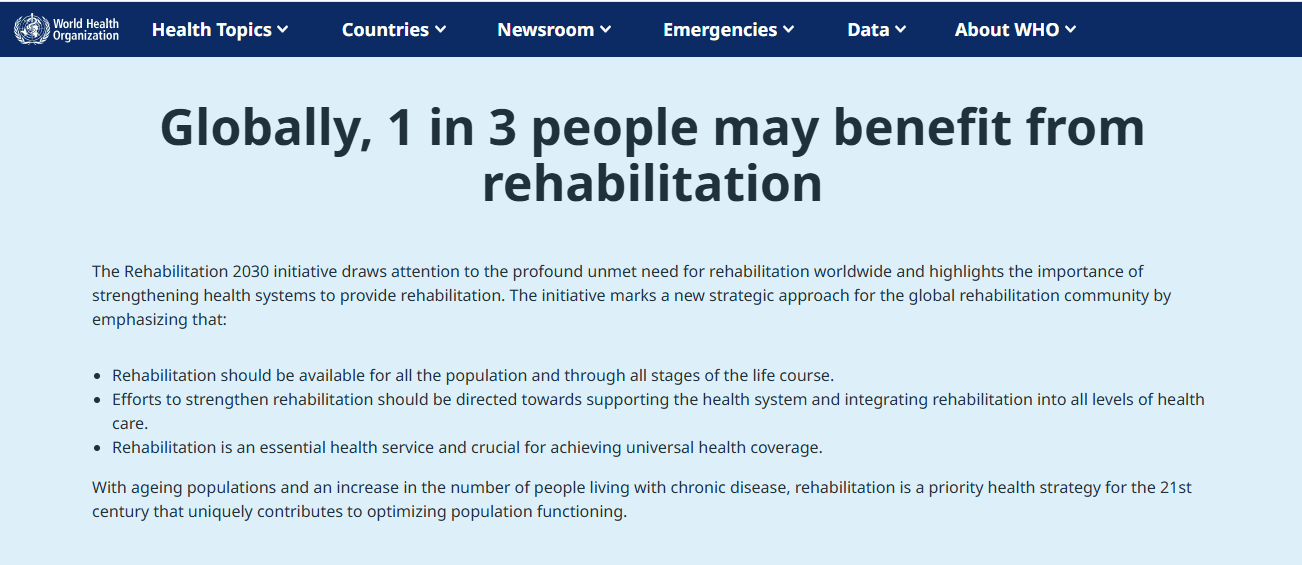
The World Health Organization (WHO) projects that between 2015 and 2050, the proportion of the world’s population over the age of 60 will nearly double, growing from 12% to 22%. Longevity without functional mobility has placed extraordinary pressure on acute and community healthcare:
- Frailty syndromes, balance dysfunctions, osteoporotic fractures, Parkinson’s disease, and ischemic stroke require continuous, high-touch physical therapy intervention to prevent institutionalization.
- In response, the WHO introduced the Rehabilitation 2030 Initiative and World Health Assembly Resolution WHA76.6, which formally recognizes rehabilitation as an essential component of universal health coverage (UHC) alongside prevention, promotion, and curative care.
Despite this mandate, health systems in low- and middle-income countries (LMICs) experience an unmet rehabilitation need exceeding 50%. Even in the Global North, public health delivery systems are unable to meet domestic targets due to an undersized workforce.
Where the Demand Is Highest
Governments across major immigrant-receiving jurisdictions have revised statutory immigration rules, occupation ceilings, and employment visa criteria to attract international physiotherapists:
GLOBAL TALENT CORRIDORS
[United Kingdom] ──> Document-Based HCPC ──> Health & Care Visa (No IHS)
[Australia] ──> APEP / APC Pathway ──> Tier-1 Priority (Subclass 189/190/482/491)
[Canada] ──> CAPR + CPTE Exam ──> Category-Based Healthcare Express Entry
[UAE / Gulf] ──> DataFlow + Pro metric ──> 8-12 Week Turnaround (Tax-Free)
Australia: Tier 1 Priority Status & National Skill Deficits
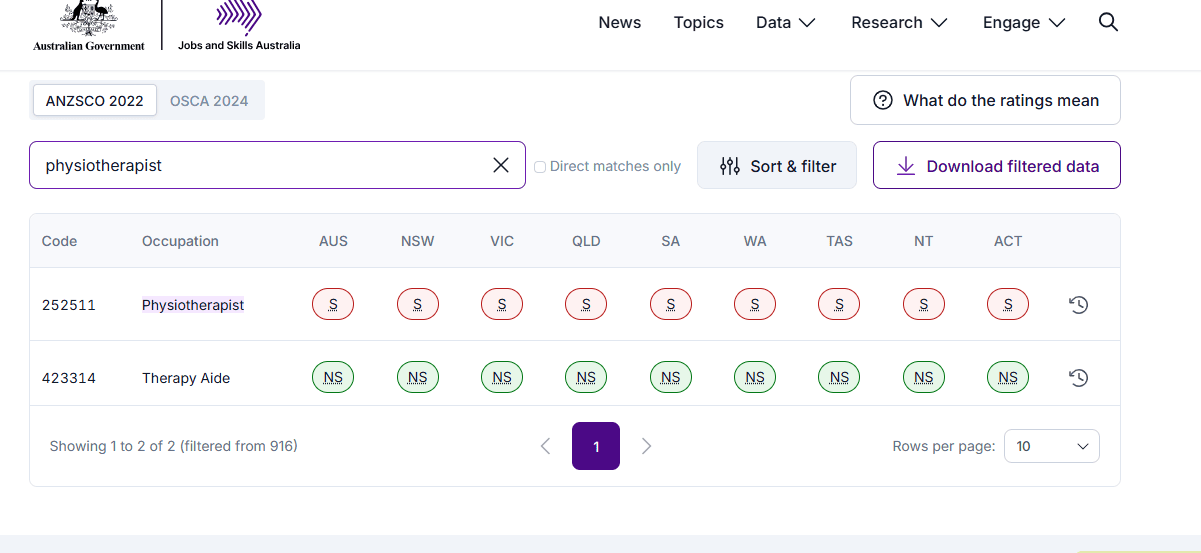
In Australia, the national agency Jobs and Skills Australia consistently classifies Physiotherapist (ANZSCO 252511) under acute shortage across all states and territories.
- The Structural Driver: The expansion of the National Disability Insurance Scheme (NDIS) has pulled thousands of experienced clinicians out of public hospitals into private community disability services. This migration has left public hospital rotational wards, regional rehabilitation centers, and rural health networks critically short-staffed.
- Immigration Status: Physiotherapy is classified as a Tier 1 (Highest Priority) occupation on the Core Skills Occupation List (CSOL), the Medium and Long-term Strategic Skills List (MLTSSL), and the Regional Occupation List (ROL). Candidates receive expedited processing under independent points-tested migration (Subclass 189), state nomination (Subclass 190), and regional provisional pathways (Subclass 491).
- Practice via Supervised Routes: Overseas therapists do not have to wait until completing their final clinical assessment to work. Candidates who complete their credentials verification and Cultural Safety Training receive an Interim Certificate from the Australian Physiotherapy Council (APC). Once passing the theoretical assessment under the Australian Physiotherapy Entry Pathway (APEP), clinicians can obtain employer sponsorship on a Subclass 482 (Skills in Demand) visa under AHPRA Limited Registration (Supervised Practice), allowing them to earn a full-time Australian wage while completing their final certification.
United Kingdom: NHS Rotational Gaps & Primary Care Triage
The UK's NHS Long Term Workforce Plan highlights Allied Health Professions as essential to reducing elective surgery backlogs and emergency department congestion.
- The Structural Driver: Primary Care Networks (PCNs) have aggressively introduced First Contact Practitioners (FCPs) advanced physiotherapists who evaluate, diagnose, and manage musculoskeletal conditions directly in GP surgeries without requiring a doctor's referral. This shift has drawn clinicians out of secondary care, leaving hundreds of Band 5 rotational positions and Band 6 specialist posts vacant across acute NHS trusts.
- Regulatory Body:Health and Care Professions Council (HCPC).
- Immigration Advantage: Unlike most overseas professionals subject to stringent immigration controls, physiotherapists qualify for the UK Health and Care Worker Visa. This pathway provides fast-tracked visa processing, reduced government fees, a 5-year pathway to Indefinite Leave to Remain (ILR), and complete exemption from the Immigration Health Surcharge (IHS) saving candidates and their families thousands of pounds.
Canada: Category-Based Express Entry & Provincial Demand
The Canadian Institute for Health Information (CIHI) reports widening gaps in surgical recovery and specialized neuro-rehab across Canada's single-payer provincial healthcare systems.
- The Structural Driver: Growing waitlists for total knee and hip arthroplasties have created acute pressure on post-acute rehabilitation pipelines across Ontario, British Columbia, Alberta, and Quebec. Furthermore, long-term care (LTC) legislation mandates higher physical therapy contact hours per resident.
- Immigration Advantage: Immigration, Refugees and Citizenship Canada (IRCC) operates Category-Based Selection in Express Entry. Healthcare professionals receive dedicated invitation rounds with Comprehensive Ranking System (CRS) point cutoffs lower than general migration streams, creating a direct path to Permanent Residency.
The Middle East: Rapid-Deployment Tax-Free Corridors
The United Arab Emirates (Dubai Health Authority [DHA], Department of Health Abu Dhabi [DOH]), Saudi Arabia (Saudi Commission for Health Specialties [SCFHS]), and Qatar offer the fastest deployment for experienced overseas clinicians.
- The Structural Driver: Major capital investments in tertiary healthcare, specialized sports medicine institutes, and specialized pediatric and adult neuro-rehab centers.
- The Advantage: Licensure requires no multi-year credential re-evaluations. Qualified physiotherapists with at least two years of post-qualification hospital experience undergo primary-source document verification via DataFlow and sit a computer-based Prometric examination. Total onboarding takes 8 to 14 weeks, backed by tax-free compensation, furnished accommodation allowances, and international relocation packages.
High-Demand Clinical Sub-Specialties
Generalist clinical background remains a solid foundation, but international health services prioritize candidates with demonstrable competencies in high-burden sub-specialties:
TARGET CLINICAL TRACKS
1. Neurological Rehabilitation
• Stroke pathways, TBI, Spinal Cord Injury, Parkinson's
• Standardized functional metrics: FIM, BBS, MAS, 10MWT
2. Musculoskeletal & Advanced Triage
• Arthroplasty protocols, post-op rehabilitation, manual therapy
• Differential diagnosis, red-flag screening, First Contact Practice
3. Geriatric Complex Care & Frailty
• Multimorbidity management, falls prevention algorithms
• Dementia motor interventions, sarcopenia progressive loading
4. Cardiorespiratory & Critical Care
• ICU early mobilization, mechanical ventilation weaning
• Secretion clearance, post-acute pulmonary rehabilitation
- Neurological Rehabilitation: Driven by stroke survival rates and the management of chronic neurological disorders. International clinics actively recruit clinicians proficient in task-specific neuro-re-education, spasticity management, gait-lab biomechanics, and validated outcome measures (e.g., Functional Independence Measure, Berg Balance Scale, 10-Meter Walk Test).
- Musculoskeletal & Advanced Triage: Driven by health networks diverting patients away from orthopedic surgeons and emergency departments. Clinicians trained in clinical red-flag screening, advanced differential diagnosis, and exercise prescription are recruited directly into outpatient networks.
- Geriatric Complex Care: Focuses on falls prevention algorithms, progressive resistance training for sarcopenia, and functional maintenance in specialized residential care facilities.
- Cardiorespiratory & Intensive Care: Driven by acute care hospital demand. Clinicians experienced in invasive and non-invasive ventilation weaning, chest clearance techniques, and early mobilization in Intensive Care Units (ICU) bypass general recruitment queues.
The Economics: Licensure Costs vs. Earning Potential
Overseas credentialing requires an upfront investment, but the return on investment (ROI) is exceptionally high due to regulated award rates and high purchasing power abroad:
| Destination Market | Primary Assessment & Examination Pipeline | Total Licensing Spend (Est. USD) | Average Starting Base Salary | Time to Recoup Costs |
| United Kingdom | HCPC Scrutiny Fee + 2-Yr Registration + OET/IELTS | $1,400 – $1,800 | £31,050 – £35,500 (NHS Agenda for Change Band 5) | ~3 to 4 weeks |
| Australia | APC Eligibility + APEP Written + Capability Assessment | $4,500 – $5,500 (Excl. optional workshops) | A$75,000 – A$88,000 (Base Award / NDIS community rates) | ~4 to 6 weeks |
| Canada | CAPR Credential Assessment + CPTE Written + Provincial Board | $3,500 – $4,200 | C$68,000 – C$78,000 (Hospital baseline) | ~5 to 8 weeks |
| United States | FCCPT Educational Review + NPTE Exam + State Licensing | $2,500 – $3,500 (Excl. transitional DPT top-ups) | $75,000 – $88,000 (Acute/Outpatient/SNF) | ~2 to 4 weeks |
| UAE / Saudi Arabia | DataFlow Primary Source Verification + Prometric Exam | $1,000 – $1,400 | AED 120,000 – AED 180,000 (100% Tax-Free) | ~3 to 4 weeks |
Don't let confusing regulatory requirements stall your career. Every country evaluates clinical hours, syllabi, and degree equivalence differently.
Get Your Free Overseas Eligibility Assessment, Speak directly with international licensing experts to see whether Australia, the UK, or the Middle East is the fastest and most cost-effective pathway for your profile.
Why Most Overseas Physios Get Stuck
Despite acute international shortages, statutory health boards will not compromise on professional clinical governance or patient safety. Thousands of qualified overseas physiotherapists fail to obtain international licenses every year due to three consistent obstacles:
THE REGULATORY BOTTLENECK
Curriculum & Clock Hours Clinical Reasoning Deficits Administrative Fatigue
• 800-1,000+ clinical hours • Western exam questions use • Document legalisation
• Balance across core rotations complex vignettes, not recall • Primary source verification
• Syllabus mapping discrepancies • Red-flag triage & ethics • English exam expiration
The Curriculum Mapping Trap & Clinical Clock Hours
International boards assess not just your degree certificate, but your daily clinical education:
- Most regulatory bodies mandate between 800 and 1,000+ supervised, verified clinical placement hours across three core areas: Musculoskeletal, Neurological, and Cardiorespiratory physiotherapy.
- If your home university transcript shows an imbalance—for instance, heavy outpatient orthopedic placement but inadequate inpatient cardiorespiratory hours—your application can be rejected or assigned costly university top-ups.
- Bodies like the UK HCPC require comprehensive institutional syllabi demonstrating alignment with their Standards of Proficiency. Preparing these documents without professional guidance often results in months of delays.
Clinical Reasoning vs. Rote-Learning Exam Formats
Licensing examinations—such as the APEP Written Assessment in Australia or the CPTE in Canada are fundamentally different from traditional university exams:
- They do not ask direct theoretical questions (e.g., "Name the origins and insertions of the supraspinatus").
- Instead, they present complex, multi-layered clinical vignettes: "A 68-year-old female 3 days post-stroke displays a sudden drop in SpO2, unilateral calf tenderness, and acute disorientation. What is the immediate priority action?"
- Candidates must prioritize patient safety, recognize medical red flags, apply evidence-based clinical reasoning, and adhere to local medicolegal standards. Without targeted training, first-time pass rates for international candidates drop significantly.
Bureaucracy and Parallel Processing
Overseas registration requires coordinating credential bodies (APC, CAPR, HCPC), testing agencies (Prometric, Pearson), primary source verifiers (DataFlow), English language boards (OET, IELTS), and immigration ministries. A delay in one component—such as an expiring language test—can stall the entire relocation process.
How Academically Bridges the Gap to Your Global Career
International licensing independently can be daunting. Academically was built to eliminate this friction, serving as a specialized global education and licensing platform for healthcare professionals.
This platform is led by Dr. Akram Ahmad and a team of international academicians and registered clinicians, Academically provides an end-to-end framework that guides international physiotherapy graduates from initial degree evaluation through to exam success and clinical practice abroad.
THE ACADEMICALLY FULL-CYCLE SYSTEM
[Free Eligibility & Audit] ──> Detailed transcript, syllabus & clinical hour mapping
│
[Targeted Exam Training] ──> Live faculty-led reasoning sessions & AI-driven mock testing
│
[Document Management] ──> Primary source verification (DataFlow, APC, HCPC Dossiers)
│
[Clinical Practice Prep] ──> Supervised registration guidance, CV tuning & interview prep
Dedicated Australia Pathway: The APEP Preparation Course
Australia offers one of the most direct and rewarding routes for international physiotherapists. Academically provides a complete, structured preparation course for the Australian Physiotherapy Entry Pathway (APEP):
- Comprehensive Live Curriculum:Over 100+ hours of live interactive sessions delivered across 14 weeks, covering the full scope of Australian practice thresholds.
- 4,000+ Exam-Calibrated Question Bank:Practice with scenario-based multiple-choice questions matching the format, timing, and clinical reasoning style of the APC Written Exam.
- APEP Remote Capability Assessment Coaching:Intensive training for the Stage 3 remote oral exam, where candidates analyze complex patient scenarios with Australian physiotherapist assessors.
- Securing Your Interim Certificate:Academically helps candidates complete credentialing and Cultural Safety Training to secure their Interim Certificate, prepare for the Written Assessment, and unlock AHPRA Limited Registration to work under supervision on a sponsored visa.
UK HCPC Fast-Track Portfolio Guidance
The UK route does not require written or clinical exams, but it demands an airtight documentation portfolio:
- Syllabus & Transcript Alignment: Academically’s admissions specialists review your university syllabus and clinical logbooks, ensuring your completed hours across MSK, Neuro, and Cardio align with the HCPCStandards of Proficiency.
- Scrutiny Process Optimization: Step-by-step guidance on completing the complex Course Information Form (CIF), eliminating common ambiguities that lead to application rejections.
Middle East Licensure: DataFlow & Prometric Coaching
For candidates targeting the Middle east - UAE (DHA, DOH/HAAD, MOH) or Saudi Arabia (SCFHS):
- DataFlow Primary Source Verification: Dedicated compliance teams manage the end-to-end credential verification process, preventing document discrepancies.
- Prometric Question Banks: Targeted preparation with mock tests designed around the computer-based Prometric blueprint, helping candidates clear their assessments in 8 to 12 weeks.
Direct Mentorship from Licensed, Practicing Clinicians
Academically’s faculty is comprised of AHPRA- and HCPC-registered physiotherapists who have navigated the overseas licensing process themselves.Candidates receive real-world clinical insight into hospital communication, documentation standards, and patient safety expectations.
Your Strategic Month-by-Month Roadmap for 2026
If you are an internationally educated physiotherapist ready to take advantage of the global shortage, follow this four-phase operational blueprint:
Phase 1: Months 1–2 Phase 2: Months 3–5 Phase 3: Months 6–9 Phase 4: Months 10–12
• Audit degree & hours • Submit to APC / HCPC • Clear APEP exam • Job interviews
• Clear OET (Grade B) • Primary verification • Interim Certification • AHPRA registration
• Syllabus consolidation • Academic assessment • Remote Capability prep • Relocation & visa
Turn Global Demand into Your Clinical Reality
The global physiotherapy shortage in 2026 has created a rare alignment between healthcare policy and skilled migration pathways. Destination countries have the clinical vacancies, the budget allocations, and the visa channels; what they need are qualified, credentialed physiotherapists who can deliver safe, autonomous clinical care.
Navigating foreign licensing boards does not have to be an uncertain, solitary process. With the right clinical preparation, structured mentorship, and end-to-end guidance from Academically, you can bypass common pitfalls, clear your licensing exams on the first attempt, and build a rewarding international healthcare career.