
EMREE stands for the Emirates Medical Residency Entrance Examination. It is the medical track of the Residency Entrance Examination administered by the National Institute for Health Specialities (NIHS) at the College of Medicine & Health Sciences, UAE University (CMHS, UAEU), located in Al Ain.
Passing EMREE is a mandatory prerequisite to apply for residency training in the UAE. The exam result is accepted by the UAE's health authorities as part of a residency application, working alongside each individual institution's unique admission requirements.
EMREE Exam Format
| Detail | Specification |
| Format | Written, multiple-choice questions (MCQs) |
| Number of questions | 120 scored questions (some sittings include additional unscored trial questions, with extra time allotted) |
| Duration | 3 hours |
| Delivery | Computer-based (a pencil-and-paper format may be offered if circumstances require it) |
| Content | Core medical specialties, focused on the clinical application of knowledge within the UAE healthcare context |
| Standard set at | The level expected of a graduate with at least one year of clinical training |
| Venue | College of Medicine & Health Sciences, Al Ain, UAE — in-person only |
EMREE Eligibility Requirements
- Who can sit: Final-year medical students, or medical graduates, are eligible to attempt the exam.
- ID Requirements: An Emirates ID is preferred for UAE residents. Candidates without UAE residency must present a valid passport.
- Visas: Non-UAE residents are strictly responsible for obtaining their own visas to travel to Al Ain for the exam. This is not facilitated by EMREE or UAE health authorities.
- Language:No TOEFL, IELTS, or English test is required to sit the EMREE itself. However, individual residency programmes set their own entry requirements, which will apply after passing.
Passing Marks, Attempts & Results (2026–2027 Cycle)
| Detail | Specification |
| Passing mark | 60% (set periodically through standard-setting processes — always confirm the current cycle's exact figure) |
| Attempts | Up to 3 attempts to pass within one academic year; no further attempts after passing in that year. Candidates who passed in a previous year get one additional retake. |
| Result validity | Maximum 2 years |
| Fee | AED 1,000, excluding tax — non-refundable under UAE University policy, regardless of the outcome. |
| Frequency | Multiple sittings per year (roughly monthly); exact dates are announced in advance. Seats are allocated on a first-come, first-served basis. |
Crucial Insight: Every attempt ( pass or fail ) appears on your transcript alongside its score, and these records are sent directly to the health authorities. The exam board's own guidance notes that multiple retakes actively reduce your chances of being favourably considered by health authorities. This is not an exam to sit casually before you are fully prepared.
What Happens After You Pass EMREE?
Passing EMREE qualifies you to apply for residency training programmes in the UAE , it does not grant you a licence to practise independently. You must then apply to specific residency programmes through the relevant health authority. Seat availability, your documentation, and each institution's specific requirements dictate acceptance.
EMREE vs AMC - Which Is Better for IMGs?
For most candidates, the real question is: Should I prepare for the UAE pathway, Australia's pathway, or both?
Here is a direct, side-by-side comparison of the two gateways.
| Feature | EMREE (UAE) | AMC (Australia) |
| Administered by | National Institute for Health Specialities, UAEU | Australian Medical Council |
| Leads to | Eligibility to apply for residency training (not direct practice rights) | AMC Certificate → eligibility to apply for Ahpra general registration to practise |
| Exam format | 120 scored MCQs, 3 hours, computer-based | 150 MCQs (Computer Adaptive Test), 3.5 hours, plus a separate Clinical Exam or WBA |
| Passing mark | 60% (No negative marking) | 250 out of 500 (No negative marking) |
| Where it's held | Al Ain, UAE (In-person only) | Pearson VUE test centres worldwide (including India and 30+ countries) |
| Frequency | Roughly monthly sittings | Four MCQ sittings a year |
| Result validity | 2 years | AMC results do not expire under current specifications |
| Retake limits | 3 attempts per academic year; heavier scrutiny on residency applications with more retakes | No stated limit on Standard Pathway MCQ attempts |
| End result | A seat in a residency training programme (supervised training follows) | A path toward registration to practise (following required components) |
Fees and Expected Salaries: UAE vs Australia
To help candidates budget effectively, here is a direct comparison of the primary examination fees and the expected starting salaries for junior doctors in both countries, calculated across three currency units (AED, INR, and AUD) based on standard 2026 conversion estimates.
| Cost / Salary Component | AED (UAE Dirham) | INR (Indian Rupee) | AUD (Australian Dollar) |
| EMREE Exam Fee | AED 1,000 | ₹22,800 | AUD 400 |
| AMC MCQ Exam Fee | AED 7,150 | ₹1,60,000 | AUD 2,920 |
| AMC Clinical Exam Fee | AED 7,350 | ₹1,65,000 | AUD 3,000 |
| UAE Resident Salary (Annual) | AED 108,000 – 180,000 | ₹24.5L – ₹41L | AUD 44,000 – 73,000 |
| Australia RMO Salary (Annual) | AED 195,000 – 270,000 | ₹44L – ₹60L | AUD 80,000 – 110,000 |
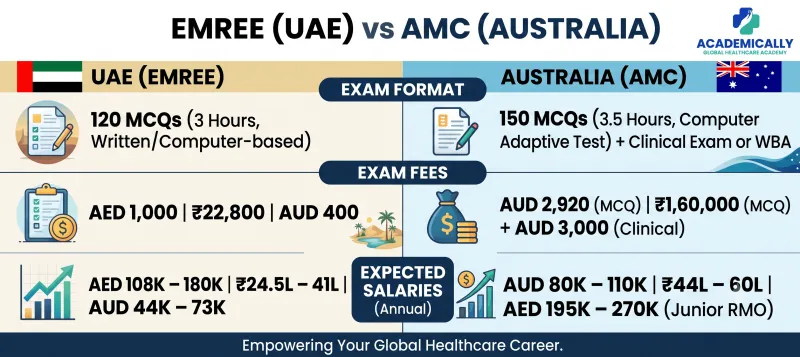
This infographic provides a direct, side-by-side comparison of the EMREE (UAE) and AMC (Australia) exams, highlighting the key differences in exam format, associated fees, and expected annual salaries for junior doctors in three currencies (AED, INR, and AUD). Image Source - Google Gemini
The Real Difference: What You're Actually Signing Up For
These two exams are not interchangeable options for the same outcome. They are gateways into entirely different systems.
- EMREE is an entrance exam into residency training. Passing it does not make you a licensed, independently practising doctor. It qualifies you to compete for a seat in a UAE residency programme, after which you will train for several more years under supervision.
- The AMC pathway (Standard Pathway) is aimed at IMGs who may already have postgraduate experience and are seeking registration to practise in Australia directly, via the MCQ plus a Clinical Exam or Workplace-Based Assessment (WBA). You are not necessarily starting a residency programme from scratch.
If you are early in your career and want structured residency training within a globally respected health system, EMREE may be the right fit. If you are aiming for direct registration, practice rights, and higher starting compensation particularly if you already have postgraduate clinical experience the AMC pathway is the more direct route.
Can You Prepare for Both simultaneously
Yes. There is meaningful overlap: both exams test core clinical specialties (internal medicine, surgery, O&G, paediatrics, psychiatry) applied to clinical reasoning and decision-making, rather than pure factual recall.
A candidate building strong clinical-reasoning fundamentals for one exam is doing the majority of the groundwork for the other. The differences lie mainly in local-context details (UAE healthcare system specifics vs Australian practice thresholds) and exam mechanics.
Securing a UAE Residency Seat
The UAE exam board does not publish an official scoring rubric for how residency seats are allocated. The parameters below are based on the professional, on-the-ground observations of Dr. Akram Ahmad, founder of Academically Global, who directly guides IMGs targeting the UAE and Australia.
"I receive countless messages about UAE residency," notes Dr. Akram Ahmad. "Candidates ask if it's easy to pass the exam, and whether getting a seat afterward is easy for IMGs with no clinical experience. The honest answer is: passing EMREE is only step one, and it's often the easier step."
Passing EMREE Is Not a Guarantee
EMREE is an entrance exam, not a guarantee of placement. The number of applicants with a passing EMREE score is typically far larger than the number of available seats in any given cycle. Passing simply earns you the right to compete.
What UAE Residency Programmes Typically Weigh
Based on patterns observed across successful candidates, UAE residency programmes look at the full picture of your candidacy:
- Local UAE clinical exposure: An observership or internship completed within the UAE health system carries significant weight. It demonstrates familiarity with local protocols.
- Communication and interviews: Clear clinical communication in English (and often a working grasp of Arabic) is heavily factored into the interview stage.
- EMREE score margin: Scoring comfortably above the 60% pass mark matters. Programmes use the score as a signal of overall preparedness, not just a yes/no gate.
- Research or publications: A meaningful differentiator when candidate pools are large.
- Clinical experience in the home country: Time spent in supervised clinical settings after MBBS strengthens an application significantly compared to a fresh graduate.
- EMREE attempt history: Candidates who pass on their first attempt are viewed more favourably.
The Reality of Local Preference
It is tough to secure a seat, and UAE residency programmes naturally give preference to local candidates over overseas doctors when all else is comparable. This is due to straightforward operational reasons: lower onboarding friction, existing visa/registration status, and demonstrated performance within their specific system. A passing EMREE score gets an overseas IMG into the applicant pool, but it does not neutralise the structural advantage held by local candidates.
Who Actually Has a Realistic Chance?
Based on Dr. Ahmad's observations of candidate outcomes, here is a realistic look at how different profiles fare:
- Tier 1 (Highest Chance): Registered practitioner in home country + UAE clinical observership completed + high EMREE score (first attempt).
- Tier 2 (Moderate Chance): Registered practitioner in home country + clinical experience + passing EMREE score.
- Tier 3 (Hardest Placed): Fresh MBBS graduate + no clinical experience + no home country registration + bare EMREE pass.
A fresh MBBS graduate with no experience is in the hardest-placed group because residency competition rewards exactly what that profile is missing. The exam is the easy part; building clinical exposure is the hard part.
Why This Pushes Many IMGs Toward the AMC Pathway
This reality is why the AMC pathway is highly attractive to many IMGs, particularly those in "Tier 3":
- No Fixed Seat Limits: The AMC Standard Pathway does not pit you against a fixed number of residency seats. Passing the required components moves you toward Ahpra general registration — a standardised, criteria-based outcome.
- Built for IMGs: Australia's registration pathway is built specifically for IMGs. There is no structural tilt toward "local" candidates because IMGs are the primary population the Standard Pathway serves.
- Forward Momentum: While clinical experience helps an AMC application, you are not fighting against a hard seat ceiling in a single cycle. A strong score keeps you moving forward.
Dr. Moazzam’s 12-hour shifts and financial stress while studying might feel impossible, but it can be done. Discover how one full-time doctor cracked the AMC exam in just 3 months.
For an IMG weighing a highly competitive, scarce residency seat (UAE) against a structured, criteria-based pathway toward registration (Australia), the AMC route is generally the more reliable option for those lacking extensive clinical experience.