You know that clarithromycin is an antibiotic. You may also know that simvastatin is prescribed to manage high cholesterol. But what happens when a patient taking simvastatin is prescribed clarithromycin and subsequently develops muscle pain?
Recognising both medicines is not enough. You need to understand how one affects the metabolism of the other, what happens to the drug concentration, and why that change matters to the patient. This is the difference between memorising pharmacology and applying it to a clinical situation.
Drug interactions are an important topic in OPRA preparation because they bring together several areas of pharmaceutical knowledge. You need to understand drug mechanisms, pharmacokinetics, adverse effects, patient characteristics and treatment outcomes. A question may test just one of these concepts or combine several of them in a patient case.
This guide explains how to approach OPRA drug interaction questions, which interaction patterns deserve attention, and how to use practice cases to improve your accuracy. Rather than learning hundreds of unrelated drug combinations, you will learn how to recognise the mechanism, predict the clinical consequence and identify the most appropriate response.
Why are drug interactions important for the OPRA exam?
The Australian Pharmacy Council (APC) updated its official OPRA exam guide on 30 July 2026. According to the guide, the examination assesses the biomedical, pharmaceutical and clinical sciences that underpin pharmacy practice in Australia and Aotearoa New Zealand.
The current examination structure includes:
| Exam detail | Official information |
| Total questions | 120 multiple-choice questions |
| Answer format | Four options, one correct answer |
| Examination duration | 150 minutes |
| Biomedical sciences | 20% |
| Medicinal chemistry and biopharmaceutics | 10% |
| Pharmacokinetics and pharmacodynamics | 10% |
| Pharmacology and toxicology | 15% |
| Therapeutics and patient care | 45% |
Drug interactions are explicitly mentioned under therapeutics and patient care as well as pharmacology and toxicology. The guide also identifies drug metabolism, enzyme-substrate relationships, pharmacokinetic interactions, adverse drug reactions and the clinical application of pharmacology as relevant areas.
This means you should not study interactions as an isolated topic.
Drug interactions become easier to interpret when you understand how medicines move through the body, including their absorption, distribution, metabolism and elimination. Revisiting the fundamentals of pharmacokinetics can help you understand why changes in metabolism or drug clearance affect treatment outcomes.
For example, a question involving an enzyme inhibitor could require you to understand CYP450 metabolism, predict an increase in drug concentration, recognise toxicity and select an appropriate clinical response.
There is no separately published percentage or fixed number of drug interaction questions. However, the topic connects directly with several assessed content areas. There are three cognitive levels:
- Recall (55%): Recognising drug mechanisms, interaction patterns and relevant facts.
- Understanding (30%): Explaining mechanisms and distinguishing between different types of interactions.
- Application (15%): Using pharmacological knowledge to solve a patient-related problem.
These are cognitive classifications, not separate drug interaction allocations. They nevertheless offer a useful way to structure your revision.
Understanding the three main types of drug interactions
Before attempting OPRA drug interaction questions, make sure you can distinguish between pharmacokinetic, pharmacodynamic and pharmaceutical interactions.
These categories are not interchangeable. Each describes a different mechanism, and recognising that mechanism is often the first step towards selecting the correct answer.
1. Pharmacokinetic interactions: What the body does to the drug
Pharmacokinetics concerns how a medicine is absorbed, distributed, metabolised and eliminated. These four processes are commonly grouped under ADME.
An interaction occurs when one medicine changes one or more of these processes for another medicine, potentially altering its concentration in the body.
Consider a patient taking a medicine that is metabolised by the CYP3A4 enzyme. A second medicine inhibits that enzyme. The first medicine may then be metabolised more slowly, resulting in increased exposure and a higher risk of adverse effects.
You should understand the following mechanisms:
| Mechanism | What happens | Possible consequence |
| Absorption | One medicine reduces or increases another medicine's absorption | Reduced efficacy or increased exposure |
| Distribution | A medicine affects transport or distribution of another | Changed drug concentration at its site of action |
| Metabolism | An enzyme inhibitor or inducer changes drug metabolism | Increased toxicity or reduced efficacy |
| Excretion | One medicine changes the elimination of another | Drug accumulation or reduced exposure |
A few examples worth understanding:
- Calcium can reduce the absorption of alendronate when administered together.
- Clarithromycin can inhibit CYP3A-mediated metabolism of simvastatin, increasing the risk of myopathy.
- Rifampicin induces drug-metabolising enzymes and can reduce exposure to medicines such as combined oral contraceptives.
- Probenecid can reduce the renal clearance of certain medicines, including penicillin.
Do not stop at remembering the drug pairs. Ask yourself what happens to the concentration of the affected medicine and whether its therapeutic effect increases or decreases.
2. Pharmacodynamic interactions: What the drug does to the body
Pharmacodynamics concerns how medicines produce their effects.
A pharmacodynamic interaction occurs when two medicines influence the same physiological system, receptor or biological process. Their effects may become stronger, weaker or opposing.
For example, combining two medicines that depress the central nervous system can produce excessive sedation. This may affect alertness, coordination and respiratory function.
Common patterns include:
Additive effects: Two medicines produce similar effects, increasing the overall response.
Synergistic effects: The combined effect may be greater than the effect expected from simply adding their individual actions.
Antagonistic effects: One medicine reduces or opposes the action of another.
Examples include:
- Tramadol combined with an SSRI can increase the risk of serotonin toxicity.
- Opioids combined with benzodiazepines can produce excessive CNS and respiratory depression.
- A non-selective beta blocker can oppose the bronchodilating effect of a beta-2 agonist.
- Combining medicines that increase serum potassium can raise the risk of hyperkalaemia.
A useful approach is to look at the physiological effects of both medicines. Even when their mechanisms differ, their actions may converge on the same organ system.
3. Pharmaceutical interactions: What happens before administration
Pharmaceutical interactions occur when medicines are physically or chemically incompatible before entering the body.
They may involve precipitation, degradation or changes in formulation when medicines are mixed.
For example, certain injectable medicines may become incompatible when combined in the same intravenous administration system.
While this category is different from drug interactions occurring inside the body, understanding the distinction prevents you from choosing an incorrect mechanism in a case-based question.
How to solve OPRA drug interaction questions systematically
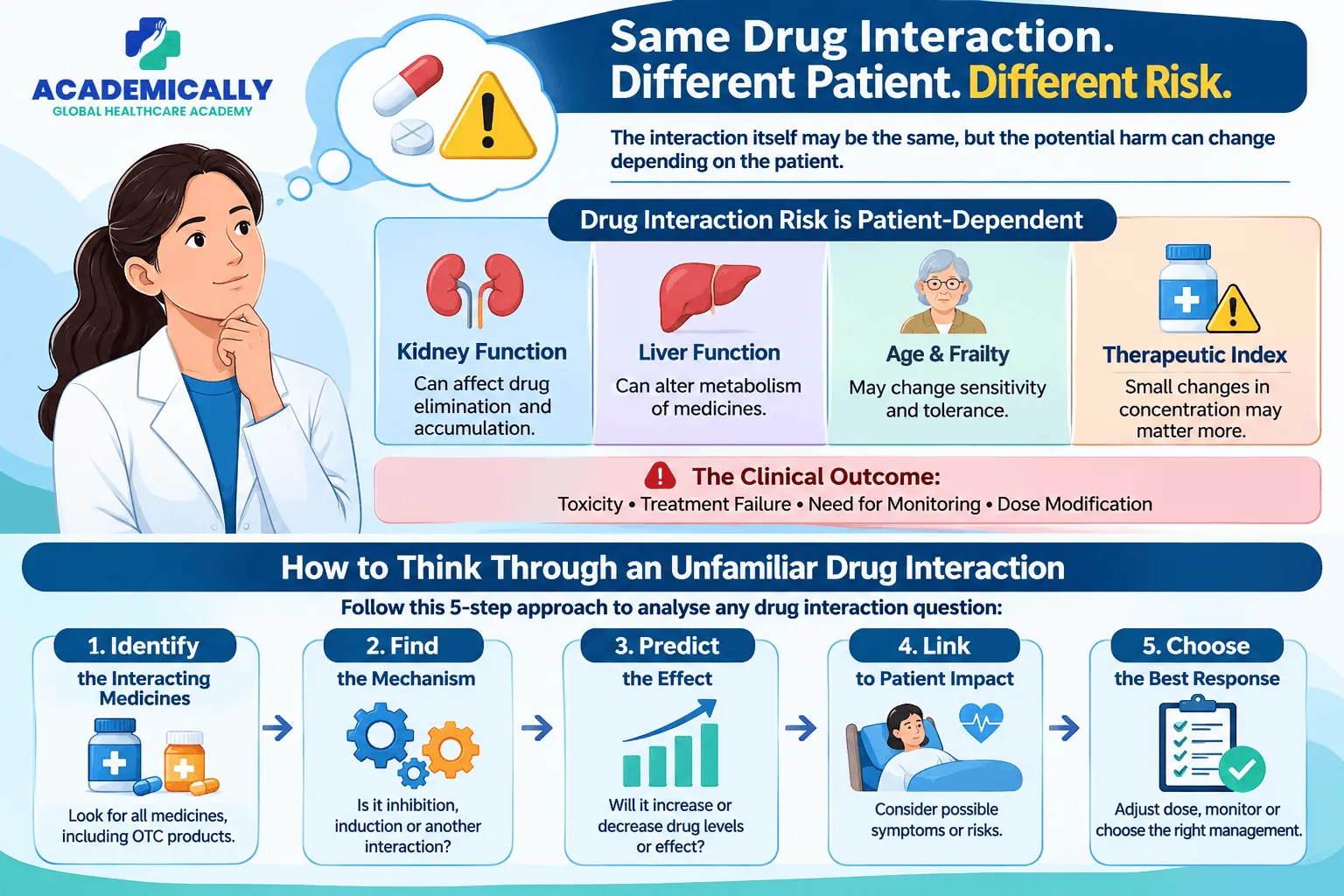
A common mistake in pharmacology revision is trying to memorise every possible interaction between two medicines. This approach becomes difficult as the number of drug classes increases. It also does not prepare you to answer questions involving unfamiliar drug combinations.
A better method is to break each clinical case into five steps.
Step 1: Identify the interacting medicines
Read the patient's medication history carefully. Identify the newly prescribed medicine, existing medicines and any additional products mentioned in the question.
Do not overlook over-the-counter medicines, herbal products or supplements. They can also contribute to clinically relevant interactions.
Step 2: Identify the mechanism
Ask what the newly introduced medicine might do to the existing treatment. Does it inhibit an enzyme? Induce metabolism? Reduce absorption? Produce an additional pharmacological effect?
Establishing the mechanism narrows down the possible answers.
Step 3: Predict the direction of the interaction
This is particularly important in pharmacokinetic questions. Determine whether the affected medicine's concentration or effect is likely to increase or decrease.
For example:
- Enzyme inhibition may increase the concentration of a medicine that depends on that enzyme for clearance.
- Enzyme induction may decrease its concentration.
- Reduced absorption may lower systemic exposure.
- Inhibition of prodrug activation may reduce the formation of its active metabolite.
Remember that enzyme inhibition or induction does not affect every medicine in the same direction. The outcome depends on the substrate and its metabolic pathway.
Step 4: Connect the interaction with the patient's symptoms
The question may describe an adverse effect, a change in laboratory findings or a loss of therapeutic response. Look for a connection between the mechanism and the clinical presentation.
A patient who develops unexplained muscle pain after starting a medicine that inhibits the metabolism of a statin may be experiencing a drug-related adverse effect.
Similarly, a patient who develops tremor, agitation and excessive sweating after adding a serotonergic medicine may have features of serotonin toxicity.
Step 5: Select the most appropriate response
Finally, consider what the question is asking. It may ask for the mechanism, the likely adverse effect, the interaction category or the appropriate management approach.
Do not automatically choose the option that sounds most cautious. Identify the exact task first.
A useful five-question checklist:
- Which medicines are interacting?
- What is the underlying mechanism?
- Does the interaction increase or decrease exposure or effect?
- What is the likely clinical consequence?
- What response best addresses the problem?
This framework makes OPRA drug interaction questions more manageable, particularly when the question uses a medicine combination you have not revised before. You can also apply the same approach to broader OPRA case-based questions, where symptoms, medical history, investigation results and medicines must be interpreted together.
High-yield drug interaction patterns to revise
You do not need to begin by learning long lists of drug pairs. Start with common mechanisms, important drug classes and the clinical consequences that can arise when treatments are combined.
The following examples are particularly useful for building your revision notes.
1. CYP450 enzyme inhibitors and substrates
The cytochrome P450 enzyme system plays an important role in the metabolism of many medicines. When an inhibitor reduces enzyme activity, the metabolism of a susceptible substrate may decrease. This can increase drug exposure and the likelihood of adverse effects.
For an instance,
Clarithromycin + Simvastatin
Clarithromycin increases simvastatin concentration and risk of myopathy or rhabdomyolysis; stop simvastatin temporarily, for the duration of clarithromycin treatment, or use alternative statin if possible (eg pravastatin). Combination contraindicated by manufacturer.
Remember the relationship:
CYP3A inhibition → reduced simvastatin metabolism → increased exposure → increased myopathy risk.
2. Enzyme inducers and reduced therapeutic efficacy
Enzyme induction can increase the metabolism of susceptible medicines. This may lower their plasma concentrations and reduce their therapeutic effectiveness.
Example: Rifampicin and combined oral contraceptives
Rifampicin is a potent enzyme inducer. It can increase the metabolism of contraceptive hormones, potentially reducing contraceptive effectiveness.
The important learning point is that an interaction does not always cause toxicity. Sometimes the main concern is treatment failure.
3. Medicines with a narrow therapeutic index
Some medicines have a relatively small difference between therapeutic and toxic concentrations. Even a modest change in their exposure may have important clinical consequences. High-priority examples include:
| Medicine | Important consideration |
| Warfarin | Changes in anticoagulant effect and bleeding risk |
| Phenytoin | Changes in serum concentration and toxicity |
| Digoxin | Increased exposure may produce toxicity |
| Lithium | Changes in renal handling can increase toxicity |
| Tacrolimus | Metabolic interactions may significantly alter exposure |
| Gentamicin | Renal function and exposure are important for toxicity monitoring |
A good revision technique is to learn why these medicines require closer monitoring rather than simply memorising that they have a narrow therapeutic index.
For example, reduced renal clearance of lithium can result in accumulation and toxicity. Similarly, changes in the metabolism of warfarin can alter its anticoagulant effect.
4. Additive CNS depression
Combining medicines with sedative properties may produce excessive central nervous system depression. Examples include opioids, benzodiazepines and sedating antihistamines.
Possible consequences include:
- Excessive drowsiness.
- Impaired coordination.
- Confusion.
- Reduced alertness.
- Respiratory depression in serious cases.
A patient case may describe someone who becomes unusually drowsy after starting an additional sedative medicine. The important task is to identify the cumulative pharmacodynamic effect.
5. Serotonergic interactions
Combining medicines that increase serotonergic activity can increase the risk of serotonin toxicity. A commonly discussed combination is tramadol with an SSRI.
Watch for clinical features such as agitation, sweating, tremor, hyperreflexia and clonus. Severe cases may involve hyperthermia and autonomic instability.
These questions test whether you can connect a medicine combination with its mechanism and recognise the resulting clinical pattern.
6. Potassium-related interactions
Certain medicine combinations can increase serum potassium.
For example, an ACE inhibitor such as ramipril may increase potassium levels. Adding a potassium-sparing diuretic such as spironolactone can further increase the risk of hyperkalaemia.
The important relationship is:
Reduced aldosterone-mediated potassium excretion + potassium-sparing effects → increased hyperkalaemia risk.
Remember to consider renal function, existing potassium levels and other medicines when analysing a case.
7. NSAIDs and other medicines
NSAIDs are worth revising because they can participate in several clinically important interactions.
Examples include:
- NSAIDs with anticoagulants: increased bleeding risk.
- NSAIDs with ACE inhibitors or ARBs and diuretics: may reduce antihypertensive effect of ACE inhibitor and may increase risk of renal impairment and hyperkalaemia
- NSAIDs with lithium: may reduce renal lithium excretion and increase risk of lithium toxicity reduced lithium clearance and potential accumulation in susceptible patients.
Notice how the same medicine class can interact through different mechanisms. That is why learning drug classes, mechanisms and clinical outcomes together is more useful than studying interaction pairs in isolation.
OPRA therapeutics practice questions: Test your understanding with five clinical cases
The following OPRA therapeutics practice questions are original learning exercises based on established pharmacological principles. They are not reproduced examination questions or predictions of the actual OPRA paper.
Attempt each question before reading the explanation. Pay attention to why the correct option is appropriate and why the other mechanisms do not fit.
Question 1: Enzyme inhibition
A 62-year-old patient has been taking simvastatin regularly for dyslipidaemia. The patient is prescribed clarithromycin for a bacterial infection. A few days later, the patient reports unexplained muscle pain. Which mechanism BEST explains this interaction?
A. Increased renal elimination of simvastatin.
B. Inhibition of CYP3A-mediated simvastatin metabolism.
C. Increased intestinal absorption of simvastatin due to enzyme induction.
D. Competitive antagonism at the HMG-CoA reductase receptor.
Correct answer: B. Inhibition of CYP3A-mediated simvastatin metabolism.
Explanation:
Clarithromycin inhibits CYP3A activity, reducing the metabolism of simvastatin. This can increase simvastatin exposure and the risk of muscle toxicity.
Option A is incorrect because the main interaction involves hepatic metabolism rather than increased renal elimination.
Option C is incorrect because clarithromycin is an enzyme inhibitor, not an inducer.
Option D describes an inappropriate mechanism. Simvastatin inhibits HMG-CoA reductase; the interaction is not explained by competitive receptor antagonism.
What to remember: Learn the difference between enzyme inhibition and induction, especially when revising CYP3A interactions.
Question 2: Serotonergic interaction
A patient taking an SSRI is prescribed tramadol for pain. The patient subsequently develops agitation, sweating, tremor and hyperreflexia. Which adverse condition is MOST consistent with this presentation?
A. Serotonin toxicity.
B. Anticholinergic toxicity.
C. Hypoglycaemia.
D. Opioid withdrawal.
Correct answer: A. Serotonin toxicity.
Explanation:
Both medicines can increase serotonergic activity. Their combined effects can lead to serotonin toxicity.
Agitation, sweating, tremor and hyperreflexia are important clinical features.
Anticholinergic toxicity may produce agitation, but the characteristic neuromuscular findings described here support serotonin toxicity.
What to remember: Connect serotonergic medicines with their potential for excessive serotonergic effects.
Question 3: Reduced drug absorption
A patient takes alendronate for osteoporosis. The patient begins taking a calcium supplement at the same time as the alendronate dose. Which outcome is MOST likely?
A. Increased alendronate absorption.
B. Reduced alendronate absorption.
C. Increased hepatic metabolism of alendronate.
D. Reduced renal clearance of alendronate.
Correct answer: B. Reduced alendronate absorption.
Explanation:
Calcium can interfere with the absorption of alendronate when the medicines are taken together. This can reduce the amount of alendronate available for systemic absorption.
The issue occurs at the absorption stage. It is not primarily related to hepatic metabolism or renal elimination.
What to remember: Revise clinically relevant interactions involving minerals, supplements and oral medicines.
Question 4: Hyperkalaemia
A patient taking ramipril for hypertension is prescribed spironolactone. During subsequent monitoring, the patient's serum potassium level is found to be elevated. Which interaction BEST explains this finding?
A. Increased potassium excretion by both medicines.
B. Additive potassium-retaining effects.
C. Increased gastrointestinal potassium absorption due to enzyme induction.
D. Reduced aldosterone activity caused by both medicines, resulting in increased potassium retention.
Correct answer: B. Additive potassium-retaining effects.
Explanation:
Ramipril reduces angiotensin II formation and aldosterone activity. Spironolactone blocks aldosterone receptors in the distal nephron.
Together, these effects can reduce potassium excretion, increasing the risk of hyperkalaemia.
Option D describes part of the physiological explanation but incorrectly attributes the mechanism to both medicines reducing aldosterone activity in the same way. Option B is the more appropriate description of their combined effects.
What to remember: Understand the relationship between the renin-angiotensin-aldosterone system, potassium balance and potassium-sparing medicines.
Question 5: Enzyme induction
A patient taking a combined oral contraceptive is prescribed rifampicin. The pharmacist identifies a potential interaction. What is the primary concern?
A. Increased contraceptive hormone exposure due to enzyme inhibition.
B. Reduced contraceptive hormone exposure due to enzyme induction.
C. Increased contraceptive absorption due to reduced gastric emptying.
D. Increased contraceptive efficacy due to reduced renal elimination.
Correct answer: B. Reduced contraceptive hormone exposure due to enzyme induction.
Explanation:
Rifampicin is a potent enzyme inducer. It can increase the metabolism of contraceptive hormones, potentially reducing their effectiveness.
This is an important example of how an interaction can result in therapeutic failure rather than an adverse effect caused by excessive drug exposure.
What to remember: Always ask whether the interacting medicine increases or decreases the concentration of the affected treatment.
How to prepare effectively with drug interaction practice cases
Attempting a few MCQs is useful, but the way you review them determines how much you actually learn. When you get a question wrong, do not simply read the correct answer and move on. Identify the knowledge gap that led to the mistake.
Was it an unfamiliar drug class? Did you confuse inhibition with induction? Did you understand the mechanism but fail to recognise the adverse effect? These distinctions help you build a more useful revision strategy.
Maintain an interaction revision table
Create a simple table and add to it whenever you encounter a new interaction.
| Drug combination | Mechanism | Expected consequence | Key concept |
| Clarithromycin + simvastatin | CYP3A inhibition | Increased simvastatin exposure | Enzyme inhibition |
| Rifampicin + combined oral contraceptive | Enzyme induction | Reduced contraceptive exposure | Enzyme induction |
| Tramadol + SSRI | Additive serotonergic activity | Serotonin toxicity risk | Pharmacodynamic interaction |
| Ramipril + spironolactone | Reduced potassium excretion | Hyperkalaemia risk | Additive physiological effect |
| Alendronate + calcium | Reduced absorption | Reduced alendronate exposure | Absorption interaction |
| NSAID + warfarin | Pharmacodynamic effects | Increased bleeding risk | Additive adverse effects |
Keep each entry short. The purpose is to create a revision resource that you can review quickly without repeatedly reading lengthy textbook explanations.
Practise changing the patient context
Once you understand a particular interaction, try changing one detail of the case.
For instance, you may first encounter a question about an enzyme inhibitor increasing drug exposure. In the next question, the patient may have hepatic impairment, renal dysfunction or an additional interacting medicine.
Ask yourself whether the original conclusion still applies.
This is particularly useful when studying special populations, which the APC identifies as part of safe and effective medicine use. Age, pregnancy, breastfeeding, renal impairment and hepatic dysfunction can all affect the clinical significance of an interaction.
Review the complete medication history
Do not limit your reasoning to prescribed medicines. A patient may also be taking:
- Non-prescription analgesics.
- Antihistamines.
- Herbal preparations.
- Mineral supplements.
- Vitamins.
- Alcohol or other substances.
For example, St John's wort can induce drug-metabolising enzymes and alter the exposure of susceptible medicines.
Similarly, alcohol can increase the sedative effects of CNS depressants.
Preparing for Drug Interaction Questions with the Right Study Resources and Practice
Understanding drug interactions requires more than memorising drug pairs. You need to know why an interaction occurs, how it affects drug concentrations or physiological responses, and what it means for patient safety.
While resources such as the Australian Pharmacy Council's OPRA Exam Guide, Australian Prescriber, TGA medicine information and clinical guidelines can help you verify concepts, you do not need to invest in a collection of textbooks to begin your preparation. What matters more is having reliable study material, a structured plan and sufficient opportunities to apply what you learn through practice questions.
This is particularly important when preparing for an exam that tests both foundational knowledge and its clinical application.
A structured preparation programme can help you move beyond isolated pharmacology concepts and understand how they connect with therapeutics, patient care and clinical decision-making. At Academically, candidates enrolled in the OPRA Exam Preparation Course receive study resources as part of their course, so they can focus on learning and practising without having to purchase additional books separately.
The course is designed to support candidates throughout their OPRA preparation with features such as:
- Live classes by OPRA-qualified pharmacists having active AHPRA-registration and settled in Australia
- Topic-wise learning to strengthen fundamental pharmaceutical and clinical concepts.
- Practice questions and exam-oriented MCQs to apply knowledge.
- AI Based grand tests and adaptive tests based on Rasch Methodology
- Case-based learning to develop clinical reasoning and therapeutic decision-making.
- Mock tests to practise answering questions under timed conditions.
- Performance analysis and 1:1 feedback to identify weaker areas and improve accuracy.
- Community support on Discord to clear your doubts and keep you updated with important information
When studying drug interactions, use a consistent routine. Revise the mechanism first, attempt related questions, analyse your mistakes and revisit the concepts you struggled with. Gradually introduce mixed-topic questions so you learn to recognise interactions even when they are embedded in unfamiliar clinical scenarios.
You can also incorporate a short daily practice session into your preparation:
| Study activity | Suggested time | What to focus on |
| Concept revision | 20 minutes | Revise one interaction mechanism |
| Drug-pair revision | 15 minutes | Understand common interacting medicines and their clinical effects |
| Case practice | 25 minutes | Attempt therapeutics and drug interaction MCQs |
| Answer analysis | 15 minutes | Understand why each option is correct or incorrect |
| Revision notes | 10 minutes | Record mistakes and revisit difficult concepts |
This is a suggested routine, not an official APC study requirement. Adjust the duration according to your preparation schedule.
If you want to practise beyond topic-wise questions, use additional OPRA sample questions and answers to familiarise yourself with MCQ-based learning and strengthen your application of concepts.
The goal is not to finish as many questions as possible. It is to understand the reasoning behind every answer, recognise recurring interaction mechanisms and apply the same knowledge when the drug combination or patient presentation changes. With structured study material, guided practice, mock examinations and consistent revision, you can work towards approaching the OPRA exam with the preparation and confidence needed to aim for success in your first attempt.
Conclusion
Drug interactions become easier to understand when you stop treating them as isolated facts.
A patient case may introduce an enzyme inhibitor, a medicine with a narrow therapeutic index or two treatments that produce similar physiological effects. Your task is to connect the pharmacological mechanism with the likely clinical outcome.
That is the skill worth developing while preparing for OPRA.
Build your notes around mechanisms, practise with different patient scenarios, and revisit every question you answer incorrectly. Most importantly, use current Australian medicine references to verify the drug-specific information you learn.
With consistent practice, you can approach OPRA therapeutics practice questions with a clearer understanding of how medicines interact, why those interactions matter and how to identify the most appropriate answer.