
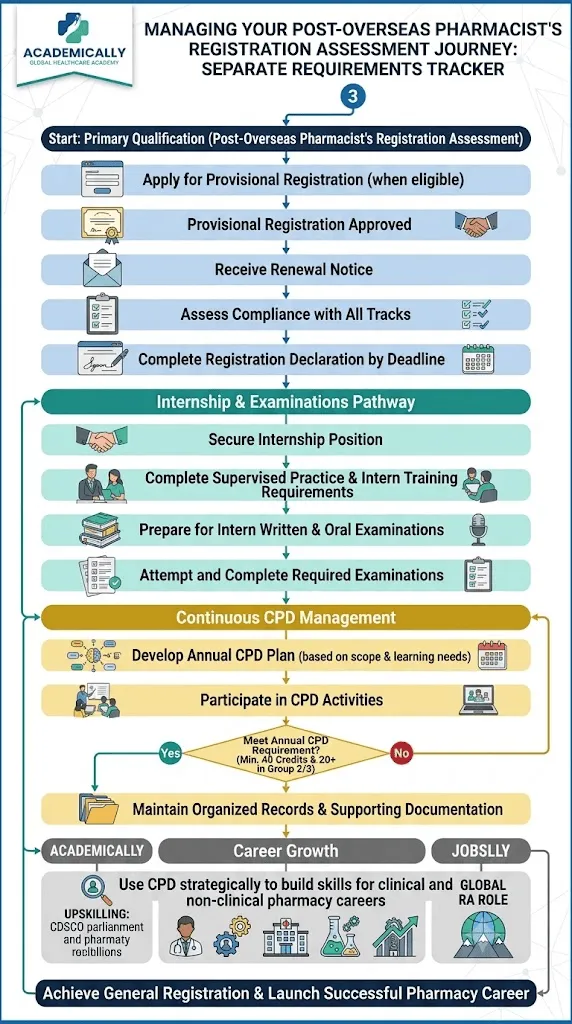
Passing the Overseas Pharmacist Readiness Assessment is a milestone for overseas‑trained pharmacists and those considering a career in Australia. However, passing this exam is just the beginning of a lengthy process. After passing Australian pharmacist licensure exam, pharmacists must go through a series of stages including registration, supervised practice, intern training, written/oral examinations and general registration.
One of the requirements following pharmacist registration in Australia is continuing professional development or CPD.
Familiarising yourself with the AHPRA CPD requirements pharmacist pathway will ensure overseas‑trained pharmacists can navigate this area with ease and build a CPD portfolio. Pharmacists must complete a minimum of 40 CPD credits during each 12-month CPD period ending 30 September, with at least 20 credits coming from Group 2 and/or Group 3 activities.
This guide discusses what happens after Overseas pharmacist readiness assessment, how the CPD system works, what activities count towards CPD, what intern pharmacists should know, what records pharmacists need to keep and how CPD can help pharmacists grow their careers as a pharmacy professional in Australia.
What Happens After Overseas pharmacist readiness assessment ?
Clearing the Australian pharmacist licensure exam is a major milestone for overseas-trained pharmacists planning to practise in Australia. However, passing Overseas pharmacists readiness assessment is not the end of the journey. Pharmacists must still progress through the Australian registration pathway and eventually maintain their professional competence through continuing professional development (CPD).
Structured preparation can support both exam readiness and professional development. Academically's Australian Pharmacist Exam Preparation Course offers 109 CPD points, giving candidates an opportunity to combine Overseas pharmacist readiness assessment-focused preparation with substantial professional learning. The course includes extensive live and recorded tutorials, study resources, mock tests, grand tests and trainer support, helping overseas pharmacists strengthen their knowledge while preparing for the OPRA assessment.
The 109 CPD points can be particularly valuable because they provide a significant amount of documented professional learning alongside exam preparation. Rather than treating OPRA preparation as a standalone examination exercise, pharmacists can use structured learning to strengthen pharmaceutical knowledge, clinical understanding, Australian practice readiness and confidence with exam-style questions.
The Overseas Pharmacist Readiness Assessment tests pharmacists seeking eligibility for provisional registration in Australia on their biomedical, pharmaceutical and clinical science knowledge. While passing it is a step towards provisional registration it is usually not enough to gain general registration as a pharmacist in Australia. The general pathway is:
Overseas pharmacist readiness assessment→ provisional registration → supervised practice/internship → Intern Written Exam → Oral Exam → general registration →ongoing CPD
Pharmacists who have progressed beyond overseas pharmacist readiness assessment can then move to Academically's Australian Pharmacy Intern Written & Oral Exam Preparation Course. The course provides structured preparation for the Intern Written and Oral Examinations through live and recorded classes, mock tests, study material, trainer support and practice opportunities. These examinations form an important part of the pathway toward general registration.
It is worth noting that the Pharmacy Board’s current registration pathway requires 1,527 hours of approved supervised practice for general registration (or another period approved by the Board) in addition to meeting other requirements such as completing the intern training program and passing the relevant examinations.
Many overseas‑trained pharmacists wrongly assume that they will only have to complete CPD activities as a registered pharmacist. In reality the Pharmacy Board’s CPD requirements also apply to pharmacists with registration. Pharmacists with provisional registration (interns) are also expected to plan their CPD and keep relevant records. Pharmacists are strongly encouraged to keep records of their learning activities undertaken during their internship to ensure the credit is claimed correctly at a date.
AHPRA CPD Requirements for Pharmacists
While the AHPRA CPD requirements pharmacist term is often used, the requirements are actually set out by the Pharmacy Board of Australia under the National Registration and Accreditation Scheme administered by Ahpra. The requirements are relatively simple:
| Requirement | What pharmacists need to know |
| Annual CPD minimum | 40 CPD credits |
| CPD period | 1 October to 30 September |
| Group 1 maximum | 20 credits |
| Group 2+ Group 3 minimum | At least 20 credits |
| CPD planning | Annual CPD plan required |
| Record keeping | Maintain evidence of completed activities |
| Renewal declaration | Declare compliance during registration renewal |
The CPD year is an important consideration for pharmacists as the 30 September deadline is not necessarily the same time as the pharmacist’s registration renewal date. It is also worth noting that excess CPD credits cannot be carried over into the following CPD period.
When a pharmacist renews their registration, he/she must declare whether they have met the CPD requirements during the CPD period. Evidence of CPD completion may be required if a pharmacist’s declaration is selected for audit by the Board or if the pharmacist declares that pharmacists were not able to meet the requirements.
Do Pharmacists Need 40 Hours or 40 Credits?
This is arguably the common question when it comes to the continuing professional development pharmacist Australia requirements.
Pharmacy CPD is measured in credits, not hours.
The credit value of activities varies depending on the group they fall under.
Group 1: Information accessed without assessment
These are usually activities where pharmacists gains information without formal assessment. Examples include attending events such as seminars, webinars or conferences, reading professional publications and participating in other similar activities.
While there is no time limit for group 1 activities each hour is worth one CPD credit and pharmacists should claim no more than 20 out of their 40 annual credits in this category.
Group 2: Knowledge or skills improved through assessment
These are activities that require pharmacists to demonstrate that pharmacists knowledge or skills have been improved through assessment.
Examples include taking assessed modules, completing case‑based education and assessment, attending workshops with an assessment component and similar activities.Group 2 activities generally attract two CPD credits per hour.
Group 3: Quality or practice improvement
This group of activities is primarily aimed at helping pharmacists apply their learning to improve their practice and reflect on the outcomes of their learning.
Group 3 activities generally attract three CPD credits per hour.
This structure means a pharmacist does not simply need to accumulate 40 hours of passive learning. The aim is to create a balanced learning portfolio that demonstrates ongoing improvement.
What Should Go Into a Pharmacist’s CPD Plan?
Pharmacists should plan their CPD in accordance with their practice setting and scope of practice. Pharmacists can follow a cycle for their learning and development which can be divided into the following stages:
Assess → Identify → Plan → Learn → Apply → Reflect → Record
The pharmacist can begin by identifying areas pharmacists need to develop, including their scope of practice to help guide pharmacists when choosing their learning activities. Once the needs have been identified the pharmacist should set learning goals. Find relevant learning activities to achieve those goals.
Some questions that can help a pharmacist identify areas for learning and development include:
- What responsibilities does my current role involve?
- What areas of practice do I need to develop?
- What areas of pharmacy knowledge are changing rapidly?
- What knowledge and skills will I need for the stage in my career?
- What learning activity can help me address these needs?
Pharmacists should keep records of all their CPD activities so that they can demonstrate that they have met the CPD requirements at the time of audit.
The CPD standard specifically expects pharmacists to reflect on their scope of practice and use relevant competency standards to identify development needs.
What CPD Activities Can Pharmacists Choose?
The choice of learning activities will depend on the pharmacist’s scope of practice.
Pharmacists working in the community may choose to focus their learning on areas such as medication use in the community, common minor ailments, immunisation, chronic disease management, counselling and new therapeutics.
Hospital pharmacists on the other hand may choose to focus their learning on clinical pharmacy, antimicrobial stewardship, medicines use in hospitals, medication reconciliation, oncology and critical care.
Pharmacists working in the industry have a range of options, including pharmacovigilance, regulatory affairs, clinical research, medical affairs and drug development.
Pharmacy practice can include roles outside patient care, including management, administration, education, research and advisory roles. This means that pharmacists can tailor their CPD according to their intended scope of practice within the healthcare industry.
What Counts as CPD During the Internship?
Intern pharmacists need to be particularly mindful of the fact that not all the activities they complete as part of their Intern Training Program (ITP) will count towards their CPD requirements. There is a distinction between activities that've mandatory components of the ITP and activities that contribute to a pharmacist’s CPD.
Some activities count towards a pharmacist’s requirements rather than the pharmacist’s CPD requirements. Activities such as attending ITP lectures or other learning activities designed to assess the student’s level of knowledge may count towards the ITP requirements than the pharmacist’s CPD requirements.
However activities that involve self‑assessment or performance appraisal and address learning needs can be claimed as CPD activities.
Intern pharmacists should keep this in mind. Have a separate CPD record to ensure pharmacists can demonstrate that they have met their CPD requirements.
How Should Pharmacists Keep CPD Records?
Good record keeping is one of the reliable ways of reducing stress for pharmacists especially when their records are selected for audit by the Pharmacy Board.
The CPD records should demonstrate the following information:
Activity date: refers to the date (or dates) when the learning activity was undertaken.
Activity title: refers to the name of the learning activity.
Activity group: refers to the group (1, 2 or 3) that the activity falls under.
Credits claimed: refers to the number of credits claimed for the activity.
Learning objective: refers to the objective of the learning activity.
Evidence: refers to the evidence of completion, where. This may include a certificate assessment results, attendance records or other documents that demonstrate that the activity was completed.
Reflection: refers to the reflection on the learning activity. Pharmacists should state what they learned and how they intend to use the acquired knowledge or skills in their practice.
Pharmacists should keep all the evidence that demonstrate that they have undertaken the learning activities claimed in their CPD records. Pharmacists must maintain their CPD records, including evidence for at least three full CPD periods, if pharmacists’ records are to be used as evidence during an audit. Intern pharmacists are encouraged to provide the records to their ITP provider as part of the ITP requirements.
What Happens If a Pharmacist Falls Short on CPD?
Failure to meet the CPD requirements should not be taken lightly as a pharmacist will be required to declare whether they met the requirements when they renew their registration.
If the pharmacist declares that they were unable to meet the requirements the Board may take action against pharmacists and may require them to provide additional information about their CPD activities. An exception can be made if the Board determines that exceptional circumstances prevented the pharmacist from completing their CPD, such, as illness or bereavement that prevented them from undertaking their CPD activities.
The reliable way of avoiding these unpleasant surprises is to ensure that CPD activities are up-to-date and that the pharmacist has met the requirements before the renewal date.
A Simple 12-Month CPD Strategy
To make it easier to meet the requirements a pharmacist can split the CPD year into four quarters. Allocate specific activities to each quarter.
Quarter 1: Identify and complete foundational learning
Quarter 2: assessed learning activities
Quarter 3: Complete practice improvement activities
Quarter 4: Review CPD, update records and complete evidence
Using this simple strategy pharmacists can ensure they complete their CPD requirements without rushing at the end of the year. Another helpful consideration is to aim to do an extra if the pharmacist has spare capacity as the Pharmacy Board does not specify an upper limit for CPD credits although excess credits cannot be carried over to the next CPD period.
CPD Can Also Help a Pharmacist’s Career Beyond the Community Pharmacy
CPD plays a very important role in a pharmacist’s career development as it enables pharmacists to continually update their knowledge and skills throughout their careers. Pharmacists looking to move into the healthcare industry have a variety of specialisations to choose from, including
- Regulatory affairs
- Pharmacovigilance
- Medical affairs
- Clinical research
- Drug safety
- Medical writing
- Quality assurance
- Clinical data management
Pharmacists need to consider the pharmacy-related areas of practice including those outside the direct patient care setting.
One option is to use structured upskilling to develop transferable skills relevant to non-clinical healthcare careers.
The Academically Global's Non-Clinical Course provides 180 CPD points, allowing pharmacists to combine structured upskilling with professional development. This can be particularly useful for pharmacists who want to make their CPD more career-focused rather than completing learning activities solely to meet an annual requirement.
The value of the course extends beyond the CPD points themselves. Pharmacists considering an industry transition can use structured learning to understand how their existing healthcare knowledge applies to non-clinical roles.
The 180 CPD points can also provide a substantial addition to a professional development portfolio, subject to the pharmacist confirming that the activity and its documentation meet the applicable Pharmacy Board CPD requirements before claiming the credits.
For pharmacists who have completed OPRA or are progressing through the Australian registration pathway, the combination of exam preparation, CPD and targeted upskilling can create a broader professional roadmap:
Overseas pharmacist readiness assessment preparation → Australian registration pathway → CPD → targeted upskilling → career opportunities
Accordingly pharmacists can use their CPD to develop the skills required for the specialisation of their choice long as it aligns with their scope of practice.
Find Right Job Opportunity as Overseas Pharmacist
Completing the ITP, passing the Intern Written Exam and Oral Examination and meeting the CPD requirements should give pharmacists the confidence and competence they need to find the opportunity. The job search can also be assisted by Jobslly a healthcare-focused job board that facilitates connecting pharmacists with a variety of opportunities, including those in pharmacovigilance, medical affairs, regulatory affairs and other healthcare-related roles.
Jobslly boosts a variety of relevant listings, including non-clinical roles pharmacists can consider as they look to build their careers in the healthcare industry. As a pharmacist you can use Jobslly to keep track of opportunities in pharmacy, pharmacovigilance, medical writing, regulatory affairs and other relevant fields.
You can use Jobslly to keep track of opportunities, including those that arise as you continue your studies to become a registered pharmacist in Australia. You may also find it beneficial to use it to keep track of opportunities so you can take advantage of the next step in your career as soon as you are ready.
Final Checklist: What Pharmacists Need to Know After Overseas Pharmacist Readiness Assessment
Conclusion
While Overseas Pharmacist Readiness Assessment can be seen as an important step towards pharmacy practice in Australia professional development does not stop once a pharmacist passes the examination. The AHPRA CPD requirements pharmacist pathway should be regarded as a process with pharmacists completing at least 40 credits of CPD each year with at least 20 of the 40 CPD credits being claimed for group 2 and group 3 activities.
Pharmacists should also think beyond the certificate by ensuring their CPD activities are relevant to their scope of practice and reflecting on how they can use the acquired knowledge and skills in practice. In addition trained pharmacists should consider how they can use their CPD to prepare for their career, in Australia including finding the relevant job opportunities using Jobslly.
Here are 10 SEO-focused FAQs designed to capture common search intent around AHPRA CPD requirements for pharmacists, OPRA, registration, and career development.