Why the clinical research industry is booming in India
This is not a hopeful prediction. The numbers are already on the table.
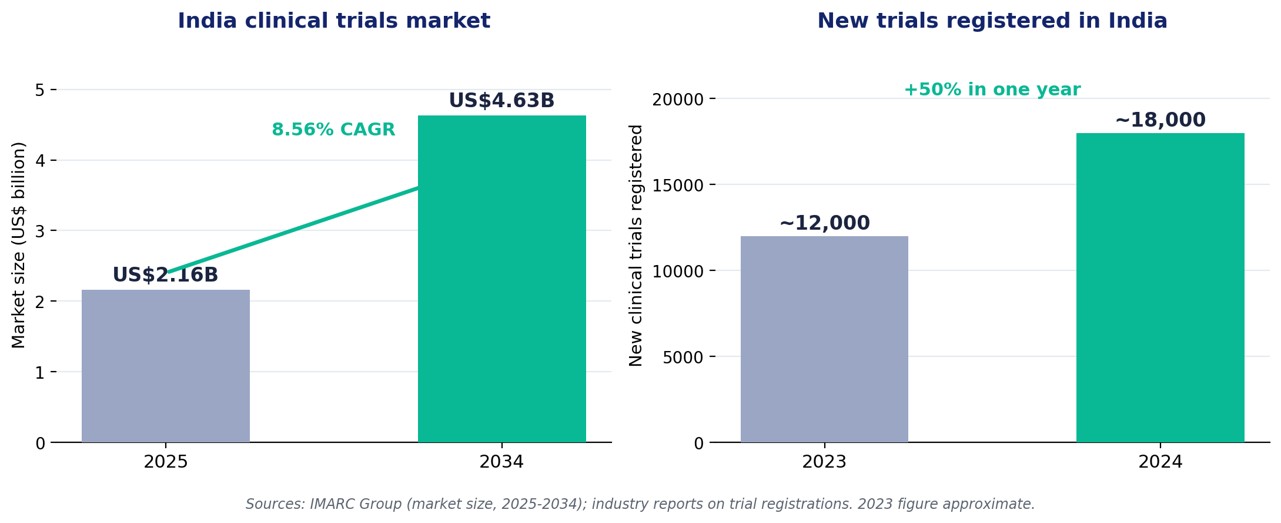
India's clinical trials market is growing at 8.56% CAGR, and trial registrations jumped roughly 50% in a single year.
Six reasons the growth is real
- The market is expanding fast. India's clinical trials market was valued at about US$2.16 billion in 2025 and is projected to reach roughly US$4.63 billion by 2034, growing at about 8.56% CAGR (IMARC Group).
- Trial volume has jumped sharply. Around 18,000 new clinical trials were registered in India in 2024, roughly a 50% increase over the previous year. Every one of those trials needs coordinators, monitors, data managers and medical oversight.
- Global companies are outsourcing to India. Contract Research Organisation (CRO) outsourcing in India is projected to grow at roughly 12% CAGR over the next five years, as global sponsors move operations here for cost efficiency and speed.
- India has a genuine structural advantage. A very large and diverse patient population, significantly lower trial costs than Western markets, and strong English-speaking scientific talent.
- Regulation has improved. The New Drugs and Clinical Trials Rules, 2019 under CDSCO created clearer timelines and a more predictable approval framework, which encouraged sponsors to return to India.
- North India is a major hub. Delhi-NCR and the surrounding belt account for the largest regional share of trial activity, alongside established clusters in Bengaluru, Hyderabad, Mumbai, Pune and Ahmedabad.
Read that as a hiring signal. A market growing at 8–12% a year, with trial volumes rising 50% in twelve months, cannot run on its existing workforce. That gap is your opportunity.
| Want to enter this industry in four months? The Executive Programme in Clinical Drug Development is built for MBBS, BDS and PharmD graduates, four months, industry-led, with full career support. Check your eligibility and scholarship options: |
What is clinical research, in plain language?
Clinical research is the process of testing whether a new medicine, vaccine or device is safe and effective before it reaches patients. Every drug you prescribe went through years of clinical trials before approval.
Those trials are run by pharmaceutical companies (sponsors) and by CROs working on their behalf. They need people who understand medicine, can follow strict protocols, manage data accurately, and work with hospitals and investigators.
In other words, they need exactly what your degree already trained you to do, applied to research instead of the bedside.
Clinical research jobs in India: the main roles
| Role | What you do | Fit |
|---|---|---|
| Clinical Research Coordinator (CRC) | Runs trials at the hospital or site - patient recruitment, consent, visits, documentation. | Excellent entry role; site-based |
| Clinical Research Associate (CRA) | Monitors trial sites for the sponsor or CRO, checks data quality and protocol compliance | The classic career track; involves travel |
| Clinical Data Manager | Designs, cleans and validates the data generated by trials | Detail-oriented; often hybrid or remote |
| Medical Monitor / Medical Advisor (trials) | Provides medical oversight of a trial, reviews safety data, advises on eligibility | MBBS preferred; high-value role |
| Clinical Trial Manager | Manages timelines, budgets, vendors and delivery of a trial | Mid-level, after CRA experience |
| Regulatory Affairs (clinical) | Prepares submissions and approvals for CDSCO, US FDA, EMA | All degrees; strong long-term track |
| Pharmacovigilance / Drug Safety | Processes and assesses adverse events during and after trials | Largest volume of fresher roles |
| Medical Writer (clinical) | Writes protocols, clinical study reports, manuscripts | Excellent for strong writers; often remote |
Who is eligible? MBBS, BDS and PharmD
All three degrees are accepted across the clinical research industry. Where they differ is which roles suit you best.
For MBBS graduates
Your medical training is the most valued in trial-facing roles. You can enter as a CRC or CRA, but the higher-value track is medical oversight, Clinical Trials Physician, Medical Monitor, Medical Advisor and drug safety physician roles that specifically require a medical degree. No FMGE, NEET-PG or clinical registration is needed, because this is not clinical practice, which also makes it a genuine route for foreign medical graduates.
For BDS and MDS graduates
A dental degree is widely accepted as a qualifying clinical qualification. Dentists work as Clinical Research Coordinators, CRAs, data managers, medical writers and in drug safety. It is one of the most established non-clinical exits from dentistry, and your clinical background gives you credibility with investigators and sites.
For PharmD and B.Pharm graduates
Pharmacy graduates are arguably the most natural fit of all. Your training in pharmacology, therapeutics and drug information maps directly onto trial work. PharmD graduates in particular do well in CRA, data management, regulatory and safety roles, and often progress quickly.
One honest note: eligibility wording varies by employer. Most CRO and sponsor job advertisements list MBBS, BDS, PharmD, B.Pharm, M.Pharm and life sciences together but always read the specific job description rather than assuming.
Salary: what clinical research pays in India
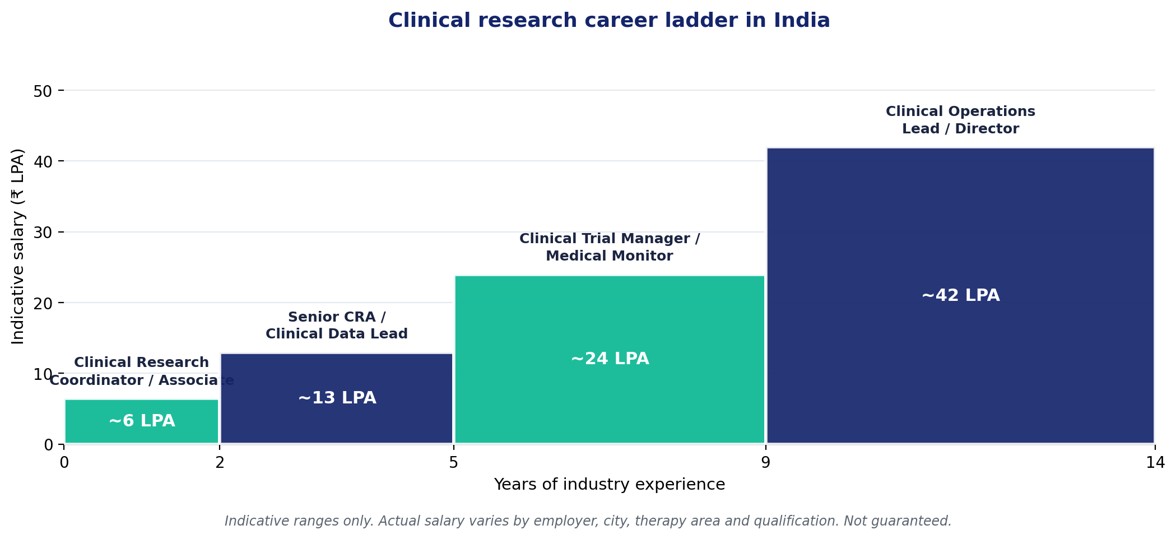
A realistic progression. The early years build the credibility that makes the later jumps possible.
| Role | Entry (0–2 yrs) | Mid (3–6 yrs) | Senior (7+ yrs) |
|---|---|---|---|
| Clinical Research Coordinator | ₹4-7 LPA | ₹8–12 LPA | ₹14-20 LPA |
| Clinical Research Associate (CRA) | ₹4-9 LPA | ₹10–18 LPA | ₹20-32 LPA |
| Clinical Data Manager | ₹5-8 LPA | ₹9-16 LPA | ₹18-30 LPA |
| Regulatory Affairs | ₹4-9 LPA | ₹10-20 LPA | ₹22-35 LPA |
| Clinical Trial Manager | - | ₹12-22 LPA | ₹25-40 LPA |
| Medical Monitor (MBBS) | ₹12-20 LPA | ₹22-38 LPA | ₹40-65 LPA |
| Clinical Trial Physician/Drug Safety Physician (MBBS) | 8-10 LPA | 14-18 LPA | 25-50 LPA |
⚠ These are indicative ranges observed in the Indian market and vary considerably by employer, city, therapy area and qualification. They are not guarantees. Be cautious of anyone promising a fresher a fixed high salary.
The skills employers actually screen for
This is where most capable graduates fall short, not on medical knowledge, but on industry-specific skills.
- ICH-GCP: Good Clinical Practice is the foundation of every trial. Employers expect you to know it.
- Trial phases and study design: Phase I to IV, endpoints, randomisation, blinding, protocol structure.
- Regulatory framework: CDSCO and the New Drugs and Clinical Trials Rules 2019, plus an awareness of US FDA and EMA requirements.
- Site and data management: informed consent, source documentation, monitoring visits, query resolution, EDC systems.
- Safety reporting: adverse events, serious adverse events, ICSR processing, MedDRA coding and Argus.
- Communication and documentation: clear scientific writing and the ability to work with investigators, sites and sponsors.
Why capable graduates still don't get hired
I have interviewed and mentored a large number of healthcare graduates. The rejection pattern is remarkably consistent, and it is almost never about medical knowledge.
| The problem | What is actually happening |
|---|---|
| “I applied to 50 CRO jobs and got no reply.” | Your CV is written in clinical language. An applicant tracking system filters it before any human reads it. |
| “I don't know what these job descriptions mean.” | Terms like GCP, EDC, ICSR, monitoring visit and query resolution are never taught in medical or pharmacy college. |
| “Recruiters never contact me.” | Most CRO hiring starts with a LinkedIn keyword search. If your profile does not carry the words, you are invisible. |
| “I freeze in the interview.” | Corporate competency-based interviews are a different skill from clinical vivas. They can be practised. |
| “They all want experience.” | Many entry roles do accept freshers but only if you can demonstrate that you understand the work. |
Knowledge gets you shortlisted. Preparation gets you hired. That gap is the entire problem.
| Struggling to get past the screening stage? Our programme rebuilds your CV and LinkedIn profile in industry language, trains you on the tools, and prepares you for real interviews. Explore the programme: |
How the Executive Programme in Clinical Drug Development helps
This programme exists to close exactly the gap described above - the distance between being medically knowledgeable and being industry-ready.
| Detail | What you get |
|---|---|
| Duration | 4 months, live online - you can continue clinical work while you study |
| Fee | ₹2 lakh |
| CPD points | 180 CPD points on completion |
| Batch | Super 30, a limited batch of 30, so mentoring is genuinely one to one |
| Faculty | Doctors and professionals currently working in leading pharmaceutical companies and CROs |
| Eligibility | MBBS, BDS/MDS, PharmD, B.Pharm, M.Pharm and other healthcare graduates |
What you learn
- Drug development lifecycle, from discovery to post-marketing
- Clinical trial phases, protocols, endpoints and study design
- ICH-GCP and the ethical framework of research
- Regulatory requirements - CDSCO, US FDA, EMA
- Site management, monitoring and data handling
- Pharmacovigilance and safety reporting - ICSR, MedDRA, aggregate reports
- Hands-on training with industry tools including Argus, Veeva Vault and MedDRA
- Real industry case studies and a capstone project you can discuss in interviews
Why the Super 30 batch matters
We deliberately keep each batch to 30 learners, and not everyone who applies is selected. The reason is practical rather than promotional: individual attention only works at small scale. In a batch of 30 we can identify each person's specific weakness - a weak CV, poor scientific presentation, interview nerves, gaps in regulatory knowledge and work on it directly, one to one, so you become employable sooner instead of drifting for a year.
Career support that runs alongside the classes
From day one, while you are still learning, our career team works on the part that actually gets you hired:
- An ATS-friendly resume, rewritten in industry language and customised per role
- Cover letters, professional emails and statement of purpose
- LinkedIn profile optimisation with the keywords recruiters search
- HR and technical interview preparation, with 1:1 mock interviews
- Relevant job openings shared and your profile referred to recruiters where applicable
- Salary negotiation and offer guidance
- Continued support after placement, including your next career move
This is why the four-month timeline is realistic. You are not studying for four months and then starting a job hunt the job hunt runs in parallel, so you finish the programme already applying with a strong profile.
⚠ We will always say this plainly: no ethical organisation can guarantee you a job. “Job assistance” means genuine assistance - training, preparation and placement support not a guaranteed placement. What structured preparation reliably improves is your readiness, your visibility and your interview performance.
Your step-by-step roadmap
- Pick your entry role. CRA/CRC, CRA, data management or drug safety are the realistic first roles. Medical Monitor comes later for MBBS graduates.
- Learn the fundamentals. ICH-GCP, trial phases, regulatory basics and safety reporting. This is what gets you shortlisted.
- Get hands-on with the tools. Argus, Veeva Vault and MedDRA appear by name in job descriptions.
- Rewrite your CV in industry language. Replace clinical postings with transferable skills, projects and tools. Make it ATS-readable.
- Rebuild your LinkedIn profile. A keyword-rich headline and summary so recruiters can actually find you.
- Apply strategically and prepare. A small number of well-matched applications with rehearsed answers beats mass applying every time.
Who hires for clinical research in India
| Category | Examples |
|---|---|
| CROs | IQVIA, ICON, Parexel, Fortrea, Syneos Health, PPD (Thermo Fisher) |
| Pharmaceutical companies | Sun Pharma, Cipla, Dr. Reddy's, Lupin, Torrent, Zydus, and the Indian arms of global sponsors |
| Biotech and vaccines | Biocon, Serum Institute, Bharat Biotech and similar organisations |
| Sites and academia | Large hospitals, medical colleges and site management organisations |
These names illustrate the categories that hire clinical research talent. They do not imply endorsement or any current vacancy.
Final thoughts
Clinical research is one of the few fields where a growing industry and an under-supplied talent pool meet. India is running more trials than ever, global sponsors are moving work here, and the roles that support all of it need people with medical training.
You already have the training. What separates the graduates who get hired from those who do not is not knowledge - it is industry vocabulary, practical tool exposure, a CV written in the right language, and the confidence to demonstrate all of it in an interview.
That is a finite, learnable gap. Four months of focused work is genuinely enough to close it.
Your degree is not a limitation. It is the reason this industry will consider you at all.