Introduction
Australia's physiotherapy workforce shortage keeps deepening. Jobs and Skills Australia has flagged physiotherapy as a national skills-shortage occupation, and rural and regional Australia in particular is chronically under-served.
Australia needs internationally qualified physiotherapists, but the regulatory pathway to get there is layered, sequential, and unforgiving of missed documentation or misunderstood timelines. Since the Australian Physiotherapy Entry Pathway (APEP) fully replaced the old Standard Assessment Pathway, every new international candidate now moves through the same five-stage journey. Eligibility Assessment, APEP assessments, the Interim Certificate, the English language requirement, and finally AHPRA registration itself.
In this blog, walks through every one of those stages in the order you'll actually experience them, with 2026 fees shown in AUD, US$ and INR, realistic timelines, common rejection reasons, and the special-case routes for UK, New Zealand and returning Australian-trained physiotherapists. Wherever it's useful, we've pointed to the specific preparation and assessment resources that make the difference between a first-attempt pass and a costly resit.
The Australian Physiotherapy Registration Journey at a Glance
Before the detail, it helps to see the whole road ahead. Here is the sequence every overseas-qualified physiotherapist follows under the current APEP framework:
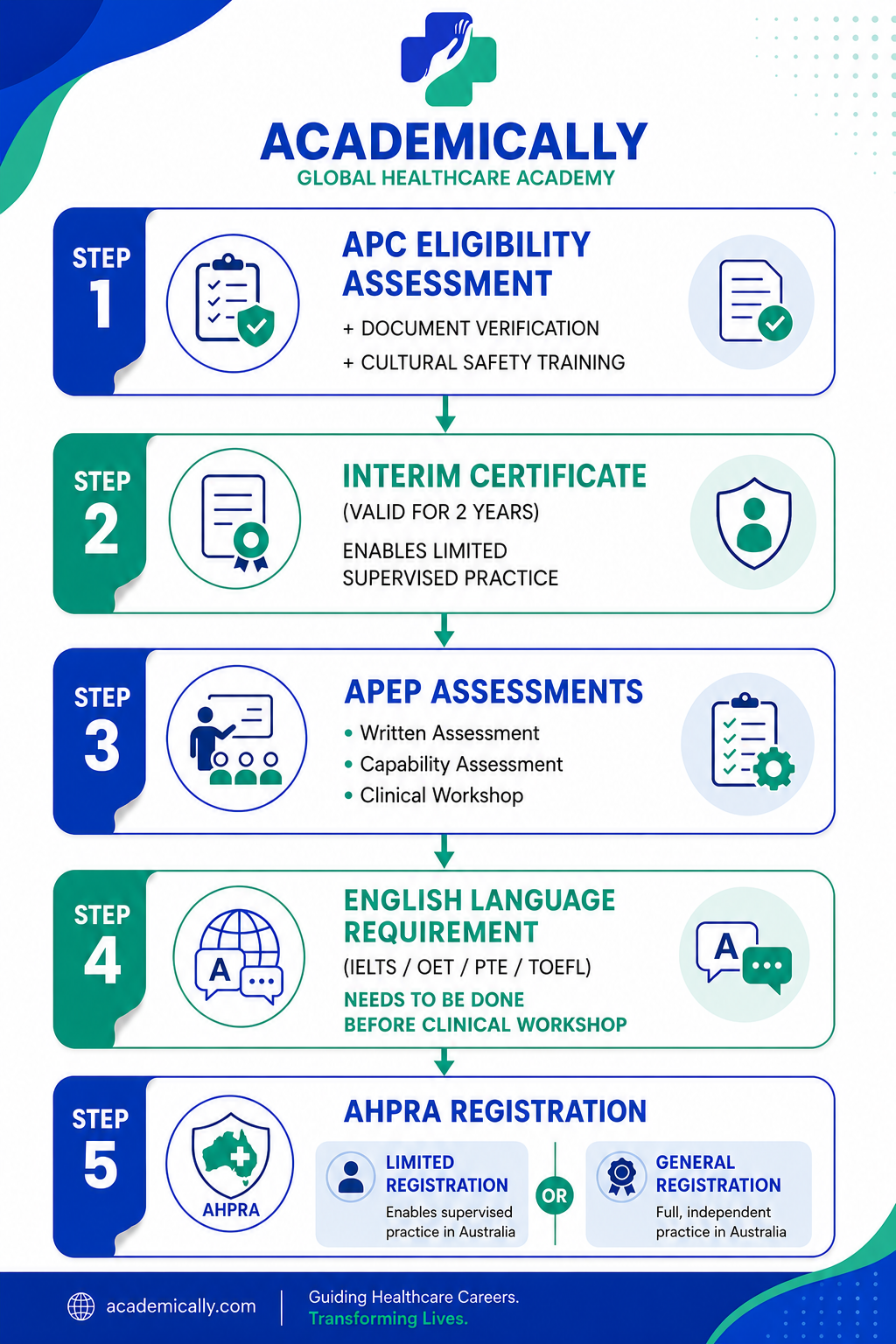
Each stage gates the next, you cannot sit the Written Assessment before completing Eligibility and Cultural Safety Training, and you cannot apply to AHPRA before you've cleared the Capability Assessment and Clinical Workshop and met the English standard.
Understanding this sequencing is the single biggest predictor of whether a candidate finishes in six months or drags the process out over two years.
Stage 1: APC Eligibility Assessment
The Eligibility Assessment is the gatekeeper stage. It is a document-based review, not an exam, and its job is to confirm that your physiotherapy qualification is equivalent to an Australian entry-level degree and that you're legally entitled to practise (or hold registration without restriction) in your training country.
Document checklist
At minimum, the APC will expect:
- Certified copies of your primary physiotherapy degree/diploma and academic transcripts
- Proof of registration (or legal right to practise) in your country of training, including a certificate of good standing where applicable
- Government-issued photo identification
- Evidence of any name changes (marriage certificates, deed polls, etc.)
- Official translations for any document not issued in English, done by a certified/NAATI-accredited translator
- Detailed course syllabi or curriculum documents if your program's equivalence isn't immediately obvious to assessors
- Your English language evidence, if you're claiming an education-based exemption rather than sitting a test outright
Missing even one certified translation or an outdated certificate of good standing is enough to trigger a request for further information and every round of back-and-forth adds weeks.
Fees and timeline
The Eligibility Assessment currently costs AUD 1,170 (approx. US$772 / ₹77,805), and Cultural Safety Training, a mandatory companion module completed alongside it is AUD 235 (approx. US$155 / ₹15,628).
Processing typically takes 2–3 weeks once your application and documents are complete, though incomplete submissions can push this out considerably.
Common refusal reasons
The most frequent reasons candidates get sent back for more information (or outright refused) include:
- Qualification gaps: training that is shorter than Australia's four-year entry-level standard, or missing clinical placement hours
- Uncertified or expired documents, especially certificates of good standing older than the APC's accepted validity window
- Inconsistent name records across passport, degree certificate and registration documents
- Non-English documents submitted without certified translation
- Unclear or non-standard curriculum structures that assessors cannot easily map to Australian competency standards
If refused, you generally have the option to submit additional evidence or lodge a formal review. But this eats into your Interim Certificate's two-year clock (more on that below), so getting the checklist right the first time matters enormously.
Stage 2: APEP Assessments
Once you clear Eligibility and Cultural Safety Training, you move into the three core APEP assessments:
- Written Assessment: a computer-based exam testing clinical knowledge, reasoning and decision-making against the Australian physiotherapy competency standards, held four times a year at venues in Melbourne and Sydney or remotely
- Capability Assessment: now conducted as a remote, open-book oral exam where you discuss simulated clinical scenarios over video call and can reference approved resources during the discussion; this has replaced the older in-person clinical examination entirely, meaning no travel to Australia is required for this stage
- Clinical Workshop: a practical, competency-based session confirming hands-on clinical skills
Resit fees if you don't pass first time are AUD 2,017 (Written), AUD 2,928 (Capability) and AUD 1,464 (Clinical Workshop) respectively.
It is exactly why structured preparation pays for itself many times over. Academically's APEP Written Exam Preparation Course is built specifically around the current competency framework and updated exam blueprint, with question banks, timed mock papers and clinical-reasoning drills modelled on real past patterns, so candidates walk into exam day having already seen the format rather than meeting it cold.
For a full stage-by-stage breakdown of syllabus weighting, question style and the Capability Assessment's oral format, see our dedicated APEP exam guide.
Stage 3: The Interim Certificate
What it is and what it allows
Once you've passed the Eligibility Assessment and completed Cultural Safety Training, the APC issues an Interim Certificate. This is not a licence to practise as a physiotherapist. You cannot see patients independently on the strength of it alone. What it does do is satisfy one of AHPRA's core requirements for Limited Registration for Supervised Practice, letting you start working (under supervision) in the Australian healthcare system while you complete the remaining APEP assessments and English requirement.
In practice, this is the stage that changes candidates' financial calculus the most.
Instead of waiting overseas, unpaid, for 12-18 months to finish every assessment before earning a cent in Australia, the Interim Certificate lets you get onto Australian soil, into a supervised clinical role, and earning a wage while you finish the Written Assessment, Capability Assessment and Clinical Workshop.
Validity and conditions
The Interim Certificate is valid for two years from the date it's issued. If your full APEP assessments and AHPRA registration aren't finalised within that window, you'll need to reapply and, in most cases, restart the Eligibility Assessment.
Two years sounds generous, but candidates who underestimate exam scheduling, remember, the Written and Capability Assessments run only four times a year can find themselves cutting it close, especially if a resit is needed.
Stage 4: English Requirement
Every AHPRA application requires evidence of English language proficiency, through one of:
- IELTS (Academic)
- OET
- PTE Academic
- TOEFL iBT
or an accepted education-based exemption for candidates whose entire schooling, from a specified point onward, was delivered and assessed in English. Score thresholds are set centrally by AHPRA's English language skills registration standard and apply uniformly across professions, though the accepted test list and score bands are reviewed periodically, so always confirm the current standard before booking a test.
Our companion English-requirement guide breaks down score bands, test choice strategy and the specific exemption criteria in depth, worth reading well before your Eligibility Assessment, since planning your English evidence early avoids a bottleneck at the AHPRA stage.
Stage 5: AHPRA Application
With APEP assessments cleared and your English requirement satisfied, the final stage is formal registration with the Physiotherapy Board of Australia through AHPRA.
Limited vs General Registration
- Limited Registration (Supervised Practice) is the entry point for almost every overseas-trained physiotherapist. It allows you to work in physiotherapy roles under a formal, AHPRA-approved supervision plan while you complete any outstanding requirements. You cannot practise entirely independently under this category.
- General Registration is granted once you've completed all APEP assessments, met the English standard, and (where applicable) satisfied any supervised practice period the Board has set. General Registration allows you to work anywhere in Australia, in any physiotherapy setting, within your scope of practice.
Supervised practice explained
Supervised practice isn't a single fixed duration for everyone. The Board tailors the supervision plan to your qualification, prior clinical experience and assessment outcomes. In practice, it typically involves:
- A named, AHPRA-recognised supervisor at your workplace
- Regular documented supervision sessions (direct and indirect, depending on your plan)
- Periodic reporting back to the Board on your progress
- A defined scope of practice you must work within until sign-off
This is also the stage where many candidates lean on visa and migration support, since Limited Registration typically needs to align with a specific visa subclass and sponsorship or skilled-migration pathway, getting the registration and visa timelines out of sync is one of the more common (and expensive) planning mistakes international candidates make.
Fees, Renewals, CPD obligations
AHPRA's physiotherapy registration fee for the 2025/26 registration period sits at approximately AUD 211 (approx. US$139 / ₹14,032) annually, reviewed and reset by the Physiotherapy Board each year.
Registration renews annually, and every practitioner must meet the Board's Continuing Professional Development (CPD) requirements each cycle. A set number of CPD hours covering a mix of clinical, professional and practice-based learning, logged and available for audit. Falling behind on CPD, or letting registration lapse without applying for non-practising status, can complicate reinstatement later, so treat renewal dates as firmly as exam dates.
Timelines: Best Case vs Typical Case
| Stage | Best-Case Duration | Typical Case |
| APC Eligibility Assessment + Cultural Safety Training | 2–3 weeks | 4–8 weeks (with document requests) |
| Written Assessment (wait for next sitting + result) | 6–10 weeks | 3–4 months |
| Capability Assessment | 4–6 weeks | 2–3 months |
| Clinical Workshop | 4–6 weeks | 2–3 months |
| English requirement (if test needed) | Can run parallel | 4–8 weeks |
| AHPRA application processing | 4–6 weeks | 6–10 weeks |
| Total, Eligibility to Limited Registration | ~6 months | 9–14 months |
| Total, to General Registration (incl. supervised practice period) | 12–18 months | 18–30 months |
The single biggest variable is the four-times-a-year cadence of the Written and Capability Assessments. Missing an application window by even a few days can add three months to your timeline.
This is precisely why most successful candidates begin structured exam preparation 3–6 months before their intended Eligibility Assessment submission, rather than waiting for approval before starting to study.
Registration for Special Cases
Not every international candidate follows the full five-stage APEP road. The APC recognises several accelerated routes.
UK/HCPC-registered physios
Physiotherapists currently registered with the UK's Health and Care Professions Council (HCPC) are assessed under the Express FLYR Pathway, a fast-track route available to candidates from a small list of countries including the UK, Canada, Ireland, Hong Kong SAR and South Africa.
Express FLYR substantially shortens the assessment burden compared with the full APEP process, since these qualifications are considered closely aligned with Australian standards. Though candidates still need to complete the English requirement (unless exempt) and go through AHPRA registration in the normal way.
New Zealand-registered physios
Thanks to the long-standing Trans-Tasman Mutual Recognition Arrangement, physiotherapists currently registered and practising in New Zealand generally have one of the most direct routes into Australian registration, often bypassing the full APC assessment pathway altogether and applying to AHPRA on the strength of their existing NZ registration, subject to standard character and health checks.
Returning Australians with overseas degrees
Australian citizens or long-term residents who completed their physiotherapy degree overseas, a growing cohort given the number of Australians studying physiotherapy abroad, are assessed exactly the same way as any other internationally qualified candidate.
Citizenship does not exempt you from the Eligibility Assessment, APEP assessments or English requirement (unless you meet an education-based exemption); the APC assesses the qualification, not the applicant's passport.
To Conclude with...
Passing the Written Assessment and Capability Assessment on the first attempt isn't just about saving the AUD 2,017–2,928 resit feet's about protecting the two-year clock on your Interim Certificate and keeping your visa timeline intact.
That's the gap Academically's APEP written assessment coaching are built to close. Structured modules mapped to the current competency blueprint, timed practice papers, and clinical-reasoning walkthroughs designed by people who track every APC schedule update.
For the oral component, the APEP Capability Assessment preparation track works through realistic simulated scenarios so you walk into that remote video assessment having already rehearsed the reasoning-aloud format examiners the open-book, discussion-style format for the first time on exam day.
Registration is only half the journey for most candidates, Academically also supports the visa and migration side of the move. It helps you sequence your Limited Registration, supervised practice plan and visa application so they land in the right order, instead of one holding up the other. If you're planning your Australian physiotherapy move end-to-end, it's worth having that conversation before you submit your Eligibility Assessment, not after.