
Same region, same accent jokes, very different registration process, salary, and lifestyle.
If you are an overseas-trained physiotherapist looking to migrate to Oceania, deciding between Australia vs New Zealand physiotherapist pathways is one of the most consequential career choices you will make. Both countries actively recruit global talent to solve critical healthcare shortages, yet their credentialing systems, immigration hurdles, and financial structures could not be more different.
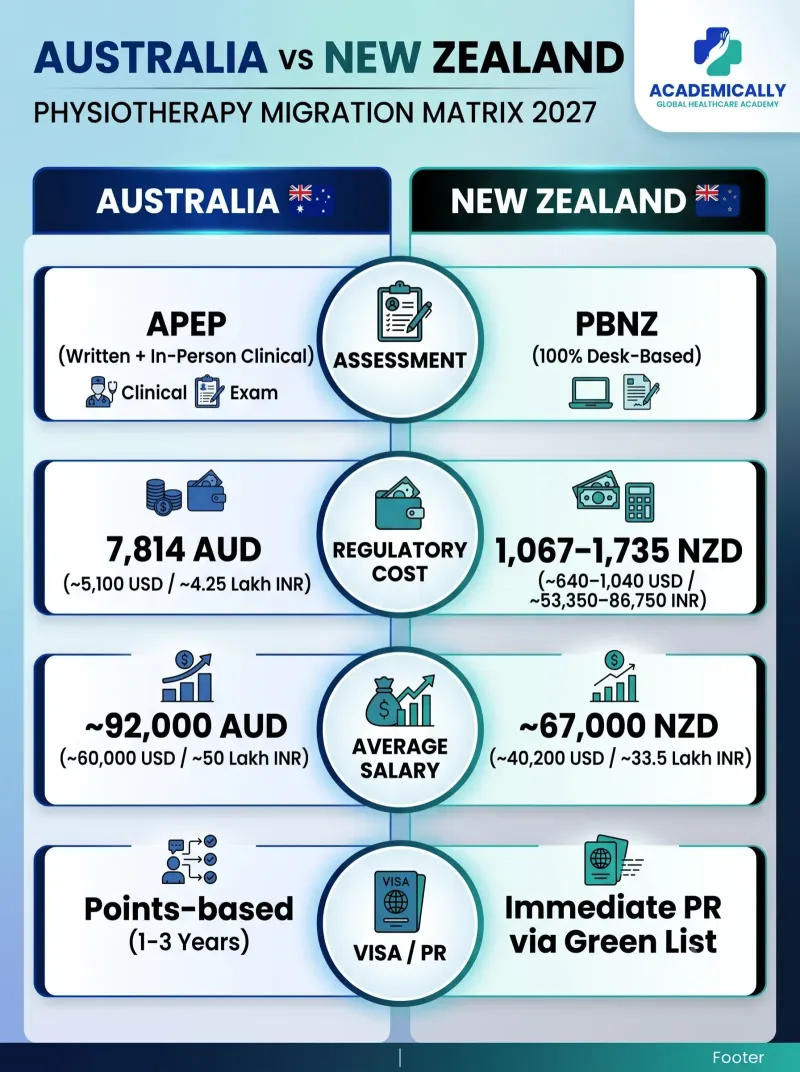
| Decision Matrix | Australia (APEP Pathway) | New Zealand (PBNZ Pathway) |
| Assessment Format | Written Assessment + In-person Clinical Workshop | 100% Remote Desk-Based Curriculum Review |
| Base Regulatory Cost | 7,814 AUD (~5,100 USD / ~4.25 Lakh INR) | 1,067 – 1,735 NZD (~640 – 1,040 USD / ~53,350 – 86,750 INR) |
| Average Mid-Career Salary | 90,000 – 100,000 AUD (~58,500 – 65,000 USD / ~49 Lakh – 55 Lakh INR) | 66,950 – 87,000 NZD (~40,170 – 52,200 USD / ~33.5 Lakh – 43.5 Lakh INR) |
| Fastest Route to PR | 1–3 years via Employer Sponsorship (482/186) or Points (189/190) | Immediate via Tier 1 Green List Straight to Residence Visa |
| Primary Clinical Sectors | Private MSK Clinics, NDIS, Public Hospitals | Te Whatu Ora Hospitals, ACC-Funded Private Practices |
Registration Process Compared: APEP vs PBNZ Pathway
The primary dividing line between the two nations is whether you are willing to sit practical examinations.
Australia: The Assessment Pathway for Eligible Physiotherapists (APEP)
Managed by the Australian Physiotherapy Council (APC), the APEP requires candidates to pass multi-stage evaluations.
- Eligibility & Document Assessment: Verification of university qualifications.
- Written Assessment: A multiple-choice exam assessing clinical reasoning.
- Capability Assessment: A remote oral presentation and clinical scenario defense.
- Clinical Assessment: A mandatory, in-person clinical simulation workshop in Melbourne.
This process requires significant capital: the total base fee is 7,814 AUD (~5,100 USD / ~4.25 Lakh INR). Note that on October 21, 2026, the full APEP pathway fee increases to 8,321 AUD (~5,400 USD / ~4.5 Lakh INR).
While New Zealand evaluates on paper, Australia tests your hands-on clinical reasoning in real time. If Australia's higher earning ceiling is your ultimate goal, do not leave your APEP written and clinical assessments to chance. Academically’s mentor-led APEP Preparation Course provides mock clinical scenarios, curriculum breakdown, and step-by-step paperwork guidance so you can pass on your first attempt.
New Zealand: The Physiotherapy Board of New Zealand (PBNZ)
The PBNZ evaluates international candidates entirely through documentation.
- Express Pathway: Available to candidates holding a recognized qualification from the UK, Ireland, Canada, or South Africa. Processing takes only 2 to 3 weeks.
- General Pathway: Designed for clinicians trained in other nations. The Board maps your university transcript and verified clinical hours (minimum 1,000 hours).
Base application fees are 1,067 NZD (~640 USD / ~53,350 INR) for the Express route and 1,735 NZD (~1,040 USD / ~86,750 INR) for the General route. You must also pay a 414 NZD (~250 USD / ~20,700 INR) Annual Practising Certificate (APC) fee upon approval.
The TTMR Route: Can You Register in NZ to Work in Australia Without APEP?
Under the Trans-Tasman Mutual Recognition (TTMR) agreement, physiotherapists with full, unrestricted registration and an active APC in New Zealand can apply directly for Ahpra registration in Australia, bypassing the APEP written or clinical exams.
The AHPRA application fee for TTMRA applicants is 645 AUD (~420 USD / ~35,000 INR), which covers a 434 AUD application fee and a 211 AUD first-year registration fee. This is dramatically less than the 7,814+ AUD required for the full APEP pathway. For clinicians who excel at comprehensive written portfolios and want to avoid high-stakes practical clinical exams entirely, qualifying via PBNZ first remains an established legal route to Australian practice.
Salary & Cost of Living Comparison
A direct comparison of physiotherapy jobs Australia or New Zealand requires looking beyond gross income to examine real purchasing power, housing, and taxes.
Gross Earning Benchmarks
- Australia: The average salary for a physiotherapist is around 92,000 AUD (~60,000 USD / ~50 Lakh INR) per year. Senior clinicians in public hospitals earn up to 120,000 AUD (~78,000 USD / ~65 Lakh INR), and rural practitioners can exceed 130,000 AUD (~84,500 USD / ~71 Lakh INR).
- New Zealand: The average base salary is 66,950 NZD (~40,170 USD / ~33.5 Lakh INR), scaling up to 87,000 NZD (~52,200 USD / ~43.5 Lakh INR) for highly experienced professionals.
Real Cost of Living & Expenses
- Rental Housing: Expect to pay roughly 700 AUD (~455 USD / ~38,500 INR) per week for a modern one-bedroom apartment in Sydney or Melbourne. Auckland and Wellington command around 600 NZD (~360 USD / ~30,000 INR) per week.
- Income Tax & Healthcare Levies: Australian tax brackets range from 16% to 37% for standard professional tiers, plus a 2% Medicare levy. New Zealand applies income tax brackets between 17.5% and 33%, plus an ACC earner's levy of roughly 1.6%.
- Consumer Goods & Food: Groceries are typically more expensive in New Zealand due to higher import freight costs and a standard 15% Goods and Services Tax (GST) applied to all food items, whereas Australia exempts basic fresh groceries from GST.
Visa & PR Pathway Differences
- New Zealand (Tier 1 Green List): Physiotherapists hold a Tier 1 Green List position. If you secure PBNZ registration and receive a full-time job offer from an accredited employer paying at or above the median wage benchmark of 35.00 NZD (~21 USD / ~1,750 INR) per hour, you can apply immediately for the Straight to Residence Visa.
- Australia (Points & Employer Sponsorship): While physiotherapy sits on Australia’s Strategic Skills List, securing permanent residency generally requires working under a temporary Skills in Demand (Subclass 482) visa for 2 years or competing in the points-tested system (Subclass 189 or 190).
Job Market Demand in Each Country
- Australia: High-volume opportunities dominate private musculoskeletal clinics and the National Disability Insurance Scheme (NDIS). Regional practices offer generous relocation bonuses ranging from 5,000 to 15,000 AUD (~3,250 to 9,750 USD / ~2.7 Lakh to 8 Lakh INR).
- New Zealand: Demand is heavily centered around integrated public health networks (Te Whatu Ora) and private rehabilitation clinics operating under the Accident Compensation Corporation (ACC).
Which Country Fits Which Type of Candidate?
Choose Australia If: You want to maximize lifetime earning potential and have the 7,814 AUD (~5,100 USD / ~4.25 Lakh INR) required for the APEP sequence.
Choose New Zealand If: You want an entirely remote, desk-based registration pathway costing just 1,735 NZD (~1,040 USD / ~86,750 INR) for general applicants and prioritize immediate family settlement via the Straight to Residence Visa.
Whether you choose New Zealand's Green List Straight to Residence visa or Australia's employer-sponsored pathways, you need an accredited healthcare employer to make your migration a reality.
Jobslly connects verified international physiotherapists directly with accredited hospitals, NDIS providers, and private MSK clinics across Australia and New Zealand. Skip the cold emails and get matched directly with employers ready to sponsor your visa.