For internationally trained physiotherapists, taking your career abroad is one of the most transformative professional decisions you will ever make. Australia and the United States represent the two premier destinations for global physical therapy practice, offering high compensation, clinical autonomy, and robust standards of living.
However, navigating the foreign licensing pathways in both countries requires extensive planning, financial investment, and strategic execution. Australia recently revolutionized its overseas credentialing framework with the Australian Physiotherapy Entry Pathway (APEP), moving away from high-stakes in-person practical exams in favor of remote clinical reasoning assessments. Conversely, the United States relies on the National Physical Therapy Examination (NPTE), administered under strict eligibility checks governed by 50 independent state licensing boards and rigorous educational credentialing.
This comprehensive guide analyzes every dimension of the APEP vs. NPTE choice including scope of practice, credentialing prerequisites, examination formats, workforce shortages, salary benchmarks, and immigration routes to determine the right pathway for your profile.
Clinical Scope of Practice: Australia vs. United States
Understanding day-to-day clinical reality is crucial before committing to a licensing pipeline. Clinical autonomy and practice rights vary considerably between Australia and the US.
Australia: True First-Contact Primary Practitioners
In Australia, physiotherapists hold complete direct-access rights nationwide. A patient can schedule an appointment without a referral from a general practitioner or specialist. Key aspects include:
- Diagnostic Autonomy: Australian physiotherapists act as primary contact clinicians, routinely ordering imaging (plain radiographs, ultrasound, and under specific frameworks, MRI) and diagnosing musculoskeletal conditions.
- The NDIS Ecosystem: The National Disability Insurance Scheme (NDIS) forms a substantial segment of the private and community healthcare market. Physiotherapists working within the NDIS design long-term functional programs for complex neurological, pediatric, and developmental cases, often commanding substantial clinical independence and billable flexibility.
- Practice Settings: Balanced across private outpatient practices, public tertiary hospitals, aged care facilities, and community health networks.
United States: Doctoral Standard and State-Regulated Access
In the United States, physical therapy is structured as a doctoral profession (Doctor of Physical Therapy, or DPT). Practice rights are shaped by state practice acts:
- Direct Access Variations: While every US jurisdiction provides some degree of direct access, restrictions vary by state. Several states permit unrestricted evaluation and treatment, while others mandate physician notification or cap direct access treatment at 30 to 60 days without a physician’s signed plan of care.
- Sub-Specialization & Diagnostics: The US excels in structured clinical specializations certified by the American Board of Physical Therapy Specialties (ABPTS), covering Orthopedics (OCS), Sports (SCS), Neurology (NCS), and Cardiopulmonary (CCS). Practice in acute post-surgical rehab and inpatient rehabilitation facilities (IRFs) is highly protocol-driven and integrated with medical teams.
- Travel Physical Therapy: The US market uniquely supports a massive "Travel PT" sector, where clinicians take short-term, 13-week staffing contracts across multiple states for premium weekly stipends.
Licensing Pathways
Exam structures reflect different pedagogical philosophies: Australia assesses clinical reasoning and communication, while the US tests comprehensive biomedical knowledge and theoretical application.
AUSTRALIA (APEP Pathway)
[Eligibility & Transcripts] ➔ [Cultural Safety Training] ➔ [Remote Written Assessment] ➔ [Remote Oral Capability Assessment] ➔ [1-Day Melbourne Workshop] ➔ [Ahpra Registration]
UNITED STATES (NPTE Pathway)
[FCCPT / CGFNS Evaluation (CWT 6)] ➔ [Clear Deficiencies (tDPT / CLEP)] ➔ [TOEFL iBT] ➔ [State Board Approval] ➔ [NPTE Exam (225 MCQs)] ➔ [VisaScreen & Licensure]
The Australian Route: APEP (Australian Physiotherapy Entry Pathway)
Administered by the Australian Physiotherapy Council (APC), the APEP provides a streamlined, modular pathway where international candidates complete the majority of assessments remotely.
- Eligibility Assessment ($1,170 AUD): The APC assesses whether your entry-level qualification corresponds to an Australian Bachelor-level standard. Graduates of 4-year Bachelor of Physiotherapy (BPT) programs regularly pass this threshold without mandatory academic bridging.
- Cultural Safety Training ($235 AUD): A self-paced online module centered on culturally secure healthcare delivery for Aboriginal and Torres Strait Islander communities.
- Written Assessment ($2,017 AUD): A remotely proctored, case-based multiple-choice exam focusing on clinical reasoning, safety triage, differential diagnosis, and Australian clinical standards across cardiorespiratory, musculoskeletal, and neurological populations.
- Capability Assessment ($2,928 AUD): Replacing historical multi-station practical exams, this is a 90-minute live oral viva conducted online. An Australian examiner presents complex clinical scenarios to evaluate your real-time clinical judgment, risk assessment, communication, and treatment selection.
- Clinical Workshop ($1,464 AUD): The sole in-person requirement. Candidates attend a one-day interactive workshop in Melbourne to demonstrate safety, manual handling skills, and patient communication.
Upon completion, candidates receive an APC Final Certificate, enabling them to apply directly to the Australian Health Practitioner Regulation Agency (AHPRA) for General Registration.
The United States Route: FCCPT & NPTE
The US licensure process is overseen by the Federation of State Boards of Physical Therapy (FSBPT) and individual state boards. It requires extensive academic equivalence verification prior to exam approval.
- Educational Credential Review (~$1,240 USD): Administered by credentialing agencies such as the Foreign Credentialing Commission on Physical Therapy (FCCPT) or CGFNS using the Coursework Tool (currently CWT 6). Foreign degrees are evaluated against the curricular requirements of an American DPT.
- The General Education & Professional Deficiencies Hurdle: Most foreign 4-year BPT programs lack specific general education credits (such as humanities, US history, social sciences) or advanced professional coursework (differential diagnosis, pharmacology). Candidates must fulfill these deficiencies via College-Level Examination Program (CLEP) exams or transitional DPT (tDPT) university courses.
- English Language Proficiency (TOEFL iBT): Most state boards mandate the TOEFL iBT with strict sub-score thresholds (typically 26 in Speaking, 24 in Writing, 22 in Reading, 21 in Listening).
- State Board Eligibility Application: Candidates apply to a specific state board (e.g., Texas, Michigan, New York) to receive an Authorization to Test (ATT).
- NPTE Examination (~$485 USD + Prometric Site Fees): A 4-hour, 225-item multiple-choice exam. The test emphasizes foundational sciences, pathology, anatomy, biomechanics, interventions, and safety regulations.
- Healthcare Worker Certification (VisaScreen): Required by US federal immigration authorities to confirm English fluency and credential comparability before employment visa processing.
Workforce Shortages & Market Demand
Both nations experience structural workforce shortages, though demand is concentrated in different sectors.
Australia: Regional Demand and the NDIS Expansion
Jobs and Skills Australia (JSA) classifies Physiotherapists in national shortage (S) across every single state and territory under both the legacy ANZSCO framework and the updated OSCA classification:
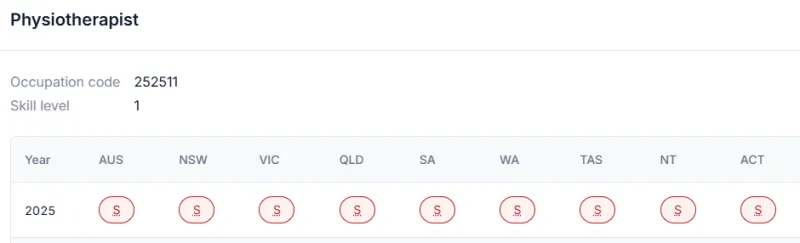
- National Shortage Status: Physiotherapists are listed on the Australian National Skills Priority List and the Medium and Long-term Strategic Skills List (MLTSSL). The Australian government projects the physiotherapy sector to grow by over 30% through the next decade.
- Key Growth Drivers: An aging population, expanded public funding for chronic condition management, and substantial allocations in the NDIS market.
- Geographic Distribution: Capital cities (Sydney, Melbourne, Brisbane) remain competitive. Conversely, regional, rural, and remote areas face severe workforce deficits, frequently offering sign-on bonuses, relocation subsidies, and accelerated visa sponsorship.
United States: Institutional Shortages and Travel Therapy
According to an APTA-informed workforce forecast published in PTJ, the U.S. had a 5.2% deficit of physical therapists in 2022 (a shortage of 12,070 FTEs). The report warns that demand for PT services is set to grow by 14.7% by 2037, outpacing overall population growth of 8%.
- Demographic Pressures: With millions of aging Baby Boomers requiring orthopedic, cardiovascular, and post-stroke rehabilitation, the US Bureau of Labor Statistics projects consistent demand growth for physical therapists.
- Sector Concentration: Skilled Nursing Facilities (SNFs), Home Health agencies, and Outpatient Orthopedic clinics report the highest recruitment deficits.
- Travel Healthcare Sector: Facilities facing staffing shortages rely heavily on travel physical therapists, creating a persistent, high-yield niche for clinicians comfortable with regional relocation every 3 months.
Salary and Compensation Comparison
Evaluating remuneration requires looking beyond base numbers to consider statutory benefits, taxation, and living expenses.
| Metric | Australia (AUD) | United States (USD) |
| Entry-Level Base Salary | $72,000 – $85,000 | $78,000 – $88,000 |
| Mid-to-Senior Base Salary | $88,000 – $140,000+ | $95,000 – $120,000+ |
| Locum / Travel Potential | $55 – $80+ / hour (Regional) | $1,800 – $2,800+ / week net (Stipends included) |
| Mandatory Retirement | 11.5%+ Employer Superannuation | Discretionary 401(k) matching (typically 3–5%) |
| Statutory Paid Time Off | 4 weeks annual leave + public holidays | Discretionary PTO (commonly 2–3 weeks total) |
| Healthcare Overhead | Universal healthcare (Medicare coverage) | Employer-sponsored plans with deductibles/premiums |
Compensation Reality: Top-tier US travel physical therapists can generate exceptionally high net income in short timeframes via non-taxable housing and per diem stipends. However, permanent positions in Australia offer competitive real compensation once statutory superannuation contributions, guaranteed annual leave, and universal healthcare coverage are factored in.
Immigration and Permanent Residency Pathways
Licensure does not grant the legal right to work. Immigration systems present entirely different operational constraints.
AUSTRALIA (Points-Based System)
[APC Final Certificate / Skills Assessment] ➔ [Submit Expression of Interest (EOI)] ➔ [Direct Permanent Residency (Subclass 189/190/491)]
UNITED STATES (Employer-Sponsored System)
[NPTE Passed & State License] ➔ [VisaScreen Certificate] ➔ [Find Employer Sponsor] ➔ [H-1B Lottery OR Schedule A EB-2/EB-3 Green Card]
Australia: Transparent Points-Based Migration
Australia provides independent and state-sponsored migration routes that do not require an immediate employer sponsor:
- Independent Skilled Migration (Subclass 189): Direct permanent residency granted based on points (age, education, English proficiency, and work experience).
- State-Nominated Migration (Subclass 190 & 491): States nominate physiotherapists to resolve local healthcare shortages, providing bonus points toward residency.
- Direct PR Outcome: Clinicians can obtain full Australian Permanent Residency prior to landing in the country.
United States: Employer-Sponsorship and Green Card Backlogs
The US system is tied directly to employer sponsorship:
- H-1B Specialty Occupation Visa: Subject to an annual federal lottery (unless hired by a non-profit university hospital system). This creates significant timeline uncertainty.
- Employment-Based Permanent Residency (EB-2 / EB-3): Physical therapists qualify under Schedule A, Group I, meaning employers are exempt from undergoing the standard, lengthy PERM labor certification process.
- Country-Specific Backlogs: While Schedule A streamlines filing, individuals born in high-demand countries (e.g., India, China) face multi-year priority date backlogs before an immigrant visa becomes available.
Comprehensive Head-to-Head Evaluation
| Parameter | Australia (APEP) | United States (NPTE) |
| Evaluating Authority | Australian Physiotherapy Council (APC) & AHPRA | FSBPT, FCCPT/CGFNS, Individual State Boards |
| Base Degree Requirement | 4-Year Bachelor of Physiotherapy (BPT) | Evaluated to US Master’s or DPT Equivalence |
| Remedial Coursework Risk | Very low for standard 4-year BPT grads | High; general education and professional deficiencies common |
| Assessment Approach | Case analysis, remote viva, hands-on workshop | 225-question standardized computer-based exam |
| Travel for Licensure | 1 required visit (Melbourne Clinical Workshop) | Can test at Prometric centers globally (if approved) |
| Standard Licensure Timeline | 12 – 18 months | 18 – 24+ months (including academic leveling) |
| Jurisdictional Mobility | National: practice anywhere in Australia | State-specific: requires endorsement across states |
| Direct Migration to PR | High; points-tested skilled visas | Complex; employer-driven with potential backlogs |
Selecting Your Optimal Pathway
Choose Australia (APEP) if:
- You Hold a 4-Year BPT Degree: The APC framework evaluates standard 4-year professional degrees without demanding additional university credits.
- You Seek Independent Permanent Residency: You prefer a merit-based, points-tested immigration system that does not bind your legal status to an employer sponsor.
- You Excel in Real-Time Clinical Reasoning: You prefer demonstrating clinical competence through oral case defense and professional dialogue rather than standardized multiple-choice exams.
- You Value Unified Regulation: You want a single, nationwide license (Ahpra) without navigating independent state rules.
Choose the United States (NPTE) if:
- You Hold a Master’s Degree or tDPT: Having post-graduate education substantially reduces or eliminates FCCPT academic deficiency findings.
- You Excel in Standardized Testing: You possess strong test-taking stamina for comprehensive, computer-based multiple-choice examinations.
- Your Goal is Peak Earning via Travel Therapy: You intend to capitalize on the lucrative US Travel PT staffing model to maximize gross income.
- You Have a Clear Sponsorship Route: You are working with an institutional sponsor capable of filing a Schedule A immigrant petition, or you were born in a country not subject to extended visa queues.
Book a 1-on-1 credential assessment with Academically's global licensing counselors. We'll evaluate your university transcripts, identify whether you face US deficiency credits, and help you map out the fastest, most cost-effective path to international practice.