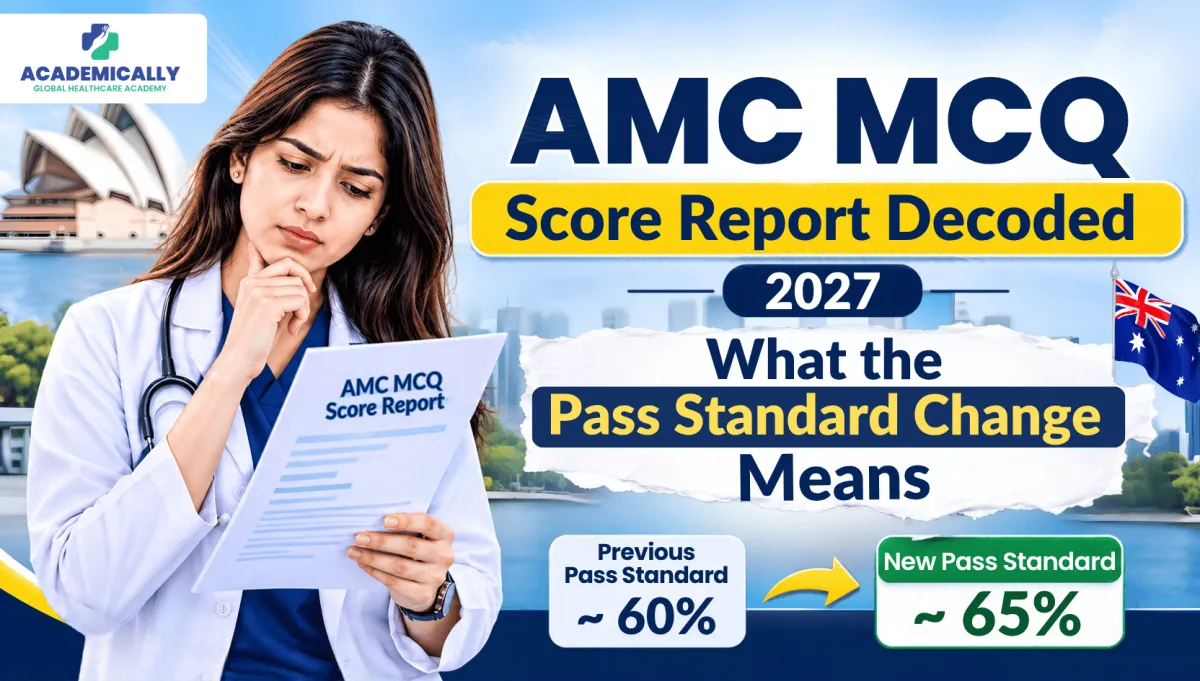
Your AMC MCQ result arrives as a single number between 0 and 500. If it says 238 or 246, the question is simple: how close was I, and what should I do now? This guide explains how the score works, what the AMC changed in its pass standard, and a practical plan if you scored between 220 and 249.
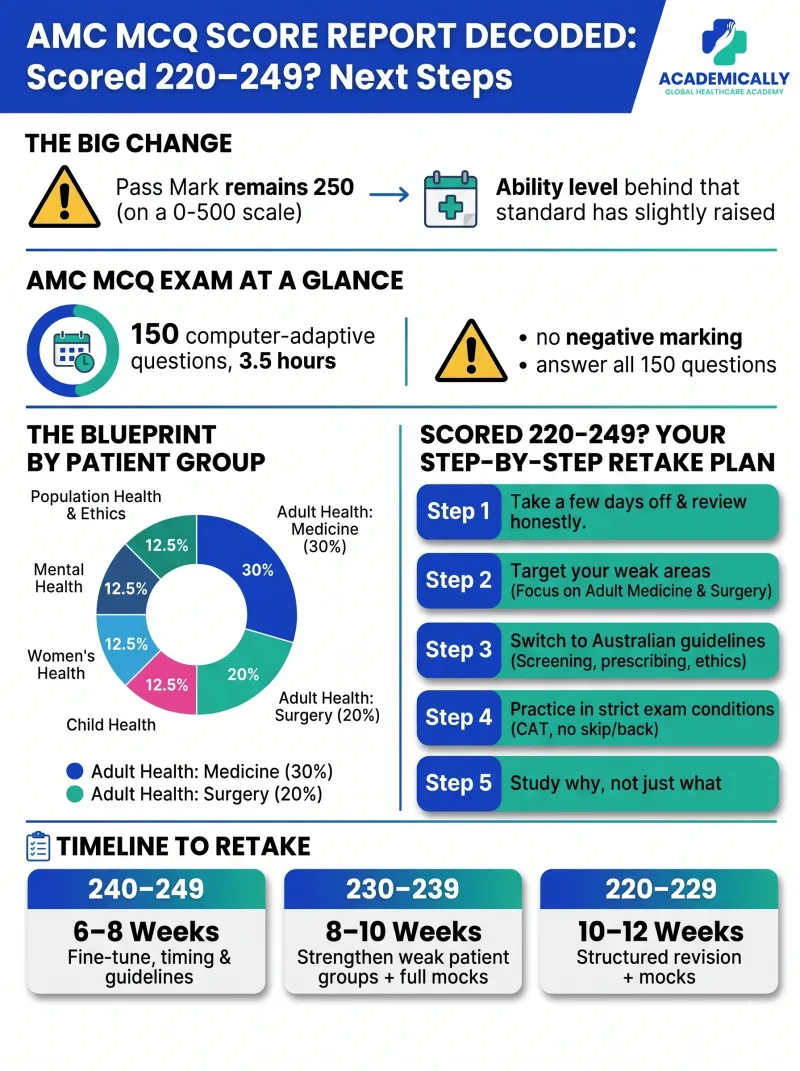
- The underlying standard rose slightly from 2026. The AMC raised the ability level behind that 250, so passing now requires slightly stronger performance on the same scale. The same standard applies if you sit in 2027 unless the AMC announces another change.
- The exam itself is the same: 150 questions, 3.5 hours, computer-adaptive, no negative marking.
- A score of 220–249 means you are close, but you need a focused plan, not just more questions.
Take Academically’s AI-based AMC Grand Test, built on the same adaptive methodology as the real AMC MCQ, before you spend on your next attempt.
How the AMC MCQ exam is scored
The AMC MCQ is a computer-adaptive test (CAT). Every candidate sees a different set of questions, chosen to match their ability.
- 150 questions in 3.5 hours, each with five options and one correct answer.
- It adapts as you go. A correct answer leads to a harder question; an incorrect answer leads to an easier one. Your ability estimate is updated after every response.
- You can’t skip or go back. Questions are answered in order, so time management matters.
- You must answer all 150. An incomplete exam may be recorded as a fail because there isn’t enough data.
- No negative marking. Never leave a question blank.
- Your score reflects ability, not a raw count. Harder questions carry more weight, so your score is not a percentage.
Questions follow a fixed blueprint by patient group:
| Patient group | Share of exam | Approx. questions |
| Adult health: Medicine | 30% | 45 |
| Adult health: Surgery | 20% | 30 |
| Women’s health: Obstetrics & Gynaecology | 12.5% | 19 |
| Child health | 12.5% | 19 |
| Mental health | 12.5% | 19 |
| Population health & Ethics | 12.5% | 19 |
Questions are also grouped by clinical task: data gathering, data interpretation and synthesis, and management.
What changed in the AMC MCQ pass standard?
On 17 December 2025, the AMC announced a slight increase to the MCQ pass standard, applying from 2026.
| Item | Before 2026 | From 2026 (and for 2027 sittings) |
| Score scale | 0–500 | 0–500 (unchanged) |
| Reported pass mark | 250 | 250 (unchanged) |
| Ability needed to reach 250 | Previous standard | Slightly higher |
| Exam content and format | 150 CAT questions, 3.5 hours | Unchanged |
What it means in plain words: 250 is still the number you need, but the ability level behind that number is slightly higher. The AMC has not published how big the change is.
Why the AMC changed it: The AMC periodically benchmarks the pass standard against the level expected of graduating medical students in Australia, working with Australian medical schools. This was a routine review, not a change in exam difficulty.
What did not change:
- The exam content, format and structure
- How results are reported (still 0–500)
- Earlier results: each result is judged against the standard in place when the exam was sat
How to read your AMC MCQ score report
Results are released in your AMC account at 4:00 pm on the Friday, three weeks after your exam. They are never given over the phone. Each candidate receives a computer-generated transcript with their result and performance feedback.
When you read it, focus on three things:
- Your scaled score (0–500). 250 or above is a pass. It is an ability estimate, not a percentage of correct answers.
- The gap to 250. A score of 240 is much closer to passing than 200. Use the gap to judge how much work you need (see the next section).
- The performance feedback. Use whatever it shows about your performance to find your weakest areas, and back it up with your own mock-test data. Compare it with the blueprint: a weak area worth 30% of the exam (adult medicine) matters more than one worth 12.5%.
Don’t compare your score with friends’ percentages from question banks. A CAT score measures how hard the questions you answered correctly were, not how many you got right.
Scored 220–249? Your step-by-step retake plan
A score in this range usually means your knowledge base is close, but something specific held you back: a weak patient group, poor timing, or not thinking the “Australian way.” Here’s how to close the gap.
- Take a few days off, then review honestly. Don’t book the next exam the same day. Write down what felt hard: specific topics, question styles, or running short of time.
- Find your weak areas using the blueprint. Adult medicine (30%) and surgery (20%) make up half the exam. If either felt weak, start there. Then check the four 12.5% areas: obstetrics and gynaecology, child health, mental health, and population health and ethics.
- Switch to Australian guidelines. Many IMGs lose marks by answering from their home-country practice. Study Australian approaches to screening, vaccination, prescribing, ethics, consent and mandatory reporting. Population health and ethics questions are often where Indian doctors drop marks.
- Practise in exam conditions. You can’t skip or go back, so practise blocks of questions in strict order with a timer. Aim to finish 150 questions comfortably within 3.5 hours. A structured AMC QBank makes timed blocks easier to track.
- Study why, not just what. For every wrong practice answer, write one line on why the right answer is right. This builds the clinical reasoning the CAT rewards on harder questions.
- Use the official AMC practice app. The free MCQ preparation app (210 questions with feedback, refreshed in April 2026) is aligned with the exam blueprint and standard.
- Set a realistic retake date. Use the table below as a starting point.
- Get feedback from someone who has passed. A mentor who has cleared the AMC can spot patterns in your mistakes much faster than you can alone.
| Your score | Suggested focus | Typical extra preparation |
| 240–249 | Fine-tune weak areas, timing and Australian guidelines | 6–8 weeks |
| 230–239 | Strengthen 2–3 weak patient groups plus full mocks | 8–10 weeks |
| 220–229 | Structured revision of all six areas plus mocks | 10–12 weeks |
These timeframes are general guidance, not AMC rules. You can only apply for one exam at a time and must receive your result before applying again. Each attempt also needs a new authorisation and fee, so don’t rush back before you’re ready.
Academically’s AI-based AMC Grand Test
The hardest part of a retake is knowing when you’re truly ready. That’s why Academically built an AI-based AMC Grand Test for its AMC coaching students.
- Built like the real exam: it uses an adaptive methodology modelled on how the AMC MCQ estimates ability, so your result reflects the kind of performance the real exam rewards.
- A clear readiness benchmark: in our experience, students who score 70% or more on the Grand Test are well placed to pass the AMC MCQ.
- Book with confidence: once a student reaches a satisfactory Grand Test score, our mentors recommend booking the exam. If not, they get a targeted study plan to close the gap first, instead of paying for an attempt they aren’t ready for.
- Measurable progress: students who use the Grand Test alongside our AMC coaching see significant improvement in their scores between attempts.
The Grand Test is a readiness guide, not a guarantee. Your real AMC result depends on your performance on exam day. Dr Hemanshu passed the AMC MCQ in the July 2026 sitting, with his result released on 7 August 2026. While working, he planned his weeks in a study diary, practised 40–50 questions every morning and took a full Grand Test every Sunday, regularly scoring around 85–90. He told Academically that the Grand Tests reflected the real exam’s question framing, language and clinical concepts, and that regular practice improved his speed. You can read Dr Hemanshu’s AMC success story for his full preparation plan.
The bottom line
The AMC MCQ pass mark is still 250, but since 2026 the ability behind it is slightly higher. If you scored 220–249, you’re close. A targeted plan built around the blueprint, Australian guidelines and timed practice is usually what closes the gap.
Academically’s AMC Exam Preparation Course, mentored by Dr Akram Ahmad (PhD, University of Sydney), includes 120+ hours of live and recorded classes, 4,000+ practice MCQs, AI-based mock tests, one-on-one guidance from AMC-qualified doctors practicing in Australia, and the AI-based AMC Grand Test to confirm you’re ready before you book.