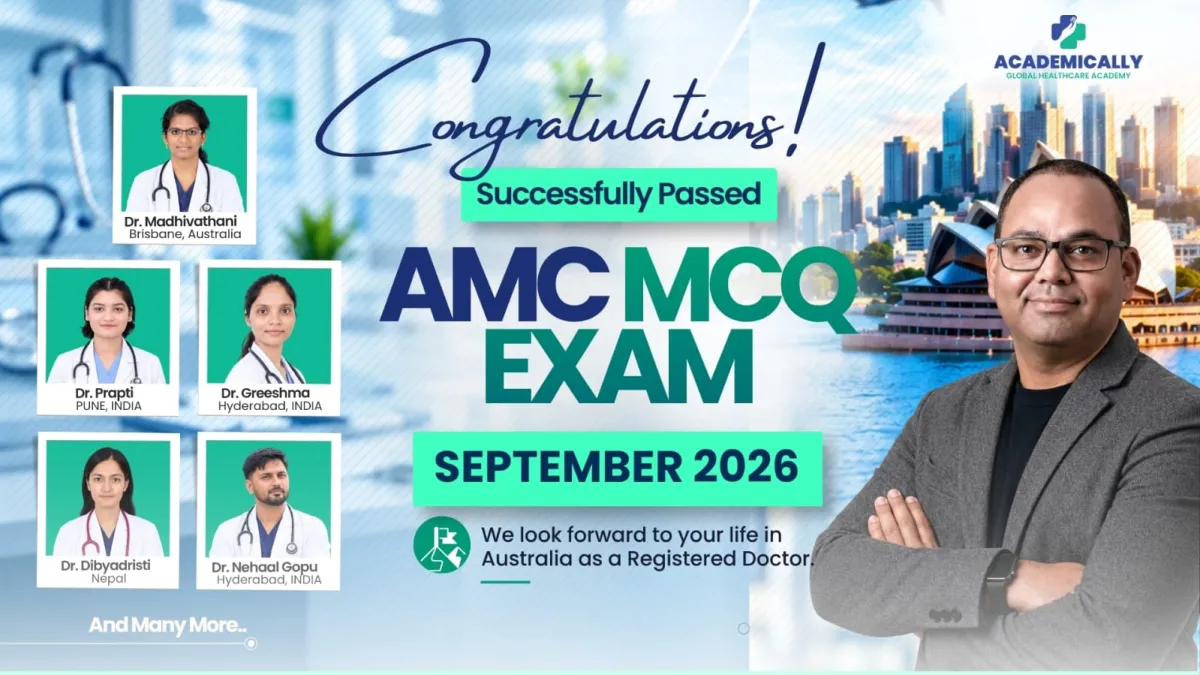
The Australian Medical Council has released the AMC CAT MCQ Part-1 results for the September 2026 examination cycle, marking a historic milestone on their journey toward clinical practice in Australia.
We are ecstatic to share that Academically Global has once again maintained an exceptional 90%+ pass rate, continuing our legacy of empowering overseas doctors to realize their Australian medical dream.
Heartiest Congratulations to Our September 2026 AMC Achievers!
A huge, heartfelt congratulations to every single candidate from the September 2026 cohort who cleared the AMC CAT MCQ examination!
Opening that result portal and seeing the word "PASS" is the culmination of countless hours of clinical reasoning, grueling late-night case revisions after long hospital shifts, and relentless perseverance. Balancing active clinical duty with the rigorous demands of the Australian curriculum is no small feat, and your triumph today reflects true clinical excellence.
The entire faculty, mentorship board, and student support team at Academically Global take immense pride in celebrating this monumental achievement with you. You haven't just cleared an exam, you have unlocked the door to your future medical career under the Medical Board of Australia and AHPRA. We celebrate your determination, your resilience, and your commitment to patient safety!
AMC Exam Results September 2026: At a Glance
| Feature | Details |
| Exam Conducted | AMC CAT MCQ (Standard Pathway Part-1) |
| Exam Delivery Window | September 2026 |
| Testing Partner | Pearson VUE (Worldwide Test Centres) |
| Academically Success Rate | 90%+ |
| Format | Computer Adaptive Test (CAT) |
| Questions & Duration | 150 Single Best Answer MCQs (3.5 Hours / 210 Minutes) |
| Scored vs. Trial Items | 120 Scored MCQs + 30 Pilot/Pre-test Items |
| Benchmark Passing Score | 250 / 500 Scaled Score |
What Made the September 2026 AMC Exam Unique?
While past exam cycles leaned heavily into classic presentation recall, candidate feedback from the September 2026 session reveals a sharp pivot toward real-time clinical safety and management hierarchy:
Shift from "What is the Diagnosis?" to "Next Safe Management Step"
Rote diagnostic stems were rarely seen. In most vignettes, the diagnosis was already explicitly given (e.g., confirmed acute pulmonary embolism or established gestational diabetes), and the question instead challenged:
- “What is the most appropriate initial investigation before initiating step-two therapy?”
- “What is the safest pharmacological dose adjustment for this patient with borderline renal clearance?”
The Weight of Australian Preventive Guidelines (RACGP "Red Book")
The September exam leaned heavily into Australian community health and public screening protocols. High-yield items regularly tested:
- Cervical screening protocols (HPV primary testing timelines and follow-up colposcopy indications under the Australian National Cervical Screening Program).
- First Nations (Aboriginal and Torres Strait Islander) adult cardiovascular and diabetes health assessments (MBS Item 715).
- Colorectal cancer screening algorithms using biennial iFOBT from age 45 vs. direct colonoscopy intervals for familial risk.
Medical Ethics, Consent & End-of-Life Law
Ethical questions in the AMC CAT MCQ are not generic "good doctor" questions. In September 2026, students noted nuanced queries testing:
- Advance Care Directives (ACDs) and Medical Treatment Decision Makers (MTDM) when family members dispute documented patient wishes.
- Mandatory reporting thresholds vs. patient confidentiality (particularly in suspected elder abuse or fitness-to-drive declarations under Austroads guidelines).
- Open disclosure protocols and informed consent involving mature minors under Gillick competence.
Topic Breakdown: September 2026 Exam Pattern
The AMC Computer Adaptive Test balances questions across six core blueprint domains, assessing safe clinical judgment at the standard of an Australian final-year medical graduate:
| Specialty Domain (AMC Blueprint) | Blueprint Weighting | September 2026 Exam Focus & High-Yield Concepts |
| Adult Health – Medicine | ~30% (35 Scored MCQs) | Therapeutic Guidelines (eTG) antibiotic ladders, acute ACS pathways, heart failure escalation, stroke thrombolysis time windows, and COPD exacerbations. |
| Adult Health – Surgery | ~20% (25 Scored MCQs) | Acute surgical abdomen (appendicitis, bowel obstruction), post-operative fever timeline (Day 1–5 "Wind, Water, Wound, Walking, Wonder drugs"), compartment syndrome, and trauma primary survey ($ABCDE$). |
| Women’s Health (O&G) | ~12.5% (15 Scored MCQs) | Antepartum and postpartum haemorrhage algorithms, pre-eclampsia diagnostic cutoffs, post-menopausal bleeding workup, and contraceptive safety criteria (MEC categories). |
| Child Health (Paediatrics) | ~12.5% (15 Scored MCQs) | The red-flag febrile child, bronchiolitis vs. viral-induced wheeze, developmental milestone delays, neonatal jaundice, and the Australian National Immunisation Program schedule. |
| Mental Health | ~12.5% (15 Scored MCQs) | State-based Mental Health Act criteria for involuntary admission, acute psychosis de-escalation, suicide risk triaging, and safety monitoring for Lithium and Clozapine. |
| Population Health & Ethics | ~12.5% (15 Scored MCQs) | RACGP Red Book screening protocols, ATSI health disparities, medico-legal duty of care, open disclosure, and impaired practitioner reporting. |
Candidate Experience & Preparation Strategy: Overcoming Exam Hurdles to Clear the AMC CAT MCQ
Dr. Sarah M.: Transitioning from Recall Memorization to Australian Clinical Reasoning
For Dr. Sarah M., an IMG balancing 10-hour hospital shifts as a junior resident, cracking the AMC MCQ on her first attempt required unlearning textbook rote-learning.
"I spent my first month memorizing recalls, but my diagnostic mock scores barely moved. Academically taught me that the CAT algorithm prioritizes clinical safety above all. Their mentors trained us to turn every recall into a thematic guideline map—especially in respiratory and antenatal emergencies. Walking out of Pearson VUE, I knew that understanding Australian clinical reasoning made all the difference."
Dr. Tariq K.: Overcoming a 3-Year Clinical Gap with Timed Adaptive Mocks
For Dr. Tariq K., returning to acute medicine after a three-year career gap made the strict 3.5-hour time limit his greatest anxiety.
"Being away from hospital wards slowed my reflexes, and I left over 20 questions blank in my first practice test. Academically completely shifted my mindset toward Australian HMO triage protocols. Their timed adaptive mocks trained me to spot red flags within 80 seconds and apply eTG ladders systematically. Clearing with a 268 scaled score proved a clinical gap is never a barrier with the right guidance."
For Dr. Ananya R., an overseas medical officer balancing exhausting 60-hour intensive care and emergency shifts, structured revision time was a scarce luxury.
"With back-to-back night duties, sitting down for four straight hours of textbook study was practically impossible. Academically completely reshaped my approach through high-yield modular learning. Instead of getting bogged down in endless theory, the live case-discussion classes helped me break down complex multi-system emergencies into Australian standard algorithms. Practicing with mobile-friendly mini-quizzes during hospital breaks sharpened my recall, and the CAT grand mocks simulated the exact cognitive fatigue of the 150-question marathon. Clearing AMC Part-1 on my very first attempt with a 274 scaled score showed me that consistency and targeted strategy easily beat unstructured, long study hours."
For Dr. Farhan A., an international medical graduate trained outside the Commonwealth system, the clinical medicine section felt manageable, but Australian medical jurisprudence, consent laws, and preventive screening were uncharted territory.
"In my home country's curriculum, public health and medico-legal protocols were barely emphasized. When I took my first diagnostic mock, I lost almost all my marks in Australian preventive guidelines, MBS items, and Mental Health Act scenarios. Academically’s deep dive into the RACGP Red Book and ethical case vignettes became my turning point. The faculty taught us how to instinctively apply Gillick competence, open disclosure protocols, and First Nations health checks just like an Australian HMO. Seeing those exact ethical dilemmas in my September Pearson VUE exam felt like second nature. Passing with confidence proved that mastering local healthcare context is the ultimate game-changer."
Ready to build your own success story? Join the next cohort and prepare with Australia-based doctors.
Upcoming AMC CAT MCQ Exam Dates & Booking Windows
The Australian Medical Council conducts the CAT MCQ examination round-the-year in monthly blocks through authorized Pearson VUE centres worldwide.
Important Calendar Note for Candidates:
The AMC does not schedule examinations in December or January. Therefore, November 2026 is the final test sitting of the calendar year, with examinations resuming in mid-February 2027.
If you are planning your test timeline, keep these exact official scheduling cut-offs and event dates on your radar:
| Examination Window | Scheduling Closes | Exam Event Dates | Expected Results Date |
| October 2026 | Mon, 21 Sep 2026 | 12 – 17 October 2026 | Fri, 6 Nov 2026 |
| November 2026(Final 2026 Sitting) | Mon, 26 Oct 2026 | 16 – 21 November 2026 | Fri, 11 Dec 2026 |
| December 2026 & January 2027 | — | NO EXAMS HELD(Annual AMC System Recalibration) | — |
| February 2027(First 2027 Sitting) | Mon, 25 Jan 2027 | 15 – 20 February 2027 | Fri, 12 Mar 2027 |
| March 2027 | Mon, 22 Feb 2027 | 15 – 20 March 2027 | Fri, 9 Apr 2027 |
.Why Academically Candidates Consistently Score 90%+
Achieving a pass rate above 90% across consecutive cohorts is no accident. Our specialized AMC curriculum bridges the gap between international medical training and Australian healthcare standards:
- Faculty of AHPRA-Registered Physicians: Live interactive sessions run by doctors who practice within the Australian healthcare system and understand local clinical pathways.
- AI-Driven Computer Adaptive Mock Exams: Simulating the CAT algorithm so candidates master pacing, question difficulty swings, and time management across 150 items.
- Focus on Australian Guidelines: Comprehensive alignment with RACGP, eTG (Therapeutic Guidelines), RANZCOG, and Australian Red Book standards.
- Structured Recall Deconstructions: Breaking down actual recent questions into clinical decision trees rather than surface-level flashcards.
Cleared AMC September 2026? Your Next Steps
Passing the AMC CAT MCQ Part-1 is a massive milestone. Here is how to keep your momentum going:
- Verify Your Language Credentials: Ensure your IELTS (7.0 in each band) or OET (Grade B in each sub-test) is valid for AHPRA.
- Select Your Pathway for Stage 2: Decide between preparing for the AMC Clinical Exam (OSCE) or pursuing hospital posts eligible for Workplace Based Assessment (WBA).
- Build an Australian-Format Medical CV: Structure your clinical logbooks and references in line with Australian medical workforce expectations.
- Begin Job Applications for PGY2/Junior Medical Officer (JMO) Roles: Keep track of mid-year campaign intakes and regional health district openings across Victoria, NSW, Queensland, and Western Australia.
The September 2026 AMC CAT MCQ results reaffirm that clinical success in Australia is entirely achievable when medical knowledge is paired with structured, guideline-anchored reasoning. As the Australian healthcare sector continues to expand its doors to international talent, clearing this initial hurdle transforms global medical graduates from aspiring candidates into competitive future Australian clinicians. With structured preparation, disciplined time management, and expert mentorship, your pathway to practicing medicine in Australia is clearer and more attainable than ever.
Master the Australian medical guidelines and crack the exam on your first attempt.