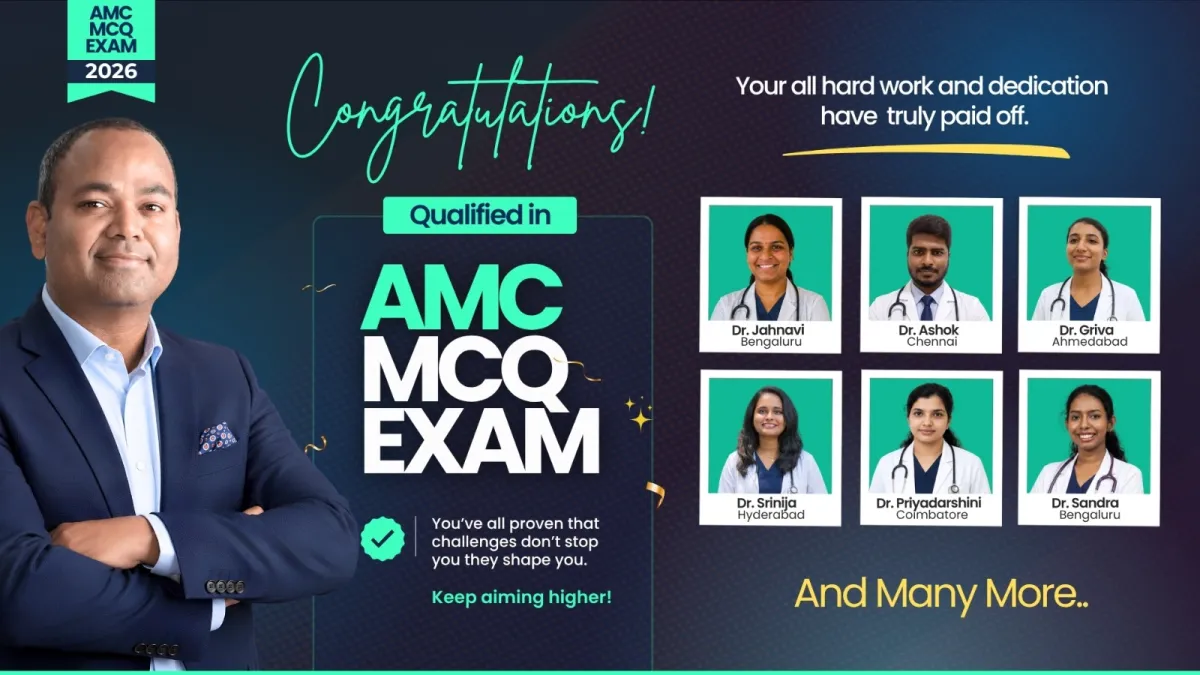
The AMC Exam Results for June 2026 are officially out, and we're proud to celebrate another remarkable milestone. More than 90% of Academically's candidates have successfully cleared the Australian Medical Council (AMC) MCQ Examination, bringing them one step closer to practising medicine in Australia.
Behind every successful result is a story that extends far beyond textbooks. Some candidates prepared while completing night shifts in emergency departments. Others balanced family responsibilities, internship, or full-time employment. A few had previously missed the passing standard and returned stronger with a different strategy.
This result season wasn't simply about achieving a pass. It was about proving that structured preparation, consistency, and the right guidance can transform uncertainty into confidence.
Since the results have declared for AMC exam on 10th July 2026, our Academic Head for Medical Licensing Studies, Dr. Ssnegdha Sharma, Academic Head of Medical Courses along with Dr. Sonal, Programme Manager for AMC Course, interacted with several successful candidates from this June cohort. Their journeys were different, but the principles behind their success were remarkably similar.
If you're preparing for the upcoming AMC examination, these experiences may help you shape your own preparation strategy. Keep reading.
AMC Exam June 2026 Results: At a Glance
Another examination cycle, another cohort of international medical graduates moving one step closer to Australia. Although the AMC continues to maintain rigorous assessment standards focused on clinical reasoning and evidence-based decision-making, our candidates consistently demonstrated that systematic preparation delivers results.
| Highlights | June 2026 Cohort |
| Overall Success Rate | 90%+ |
| Countries Represented | India, Nepal, UAE, Nigeria, Sri Lanka & Philippines |
| Average Preparation Duration | 4–7 Months |
| Mock Questions Solved Before Exam | 1,000+ |
| Exam Format | 150 Computer Adaptive MCQs |
Unlike many licensing examinations that primarily reward rote-learning, the AMC increasingly evaluates clinical judgement, prioritisation, and decision-making within the Australian healthcare system.
That shift was reflected throughout the June examination, where candidates consistently reported scenarios testing first-line management, emergency care pathways, preventive medicine, ethics, and Australian clinical guidelines rather than isolated factual recall.
Fortunately, these areas had already become an integral part of our preparation programme through updated mock examinations, recall-based revisions, adaptive assessments, and regular faculty-led discussions.
How International Medical Graduates Cleared the AMC Exam in June 2026
Every successful candidate prepared differently. Some relied heavily on mock examinations. Others built concise revision notes. A few transformed previous failures into learning opportunities, while others balanced demanding hospital schedules alongside preparation.
Here are some of the inspiring journeys from our June 2026 passouts.
Dr. Mehak Singh: Turning Average Mock Scores into an AMC Pass
When Dr. Mehak Singh, an MBBS graduate from Punjab, began her preparation in February, her initial Grand Test scores rarely crossed 56%. Like many international medical graduates, she questioned whether she was actually ready for the AMC examination. She recalled:
"I used to compare my scores with everyone else in the discussion group. Whenever someone scored above 70%, I felt I was falling behind."
Instead of extending her study duration indefinitely, she decided to understand why her scores remained stagnant. Every incorrect answer was categorised into one of three groups:
- Concept not understood
- Misread the question
- Changed the correct answer during review
Within three weeks, a pattern emerged. Almost half of her mistakes weren't due to poor medical knowledge. They resulted from rushing through lengthy clinical scenarios and changing answers despite selecting the correct option initially. Rather than studying new material, she focused on improving decision-making. Each mock examination became less about marks and more about understanding her thought process.
By the final month before the examination, her scores consistently reached the mid-70s.
"The biggest improvement wasn't learning more medicine. It was learning how the AMC asks questions."
She also maintained a dedicated notebook titled Australian Guidelines Revision, where she summarised high-yield recommendations for asthma, hypertension, antenatal care, cervical screening, diabetes, and emergency medicine into quick one-page revision sheets. Those summaries became her primary revision material during the final fortnight.
Her advice for future candidates is simple:
"Don't judge yourself by one mock score. Judge yourself by whether you're making fewer mistakes every week."
What Aspirants Can Learn
Many candidates treat mock examinations as performance reports. They're far more valuable as diagnostic tools. Every incorrect answer reveals a specific weakness, whether conceptual understanding, interpretation, or exam temperament. Identifying these patterns early allows focused improvement and often produces greater score gains than simply studying additional theory.
Dr. Emmanuel Okafor: Studying Around ICU Shifts Without Burning Out
Preparing for the AMC while working in intensive care isn't easy. For Dr. Emmanuel Okafor, a physician working in Lagos, Nigeria, finding uninterrupted study time was nearly impossible. Some weeks included overnight ICU duties followed by daytime revision sessions.
"I realised very quickly that waiting for free time wasn't going to work."
Instead of chasing long study hours, he divided preparation into manageable blocks.
- Morning: 30 MCQs
- Lunch break: Review explanations
- Evening: One recorded lecture
- Weekend: Full-length mock examination
Rather than measuring productivity by hours studied, he tracked completed learning objectives. This small change helped him remain consistent without feeling overwhelmed. Another habit proved invaluable. Every Sunday, he revisited questions answered incorrectly during the previous week. Instead of solving new questions, he focused entirely on understanding why he had made mistakes.
"The same concepts appeared repeatedly. Once I corrected those gaps, my confidence improved automatically."
He also highlighted one area that many IMGs underestimate, Australian preventive healthcare. Topics like national screening programmes, vaccination schedules, smoking cessation counselling, and antenatal recommendations appeared frequently throughout his preparation and eventually in the actual examination.
"Clinical medicine is important, but Australian healthcare places enormous emphasis on prevention. Once I understood that, many questions became much easier."
What Aspirants Can Learn
Consistency often matters more than marathon study sessions. Even candidates working full-time can prepare effectively by dividing learning into smaller, structured sessions and reviewing mistakes regularly. Progress comes from sustained improvement over months rather than occasional bursts of intensive study.
Dr. Riya Menon: How an FMGE Qualifier Cracked the AMC on Her First Attempt
For Dr. Riya Menon from Kerala, preparing for the AMC Exam began almost immediately after clearing the Foreign Medical Graduate Examination (FMGE). Although she had already spent months revising medicine for FMGE, she quickly realised that the Australian Medical Council Exam expected a very different style of thinking. She said:
"I assumed the knowledge I had gained for FMGE would be enough. After my first mock test, I realised the questions weren't asking what the disease was, they were asking what I would actually do as the treating doctor."
Instead of memorising isolated facts, she started organising every topic around a simple clinical sequence:
- Patient presentation
- Differential diagnosis
- First investigation
- Confirmatory investigation
- Initial management
- Definitive treatment
- Follow-up
This approach transformed her preparation. Rather than reading medicine chapter by chapter, she began thinking like a clinician managing real patients.
She also maintained a spreadsheet of Australian guidelines that differed from common practices she had learned during MBBS and FMGE preparation. Every time she encountered a new recommendation in asthma, antenatal care, cervical screening, mental health, or preventive medicine, she added it to her revision sheet.
By the final month, those concise notes had replaced bulky textbooks.
"The AMC isn't looking for the smartest doctor in the room. It's looking for the safest one."
Another major contributor to her success was repeated AI-based mock practice that would adapt to the candidate's response and display the next questions. She attempted every comprehensive mock available and carefully reviewed explanations, even for questions she answered correctly.
"I realised correct answers can sometimes come from guessing. Unless I understood why an option was correct, I didn't consider that topic finished."
She cleared the exam on her very first attempt.
What Aspirants Can Learn
Many FMGE-qualified doctors already possess strong theoretical knowledge. The challenge lies in adapting that knowledge to Australia's evidence-based clinical practice. Learning to think in terms of patient management pathways rather than isolated facts significantly improves clinical reasoning, one of the most heavily tested skills in the AMC examination.
Dr. Ahmed Al-Hassan: Why He Used Recalls to Build Concepts Instead of Memorising Questions
Originally from the UAE, Dr. Ahmed Al-Hassan had seen countless recall documents circulating across Telegram and WhatsApp groups before his AMC examination. Initially, he considered memorising them. Fortunately, advice from mentors changed his strategy.
"I stopped asking whether the exact question would appear. I started asking why that topic kept appearing."
Every recalled question became the starting point for broader revision. If candidates reported pulmonary embolism, he revised:
- Risk factors
- Clinical presentation
- Wells Score
- D-dimer interpretation
- CT Pulmonary Angiography
- Initial anticoagulation
- Long-term management
Similarly, if recalls mentioned postpartum haemorrhage, he revised the complete management algorithm rather than a single recalled scenario. This approach gave him confidence even when unfamiliar questions appeared during the actual examination.
"The wording was different, but the clinical reasoning felt familiar."
Another habit helped enormously. Instead of spending the last week reading textbooks, he exclusively revised:
- Mock test explanations
- Personal notes
- Incorrect questions
- Australian guideline summaries
He deliberately avoided beginning any completely new subject.
"The last week isn't the time to increase knowledge. It's the time to improve recall."
When his result arrived in June, the strategy had paid off.
What Aspirants Can Learn
Recalls remain valuable, but only when used correctly. Rather than memorising individual questions, use recalls to identify repeatedly tested topics and revise those concepts comprehensively. This prepares you for new clinical scenarios while strengthening overall understanding.
High-Yield Topics Reported in AMC Exam June 2026
Although the Australian Medical Council does not publish official subject-wise weightage, candidates from the June 2026 cohort consistently reported seeing several recurring themes throughout the examination. These observations are based on candidate feedback collected after the exam and should be viewed as preparation guidance rather than official AMC data.
| Subject | Candidate Feedback |
| Emergency Medicine | ★★★★★ Very High |
| General Practice | ★★★★★ Very High |
| Medical Ethics & Professionalism | ★★★★★ Very High |
| Obstetrics & Gynaecology | ★★★★☆ High |
| Preventive & Community Medicine | ★★★★☆ High |
| Psychiatry | ★★★★☆ High |
| Infectious Diseases | ★★★★☆ High |
| Paediatrics | ★★★☆☆ Moderate |
| Cardiology | ★★★☆☆ Moderate |
| Endocrinology | ★★★☆☆ Moderate |
| Respiratory Medicine | ★★★☆☆ Moderate |
| Orthopaedics | ★★☆☆☆ Moderate-Low |
Across interviews with successful candidates, several common themes emerged. Candidates frequently encountered questions requiring them to:
- Select the most appropriate first-line investigation
- Choose the safest next step in management
- Apply Australian screening recommendations
- Interpret emergency scenarios rapidly
- Differentiate between multiple clinically plausible diagnoses
- Demonstrate ethical decision-making within the Australian healthcare system
Very few candidates described the examination as purely factual. Instead, most agreed that success depended on combining clinical knowledge with sound judgement.
AMC Preparation Timeline Followed by Our June-July 2026 Passouts
Although every doctor's journey was different, their preparation timelines followed remarkably similar patterns.
| Preparation Phase | Average Duration | Main Focus |
| Foundation Phase | Weeks 1–4 | Understand the AMC exam pattern, revise core medicine, surgery, paediatrics, obstetrics & gynaecology, and begin learning Australian clinical guidelines. |
| Practice Phase | Weeks 5–8 | Solve subject-wise MCQs, attend live/recorded sessions, strengthen weak subjects, and build clinical reasoning skills. |
| Integration Phase | Weeks 9–12 | Attempt comprehensive mock tests, revise recall topics, improve differential diagnosis, and analyse incorrect answers. |
| Performance Phase | Weeks 13–16 | Take full-length Grand Tests, improve speed and accuracy using AI analytics, and focus on high-yield topics and Australian ethics. |
| Final Revision | Last 2–3 Weeks | Revise personal notes, mock explanations, Australian guidelines, ethics, emergency medicine, and frequently recalled concepts. Avoid starting new topics. |
| Exam Week | Final 5–7 Days | Focus on light revision, review incorrect MCQs, maintain confidence, and prioritise rest over intensive studying. |
One interesting observation across the June cohort was that almost every successful candidate shifted their focus away from learning new material during the final fortnight. Instead, they concentrated on improving accuracy, strengthening decision-making, and revising previously identified weak areas.
What Made the AMC June-July 2026 Cohort Successful?
Despite coming from different countries, backgrounds, and clinical experiences, all four successful candidates shared several common habits.
| Successful Habit | Why It Worked |
| Started mock tests early | Improved familiarity with AMC-style questions |
| Analysed every incorrect answer | Reduced repeated mistakes |
| Revised Australian clinical guidelines | Helped answer management-based questions confidently |
| Prioritised clinical reasoning over memorisation | Matched the AMC examination style |
| Focused on ethics and preventive medicine | Frequently tested areas in recent exams |
| Used recalls to identify topics, not memorise questions | Built stronger conceptual understanding |
| Limited new study during the final week | Improved retention and confidence |
One message came through clearly from every interview. Passing the AMC examination was never about studying every possible topic. It was about studying the right topics, revising them consistently, and developing the confidence to make safe clinical decisions under examination conditions.
The Ultimate AMC Preparation Strategy: What Every Success Story Had in Common
One of the most fascinating observations from our post-result interviews was that no two candidates followed the exact same timetable. Some studied for six months, while others prepared in just over three. Some worked full-time in hospitals, while others prepared immediately after graduation.
Yet despite their different journeys, several common habits emerged across almost every successful candidate. These weren't shortcuts or secret resources. They were practical strategies that consistently helped candidates perform well in the AMC MCQ Examination.
1. Clinical Decision-Making Always Came Before Rote-Learning
One recurring theme across every interview was that successful candidates gradually shifted their focus from "What is the diagnosis?" to "What should I do next?" Unlike many undergraduate examinations, the AMC doesn't simply assess whether you recognise a disease. It expects you to make safe, evidence-based decisions within the Australian healthcare system.
Candidates who consistently performed well practised questions that required them to identify:
- The most appropriate first investigation
- The next best investigation when initial tests were inconclusive
- First-line management
- Definitive treatment
- Appropriate follow-up
- When referral was necessary
This approach helped them think like practising clinicians rather than students preparing for a theory examination.
2. Mock Tests Became Learning Sessions, Not Scorecards
Many candidates admitted that their first few Grand Test scores were disappointing. Instead of becoming discouraged, they used those scores to guide their preparation. Every incorrect answer was reviewed carefully. Questions were analysed to determine whether the mistake resulted from:
- Lack of knowledge
- Misinterpreting the clinical scenario
- Poor time management
- Confusion between similar treatment options
- Overthinking simple questions
Several candidates mentioned that analysing mistakes contributed more to their improvement than solving additional MCQs.
3. High-Yield Revision Replaced Endless Reading
Almost every doctor interviewed described a similar experience. The closer the examination approached, the less time they spent reading textbooks. Instead, they focused on:
- Personal revision notes
- Mock test explanations
- Australian clinical guidelines
- Ethics
- Frequently tested diseases
- Candidate recall topics
- Rapid review sheets
This strategy helped improve recall speed while reducing information overload during the final weeks.
4. Australian Guidelines Were Treated as Separate Subjects
One of the biggest adjustments for many international medical graduates involved adapting to Australian clinical practice. Candidates repeatedly emphasised the importance of understanding:
- Cervical screening recommendations
- National immunisation schedules
- Antenatal care
- Mental health legislation
- Smoking cessation counselling
- Indigenous healthcare
- Preventive medicine
- Shared decision-making
Many questions appeared straightforward medically but required selecting the management option recommended within Australia's healthcare system.
5. Consistency Outperformed Long Study Hours
Some successful candidates studied four hours a day. Others managed only ninety minutes because of clinical duties. Interestingly, the total number of daily study hours wasn't the strongest predictor of success. Consistency was.
Candidates who maintained regular revision schedules over several months generally reported greater confidence than those attempting last-minute intensive preparation. Small daily improvements accumulated into substantial progress over time.
Why Australia Continues to Attract International Medical Graduates
For most overseas doctors, passing the AMC examination represents much more than clearing another licensing test. It opens the door to practising medicine in one of the world's most respected healthcare systems while offering long-term professional growth, financial stability, and an excellent quality of life.
Australia continues to experience workforce shortages across multiple medical specialties, particularly in regional and rural areas. International Medical Graduates (IMGs) therefore remain an essential part of the country's healthcare workforce. Some of the major reasons doctors continue choosing Australia include:
- Competitive salaries across both public and private healthcare sectors
- Better work-life balance compared with many other healthcare systems
- Clearly structured specialist training pathways
- Opportunities for permanent residency
- High standards of workplace safety and professional support
- Modern hospitals with strong emphasis on evidence-based medicine
- Growing demand across emergency medicine, psychiatry, general practice, geriatrics, rural medicine, and rehabilitation
Beyond financial incentives, many doctors also highlighted the collaborative culture within Australian hospitals, where multidisciplinary teamwork, patient safety, and continuing professional development are strongly encouraged.For international graduates seeking long-term career stability, Australia continues to remain one of the most preferred destinations globally.
AMC vs FMGE 2026: Which Licensing Exam Should Indian Doctors Choose?
Following the FMGE June 2026 results, one of the most common questions among Indian medical graduates has been whether they should continue pursuing registration in India or explore opportunities in Australia through the AMC pathway.
The answer depends entirely on your career goals. If your objective is to practise medicine within India, the FMGE remains the mandatory licensing examination for eligible foreign medical graduates.
However, if you plan to build a medical career in Australia, the AMC pathway is specifically designed for international medical graduates seeking registration with the Medical Board of Australia. The two examinations assess different competencies and lead to entirely different career pathways.
| Factor | AMC Examination | FMGE |
| Primary Purpose | Medical registration in Australia | Medical registration in India |
| Conducting Authority | Australian Medical Council (AMC) | National Board of Examinations in Medical Sciences (NBEMS) |
| Eligibility | International medical graduates | Indian citizens/OCI with eligible foreign medical qualifications |
| Examination Pattern | 150 Computer Adaptive MCQs | 300 Multiple Choice Questions |
| Duration | 3.5 Hours | 5 Hours (Two Papers) |
| Assessment Style | Clinical reasoning and patient management | Medical knowledge across all MBBS subjects |
| Focus on Guidelines | Australian clinical guidelines | Indian medical curriculum |
| Ethics Component | Extensive | Moderate |
| Clinical Decision-Making | Very High | Moderate |
| Registration After Passing | Medical Board of Australia pathway | State Medical Council registration (after meeting applicable requirements) |
| Career Destination | Australia | India |
Which Exam Is Better?
Neither examination is inherently "better." Instead, each serves a different purpose.
Choose FMGE if:
- You wish to practise medicine in India.
- You plan to pursue postgraduate medical education in India.
- Your long-term career goals are centred around the Indian healthcare system.
Choose AMC if:
- You want to practise medicine in Australia.
- You are seeking international career opportunities.
- You value structured career progression, work-life balance, and long-term settlement options in Australia.
Many Indian doctors today prepare for the AMC pathway directly because their long-term professional aspirations align more closely with Australia's healthcare system. Ultimately, the right examination is the one that supports your career ambitions, not simply the one perceived to be easier.
Preparing for the Next AMC Examination?
Every result season reminds us that success doesn't belong exclusively to top rankers or doctors with years of overseas experience. Many of our June 2026 passouts were:
- First-time AMC candidates
- Working full-time in hospitals
- Preparing after internship
- Managing family responsibilities
- Returning after an unsuccessful previous attempt
What united them wasn't extraordinary intelligence. It was a structured preparation strategy, consistent revision, regular mock practice, and the willingness to improve after every mistake.
At Academically, our AMC Preparation Programme is designed around exactly those principles. Candidates receive:
- Live interactive classes with experienced faculty who are AMC-qualified, AHPRA-registered doctors settled an practicing in Australia
- Comprehensive recorded lectures for flexible learning
- AI-powered adaptive mock tests with detailed analytics
- Subject-wise practice questions and Grand Tests
- Regular recall discussions and high-yield revision sessions
- Personalised academic guidance throughout the preparation journey
Every feature is designed to help candidates prepare with confidence, not uncertainty. Whether you're planning to appear in the next AMC examination or beginning your preparation from scratch, the right strategy today can become tomorrow's success story.
What's Next After Passing the AMC MCQ Examination?
Clearing the AMC MCQ Examination is a significant milestone, but it's only the beginning of your Australian medical journey. The next phase focuses on meeting registration requirements, strengthening your clinical profile, and preparing for employment within Australia's healthcare system. While individual pathways may differ depending on your qualifications and employment opportunities, most international medical graduates follow a similar roadmap after successfully clearing AMC Part 1.
Your Roadmap After Passing AMC MCQ
| Stage | What You Should Do |
| Step 1 | Celebrate your achievement and download your official AMC result. |
| Step 2 | Complete your English language requirement (IELTS Academic, OET, or PTE Academic) if not already fulfilled. |
| Step 3 | Decide your next assessment pathway, such as the AMC Clinical Examination or an approved Workplace-Based Assessment (WBA), depending on eligibility. |
| Step 4 | Continue building Australian clinical knowledge through observerships, CPD activities, workshops, or supervised clinical exposure wherever possible. |
| Step 5 | Prepare an Australian-style CV, optimise your LinkedIn profile, and begin networking with healthcare recruiters and hospitals. |
| Step 6 | Apply for suitable hospital positions once you become eligible under your chosen registration pathway. |
| Step 7 | Complete registration requirements with the Medical Board of Australia through the applicable pathway and begin practising. |
How Academically Supports Candidates Beyond AMC Results
Passing the examination is only one part of the journey. Our support continues well beyond result day. Following every successful examination cycle, candidates participate in dedicated guidance sessions covering:
- Australian CV writing
- Healthcare interview preparation
- LinkedIn optimisation for doctors
- Understanding Australian hospital recruitment cycles
- Continuing Professional Development (CPD)
- Clinical pathway planning
- Workplace-Based Assessment (WBA) guidance
- Career mentoring by experienced faculty
Our objective is not simply to help candidates clear an examination but to help them successfully transition into medical practice in Australia.
Your Success Story Could Be Next
Every doctor featured in this article started with uncertainty. Some questioned whether they had enough time. Others wondered if they were good enough after previous unsuccessful attempts. Several balanced demanding hospital duties while preparing. Yet today, they are one step closer to practising medicine in Australia. Their journeys demonstrate an important lesson.
Success in the AMC examination rarely depends on studying every textbook cover to cover. It comes from understanding the exam pattern, practising consistently, learning from mistakes, and following a structured preparation plan.
If you're preparing for the next AMC examination, your story is still being written. With the right guidance, disciplined preparation, and consistent effort, you could be celebrating your own result in the next cohort.