
Every AMC aspirant asks some version of the same question before they start. Is my path unconventional enough to still work? Maybe you didn't study MBBS in India. Maybe you're juggling an internship and exam prep at the same time. Maybe you've already cleared one licensing exam and are wondering if that experience even transfers to the next one.
Dr. Shobhika Ravichandran had all three of those questions herself, not so long ago. She studied MBBS in Georgia. She came back to India and had to clear the FMGE before she could do anything else. Now, she's received herAMC exam results August 2026 of Part I.
Dr. Akram Ahmad (PhD from Faculty of Medicine and Health, University of Sydney) sat down with her for this inspiring journey.
Dr. Shobhika's Inspiring AMC Journey: At a Glance
| Milestone | Dr. Shobhika's Inspiring Journey |
| Medical degree | MBBS completed in Georgia |
| First hurdle back in India | FMGE, cleared on the first attempt |
| Current role | Completing internship at a hospital in Chennai |
| Reason for choosing Australia | Work-life balance, not primarily salary |
| How she found Academically | A friend's recommendation; the friend had used the same program to pass AMC |
| Starting study load | Roughly 2 hours a day |
| Peak study load (final 2 months) | 5–6 hours a day |
| Three things she credits her pass to | Regular mock tests, high-yield topic focus, one-to-one feedback |
| Prepared with a study partner | Yes, both of them passed |
| AMC result | PASS |
| What's next | Registration and employment steps toward practising in Australia |
How an MBBS Graduate from Georgia Passed FMGE on First Attempt?
Dr. Shobhika's venture into medicine didn't follow the usual roadmap. She didn't study MBBS in an Indian college at all. She received her medical training in Georgia. So when she came back to India, the first thing standing between her and any kind of medical career at home was the Foreign Medical Graduate Examination.
She'd seen plenty of other international medical graduates struggle with FMGE preparation, and by her own admission, she went into it nervous. It's a fair thing to feel, the exam has a reputation, and watching peers stumble over it doesn't exactly build confidence. But she put the work in and cleared it on her first attempt.
Today, she's completing her internship at a hospital in Chennai, picking up real clinical hours, while quietly working toward the bigger goal sitting on the horizon: Australia.
Why International Doctors Choose Australia?
Australia continues to attract international doctors, with 4,947 international medical graduates becoming first-time registered medical practitioners. More than half of all first-time medical registrants that year. The demand is also growing among internationally trained specialists, with the Medical Board of Australia reporting a nearly 30% increase in specialist IMGs seeking a pathway to practise in Australia.
According to Jobs and Skills Australia, there is a huge shortage of GPs, oncologists, medical practitioners in both regional and urban areas of Australia.
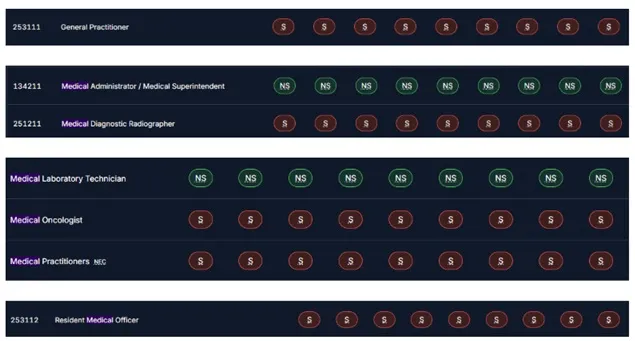
Here's where the conversation got interesting. Ask most people why they want to move abroad for medicine, and the answer usually circles back to money at some point. Shobhika's didn't.
When we asked her directly, she said the pull toward Australia wasn't primarily about a bigger salary or the appeal of "moving overseas" as a concept. What actually drew her in was work-life balance, the idea of practising medicine without it swallowing every other part of her life. Room for hobbies, room for family, room to just... exist outside a hospital.
After years of demanding coursework and long clinical shifts, that mattered to her as much as the career itself. It's a reminder that the reasons behind an AMC attempt aren't always about the obvious things.
How Meritorious Doctors Must Prepare for International Licensure Exams like AMC Exam?
Shobhika joined Academically's AMC exam preparation course because a friend recommended it; a friend who had already used the exact same programme to pass AMC herself. That kind of word-of-mouth carries weight in a way that ads never quite do.
Her preparation didn't start with a bang. In the beginning, she was studying about 2 hours a day. Nothing dramatic. As the exam got closer, that number climbed, and in her final two months, she was putting in 5-6 hours daily.
This detail is worth sitting with if you're just starting your own AMC preparation you don't need to open with 6-hour days. Start where you honestly are. Build the habit of consistency first. Let the intensity climb as the exam date actually approaches, not before.
When we asked what helped her most during her AMC coaching, she didn't hesitate. Three things, specifically:
- Participation in AMC mock tests: not just for the score, but to understand the exam's actual style and figure out exactly where she was weak, instead of studying blind and hoping for the best.
- Getting trained by AMC-qualified, AHPRA-registered medical doctors mentor you from the beginning
- A focus on high-yield topics: narrowing her attention to what actually shows up and matters, rather than trying to give every topic equal weight.
- 1:1 after every mock test: this was her favourite part, by a distance. Instead of just seeing a number, she could sit down and understand why a particular answer was wrong, how she should have approached that clinical scenario, and where her reasoning had gone off track.
That last one is worth dwelling on. A score tells you that you got something wrong. Feedback tells you why and that's usually the difference between repeating a mistake and actually fixing it.
AMC vs Other Licensure Exams
One of the more useful things Shobhika shared was how different AMC felt compared to every other exam she'd sat before it.
The AMC assessment doesn't really reward rote recall. It's built around clinical reasoning, ethics, communication, and how you'd handle patient care specifically within the Australian healthcare context, pitched at the level expected of a newly qualified graduate stepping into internship there.
Her advice, in her own words, stop asking "how do I remember this?" and start asking "how would I actually approach this patient as a doctor in Australia?" That single shift in framing, she says, changed how she prepared from that point on.
Shobhika prepared for AMC alongside a close friend. They studied together, pushed each other through the rougher weeks, and shared the whole ride, the good stretches and the frustrating ones.
Both of them passed. It's a small but genuine reminder that the right study partner can make a demanding exam noticeably more bearable. Not easier, necessarily. Just less lonely.
FMGE vs AMC: What’s the Difference?
| Factor | FMGE | AMC |
| Full Form | Foreign Medical Graduate Examination | Australian Medical Council Examination |
| Country / Goal | India: pathway for eligible foreign medical graduates seeking registration to practise in India | Australia: standard pathway for international medical graduates seeking general registration |
| Who takes it? | Eligible Indian citizens/OCI medical graduates who obtained their primary medical qualification outside India, subject to applicable NMC requirements | International medical graduates who are not eligible for the Competent Authority or Specialist pathways |
| Main Written Exam | FMGE Screening Test | AMC CAT MCQ Examination |
| Assessment Format | Screening examination | Computer-adaptive MCQ examination |
| AMC MCQ Format | — | 150 scored MCQs, one correct answer from five options, in a 3.5-hour session |
| What is tested? | Medical knowledge across the prescribed FMGE syllabus | Medical knowledge, clinical examination/diagnosis, investigation, therapy and management |
| Clinical Assessment After Written Exam | FMGE itself is the screening examination; applicable internship/registration requirements follow | Candidates pursuing the Clinical route must pass the AMC Clinical Examination after the MCQ |
| Clinical Exam | — | 16 assessed stations + 4 rest stations; stations assess history taking, examination, diagnostic formulation and management/counselling/education |
| Clinical Focus | Knowledge required for the Indian medical licensing pathway | Applying clinical knowledge, skills, communication and professional judgement at the level expected of a newly qualified Australian medical graduate |
| Alternative to Clinical Exam | — | AMC-accredited Workplace-Based Assessment (WBA) can be an alternative after passing the MCQ, subject to eligibility |
| End Goal | Eligibility for registration to practise medicine in India | AMC Certificate followed by the relevant Medical Board of Australia/Ahpra registration pathway |
| Key Challenge for an IMG | Adapting overseas medical education to the Indian screening examination | Adapting medical knowledge to Australian clinical reasoning, communication and practice expectations |
What's Next after AMC Exam Part I?
Passing AMC Exam Part I is a major milestone. But it is not the end of the Australian medical registration journey. For IMGs planning to continue towards medical practice in Australia, the next key step is preparing for the AMC Clinical Examination, where the focus shifts from written knowledge to applying clinical skills and reasoning in simulated clinical settings.
- Move from MCQ preparation to clinical preparation: Build on the clinical reasoning developed during Part I and prepare to demonstrate your approach to real-world patient scenarios.
- Understand the Clinical Exam format: Familiarise yourself with the clinical stations, assessment criteria and the types of cases you may encounter.
- Practise communication and examination skills: The Clinical Exam requires more than knowing the diagnosis. You need to demonstrate how you communicate, assess and manage patients.
- Get structured feedback: Regular practice with experienced mentors can help identify gaps in your clinical approach, communication and time management.
- Start preparing early: Just as Shobhika learned from her own journey, leaving preparation until the last minute can make an already demanding pathway more stressful.
To Conclude With...
There's nothing especially dramatic about Shobhika's story, and that's sort of the point. She didn't have the "typical" MBBS background. She was nervous going into FMGE. She started her AMC prep with just 2 hours a day, not some heroic study schedule. She leaned on a friend instead of white-knuckling it solo. She still passed.
If you're reading this while wondering whether your own non-linear path, a foreign MBBS, an FMGE clearance, a full-time internship can still lead somewhere, her answer is a fairly simple one: it can. Start where you are. Build consistency before intensity. Find someone to go through it with, if you can. And treat every mock test as information, not just a scorecard.