If you are an overseas-qualified dentist planning to practise in Australia, the Australian Dental Council (ADC) pathway is one of the most important routes to registration. The opportunity is huge. Australia currently has 25,800 dental practitioners, with employment increasing by 2,300 over the year in the latest Jobs and Skills Australia data. Dentists themselves account for about 14,200 employed professionals in the available occupation profile.
But the ADC journey is not simply an exam. It is a structured assessment of whether an overseas-trained dentist can demonstrate the knowledge, clinical judgement, technical ability and professional competence expected of a dentist entering Australian practice.
In this blog, you will get detailed pathway, including eligibility, initial assessment, written and practical examinations, syllabus, fees, dates, English requirements, preparation strategy, registration and career prospects.
What Is the ADC Exam?
The ADC assessment process is designed for overseas-qualified dentists whose dental qualifications do not meet Australia's requirements for direct registration. The assessment is broader than testing textbook knowledge. The ADC states that the process assesses:
- Knowledge
- Clinical judgement
- Clinical reasoning
- Practical clinical skills
- Professional competence
The standard is effectively that of a newly qualified Australian dentist, rather than simply testing whether you remember the dentistry you studied at university. That distinction matters. A candidate may have years of clinical experience overseas and still need to adapt to Australian expectations around clinical decision-making, communication, ethics, infection control, patient safety, evidence-based practice and professional responsibilities.
ADC Exam Pathway: Step-by-Step
The ADC pathway involves multiple stages, and each stage has its own eligibility criteria, timelines and assessment requirements. Understanding the sequence beforehand can help you plan your documents, preparation, budget and transition to Australian dental registration more effectively.
Here is the step-by-step ADC pathway for overseas-qualified dentists:
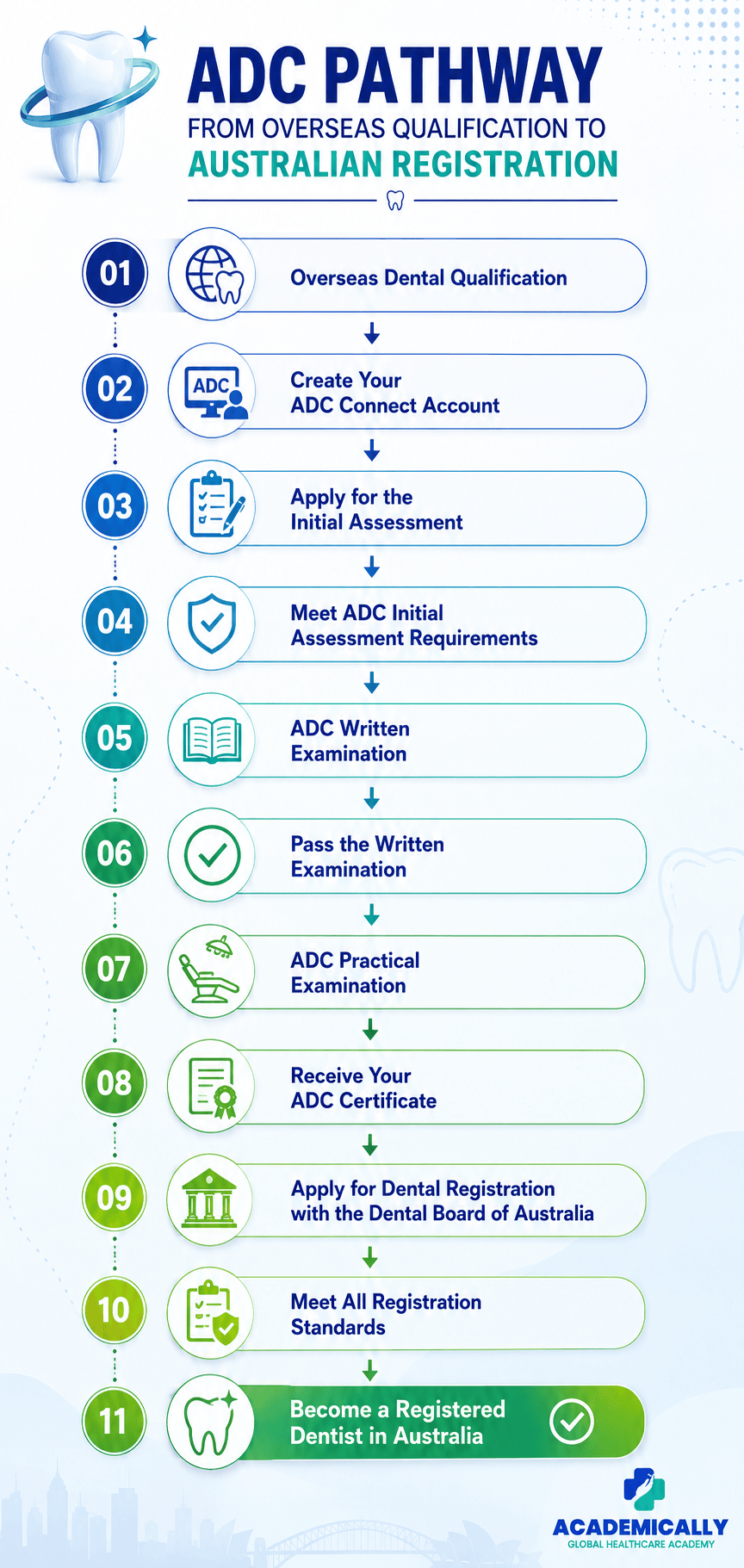
The initial assessment is approximately eight weeks, although incomplete documentation can delay processing. The written stage takes approximately five months from the relevant application period to results release, while the practical stage generally takes four to seven months from its application period to results release.
Stage 1: ADC Initial Assessment
The initial assessment determines whether you are eligible to enter the ADC dental practitioner assessment process. For dentists, the ADC currently specifies a minimum four-year full-time degree or diploma as the qualification requirement for this pathway. The initial assessment costs A$647 and is valid for seven years.
Initial Assessment Fee 2026 -2027
| Component | AUD | Approx. USD | Approx. INR |
| Initial assessment application | A$647 | US$460 | ₹43,304 |
| Registration-only renewal | A$35 | US$25 | ₹2,343 |
Documents you may need
The ADC's documentation requirements include:
- Current passport
- Recent passport photograph
- Dental qualification/certificate
- Academic transcript
- Internship certificate, where applicable
- Evidence of dental registration/licensure
- Two written professional references
- Evidence of practice or employment history
- Evidence of name change, if applicable
- Official English translations for documents issued in another language
You must also arrange for a certificate or letter of good standing to be sent directly to the ADC by the relevant dental regulator. A common mistake is treating document collection as administrative work that can be completed at the last minute. It can directly affect your examination timeline.
Top tip: Start requesting university transcripts, registration verification and good-standing documentation before you are ready to submit the application.
Who Needs the ADC Examination Pathway?
The ADC pathway is primarily relevant to overseas-qualified dentists whose qualifications are not recognised for direct Australian registration. However, not every international dentist follows the same route.
The ADC identifies alternative skills-assessment circumstances for certain dentists with eligible qualifications from countries such as the United Kingdom, Ireland, New Zealand and Canada, as well as certain Australian-qualified dentists.
Eligibility depends on the qualification, country, registration status and applicable requirements. Therefore, do not automatically assume that every overseas-qualified dentist must sit the ADC written and practical examinations.
Check your qualification pathway before paying for an examination.
Stage 2: ADC Written Examination 2026-2027
The written examination is the second stage. The ADC describes it as a 2-day examination testing the application of knowledge to clinical practice. It assesses knowledge of the science and practice of dentistry alongside clinical judgement and reasoning relevant to Australian dental practice.
The examination is delivered through Pearson VUE test centres, with the ADC currently scheduling the general dentistry written examination twice a year, usually around March and September.
Written examination dates 2026-2027
| 2026 period | Application period | Examination |
| Period 1 | 9–16 December 2025 | 11–12 March 2026 |
| Period 2 | 9–16 June 2026 | 16–17 September 2026 |
For the September 2026 sitting, the initial assessment deadline was 12 April 2026. Candidates should always verify future deadlines directly with the ADC because eligibility and application periods can change.
Written examination fee
A$2,122 ≈ US$1,508 ≈ ₹1,42,025
The written examination result is currently valid for five years for candidates who pass from March 2026 onwards. This is an important 2026 change from the previous three-year validity period.
What Does the ADC Written Exam Test?
The written examination is built around the Professional Competencies of the Newly Qualified Dentist. The ADC revised its general dentistry blueprint for examinations beginning in 2026 to reflect updates to these professional competencies. Rather than approaching preparation as a collection of disconnected subjects, candidates should think in terms of clinical decision-making. Major preparation areas include:
| Area | What candidates should be comfortable with |
| Restorative dentistry | Diagnosis, treatment planning, restorative procedures |
| Cariology | Caries risk, prevention, diagnosis and management |
| Endodontics | Diagnosis, treatment planning and endodontic principles |
| Periodontics | Diagnosis, periodontal management and maintenance |
| Prosthodontics | Fixed and removable prosthodontic principles |
| Oral surgery | Extractions, complications and patient management |
| Oral medicine/pathology | Diagnosis, lesions and appropriate referral |
| Paediatric dentistry | Child assessment, prevention and treatment |
| Orthodontics | Basic diagnosis, principles and referral |
| Radiology | Interpretation, safety and appropriate imaging |
| Dental materials | Selection, properties and clinical application |
| Pharmacology/medicine | Drug interactions, medical conditions and safe prescribing |
| Preventive/community dentistry | Prevention, population health and risk management |
| Ethics | Professional conduct, consent and patient-centred care |
| Infection control | Australian infection-prevention principles |
| Emergency management | Recognition and immediate management of emergencies |
The ADC also provides official examination materials, including a practice paper, written handbook and resource list.
The Biggest Shift in ADC Preparation: From Rote Learning to Clinical Reasoning
This is where many experienced dentists underestimate the examination. You are not simply preparing for: “What is the correct definition?”
You are preparing for:
“Given this patient, history, clinical finding and investigation, what should a competent Australian dentist do next?”
That requires you to connect:
History → Diagnosis → Risk assessment → Differential diagnosis → Investigation → Treatment options → Consent → Management → Follow-up
A strong preparation strategy therefore combines knowledge revision with extensive scenario-based question practice.
How to Prepare for the ADC Written Examination
1. Start with the official blueprint
Do not begin by buying ten textbooks. Begin with the ADC's official handbook, blueprint, competencies and practice paper. These establish the examination framework and help you understand what the ADC expects.
2. Build your Australian dentistry knowledge
International graduates often know the underlying science but need to become comfortable with Australian clinical expectations. Pay particular attention to:
- Australian guidelines
- Ethics
- Infection control
- Pharmacology
- Patient communication
- Consent
- Risk management
- Preventive dentistry
- Evidence-based clinical decisions
3. Use questions to expose weak areas
A useful cycle is:
Study → Questions → Analyse mistakes → Revise → Repeat
Do not measure progress only by the number of questions you complete. Measure whether you can explain why the correct answer is correct and why the alternatives are inappropriate.
4. Practise under time pressure
Knowledge without speed can become a problem in a long examination. Introduce timed blocks progressively rather than waiting until the final week.
5. Build an error notebook
Record:
- Topic
- Question type
- Your answer
- Correct answer
- Why you were wrong
- The clinical principle you missed
Your error notebook becomes one of the most valuable revision resources before the examination.
At Academically, you can experience sessions directly from ADC-qualified mentors who have active registration with AHPRA, practicing and settled in Australia. You can also hugely benefit from a range of mock tests that simulate real time exam conditions, community support and lots more.
Success Stories of Overseas Dentists Who Chose Academically for ADC Exam Coaching
Dr. Marlyn Borgesi, an Academically ADC-qualified student, cleared the ADC Written Examination on her first attempt. Her preparation was not completely linear. She had to pause her preparation because of personal circumstances and later restart. What helped was maintaining a structured preparation system that included:
- Live classes
- Recorded sessions
- Mock tests
- Faculty support
- Community support
- Consistent revision
Her biggest takeaway was that the ADC is not simply about memorising difficult dental concepts. It requires candidates to think like a dentist practising in Australia. That distinction is particularly relevant for internationally trained dentists adapting to a new professional environment.
Another story demonstrates a similar principle. Structured preparation can make a major difference when the candidate focuses on clinical reasoning rather than passive reading. Dr. Sonu's journey highlights:
- Understanding what the examination actually tests
- Creating a focused study framework
- Repeated revision
- Question-based learning
- Learning from mistakes
- Using resources strategically rather than collecting unlimited material
Her experience reinforces an important point. ADC preparation should be exam-specific, not simply a return to dental school textbooks.
Stage 3: ADC Practical Examination
Passing the written examination takes you to the final ADC assessment stage: the practical examination. The practical examination is conducted over two days:
Day 1: Technical Skills
Candidates demonstrate procedural restorative skills using typodont models in a manikin-based simulated environment.
Day 2: Clinical Skills
The clinical component uses a station-based Objective Structured Clinical Examination (OSCE) format and assesses a broader range of clinical competencies. The ADC Examination Centre is located in Melbourne, Victoria.
Practical examination fee
A$4,775 ≈ US$3,393 ≈ ₹3,19,591
The ADC currently states that the practical examination itself does not expire. However, the practical examination eligibility page states that candidates are eligible to sit the practical within three years of completing the written examination. Candidates should therefore plan the transition from written to practical carefully rather than assuming that the five-year written validity automatically means a five-year practical window.
What Is Assessed in the ADC Practical Exam?
The practical assessment can involve:
- Technical procedures
- Restorative skills
- Clinical examination
- Diagnosis
- Treatment planning
- Communication
- Professional behaviour
- Infection control
- Clinical reasoning
- Patient-centred care
- Safe practice
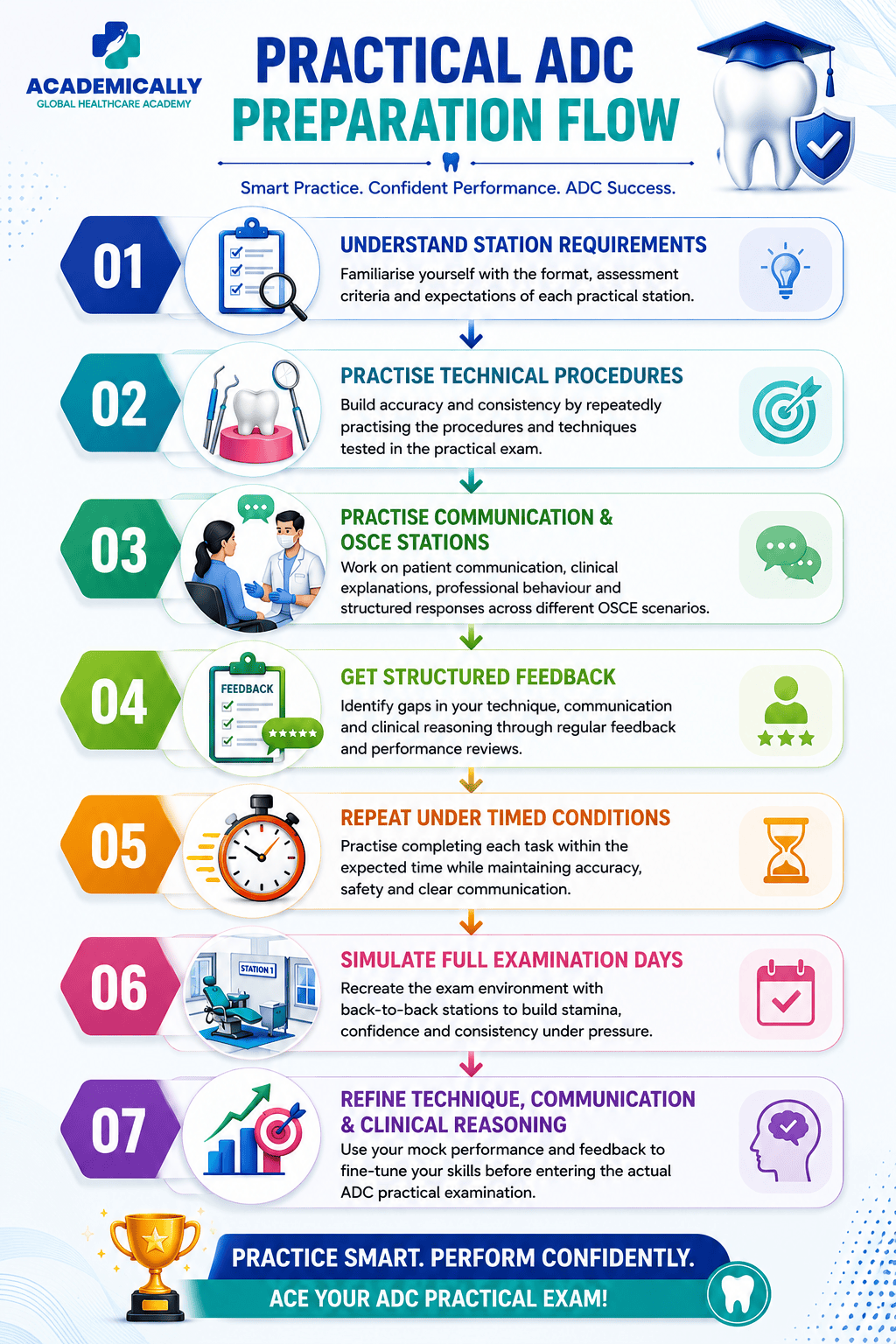
The practical examination is not the time to discover that you know the procedure but cannot explain it clearly to a patient.
ADC Exam Fees 2026-2027
For a dentist completing all three core ADC stages:
| ADC stage | AUD | Approx. USD | Approx. INR |
| Initial assessment | A$647 | US$460 | ₹43,304 |
| Written examination | A$2,122 | US$1,508 | ₹1,42,025 |
| Practical examination | A$4,775 | US$3,393 | ₹3,19,591 |
| Total | A$7,544 | US$5,360 | ₹5,04,920 |
These figures cover the principal ADC fees only. An overseas candidate may also need to budget for:
- English-language testing
- Document certification/translation
- University documentation
- Professional verification
- Travel to examination centres
- Australian accommodation
- Local transport
- Food and living expenses
- Practical preparation equipment/training
- Dental Board registration
- Visa and migration-related costs, where applicable
Therefore, A$7,544 should not be treated as the complete cost of becoming a registered dentist in Australia.
English Language Proficiency Requirements for ADC Candidates
English proficiency is an important distinction in the ADC pathway. The ADC assessment and the Dental Board of Australia's registration requirements are not identical. Passing the ADC examinations does not automatically remove the need to satisfy the applicable English Language Skills registration standard. The current common Ahpra English standard applies to dental registration. From 23 April 2026, the National Boards introduced revised minimum scores for accepted English tests. For tests taken from 23 April 2026, examples include:
| Test | Current minimum |
| IELTS Academic | Overall 7; L7, R7, W6.5, S7 |
| OET | L350, R360, W350, S360 |
| PTE Academic | Overall 63; L58, R59, W60, S76 |
| TOEFL iBT | Overall 91; L22, R22, W23, S24 |
| Cambridge C1 Advanced | Overall 178; L175, R179, W180, S194 |
The rules also allow certain applicants to combine results from a maximum of two sittings within a 12-month period, subject to the standard's conditions.
Because English requirements are regulatory rather than an ADC examination component, always verify your circumstances directly against the current AHPRA standard before booking a test.
What Happens After You Pass the ADC Practical Exam?
Successfully completing the practical examination is a major milestone, but it is not the final administrative step. The ADC awards a certificate confirming your eligibility to apply for registration with the Dental Board of Australia. You then need to apply for registration and satisfy the Board's applicable requirements, which can include:
- English language requirements
- Criminal history requirements
- Recency of practice
- Professional indemnity insurance arrangements
- Continuing professional development requirements
- Other registration standards applicable to your circumstances
So the pathway is best understood as:
ADC qualification → Dental Board registration application → Meet registration standards → Registration → Practise as a dentist
Dentist Salary in Australia After ADC
For overseas dentists, the earning potential after completing the ADC pathway is one of the biggest attractions of practising in Australia. A dentist in Australia earns an average salary at around A$215,000–A$245,000 a year, although actual earnings can vary significantly by experience, location, practice type, working hours and remuneration model.
SalaryExpert estimates the average dentist salary in Australia at A$242,275 per year, while ERI's 2026 estimate is A$245,508 per year. That puts the indicative annual salary at approximately:
A$215,000–A$245,000 ≈ US$150,500–US$171,500 ≈ ₹1.44–₹1.64 crore per year
Note: Approximate conversions based on August 2026 exchange rates. Actual exchange rates received through banks or remittance providers may vary.
SalaryExpert's estimate is based on compensation survey data, while ERI also reports that salary varies with experience. For example, its 2026 data puts entry-level medical dentist compensation at around A$167,738, while senior-level compensation can reach approximately A$274,466.
SEEK's 2026 salary data also shows why location matters. Its April 2026 salary insights list average advertised salaries of A$250,000 or more in several regional markets, with some locations exceeding A$300,000. SEEK notes that its figures are based on full-time salary ranges disclosed by employers and that some advertised packages include superannuation while others do not.
Meanwhile, Jobs and Skills Australia's latest data reports 25,800 Dental Practitioners in Australia and median full-time earnings of A$3,232 per week, or approximately A$168,064 annually when annualised. However, this figure covers the broader Dental Practitioners (ANZSCO 2523) category, which includes dentists and dental specialists. JSA specifically reports N/A for the six-digit Dentists (ANZSCO 252312) salary figure, so the A$168,064 figure should not be presented as the average salary of dentists alone.
Your income after ADC can depend on several factors:
- Experience: Senior dentists generally command higher compensation than early-career dentists.
- Location: Regional and rural areas can offer particularly competitive packages because of workforce demand.
- Practice type: Private practices may offer different earning structures from public or community dental services.
- Remuneration model: Some dentists receive a fixed salary, while others work under percentage-based or production-based arrangements.
- Working hours: Full-time earnings naturally differ from part-time arrangements.
- Specialisation: Specialist dentists can earn substantially more than general dentists.
- Practice ownership: Owning or co-owning a practice can create a different income profile from working as an associate.
For an overseas dentist, the ADC pathway therefore represents more than a route to Australian registration. It can also open access to a dental market where experienced professionals have significant earning potential.
Once you have progressed toward registration, platforms such as Jobslly, India's first healthcare only job portal can help candidates shift their focus from examination preparation to career discovery, job opportunities and professional positioning.
Is the ADC Exam Difficult?
Yes, but difficulty is highly individual. The challenge comes from the combination of:
- Large clinical knowledge requirements
- Australian practice expectations
- Scenario-based clinical reasoning
- Time pressure
- Professional and ethical judgement
- A separate practical assessment
- Significant financial and logistical investment
The biggest preparation mistake is treating ADC as a conventional theory examination. A better question is: Can I consistently make the decision a competent Australian dentist would make when faced with an unfamiliar clinical scenario?
If the answer is not yet yes, more question practice and clinical reasoning work are usually more valuable than simply reading another textbook.
How Long Should You Prepare for the ADC Exam?
There is no universal preparation duration. Your timeline depends on:
- Years since graduation
- Current clinical exposure
- Previous ADC attempts
- Strength of foundational knowledge
- Familiarity with Australian dentistry
- English proficiency
- Weekly study time
- Access to structured practice
- Whether you are preparing while working
A useful framework is:
Foundation phase
Build your understanding of the blueprint and identify gaps.
Consolidation phase
Study major disciplines systematically while practising questions.
Application phase
Shift heavily toward clinical scenarios and timed practice.
Final revision phase
Focus on weak areas, error logs, high-yield concepts and examination simulation.
The objective should not be to study for the longest possible period.
The objective is to become examination-ready.
10 Mistakes to Avoid During ADC Preparation
1. Studying without the ADC blueprint
You may spend months studying material that does not deserve the same priority.
2. Memorising instead of reasoning
Clinical scenarios demand application, not recall alone.
3. Collecting too many resources
More books do not automatically mean better preparation.
4. Ignoring Australian guidelines and professional expectations
Your previous clinical environment may differ significantly.
5. Avoiding mock examinations
You need to know how you perform under time pressure.
6. Delaying practical preparation
The practical exam requires different skills from the written exam.
7. Ignoring communication
Clinical competence includes how you communicate with patients and colleagues.
8. Leaving documents until the last minute
Good-standing letters, transcripts and references can take time.
9. Assuming ADC completion equals registration
You still need to satisfy the Dental Board's registration requirements.
10. Using outdated information
ADC examination formats, fees, dates and regulatory requirements can change. Always cross-check the current official sources before making financial or scheduling decisions.
To Conclude with...
For overseas-qualified dentists, the ADC pathway can be a demanding but rewarding route to building a dental career in Australia. From the initial assessment and written examination to the practical examination and Dental Board registration, every stage requires careful planning, consistent preparation and an understanding of Australian clinical standards. The financial investment is significant, but so is the potential career opportunity, with current salary estimates indicating strong earning potential for qualified dentists. The key is to approach the journey strategically rather than treating it as just an examination. Start by understanding your eligibility, follow the official ADC requirements, prepare around the examination blueprint and plan your registration and career steps early. With the right preparation and persistence, the ADC pathway can take you closer to practising dentistry in Australia.