AI in Pharmacovigilance: How Automation Is Changing Drug Safety Careers

Written by

Dr. Akram Ahmad

Reviewed by

Dr. Ateeb A. Parray
AI in Pharmacovigilance: How Automation Is Changing Drug Safety Careers
3 min read

Summary:

Artificial intelligence and intelligent automation are radically transforming the way drug safety and pharmacovigilance activities are conducted worldwide. The purpose of today’s automated platforms is not to replace human professionals, but to facilitate repetitive tasks such as Individual Case Safety Report intake, narrative generation, medical coding and initial signal identification. Such technological progress enables drug safety specialists to move away from ordinary administrative processing toward high-value clinical reviews, risk management methods and regulatory decision-making. In this shifting context, professionals need to combine core clinical knowledge with technical agility, knowing how automated models process and learn from real-world data and clinical evidence. The big pharmaceutical companies, contract research organizations and specialist health technology suppliers are embracing automated solutions to secure career longevity and improve patient safety standards worldwide. Digital revolution is changing how we work in life sciences… but the need to be adaptable is still key to our success in careers.

Key Takeaways

  • AI automates repetitive pharmacovigilance processes
  • For safety-critical judgments, human assessment remains a must.
  • PV professionals need digital abilities and drug safety knowledge.
  • Cloud-based drug safety database platforms are opening up remote and hybrid roles.
  • AI should be used as a supportive co-pilot.

AI is here. Use it as a crutch rather than a limb.

Adverse event reporting is growing significantly in the fast-paced biopharmaceutical field. Pharmacovigilance (PV) departments are faced with large amounts of Individual Case Safety Reports (ICSRs) from literature, clinical trials, healthcare providers and social media. In the past, PV colleagues spent infinite hours manually entering cases, transcribing clinical narratives and assigning MedDRA codes. 
This persistent demand led to operational bottlenecks, risk of human error, and employee burnout.

An operational problem like this has created one of the most promising career evolutions in the biological sciences. As pharmaceutical companies are embracing machine learning, Optical Character Recognition (OCR) and Natural Language Processing (NLP), there is a booming demand for forward-thinking specialists in AI in pharmacovigilance roles.

Automation is not replacing human safety teams. It is turning mundane data entry into strategic, tech-enabled clinical surveillance.


The Evolution of Drug Safety: From Manual Processing to Intelligent Automation  

The core mandate of pharmacovigilance- detecting, assessing, understanding, and preventing adverse effects, has not changed. What has changed is the velocity and scale at which data arrives.

Operational AreaTraditional PharmacovigilanceAI-Enabled Pharmacovigilance
Case Intake & ProcessingManual data entry taking 45–90 minutes per case.Automated extraction (OCR/NLP) completed in under 3 minutes.
Medical Coding (MedDRA/WHODrug)Manual searching and manual term selection.Automated coding suggestions with confidence scoring algorithms.
Narrative GenerationWritten manually line-by-line by safety writers.Generated automatically by natural language tools for human review.
Signal DetectionDisconnected batch statistical runs performed periodically.Real-time predictive analytics on multi-source datasets.
Primary Career FocusOperational execution and administrative data intake.Clinical interpretation, algorithm auditing, and risk strategy.


What This Means for Careers  

The work is shifting toward managing, checking and improving AI-assisted workflows, with more attention on exceptions, quality, interpretation and validation.

Skills to Learn for AI in Pharmacovigilance Careers  


1. Build strong PV fundamentals  

Learn ICSR processing, seriousness, expectedness, causality, literature surveillance, signal management and global PV requirements. Understand systems such as Oracle Argus and VigiFlow.
The Executive Program in Clinical Drug Development by Academically is a structured industry training to help doctors, dentists, pharmacists and life sciences graduates (MBBS, BDS, PharmD, B.Pharm, M.Pharm) to quickly obtain these core competencies with a deep, practical grounding in ICSR processing, safety databases, GVP regulations and clinical trial workflows.

2. Add AI and data literacy  

You do not need to become an ML engineer. Learn NLP, generative AI, information extraction and anomaly detection. Start with Excel and data cleaning, then add SQL, dashboards or Python.

3. Learn prompt engineering and workflow design  

AI-enabled PV work can involve prompt design, model evaluation and agent behaviour. Parexel’s current India roles mention LLMs, prompt engineering and AI-based adverse-event processing.

4. Understand validation and governance  

A model output cannot automatically become a regulatory decision. Learn human-in-the-loop review, audit trails, bias, privacy, validation and GxP concepts. Recent research identifies these as important barriers to routine AI adoption in PV.

Employers increasingly value professionals who can combine scientific accuracy with technology awareness. Show that you can question AI outputs, document decisions, communicate clearly, and improve workflows without weakening compliance, patient safety, or scientific integrity unnecessarily.


The Automated Pharmacovigilance Workflow: A Step-by-Step Overview  

To succeed in modern AI in pharmacovigilance careers, you must understand how data moves through an automated safety ecosystem. Human oversight remains mandatory at critical clinical junctions to ensure patient safety and compliance with global regulatory standards.
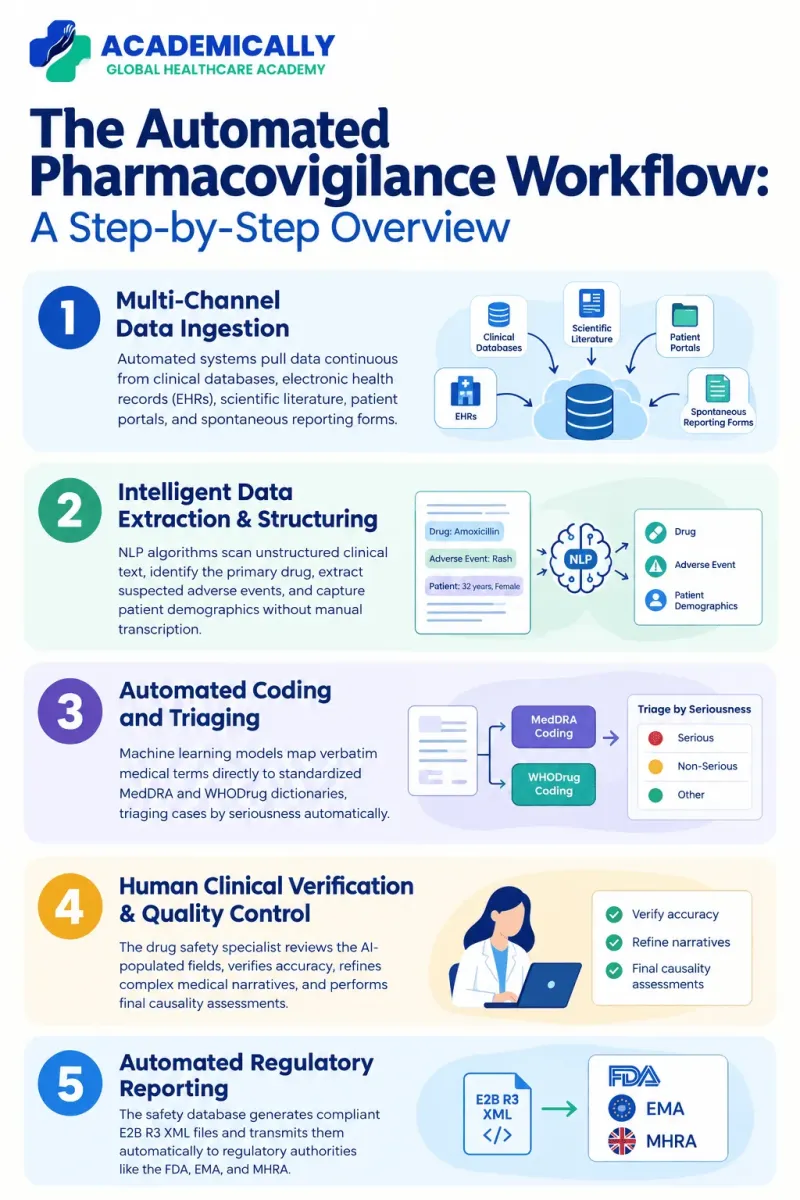
The Automated Pharmacovigilance Workflow


You can remain in a core drug-safety role while adding technology skills, or move toward safety analytics, PV automation, AI validation, medical safety technology or AI engineering.
To ease the path toward this journey, applicants typically rely on experiential, scenario-based capstone projects such as those integrated into Academically’s Executive Program in Clinical Drug Development, that mirror real-world pharmacovigilance workflows and industry deliverables.

Which Companies Are Hiring?  

TOP EMPLOYERS IN TECH-ENABLED SAFETY
Global PharmaContract Research Orgs (CROs)Health Tech VendorsRegulatory Agencies
• Pfizer• IQVIA• Veeva Systems• FDA (US)
• Novartis• Parexel• ArisGlobal• EMA (Europe)
• Roche• ICON plc• Oracle Health• MHRA (UK)
• AstraZeneca• Syneos Health• Intuition Labs• Health Canada


healthcare company logos

Can Pharmacovigilance Jobs Be Remote?  

Yes, but remote work depends on the employer, role and location.

ICON currently lists an India Pharmacovigilance Reporting Specialist role with an “Office or Home” model. 
Parexel’s current AI roles in agentic pharmacovigilance list remote India locations. ProductLife Group has also advertised India PV case-processing work with remote work possible.
 

Fully RemoteHybrid FlexibleIndependent Consulting
• Remote Case Review• 2-3 Days Office / Home• System Validation
• Narrative Auditing• Signal Team Strategy• AI Workflow Auditing
• Global Submissions• Cross-dept Meetings• Freelance PV Writing

Many positions remain hybrid because of team, system and process requirements.


Salary Range

AI-specific PV salary bands are not standardised, so treat AI as a skill advantage, not a guaranteed pay premium.
Indian Salary Range

Career stageIndicative India range*
Fresher / entry PV₹4–5.5 LPA
Early experienced₹5–10 LPA
Experienced specialist₹8–15+ LPA
Senior or niche AI/PV roles₹15-25+LPA

*These are market indicators, not guaranteed offers.
Qualification, PV experience, employer, city, technical skills and role complexity can change compensation.

Global Salary Range

Career LevelTypical Job TitlesExpected Annual Salary (USD)Core Responsibilities
Entry-LevelPV Associate, AI Safety Specialist, Case Processing Analyst$65,000 – $88,000Verifying AI data extraction, managing MedDRA coding outputs, and reviewing auto-drafted narratives.
Mid-LevelSenior PV Scientist, Safety Automation Lead, Signal Detection Manager$95,000 – $135,000Managing complex safety signals, auditing AI system accuracy, drafting RMPs, and overseeing CRO workflows.
Senior-LevelPV Director, Head of Safety Automation, Global Safety Lead$145,000 – $210,000+Setting enterprise safety strategy, leading AI technology adoption, managing regulatory audits, and leading global teams.


The Future of AI in Pharmacovigilance  

The likely direction is AI handles more repetitive work, while professionals handle judgement, exceptions, validation and accountability.

Data quality, bias, interpretability and regulatory acceptance remain important challenges.  

Let AI accelerate searching, sorting and routine work, but keep clinical reasoning, regulatory knowledge and accountability human.

How Academically Can Launch Your AI-PV Career

Getting into a high-paying, non-clinical drug safety position takes more than book smarts. You have to be ready for the industry. This is where the Executive Program in Clinical Drug Development by Academically fills the gap.

This full executive program is designed for doctors, pharmacists and life science graduates and comprises 12 courses that are practical and job-oriented. 

You will get end to end knowledge of the clinical trial phases, global regulatory submission processes, GCP guidelines and dedicated Pharmacovigilance & Drug Safety activities (ICSR processing, signal detection, safety database processes).

Certification To Placement via Jobslly 

Learning the basics is only half the battle, the other is landing the actual job.

You can find pharmacovigilance jobs and other related pharma jobs at leading pharmaceutical companies and CROs on Jobslly.

1-on-1 Mock Interviews & Portfolio Building: Get one-on-one coaching on how to structure your CV, optimize your LinkedIn profile and write a cover letter that will attract corporate recruiters.

Direct Application Assistance: Receive direct assistance in applying for high-growth positions such as Drug Safety Associates, PV Associates, Medical Reviewers and Regulatory Affairs Specialists.

Academically’s rigorous practical courses and hands-on capstone projects, along with Jobslly’s dedicated placement ecosystem, enable aspiring healthcare professionals to transfer comfortably from clinical practice or traditional academia to lucrative, tech-enabled drug safety positions.

                      

About Us

Academically is a global Ed-Tech healthcare platform, led by Dr. Akram Ahmad (PhD in Medicine, University of Sydney, Global Healthcare Career Coach) and his expert team, that helps pharmacists, doctors, dentists, physiotherapists, and other allied healthcare professionals to achieve their career goals in India and abroad. We provide complete career guidance, like skill assessment, Visa, PR and coaching for International licensure exams such as AMC, Overseas Pharmacist Readiness Assessment, APEP, ADC, DHA, SPLE, OCANZ COE and more for countries like Australia, New Zealand, Gulf countries, the US, the UK, and Canada. We have trained more than 10,000+ students across 88+ countries, with a 90%+ success rate on international healthcare licensure exams. We are India’s first healthcare Ed-Tech platform to introduce AI-based mock tests, to help students study smarter and track progress effectively. Beyond exam preparation, we also offer job assistance programmes, such as Upskill by Academically, covering clinical drug development and medical affairs. To help you land your dream job, we have recently launched our job platform Jobslly by Academically, only for healthcare professionals for both India and abroad.

FAQs

Will AI replace pharmacovigilance positions?

AI is automating parts of pharmacovigilance, especially repetitive data-handling tasks. The use of automation is identified in case processing, duplicate identification, signal detection and information extraction, but human review, validation and regulatory monitoring are still strongly emphasized. Tasks aren't disappearing entirely, they're just shifting. As jobs evolve, workers that embrace AI-assisted workflows will be able to adjust.

What should I study to have a job in AI pharmacovigilance?

Start with ICSR processing, MedDRA, safety databases, literature monitoring and signal management. Add Excel, data analysis, basic SQL or Python, AI basics, NLP, rapid engineering and AI testing. A good profile has PV knowledge and enough technical know-how to challenge, verify and document AI-generated outputs, not just accept them.

Will I have to learn to code to work in AI pharmacovigilance?

Not really. Many AI-enabled PV occupations can benefit from data literacy but do not require software engineering. More advanced skills might include Python, SQL, machine learning or model evaluation, whilst operational and clinical roles could focus on PV knowledge and the safe use of AI tools. How deep your coding should be depends on the role you wish to target.

What companies hire pharmacovigilance professionals?

Current India ads include opportunities with organizations such as Parexel, ICON, Accenture, Cognizant, IQVIA, Syneos Health, Amgen. Look at real vacancy listings, not static lists, as hiring is often dynamic. Search for patient safety, drug safety, pharmacovigilance, safety analytics and PV technologies, as well as classic PV titles

Is it possible to have a remote pharmacovigilance job in India?

Yes. There are several PV and AI related jobs listed as remote or office/home at the moment. ICON is looking for a PV reporter in India and the model is office-or-home based. Parexel is looking to hire people in India to work remotely in AI jobs in agentic pharmacovigilance. Availability still depends on employer policy and the requirements of the role and area.

What is the salary of a newbie in pharmacovigilance?

Market indicators today suggest many entry level PV roles are in the 4-5 LPA per year bracket, however offers vary by business, location and certification. Recent job listings reveal there are variances among firms. As you grow your experience, strong PV fundamentals, communication skills, safety database and other analytics or AI talents may unlock the kind of roles you are eligible for.

How is AI in PV different from traditional pharmacovigilance?

Traditional PV is very dependent on manual review and established routines. AI-enabled PV automates screening, extraction, categorization, prioritization and pattern recognition. Professionals increasingly need to monitor outputs, handle exceptions, understand signals, validate systems and help compliance. The two techniques will work together more and more, rather than have wholly independent professional paths.

Is rapid engineering effective for pharmacovigilance?

It may be valuable for teams designing or deploying generative AI workflows. Prompt design influences model extraction, classification or summarization of safety information, but PV implementations require testing, defined boundaries and human evaluation. Prompt engineering and agent development are explicitly listed in AI pharmacovigilance jobs at Parexel.

What is the most future-proof pharmacovigilance role?

Professionals can expand their options by combining PV fundamentals with signal management, safety analytics, automation, AI validation, regulatory technology, or medical safety. A more realistic goal is to establish abilities that allow you to operate confidently across drug safety science, data and technology as workflows improve.

How do I transition from pharmacovigilance to AI jobs?

Find the PV routine you are familiar with and identify repetitive chores that can be supported by technology. Then learn data analysis, fundamentals of AI, rapid engineering and workflow automation. Create a tiny project to demonstrate a controlled PV use case with human evaluation and documentation. Search for roles that specifically combine pharmacovigilance with analytics, automation or AI, rather than just applying for general AI positions.

Dr. Akram Ahmad
Dr. Akram Ahmad

BPharm, PharmD, PhD (University of Sydney, Australia)

about the author

Dr. Akram Ahmad, PhD, is a clinical pharmacist, researcher and healthcare educator with more than 14 years of teaching and research experience across India, Malaysia and Australia. He completed his PhD at the Faculty of Medicine and Health, University of Sydney, where his research focused on medication safety and health outcomes, and has authored over 110 peer-reviewed publications in international journals.

He is the founder and CEO of Academically Global, a healthcare education company that has supported more than 10,000 doctors, dentists, pharmacists, nurses and physiotherapists across 88 countries, and of Jobslly, a healthcare careers platform. He is a TEDx speaker and has been featured on JioHotstar and Wikipedia, and has mentored healthcare professionals in both university and industry settings.

Dr. Ahmad writes and speaks on two areas in particular: international licensing pathways for healthcare professionals, including the AMC (Australia), USMLE (USA), OPRA (Australia and New Zealand), PEBC (Canada), PSI (Ireland) and DHA/MOH (Gulf) examinations, and non-clinical career transitions into pharmacovigilance, Medical Affairs/MSL, clinical research, medical writing and regulatory affairs.

His goal with every article is simple: to give healthcare professionals accurate, practical information about global career options that no one taught them in college.

Dr. Ateeb A. Parray
Dr. Ateeb A. Parray

Programme Manager- Non Clinical/Upskilling Courses

BDS, MSS, MPH

about the reviewer

Dr. Ateeb A. Parray, BDS, MSS, MPH, is a medical, social science, and public health professional with nearly a decade of experience in the design, development, implementation, monitoring, and evaluation of public health and healthcare programmes.

An accomplished scientist and program management professional, Dr. Parray has authored and co-authored over 25 scientific publications in leading international peer-reviewed journals, garnering more than 16,000 citations, with an h-index of 14 and an i10-index of 17. His professional experience spans several geographical settings, including India, Bangladesh, Afghanistan, and the United States, where he has served in multiple capacities, including programme management and execution at Johns Hopkins University.

In recognition of his contributions to public health, research, and implementation science, Dr. Parray has received several prestigious honours and distinctions, including the WHO-TDR Fellowship in Implementation Science, Young Investigator Award, Begum Rokeya Sakhawat Hossain Award, and Bloomberg Leadership Hall of Fame Award.

Currently, Dr. Parray serves as Program Manager at Academically Global Healthcare Academy., where he leads the Academically Upskilling Programme, overseeing executive-level professional development initiatives in Medical Affairs and Clinical Drug Development. These programmes encompass key domains such as Pharmacovigilance, Clinical Research, Clinical Data Management, and Medical Writing. In this role, he has also played a significant part in facilitating the recruitment and career placement of over 80 medical doctors, pharmacists, and AYUSH professionals, supporting their transition into diverse opportunities across the healthcare and pharmaceutical industries. 

Build a Successful Global Healthcare Career

100% secure & confidential.

Academically

Get Complete Details & Expert Guidance

Our experts will contact you soon

Free guidance • No spam • No obligation

Students
Trusted by 50,000+ healthcare aspirants