The Core Technologies Powering Modern Physiotherapy
Physiotherapy has always relied on the clinician's skilled eyes, palpation, and clinical intuition. However, human observation has natural physiological limits: the eye cannot calculate angular velocity in milliseconds, measure ground reaction force distribution during a cutting maneuver, or track home exercise adherence across a three-week gap. Modern technological solutions serve as an objective extension of the clinician’s diagnostic and therapeutic toolkit.
Continuous Digital Patient Journey
▼ ▼ ▼
┌──────────────────┐ ┌──────────────────┐
│ Computer Vision │ │ Wearable Sensors │ │ Ambient & ML │
│ • Pose estimation│ │ • Multi-axis IMU │ │ • Ambient scribes│
│ • Joint angles │ │ • Smart insoles │ │ • Predictive algorithms│
│ • Kinetic symmetry│ │ • Wireless sEMG │ │ • Trend analysis │
└──────────────────┘ └──────────────────┘
Flowchart depicting - Continuous Patient Journey
Markerless Computer Vision & Dynamic 3D Pose Estimation
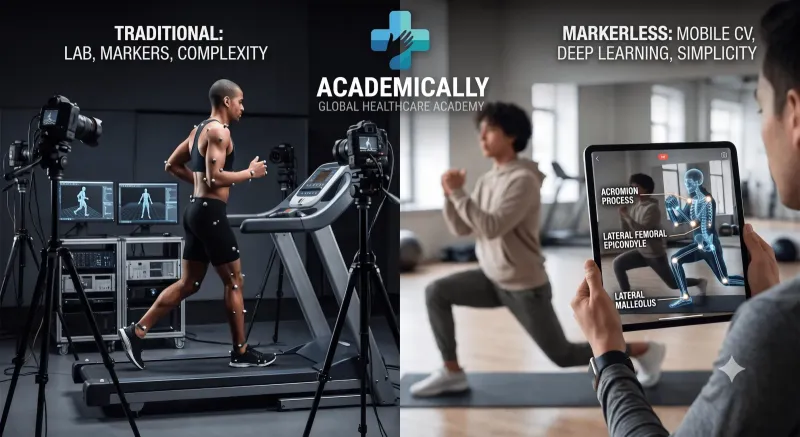
This infographic contrasts traditional, complex marker-based motion capture labs with modern, simple markerless systems using deep learning on mobile devices. Image Souce - Google Gemini
Traditional biomechanical motion capture required dedicated multi-camera laboratories, expensive retro-reflective markers taped to anatomical landmarks, and extensive post-capture calibration.
Markerless computer vision replaces that laboratory footprint with software. Utilizing high-frame-rate 2D cameras frequently standard high-resolution tablets or mobile devices deep-learning neural networks identify anatomical landmarks (such as the acromion process, lateral femoral epicondyle, and lateral malleolus) across sequential video frames.
- Sub-Millimeter Angular Tracking: Modern pose estimation models instantaneously construct a functional skeletal wireframe. When evaluating an anterior cruciate ligament (ACL) reconstruction patient performing a single-leg drop vertical jump, the software calculates dynamic knee valgus angles, hip internal rotation, and trunk lateral tilt at initial ground contact.
- Micro-Compensation Detection: Visual observation often misses micro-compensations when a patient fatigues. Computer vision algorithms continuously calculate velocity curves and movement planes, instantly alerting the therapist to subtle pelvic drops during terminal hip extension or early rib flair during overhead lifting.
- Telerehabilitation Integration: Because these vision models operate via standard webcams, patients participating in remote therapy sessions receive real-time, on-screen graphical corrections (e.g., green-to-red feedback vectors) if their lumbar spine flexes past safe thresholds during a Romanian deadlift.
Inertial Measurement Units (IMUs) & Smart Biomechanical Insoles
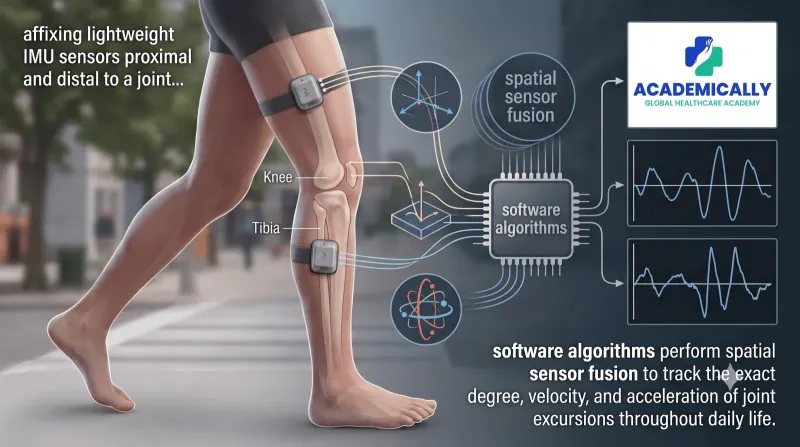
This infographic illustrates how lightweight IMU sensors and spatial sensor fusion algorithms track the precise degree, velocity, and acceleration of joint motion throughout daily life. Image Source - Google Gemini
Inertial Measurement Units miniaturized sensor nodes combining 3-axis accelerometers, 3-axis gyroscopes, and 3-axis magnetometers—measure linear acceleration, angular velocity, and spatial orientation.
- Continuous Joint Kinematics: By affixing lightweight IMU sensors proximal and distal to a joint (such as on the mid-thigh and proximal tibia), software algorithms perform spatial sensor fusion to track the exact degree, velocity, and acceleration of joint excursions throughout daily life.
- Plantar Pressure & Smart Insoles: Modern pressure-sensing insoles contain arrays of piezoresistive sensors embedded directly into flexible footbeds. They record spatial-temporal gait parameters:
- Cadence and stride length
- Stance-to-swing phase ratios
- Center-of-Pressure (CoP) trajectory
- Ground reaction force (GRF) distribution across the heel, midfoot, and metatarsal heads
- Ecological Monitoring: A patient recovering from an ankle fracture may walk with a clean, symmetrical gait pattern across a flat, 10-meter clinical walkway. However, data streaming from smart insoles over a 72-hour period reveals severe antalgic offloading, reduced push-off power, and step-time variability when navigating outdoor terrains, uneven sidewalks, or community stairs.
Wireless Surface Electromyography (sEMG) & Closed-Loop Biofeedback
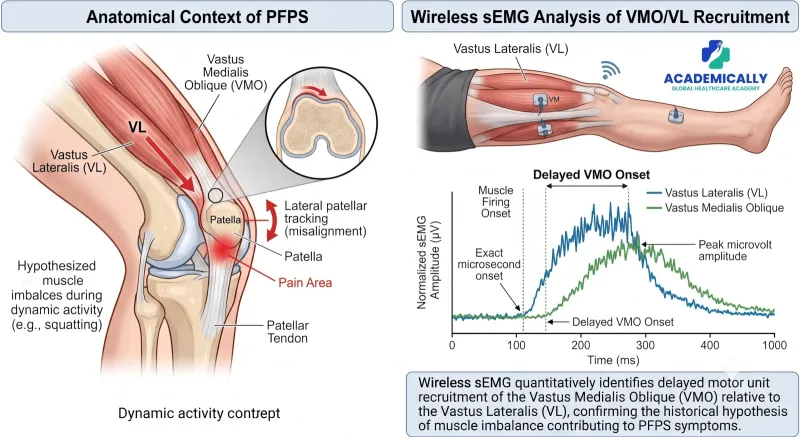
This infographic explains Patellofemoral Pain Syndrome (PFPS), comparing the leg's anatomy with muscle imbalances to a wireless sEMG analysis that reveals delayed muscle activation in the vastus medialis oblique (VMO) relative to the vastus lateralis (VL). Image Source - Google Gemini
Surface electromyography has shifted from bulky, wired desktop towers to adhesive, wireless sensor patches smaller than a standard ECG lead. These modern patches track real-time electrical activity generated during muscle depolarization.
- Neuromuscular Activation Timing: In conditions like patellofemoral pain syndrome (PFPS), clinicians have historically hypothesized an imbalance between the vastus medialis oblique (VMO) and vastus lateralis (VL). Wireless sEMG quantitatively logs the exact microsecond of muscle firing onset and peak microvolt amplitude, confirming whether the VMO exhibits delayed motor unit recruitment.
- Inhibiting Synergist Dominance: In chronic neck pain and scapular dyskinesia, patients frequently compensate for weak lower trapezius and serratus anterior activation by over-recruiting the upper trapezius and levator scapulae. Wearable sEMG patches provide immediate vibratory or auditory biofeedback when the upper trapezius fires beyond a calibrated microvolt threshold during arm elevation, retraining neuromuscular coordination.
- Pelvic Floor and Core Rehabilitation: Compact, non-invasive biofeedback sensors allow patients undergoing pelvic health rehabilitation to visualize their pelvic floor muscle contractions, ensuring they achieve deep motor unit recruitment alongside full eccentric relaxation between repetitions.
Ambient Clinical Documentation & Generative AI Scribes
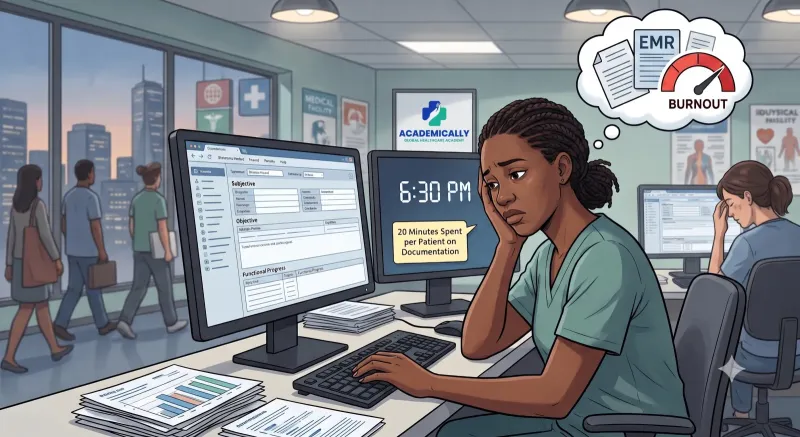
Image shows exhausted nurse at a desk with EMR burnout.Image Source - Google Gemini
Clinical documentation fatigue remains a leading driver of physical therapist burnout globally. Clinicians often spend 15 to 20 minutes per patient typing subjective updates, objective measurements, and functional progressions into Electronic Medical Records (EMRs).
- Passive Ambient Acoustic Scribing: Ambient listening models securely capture the clinician-patient dialogue during treatment. Using fine-tuned medical Natural Language Processing (NLP), the software filters out casual conversation, identifies clinically salient statements, and converts conversational phrasing into structured, standardized SOAP notes (Subjective, Objective, Assessment, Plan).
- Automated Kinematic Ingestion: Modern ambient systems interface directly with the clinic's computer vision and wearable sensor feeds. If the therapist measures shoulder active range of motion via camera or palpates a grade II joint restriction, the software automatically populates the objective section with: "Left glenohumeral active abduction: 138° with scapular elevation compensation at 110°; passive abduction: 155° with capsular end-feel."
Predictive Machine Learning for Recovery Curves
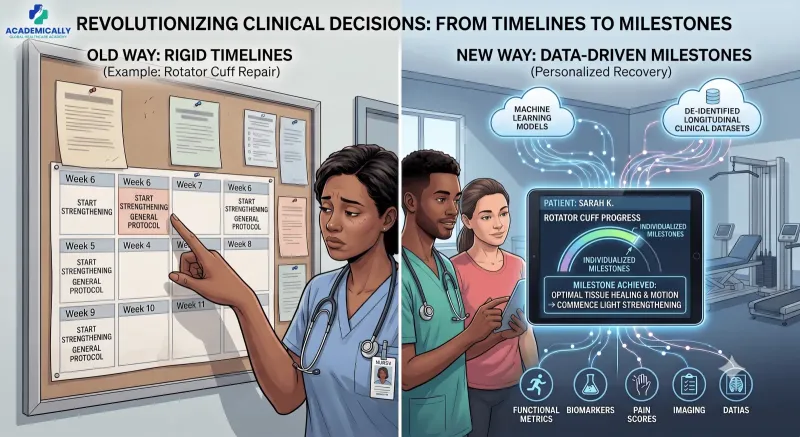
This infographic illustrates the shift from old rigid rehabilitation timelines to modern personalized data-driven recovery milestones.Image Source - Google Gemini
Machine learning models trained on vast, de-identified longitudinal clinical datasets allow clinicians to move away from rigid, arbitrary recovery timelines (e.g., "all rotator cuff repairs begin strengthening at week 6") toward individualized, data-driven milestones.
- Risk Stratification: By analyzing baseline metrics—including age, pre-operative functional scores, baseline psychological readiness (Tampa Scale of Kinesiophobia), tissue quality, and continuous wearable-derived movement quality—algorithms classify patients into rapid, standard, or delayed recovery trajectories.
- Preemptive Flare-Up Detection: Algorithms detect subtle downward trends in daily step count, increases in movement asymmetry, or micro-spikes in resting heart rate and pain scores 48 to 72 hours before a patient experiences a symptomatic clinical setback. This allows the physiotherapist to proactively scale down training load before chronic tendon overload or structural failure occurs.
Robotics, Dynamic Exoskeletons & Immersive Virtual Reality (VR)
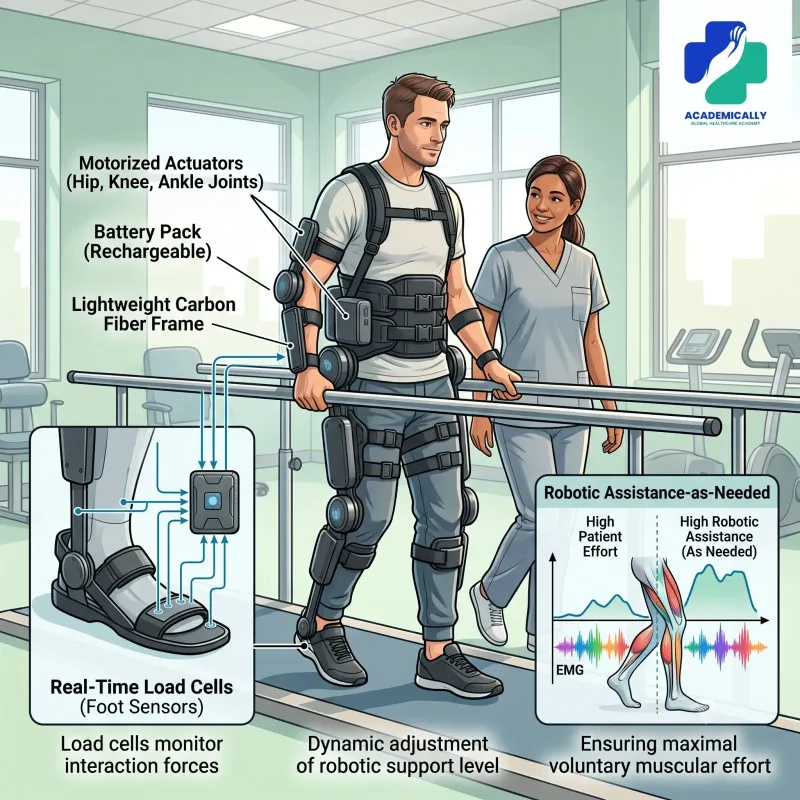
This infographic shows Robotic Assistance in Gait Training. Image Source - Google Gemini
Particularly in neurological rehabilitation, robotic automation provides the high repetition and task-specific training required to drive neuroplastic reorganization.
- Overground Robotic Exoskeletons: Motorized orthoses support patients with spinal cord injuries, stroke, or traumatic brain injury (TBI). Real-time load cells dynamically adjust the level of robotic assistance-as-needed, ensuring the patient exerts maximal voluntary muscular effort while maintaining a physiological gait pattern.
- Immersive VR for Pain Neuroscience & Motor Retraining: Virtual reality headsets distract central pain pathways via sensory immersion while engaging patients in functional rehabilitation. Patients with complex regional pain syndrome (CRPS) or severe kinesiophobia can interact with virtual environments where their limb movement is visually amplified, reducing fear avoidance and retraining corticomotor pathways without provoking nociceptive distress.
Why Digital Competency is Tested Globally In Licensing Exams
International physiotherapy licensing examinations focused solely on foundational anatomy, biomechanics, pathology, manual techniques, and traditional exercise prescription. However, modern licensing authorities have updated their competency frameworks to ensure international candidates can practice safely in digitalized clinical environments.
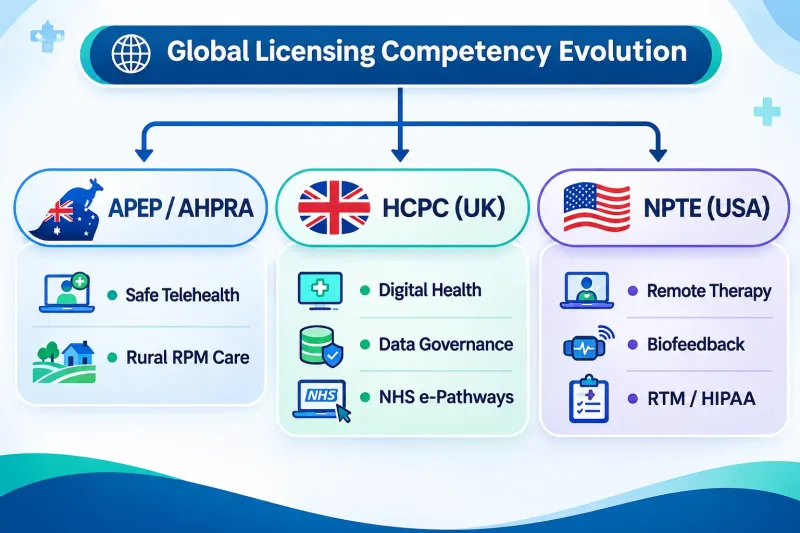
Flow chart depicting Important topics in global licensing exams
Regulatory boards do not expect candidates to be software engineers. Instead, they test clinical governance, risk assessment, data interpretation, and patient safety in tech-augmented environments:
- Objective Data Critical Appraisal: Can the candidate distinguish between clinically validated sensor metrics and inaccurate consumer-grade telemetry?
- Safety & Adverse Event Mitigation: Can the candidate identify when a telehealth or sensor-guided intervention is contraindicated, unsafe, or failing to protect patient wellbeing?
- Informed Consent & Data Privacy: Does the clinician understand legal frameworks regarding the transmission, cloud storage, and security of sensitive biomechanical and biometric data?
- Preservation of Clinical Reasoning: Does the clinician treat AI as an advisory co-pilot while retaining ultimate diagnostic and therapeutic accountability, avoiding automation bias.
Major Global Licensing Pathways
Australia: APEP (Australian Physiotherapy Council) & AHPRA Standards
The Australian Physiotherapy Council assesses internationally qualified physiotherapists through the Australian Physiotherapy Examination Process (APEP), leading to general registration with the Physiotherapy Board of Australia (under AHPRA).
Australia’s vast geography makes rural and remote healthcare delivery a top national priority. Consequently, the Australian Digital Health Agency and the APC have embedded digital health competencies directly into the entry-level practice thresholds.
How It Appears in the Written & Clinical Exams
- Clinical Vignettes in Written Papers: You may encounter a scenario involving a patient living in regional Western Australia recovering from a total knee arthroplasty who is monitored via a smart knee brace measuring daily range of motion and stride symmetry. The question may ask you to identify a clinical red flag from the sensor dashboard (e.g., an abrupt loss of terminal knee extension accompanied by elevated local skin temperature metrics), requiring an immediate referral to rule out deep vein thrombosis or surgical site infection.
- The Clinical Exam (OSCE Simulation): In dynamic clinical simulations, candidates are often evaluated on their communication skills during simulated telerehabilitation consultations. You must demonstrate:
- Verifying patient identity and physical location in case of an emergency.
- Assessing the patient’s physical environment via video to ensure zero fall risks before commencing balance exercises.
- Instructing a patient on the correct anatomical placement of a wearable sensor or providing clear, verbal instructions when guiding them through camera-based movement assessments.
- Documenting digital informed consent, explicitly informing the patient where their kinematic data is hosted and who has access to it.
APEP Clinical Exam Tip: Telehealth
│ Always verbalize your safety checks: "Before we begin our │
│ movement screen today, I want to confirm your physical │
│ address in case of emergencies, ensure your space is clear │
│ of tripping hazards, and confirm you can hear and see me." │
United Kingdom: HCPC Standards of Proficiency & NHS Integration
In the United Kingdom, international physiotherapists must register with the Health and Care Professions Council (HCPC). The HCPC updated its Standards of Proficiency for Physiotherapists to place dedicated emphasis on digital health literacy, information governance, and technology-supported care.
Under the NHS Long-Term Digital Plan, musculoskeletal (MSK) triage and chronic disease management increasingly utilize digital pathways to relieve pressure on outpatient departments.
Key Competency Focus Areas for HCPC Applicants
- Standard 8 (Communication and Digital Technologies): Candidates must be able to use digital health systems safely, select appropriate digital interventions, and ensure equitable access for patients who may experience digital exclusion (e.g., elderly patients or those without high-speed internet access).
- Data Governance & UK-GDPR: Candidates must demonstrate an understanding of data security frameworks. If a clinic utilizes an AI scribe or a remote patient monitoring platform, the candidate must know how to ensure that the patient’s data is handled in compliance with UK-GDPR and Caldicott Principles, ensuring no identifiable health data is transmitted over unsecured networks.
- Supported Self-Management: In NHS trusts, apps integrating wearable trackers (e.g., tracking exercise completion in axial spondyloarthritis) are widely prescribed. HCPC expectations center on whether the physiotherapist can critically evaluate these digital tools, interpret their adherence logs, and adapt the clinical management plan accordingly.
United States: The NPTE (FSBPT) & Value-Based Healthcare
The Federation of State Boards of Physical Therapy (FSBPT) administers the National Physical Therapy Examination (NPTE), the required credentialing exam for all 50 states.
The US healthcare system has institutionalized wearable technology through dedicated Current Procedural Terminology (CPT) billing codes for Remote Therapeutic Monitoring (RTM) (specifically CPT codes 98975, 98977, 98980, and 98981). These codes allow physical therapists to bill for monitoring non-physiological musculoskeletal data—such as therapy adherence and pain levels—using medical-grade digital health devices.
NPTE Exam Dimensions
- Physical Agents and Modalities: The NPTE tests candidates on electrotherapy, biofeedback, and motor retraining. Questions frequently focus on the precise electrode placement for sEMG biofeedback during functional rehabilitation (e.g., placing dual surface electrodes over the anterior tibial compartment to retrain dorsiflexion during the swing phase of gait in post-stroke hemiplegia).
- Safety, Ethics, and Jurisprudence: The NPTE includes multiple-choice questions regarding HIPAA-compliant technology, patient confidentiality during digital transmission, and the boundaries of physical therapy scope of practice when utilizing automated diagnostic software.
- Objective Metric Evaluation: Expect questions that present quantitative kinematic datasets—such as an automated gait analysis report showing asymmetrical stance time, reduced cadence, and excessive lateral trunk shift—requiring the candidate to identify the primary underlying muscle weakness (e.g., gluteus medius insufficiency).
The Gulf Region: DHA, HAAD (DoH), MOHAP, and Saudi Prometric Exams
Healthcare systems across the Gulf Cooperation Council (GCC) notably Dubai (DHA), Abu Dhabi (Department of Health - DoH/HAAD), the UAE Ministry of Health and Prevention (MOHAP), and the Saudi Commission for Health Specialties (SCFHS/Prometric) have invested heavily in ultra-modern smart hospitals and robotic rehabilitation institutes.
Exam Blueprint Realities
- Robotic and Advanced Neuro-Rehabilitation:Gulf credentialing exams frequently assess a candidate's knowledge of advanced technological rehabilitation modalities. Candidates should expect questions regarding the indications, precautions, and contraindications of robotic-assisted gait training (RAGT), body-weight-supported treadmill systems with computerized biofeedback, and functional electrical stimulation (FES) integrated with motion sensors.
- Contraindication Recognition: A typical Prometric exam scenario might ask: "A 58-year-old post-stroke patient with severe lower limb spasticity (Modified Ashworth Scale 4) is referred for robotic exoskeleton gait retraining. What is your immediate clinical decision?" The correct clinical reasoning recognizes that severe, fixed joint contractures or extreme spasticity (MAS 4) represent a definitive contraindication to rigid motorized exoskeletal walking, requiring manual management, antispasmodic medical coordination, and gentle mobilization first.
Canada: The Physiotherapy Competency Examination (PCE) & Provincial Licensing
In Canada, provincial regulatory colleges (such as the College of Physiotherapists of Ontario - CPO, or the College of Physical Therapists of British Columbia - CPTBC) regulate practice, guided by the national Competency Profile for Physiotherapists in Canada.
- Virtual Care & Remote Practice Guidelines: Following the rapid expansion of telerehabilitation across northern territories and rural provinces, Canadian regulators established strict standards for digital practice. Candidates must demonstrate an understanding of cross-provincial licensing limitations (you cannot treat a patient residing in another province via telehealth unless explicitly registered there) and mandatory protocols for technical failures during an assessment.
- Clinical Reasoning with Predictive Tools: Canadian assessments place heavy emphasis on client-centered care. If an AI platform generates a predicted discharge timeline, the candidate is expected to demonstrate how they communicate that data to the client, negotiate collaborative functional goals, and prevent the technology from driving the clinical narrative at the expense of the patient’s subjective values and psychosocial needs.
Passing international licensing exams requires more than textbook knowledge it demands an understanding of updated clinical frameworks, safety guidelines, and region-specific healthcare protocols.
Real-World Clinical Adoption: Australia, Canada, and the UK
To demonstrate fluency on exams or in clinical interviews, you must understand how these tools operate inside modern physiotherapy practices:
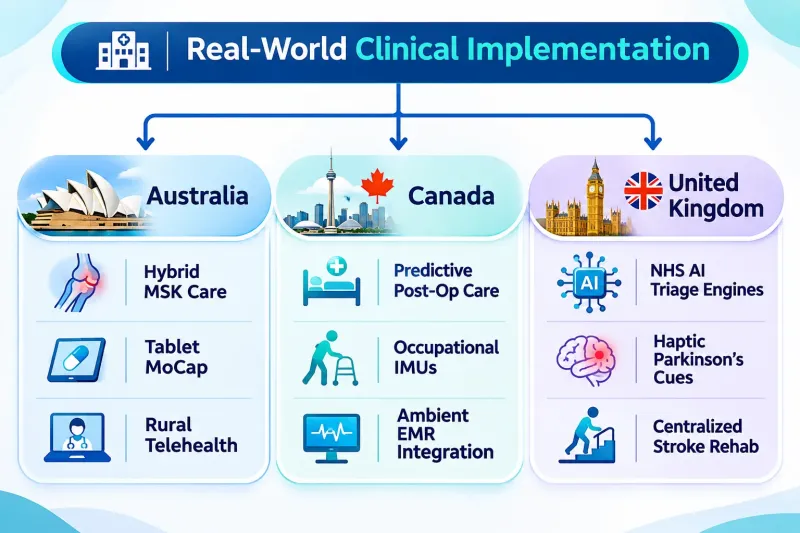
Australia: Hybrid Care Models and Elite Sports Biomechanics
Australian private practices frequently utilize hybrid rehabilitation pathways. A patient with a chronic rotator cuff tendinopathy may attend an in-person session in week one for manual therapy, dry needling, and baseline markerless motion capture. For weeks two through five, the patient transitions to asynchronous remote monitoring:
- Patients execute their exercise program in front of a clinic-prescribed app that leverages markerless pose estimation on their smartphone.
- The software verifies that the patient performs scaption within their pain-free zone (e.g., maintaining 30 degrees of anterior plane elevation) and logs rep velocity.
- Australian sports physios working within AFL (Australian Rules Football) and cricket clubs employ micro-IMU arrays taped over the lumbar spine to monitor rotational stress and bowling workloads, managing acute-to-chronic workload ratios (ACWR) dynamically to mitigate stress fractures.
Canada: Occupational Ergonomics and Ambient Charting
In Canadian clinics, ambient AI scribing has gained rapid adoption to alleviate administrative burdens within high-volume practices:
- During a complex functional capacity evaluation (FCE), the ambient AI system transcribes the session, isolating objective lifting capacities, push-pull dynamometry scores, and pain scale descriptions directly into provincial workers' compensation board templates.
- In occupational rehabilitation centers, therapists utilize wearable smart garments equipped with stretch sensors and micro-gyroscopes to evaluate industrial workers returning from lumbar spine injuries. The sensors provide real-time vibration alerts when a worker exceeds safe lumbar flexion angles during repetitive lifting, retraining safe lifting biomechanics on the warehouse floor.
United Kingdom: NHS Digital Triage and Neuro-Rehab Centers
The NHS leverages AI engines primarily for population health management and clinical triaging:
- Patients suffering from acute lower back pain complete an interactive digital intake tool that employs clinical NLP to screen for cauda equina syndrome, fracture, malignancy, and systemic inflammatory disease.
- If red flags are cleared, the system categorizes the patient's STarT Back risk score and guides them to appropriate conservative self-management resources or books them into a specialized NHS physiotherapist slot.
- In centralized neuro-rehabilitation units, UK physiotherapists utilize sensory wearables for patients with Parkinson’s disease. When an IMU on the foot detects a sudden alteration in cadence or spatial-temporal freezing of gait, the wearable delivers rhythmic auditory or vibrotactile pulses, stimulating motor
Clinical Reasoning & Ethics
Regardless of how sophisticated an algorithm becomes, the fundamental tenet of healthcare regulation remains unchanged: AI is an advisory tool; the physiotherapist
[ Quantitative Data ] [ Qualitative Data ]
• AI Pose Estimation + • Patient Pain Scale
• Wearable Sensor Metrics • Clinical Palpation
• Predictive Timelines • Psychosocial Factors
│ │
└──────────────────┬───────────────────┘
[ Physiotherapist Analysis ]
(Synthesizes data with empathy)
│
▼
[ Final Treatment Decision ]
(100% clinician accountable and directed)
The Pitfalls of Automation Bias
Automation bias occurs when a clinician uncritically accepts a computer-generated output, suspending their own clinical judgment.
- Scenario: A computer vision app evaluates a patient's overhead squat and outputs a "perfect 100% movement score" because joint angles fall within programmed normal ranges.
- The Clinical Reality: The physiotherapist observes the patient holding their breath, exhibiting significant facial grimacing, clenching their jaw, and palpates severe paraspinal muscle hypertonicity.
- The Action: The clinician overrides the automated score, identifying that while macro-kinematics look sound, the patient is utilizing high-stress protective guarding strategies that must be addressed through breathwork and graded exposure.
Data Security, Privacy & Inherent Algorithmic Bias
- Data Vulnerability: Video feeds and kinematic coordinates constitute sensitive biometric data. Clinicians must ensure that any app or platform used holds ISO 27001 certification, is HIPAA compliant, and adheres to local privacy regulations (such as the Australian Privacy Principles or UK-GDPR). Raw video data must be encrypted in transit and at rest, ideally converted to anonymized skeletal coordinate vectors rather than storing raw facial and bodily imagery.
- Algorithmic Bias: Many AI models are trained on datasets composed primarily of healthy, young, athletic populations. When applying these models to frail, elderly populations or individuals with structural joint deformities (such as severe scoliosis or Charcot-Marie-Tooth disease), the algorithms frequently misidentify anatomical landmarks or register normal compensatory strategies as severe pathology. The clinician must continuously evaluate whether an AI tool is validated for their patient’s specific demographic.
Elevate Your International Journey with Academically
Preparing for international physiotherapy licensing exams is a transformative career milestone. Navigating the rigorous documentation, understanding updated exam blueprints, and mastering modern clinical competencies like digital health, telehealth governance, and tech-augmented practice can be daunting.
At Academically, we bridge the gap between your home country qualifications and your international career aspirations.
│ Your Global Career Pathway with Academically │
│ ✓ APEP (Australia) Comprehensive Preparation │
│ ✓ HCPC (UK) Registration Guidance & Document Audits │
│ ✓ Gulf Board Exams (DHA / HAAD / MOH / Pro metric) Prep │
│ ✓ Modernized Curriculum Including Digital Health Competencies│
Whether you are targeting registration with AHPRA in Australia through the APEP pathway, seeking to join the NHS via the HCPC in the United Kingdom, or planning your migration to the Gulf, our expert clinical faculty provides the structured guidance, mock exams, and mentorship you need to clear your exams on the first attempt.