For overseas-qualified dentists, the choice of where to build their careers can be as important as the choice of registration pathway. Australia and New Zealand both offer appealing career choices, but the differences in the registration processes, scope of examinations, career opportunities, earning potential, lifestyle and long-term prospects are considerable.
Two of the most popular pathways for overseas-qualified dentists are the Australian Dental Council (ADC) and the New Zealand Dentist Registration Examination (NZDREX). So, which one is the better option for you: ADC vs NZDREX?
The choice ultimately depends on your desired outcomes. Let’s take a closer look at the two pathways.
ADC vs NZDREX: Comparison Table
Let`s compare the two pathways in detail:
| Factor | ADC – Australia | NZDREX – New Zealand |
| Regulatory body | Australian Dental Council | Dental Council of New Zealand |
| Qualification requirement | Minimum 4-year full-time dental degree/diploma from a recognised university | Appropriate dental qualification from a recognised tertiary institution |
| Main assessment route | Initial Assessment → Written Exam → Practical Exam | NDEB Equivalency Process: AFK → ACJ → NDECC |
| Registration authority | Dental Board of Australia/AHPRA | Dental Council of New Zealand |
| Written assessment | ADC Written Examination | NDEB AFK + ACJ |
| Clinical assessment | ADC Practical Examination | NDEB Clinical Skills/NDECC |
| Examination location | Written exam available through international Pearson VUE centres; practical in Australia | NDEB examination locations/process |
| Career market | Larger | Smaller |
| Geographic opportunities | Major cities + regional/rural Australia | Major cities + regional/rural New Zealand |
| Long-term mobility | Strong | Strong, including Trans-Tasman options |
| Best suited for | Dentists seeking a large and diverse Australian market | Dentists specifically targeting New Zealand |
Dr. Akram Ahmad (PhD in University of Sydney) explains, the pathway for overseas dentists who want to practise in New Zealand. Dentists with a BDS, MDS, or other recognised dental qualification must complete the required New Zealand registration process. The video highlights the National Dental Examination Board of Canada (NDEB) pathway, requiring candidates to pass the Assessment of Fundamental Knowledge (AFK), Assessment of Clinical Judgement (ACJ), and Assessment of Clinical Skills (ACS). The first two components must be completed within three years, with a maximum of three attempts, while the clinical skills requirement must be completed within five years. The speaker also suggests considering Australia’s ADC pathway, which may offer a more practical route for some overseas dentists. Overall, candidates should carefully compare both pathways before deciding where to practise.
What Is the ADC Pathway?
The Australian Dental Council assesses overseas-qualified dentists whose qualifications are not directly recognised in Australia. The ADC pathway consists of three main stages:
- Initial Assessment
- Written Examination
- Practical Examination
To be eligible for the initial assessment, overseas-qualified dentists must have a minimum four-year full-time dental degree or equivalent from a recognised university. The initial assessment determines your eligibility for the next stages of the process.
Following the initial assessment and the successful completion of the written and practical examinations, you will be eligible for registration with the Dental Board of Australia.
ADC Written Examination
The ADC written examination tests your dental science and clinical knowledge, as well as your clinical judgement and reasoning. It is a two-day computer-based multiple-choice exam and is currently delivered at Pearson VUE International Testing Centres. The ADC examination fees are AUD $2,122 for the written exam, with a five-year result validity.
ADC Practical Examination
The ADC practical examination is taken after successfully passing the written examination. It consists of two days of testing your technical and clinical skills in a dental setting. The ADC examination fees are AUD $4,775 for the practical examination, with eligibility for registration with the Dental Board of Australia upon successful completion.
How to Prepare for the ADC Skills Assessment
Clearing the ADC pathway requires more than simply revising dental theory. The practical examination assesses your ability to apply your knowledge in a clinical setting, making hands-on preparation, clinical reasoning and familiarity with the examination format extremely important.
This is where structured preparation can make a difference.
Academically’s ADC Exam Course is designed to help overseas dentists prepare specifically for the ADC examination journey. The course can support candidates with structured learning, exam-focused preparation and guidance to help them understand what to expect throughout the assessment process.
What Is NZDREX?
The New Zealand Dentist Registration Examination (NZDREX) is the preferred method of registration for overseas-qualified dentists whose qualifications are not prescribed for registration in New Zealand.
One of the most surprising aspects of the NZDREX is that it requires completion of the National Dental Examining Board of Canada (NDEB) equivalency process.
According to the Dental Council of New Zealand, it consists of:
- Assessment of Fundamental Knowledge (AFK)
- Assessment of Clinical Judgement (ACJ)
- Assessment of Clinical Skills (NDECC)
These components must be successfully completed before being eligible to apply for registration in New Zealand.
AFK and ACJ can be attempted a maximum of three times, while NDECC can be attempted multiple times within the 60-month eligibility window.
It is worth noting that compared to the straightforward three-step process of the ADC, NZDREX has a more complex structure due to its link with the NDEB equivalency pathway.
Eligibility and Qualification Requirements
ADC Requirements
To be eligible for the Initial Assessment by the ADC, overseas-qualified dentists must have completed a minimum four-year full-time dental degree or equivalent from a recognised university. In addition, they must provide information about their education, registration/licensure and professional experience. Eligibility assessment standards include identity, education and training, experience and registration history, and clinical competence.
NZDREX Requirements
To be eligible for NZDREX, candidates must have an appropriate dental qualification from a recognised tertiary institution and meet the English language requirements.
Before proceeding with either of the two pathways, it is essential to be certain that your dental qualification meets the eligibility criteria set by the relevant regulatory authority.
ADC vs NZDREX: Which Examination Process Is More Streamlined?
This consideration takes us back to the structural differences between the two pathways.
ADC
The general structure of the ADC pathway is as follows:
BDS or a recognized dental degree → Initial Assessment → Written Examination → Practical Examination → Australian registration
The process is quite straightforward, with all requirements set out clearly by the ADC.
NZDREX
The NZDREX pathway involves the additional step of the NDEB equivalency process:
BDS or a recognized dental degree → AFK → ACJ → NDECC → NZDREX eligibility → New Zealand registration
While the process is still relatively uncomplicated from a structural perspective, understanding the exact requirements can be challenging, as NZDREX is not directly linked to one regulatory authority but rather involves the NDEB equivalency process.
To summarise, compared to the largely Australia-specific requirements of the ADC, NZDREX has a slightly more complex structure due to its connection to the NDEB.
ADC vs NZDREX Fees Structure
When it comes to cost considerations, the main difference between the two pathways is that the NZDREX-linked process does not have clearly defined examination and registration fees. The ADC pathway, on the other hand, has a transparent breakdown of all associated costs.
For the ADC pathway, the examination and registration fees include:
| ADC Stage | Fee (AUD) | Approx. USD* | Approx. INR* |
| Initial Assessment | AUD$647 | US$468 | ₹44,500 |
| Written Examination | AUD$2,122 | US$1,534 | ₹1,46,000 |
| Practical Examination | AUD$4,775 | US$3,451 | ₹3,28,500 |
| Total | AUD$7,544 | US$5,453 | ₹5,19,000 |
This brings the total cost of major assessments to approximately AUD $7,544, excluding additional expenses such as registration, travel, study leave, documentation verification and other costs.
For the NZDREX pathway, the Dental Council of New Zealand lists a 2026/27 registration application fee of NZD $1,597 which is approximately around INR 88,750 i.e. US $935.48 including assessment and registration for applicants with prescribed overseas qualifications, while the registration route for non-prescribed overseas qualifications and experience under section 15(2) is listed at NZD $8,641.10 including GST.
To compare the costs of the two pathways accurately, it is necessary to take into account additional expenses associated with both examinations and registration.
Salary: Where Can You Earn More?
In terms of financial rewards, dentistry can be an extremely rewarding profession in both Australia and New Zealand. However, compared to New Zealand, Australia has a consistently higher average salary across a broader range of professions and industries.
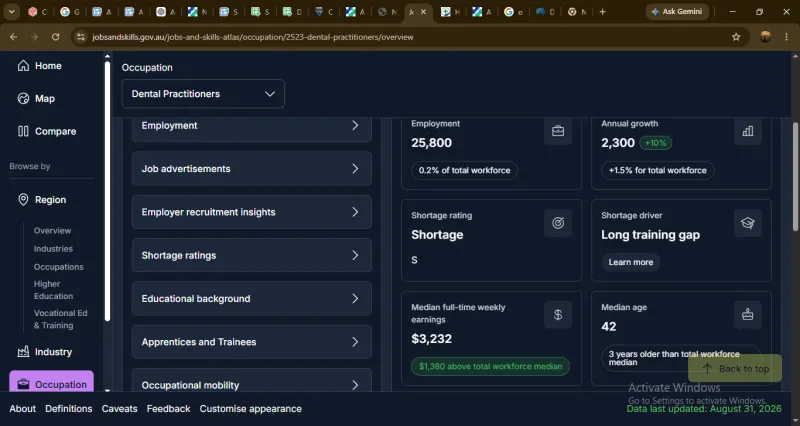
According to Jobs and Skills Australia, dental practitioners working full-time earn a median weekly income of AUD $3,232, equivalent to approximately AUD $167,000 or AUD $85 per hour if averaged across 52 weeks.
At the same time, it is essential to remember that salaries can vary significantly depending on:
- Location
- Experience
- Employment type (public/private)
- Practice ownership
- Clinical specialisation
- Hours worked
- Incentive schemes
- Rural vs metro practice
Salaries in New Zealand tend to be highly competitive, particularly in public-sector and specialist roles, but they generally follow a similar pattern to those in Australia.
Job Opportunities
When comparing job opportunities, it is logical to assume that bigger countries have more job opportunities than smaller ones. And this rule certainly applies to Australia and New Zealand.
Compared to New Zealand, Australia has a much larger population and a significantly bigger economy. Both factors contribute to a bigger job market for dentists in Australia. In particular, Australia has more major employment hubs, including Sydney, Melbourne, Brisbane, Perth, Adelaide, Canberra, Gold Coast and many other regional centres.
Clearing the ADC pathway is only one part of your journey. Finding the right job after registration is the next important step.
This is where Jobslly can be useful. Instead of manually searching across multiple platforms, overseas dentists can use Jobslly to discover relevant healthcare and dental job opportunities in Australia and streamline their job search.
This variety means that you will have more options as an overseas-qualified dentist seeking employment in Australia. And the opportunities will be different: some employment hubs offer more private practice opportunities, while others lean towards public-sector roles. There are also variations in terms of lifestyle, cost of living, local culture and other factors.
New Zealand has several major employment centres, including Auckland, Wellington, Christchurch and other regional hubs. The country actively recruits overseas-qualified dentists, but its overall job market is smaller than that of Australia.
Australia Offers Greater Career Diversity
Another advantage of working in Australia is the presence of a bigger healthcare ecosystem. As a dentist, you have more options in terms of your career specialisation, practice settings, management roles, education and research. In particular, after obtaining your dental registration, you can consider the following career paths:
- General and specialist dentistry
- Public and private practice
- Corporate dentistry
- Rural and regional dentistry
- Academic and research careers
- Clinical education and management
- Digital/dental technology and telehealth
- Healthcare leadership
The bigger ecosystem also means that there are more multidisciplinary healthcare organisations and professional networks in Australia.
An Important Advantage: Australia Can Also Open the Door to New Zeal and
New Zealand recognises Trans-Tasman Mutual Recognition for eligible practitioners registered in Australia. The Dental Council states that dentists registered in Australia may be eligible to register in New Zealand under the Trans-Tasman Mutual Recognition Act 1997.
That means choosing Australia doesn't necessarily mean permanently closing the door on New Zealand. For an eligible dentist, an Australian registration can potentially provide a pathway toward New Zealand registration later.
This creates an interesting strategic advantage:
ADC → Australia → build experience → potentially explore New Zealand later rather than immediately limiting your career to the smaller New Zealand market.
Conclusion
New Zealand has many appealing attributes, including excellent lifestyle and employment opportunities. However, if you are seeking greater career flexibility and a bigger healthcare ecosystem, the ADC pathway has distinct advantages.
To put it another way, while NZDREX will keep you within the smaller New Zealand market, the ADC pathway gives you the opportunity to thrive in the larger Australian market while still retaining the possibility to move to New Zealand. Such strategic flexibility can be extremely valuable for overseas-qualified dentists who want to build long-term careers in either country.
Before making the final decision, it is essential to conduct further research and consult the relevant official resources, since the requirements for both pathways can change.
Your career choice should ultimately reflect your professional goals and personal preferences. After all, your dental career should not be limited to just one country or one practice setting.