The global physiotherapy landscape is rapidly evolving. For students and practicing physiotherapists, qualifications like BPT, MPT, DPT, or PhD are no longer viewed solely within regional borders. Professionals are actively seeking international registration, licensing roadmaps, and career pathways across Australia, New Zealand, the Gulf, and the United Kingdom.
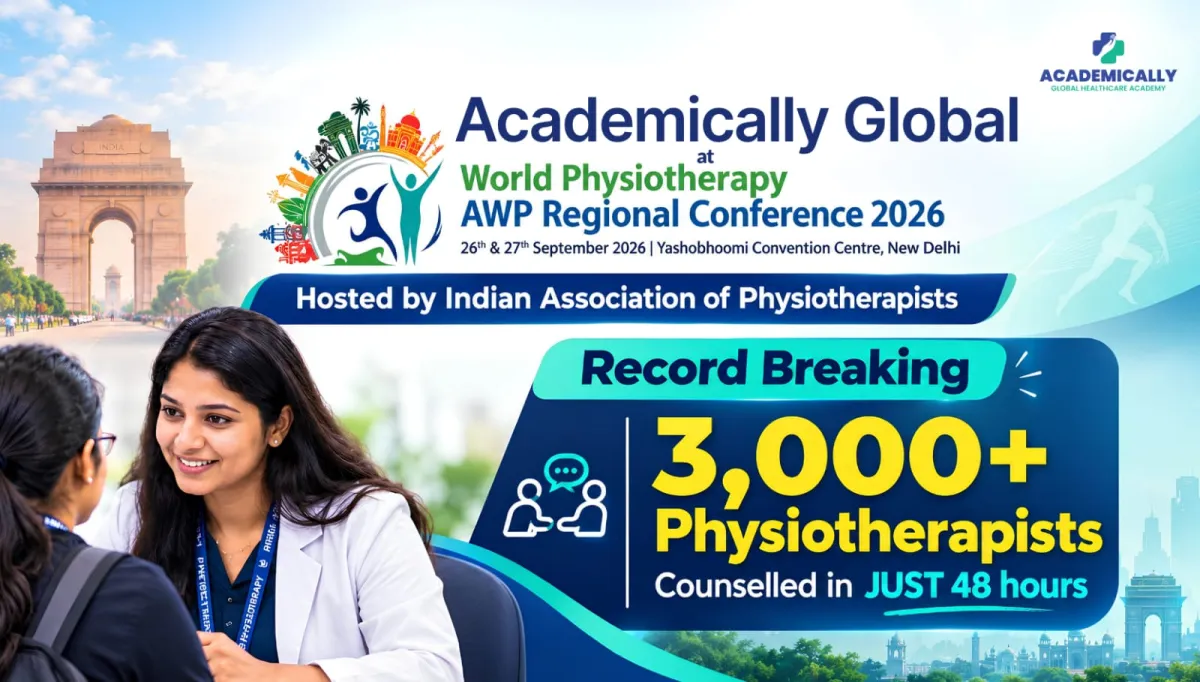
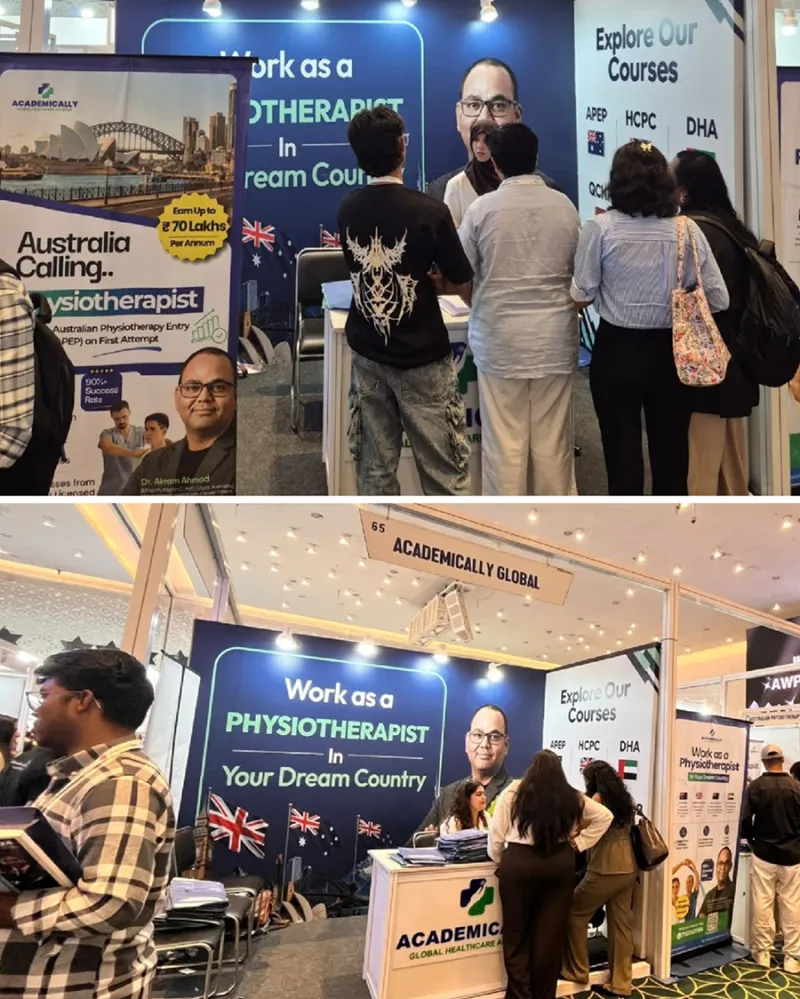
This growing momentum was on full display at the World Physiotherapy AWP Regional Conference 2026, held at the Yashobhoomi Convention Centre in New Delhi on 26–27 September 2026. Hosted by the Indian Association of Physiotherapists (IAP), Academically Global counselled more than 3,000 physiotherapy professionals from its dedicated kiosk.
For Academically Global, this milestone represents thousands of career questions converted into structured, actionable international pathways.
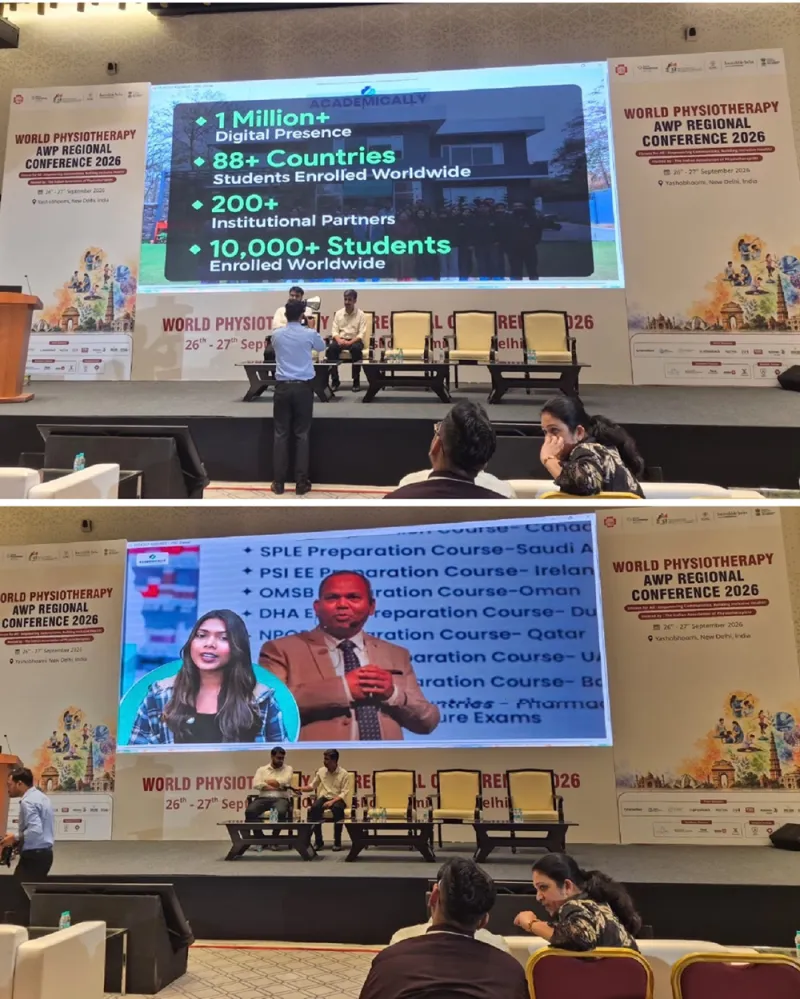
Dr. Akram Ahmad's Presence all the way from Australia Added a Global Perspective
A special highlight for the Academically Global team was the presence of Dr. Akram Ahmad, PhD, University of Sydney, who joined the conference all the way from Australia.
As an international healthcare career coach and the Founder & CEO of Academically Global, Dr. Akram brought a perspective shaped by the realities of global healthcare education, professional licensing and international career development.
His presence also reinforced an important part of Academically Global's philosophy. Physiotherapists should not have to navigate an unfamiliar international system without understanding how the pieces fit together.
For a student contemplating the first step and an experienced professional planning the next one, the right guidance can change the entire trajectory of a career.
The Incredible Milestone at WPAWP 2026 Hosted by Indian Association of Physiotherapists (IAP)
Over the two-day conference, the Academically Global kiosk became a meeting point for students, experienced physiotherapists, researchers and professionals considering international careers.
More than 3,000 physiotherapy students and practitioners were counselled in 48 hours, with conversations spanning academic backgrounds including:
| Candidate Profile | Key Questions & Guidance Topics |
| BPT Students & Graduates | International eligibility, language tests, and baseline registration requirements. |
| MPT Professionals | Overseas specialization recognition, advanced clinical scope, and career growth. |
| DPT Graduates | International qualification equivalency and direct licensing pathways. |
| PhD Scholars | Academic, clinical research, and higher-education career routes. |
| Working Practitioners | Experience verification, employer requirements, and visa/relocation pathways. |
The sheer volume of conversations reflected a clear shift in the way many physiotherapists are approaching their careers. The question is no longer simply, “Where can I work after physiotherapy?”
It is increasingly becoming, “Which country fits my qualifications, experience, career goals and professional pathway?”
That distinction matters because physiotherapy is a regulated profession in many international destinations. A degree earned in one country does not automatically grant the right to practise in another.
Country-Wise Regulatory & Licensing Pathways
One of the most valuable aspects of the conversations at WPAWP 2026 was helping candidates understand that international physiotherapy is not one single pathway.
The right route depends on the destination country, qualification, registration status, professional experience and, in some cases, the regulator’s assessment of the candidate’s education and competence.
Here is a high-level overview of the destinations discussed at the conference.
| Destination | Regulatory Body | Core Assessment / Licensing Pathway |
| Australia | Physiotherapy Board of Australia / AHPRA | Australian Physiotherapy Entry Pathway (APEP) via Australian Physiotherapy Council |
| New Zealand | Physiotherapy Board of New Zealand | General Assessment or International Express Pathway (IEP) |
| Dubai (UAE) | Dubai Health Authority (DHA) | Primary Source Verification (PSV) + DHA Professional Licensing Exam |
| Qatar | Department of Healthcare Professions (DHP) | DHP Credentialing & Verification Pathway |
| Saudi Arabia | Saudi Commission for Health Specialties (SCFHS) | Professional Classification & Prometric Examination |
| United Kingdom | Health and Care Professions Council (HCPC) | HCPC International Registration Route |
These pathways should not be treated as interchangeable. Each regulator has its own eligibility criteria, documentation requirements, assessments and registration process.
Australia: APEP and the route to physiotherapy registration
Australia was one of the strongest areas of interest among candidates visiting the Academically Global kiosk.
The Australian Physiotherapy Council's Australian Physiotherapy Entry Pathway (APEP) supports overseas-qualified physiotherapists seeking entry into the Australian physiotherapy workforce. The current pathway includes Eligibility Assessment, Cultural Safety Training, Written Assessment, Capability Assessment and a face-to-face Clinical Workshop in Melbourne. Successful candidates can then progress towards registration with Ahpra.
The pathway has also evolved considerably. APEP replaced the earlier Standard Assessment Pathway and was designed with a greater proportion of remote assessment, making the process more accessible to internationally trained physiotherapists.
For an Indian physiotherapist, therefore, understanding eligibility first is critical. Preparing for an assessment without confirming the applicable route can lead to unnecessary delays and expense.
New Zealand: Understanding international physiotherapy registration
Regulated by the Physiotherapy Board of New Zealand, international registration features both general and express pathways. The International Express Pathway (IEP) assists candidates holding eligible registration in recognized jurisdictions like Australia, the UK, Ireland, South Africa, or Canada.
Gulf countries: Dubai, Qatar and Saudi Arabia
The Gulf continues to attract physiotherapists looking for international exposure, career mobility and opportunities outside traditional home markets.
In Dubai, physiotherapists must meet the applicable Dubai Health Authority (DHA) licensing requirements. The UAE's Unified Healthcare Professional Qualification Requirements provide the broader framework used by UAE health regulators, with specific criteria applying to professional titles and licensing examination requirements.
In Qatar, the Department of Healthcare Professions under the Ministry of Public Health (erstwhile, Qatar Council for Healthcare Practitioners) sets requirements for physiotherapy registration. The official scope document recognises qualifications including bachelor's, DPT and master's-level physiotherapy qualifications, subject to the applicable regulatory requirements.
For Saudi Arabia, international physiotherapists need to understand the Saudi Commission for Health Specialties' professional classification and the physiotherapists' registration process in Saudi. SCFHS states that professional classification is the first legal step before professional registration, with submitted qualifications, registration and professional experience subject to verification and assessment. Its current classification-exam system also lists a Physiotherapy Specialist examination delivered through Prometric.
The key lesson across the Gulf is simple: licensing requirements must be checked country by country rather than assuming that one Gulf registration automatically applies everywhere.
UK: HCPC registration for internationally trained physiotherapists
For physiotherapists targeting the UK, the Health and Care Professions Council (HCPC) provides an international application route for professionals who trained outside the UK.
Applicants need to demonstrate that their qualification and training are relevant to the profession and provide evidence against the HCPC's standards of proficiency. International applicants must also prepare the required certified documentation and meet the regulator's application requirements.
This makes an early review of academic transcripts, clinical education, registration and professional experience especially important.
What Physiotherapists Learned at the Academically Global Kiosk
The biggest value of the 48-hour interaction was not simply introducing students to different countries. It was helping them understand the difference between an international career aspiration and an actionable licensing plan.
A physiotherapy student may know that they want to work in Australia. A practising physiotherapist may already have several years of experience and be considering the Gulf. Another candidate may be looking at New Zealand because of long-term career and migration goals.
Yet each candidate starts from a different point. The same destination can mean different requirements for:
- A fresh BPT graduate: eligibility, English-language requirements, documentation and assessment planning.
- An MPT professional: previous registration, postgraduate education, experience and the applicability of the qualification.
- A DPT graduate: international recognition of the qualification and the destination regulator's assessment framework.
- An experienced physiotherapist: registration status, recency of practice, experience documentation and employment readiness.
That is why personalised counselling matters.
Why International Physiotherapy Pathways Need Early Planning
International registration is rarely a single-step application. There may be qualification assessments, primary-source verification, English-language requirements, examinations, competence assessments, professional registration and then employment or immigration processes.
Trying to solve everything at once can make the process unnecessarily complicated. A better approach is to work backwards from the intended destination.
Choose the destination → identify the regulator → confirm eligibility → understand the assessment pathway → prepare documentation → plan the required assessment or examination → pursue registration → explore employment and migration options.
The exact sequence varies by country, but the principle remains the same. This is where accurate information can make a meaningful difference.
An incorrect assumption about eligibility can delay a candidate. A missed document can slow an application. Preparing for the wrong examination can waste months of effort. Confusing professional registration with a visa or migration outcome can also create unrealistic expectations.
For physiotherapists planning an international move, career planning and licensing planning need to happen together, but they are not the same process.
A Conference That Connected Physiotherapy With the Future
WPAWP 2026 was much bigger than international career discussions. The official programme brought together keynote lectures, workshops, scientific presentations, panel discussions and sessions spanning multiple areas of physiotherapy practice, education, research and public health.
That breadth made the conference particularly significant for a profession that is expanding across clinical care, technology, education, research, community health and leadership. For Academically Global, being present at the conference created an opportunity to connect that professional evolution with another important conversation: global mobility.
A physiotherapist can build a career in clinical practice. They can move towards advanced practice, research, education, leadership or international healthcare systems. The pathway may look different for every professional, but the need for informed decision-making remains constant.
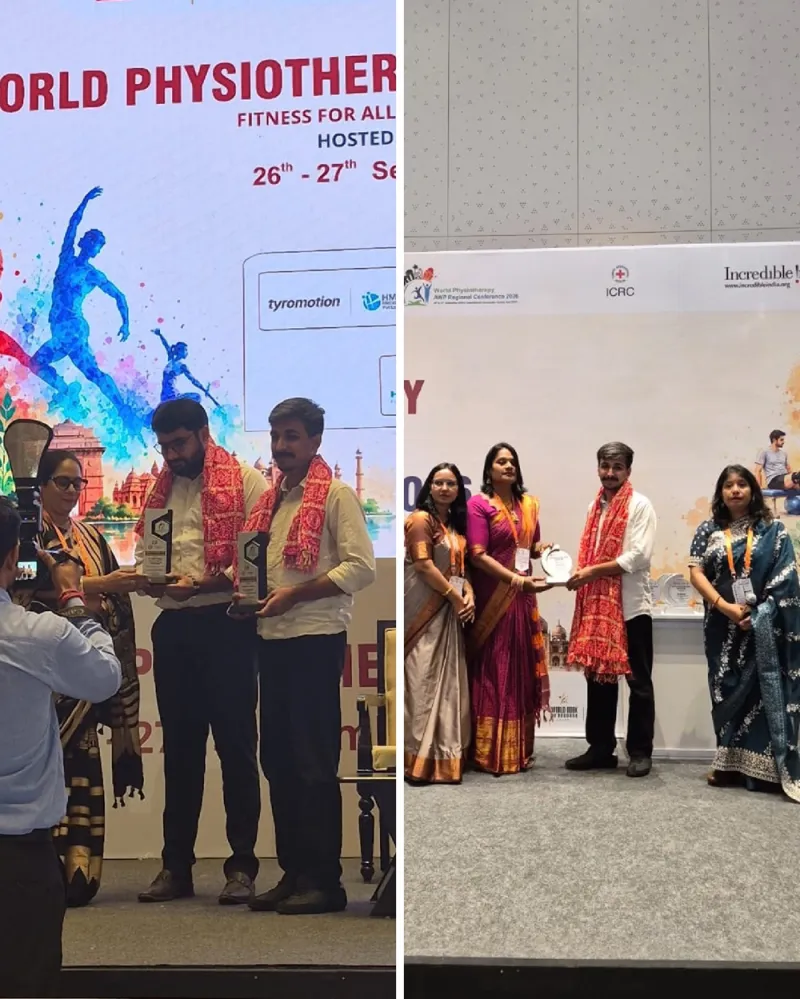
Gratitude to the Physiotherapy Community
Academically Global's participation would not have been possible without the platform created by the Indian Association of Physiotherapists.
The organisation's role in bringing together clinicians, educators, researchers, students and international leaders made WPAWP 2026 an important meeting point for the profession.
Special appreciation goes to Dr. Ruchi Varshney, Treasurer of IAP and Organising Secretary of WPAWP 2026, whose leadership and support helped create this platform. The official conference website identifies Dr. Ruchi Varshney as the organising secretary.
The event also provided an opportunity to connect with international leaders, including Dr. Rik Dawson, National President of the Australian Physiotherapy Association (APA) Board, whose participation formed part of the conference's wider international programme.
The presence of Smt. Rekha Gupta, Hon'ble Chief Minister of Delhi, added further significance to an event focused on physiotherapy, inclusive health and the future of healthcare.
Most importantly, the conference belonged to the thousands of students and professionals who walked through its halls with questions about their future.
To Conclude With...
The most meaningful number from the event is not only 3,000+. It is what those conversations represented. Every candidate who approached the Academically Global kiosk had a different starting point. Some were students discovering international physiotherapy for the first time. Some were experienced professionals looking for a new country. Others were trying to understand a licensing examination, registration pathway or long-term career option.
Each conversation started with a question.
- Can I work in Australia?
- Is my physiotherapy degree recognised in New Zealand?
- What does it take to become a licensed physiotherapist in Dubai?
- Should I consider the UK or the Gulf?
- Which pathway is relevant to my qualification and experience?
Those questions are not small. For many healthcare professionals, they represent a potential career change, an international move and years of professional investment. That is why the milestone at the World Physiotherapy AWP Regional Conference 2026 carries significance for Academically Global. It reinforces a belief that has remained central to its work: access to the right information at the right stage can make an international healthcare career far more structured and achievable.
After 48 remarkable hours at Yashobhoomi, one thing was clear. The ambition among physiotherapy professionals is already global. The next step is helping more of them understand the path.