


100 hours of recorded videos

One-on-one feedback sessions with the trainer

Highly skilled trainers, who have previously worked as lab technicians/scientists and lecturers in India and Australia
Why Become a Laboratory Scientist in Australia?
$82,000
Average annual salary of laboratory scientists in Australia
3000+
Current openings for the role of laboratory scientist in Australia
185,000+
Visas for skilled medical workers in Australia
About The Course


Who Is The Course For?
Medical laboratory technicians and scientists who want to practise, migrate, and settle in Australia.
Candidates who are appearing for the AIMS exam for the first time
Ideal for candidates who want to take on the examination with full preparation

What's More That Comes
With Our Course?

1-On-1 Q&A Sessions
We provide online one-on-one counselling and Q&A sessions to ensure online learning is beneficial for the aspirants. Our mentors help aspirants clear their doubts and queries and get all the answers they need.

Live+Recorded Sessions
Missed a live lecture? Don’t worry. You can always find a recorded lecture on our platform and revisit it as many times as you want during the course duration.

Extended Course Access
Getting the course once will help you prepare for not one but multiple attempts. You get access to all the resources for more than a year, to ensure proper revision.

Community Building
We help you get in touch with a community of experts, which includes mentors, registered practitioners, previous alumni and those who have successfully cleared the exams. This adds value to your preparation and get all the guidance and motivation you need.
Meet Our Faculty
Success Stories


I still can't believe I have passed the exam of dental practice in Australia. Thanks to the AHPRA-registered faculty and program manager who was always there by my side. The live classes, recorded sessions, mock tests, and community suppor ton Discord helped me understand that ADC is not about memorising difficult concepts. It is about thinking like a general dentist, practicing in Australia. I had to pause my preparation due to personal reasons, but the support and flexibility helped me restart and stay focused. With consistent effort and the right strategy, I cleared the ADC Written Exam on my first attempt and moved one step closer to my dream of practising dentistry in Australia.
Dr. Marlyn Borgesi
ADC Qualified Student
Preparing for the DHA Exam while working at a dental clinic was challenging, but having the right structure made the journey possible. I managed my clinic hours along with recorded lectures, live sessions by DHA-qualified faculty, revision, and regular practice tests. The 1:1 mentorship and doubt-solving support helped me focus on the right topics instead of feeling overwhelmed. In the final days, I dedicated my time completely to revision and mock tests. Clearing the DHA Exam proved to me that with consistency, proper guidance, and a clear goal, it is possible to build an international dental career while managing your professional commitments.
Dr. Anushree
DHA Qualified Student
Preparing for OPRA while managing my family, children, and a business was not easy. There were days when finding time to study felt impossible, but I knew becoming a registered pharmacist in Australia was worth the effort. Academically gave me the structure, guidance, and confidence I needed. The live classes by OPRA and qualified faculty, notes, mock tests, and constant support from programme managers helped me stay focused. My final month of preparation was intense, but seeing the result made every sacrifice worth it. If you stay consistent and believe in yourself, OPRA is achievable.
Bushra
OPRA Qualified Student
After completing my pharmacy education, I started my career in QA and QC in India, earning around ₹16,000 per month despite long working hours. I wanted better growth, so I moved into retail pharmacy and spent four years building my skills, patient counselling experience, and confidence. I prepared for the DHA exam while working and successfully cleared it in November 2025. Today, I work as a licensed pharmacist near Burj Khalifa, Dubai. All thanks to Academically's coaching supported by DHA-qualified faculty, mock tests, support by programme managers and incredible community support on Discord.
Anisha
DHA Qualified Student
Moving to Australia and restarting my pharmacy career was challenging, but I knew I wanted to continue growing as a pharmacist. I started with a pharmacy assistant role, learning the Australian healthcare system step by step while preparing for the OPRA exam. Academically gave me the right guidance by AHPRA-registered faculty, structure, and confidence throughout my preparation journey. The recorded classes, revision materials, and AI based mock tests helped me stay consistent even while managing my studies and work. Clearing OPRA showed me that with the right approach and dedication, your global pharmacy dream is achievable.
Megha
OPRA Qualified Student
After working as a pharmacist in Oman for 16 years, returning to studies after such a long gap felt challenging. The OPRA Exam was a completely new experience for me, but Academically gave me the right guidance, resources, and confidence to prepare effectively. The lectures by OPRA qualified faculty, PDF notes, AI-based mock tests, and Grand Tests helped me understand what to focus on. In the final month, I studied consistently for 6–7 hours daily while managing my responsibilities. Clearing OPRA proved that age or years away from academics do not matter when you have the right mindset and preparation strategy. If I can do it, anyone can.
Nijeesh
OPRA Qualified Student
I completed my B.Pharm from RIMT University, Punjab, and gained experience in hospital and retail pharmacy roles in India. To pursue my international career goals, I prepared for the NPQE/Qatar Prometric Exam. With Academically’s live classes, recordings, study material, and mock tests, I cleared the exam on my first attempt. Stay consistent—success comes with focused preparation.
Zeeshan
NPQE/Qatar Prometric Qualified Student
After completing my MBBS, DCH, and DNB, I believed my career would remain purely clinical. Although I loved patient care, long working hours and limited work-life balance made me seek better growth and stability. Academically’s Executive Programme in Clinical Drug Development introduced me to non-clinical opportunities. With expert-led sessions and interview preparation, I cleared my first non-clinical interview and received multiple offers.
Dr. Lakshmi
Drug Safety Physicians - Tata Consultancy Services, 32 LPA
After completing my MBBS from a government medical college, I worked as a physician and believed clinical practice was my only career path. However, long hours, family responsibilities, and limited growth made me explore new options. Through Academically’s Executive Programme in Clinical Drug Development, I discovered non-clinical opportunities. With structured learning, LinkedIn guidance, and interview preparation, I transitioned successfully and secured a role at Accenture with ₹21 LPA.
Dr. Shruti Wagh
Pharmacovigilance Services Specialist - Accenture, 21 LPA
After completing my BDS, I was excited to begin my career, but the reality of low-paying dental jobs made me rethink my path. I discovered Academically on Instagram and joined the Executive Programme in Clinical Drug Development. The course improved my industry knowledge, communication, and interview skills. Within two weeks, I received multiple interview calls and secured job offers, including one worth ₹6.5 LPA.
Dr. Oshi Goswami
Pristyn Research - 6.5 LPA Offer
After completing my MBBS from Shihezi University, China, I spent eight years learning Mandarin and adapting to a new environment. I ranked third in my batch and earned a Certificate of Merit. After facing challenges with FMGE and AMC, I discovered Academically and joined the Executive Programme in Medical Affairs. With mentorship, training, and communication support, I gained confidence and secured a role at Bajaj General Insurance with ₹13 LPA.
Dr. Saif
Assistant Manager of injury claims, Bajaj General, 13 LPA
After completing my MBBS and rural posting, I realised I wanted to explore research beyond clinical practice. Coming from a medical family, choosing a non-traditional path was not easy. Academically’s Executive Programme in Clinical Drug Development helped me learn clinical research, pharmacovigilance, ICSR, signal detection, and MedDRA coding. With strong interview preparation, I confidently transitioned into a non-clinical role at Accenture with ₹17 LPA.
Dr. Pragya Mishra
Clinical Drug Development Professional, Accenture, 17LPA
About The Examination
Why Should You Take the AIMS Exam?
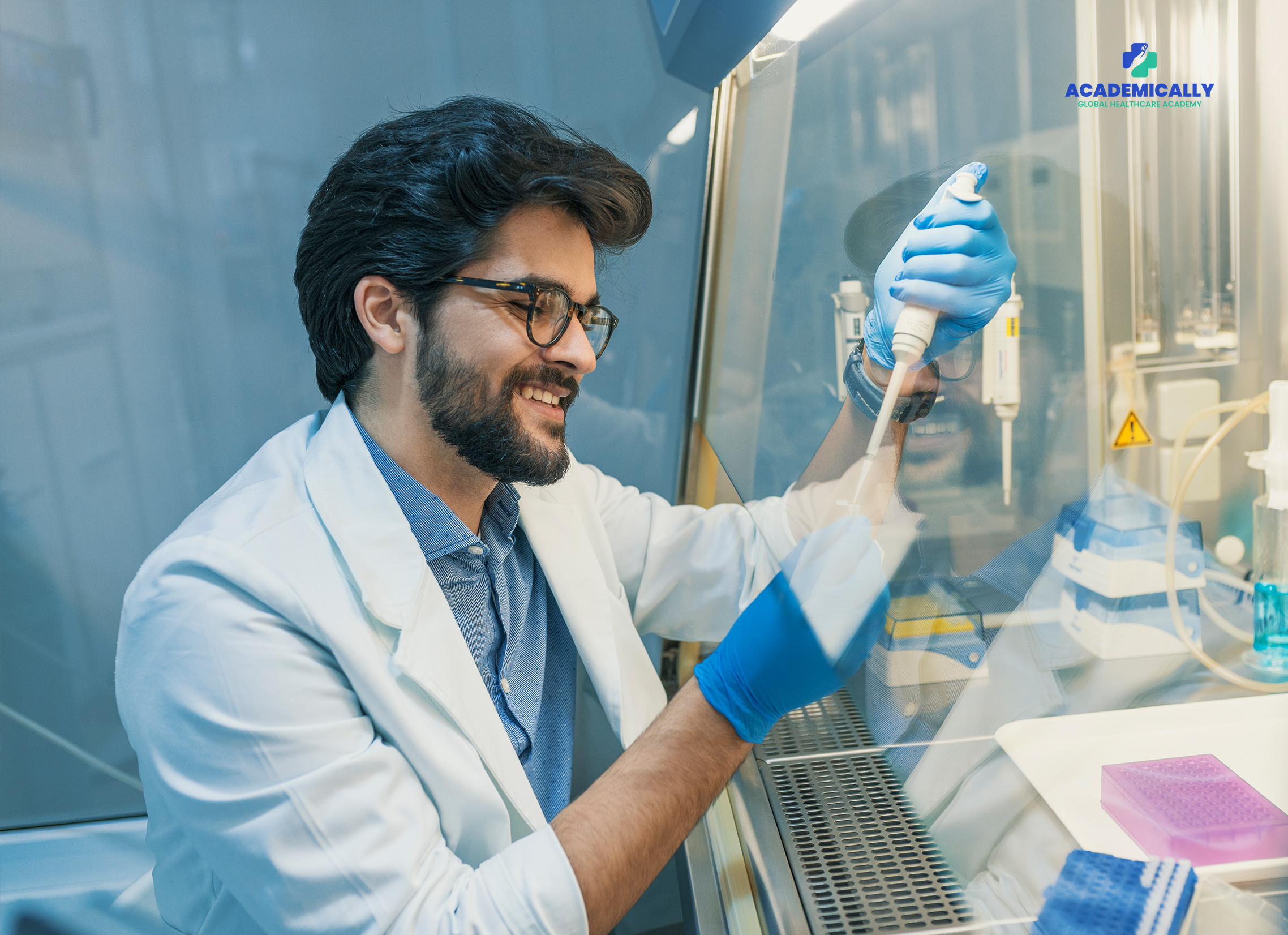
The AIMS Professional exam is conducted to assess the overseas-trained medical laboratory technicians and scientists to determine if they are eligible for the skilled occupation of medical laboratory scientist and for professional membership of AIMS. The AIMS Medical Laboratory Scientist Professional exam is an important milestone for individuals aiming to become certified medical laboratory scientists in Australia. It evaluates a candidate's understanding of various scientific concepts, and laboratory techniques, and their ability to apply these skills. There are various AIMS Professional exam centres around the world.


Procedure For AIMS
To be eligible to work in Australia as a medical laboratory scientist, a few steps need to be followed.
1. English Proficiency
The candidate applying for the AIMS professional exam should be proficient in the English language and must provide proof for the same while applying. By taking tests like IELTS/OET/PTE, English proficiency can be evaluated. The candidate should have a band score of 7 in each component.
2.Skill Assessment
The application for the assessment should be submitted along with the supporting documents. At this point, the AIMS verifies the submitted documents. Once the above procedure is completed, the Australian Institute of Medical and Clinical Scientists completes the assessment, and the candidate will receive the results via mail.
3.AIMS Professional Exam
Take the AIMS Professional Exam through an online mode, and clear it to get registration as a Medical Laboratory Scientist in Australia. The exam is 3 hours long and is an online proctored test.
Take the next step towards your goals
- Join our platform with 10000+ students
- 100+ faculty members
- 50+ courses, and a 90% passing rate ensuring your success
AIMS Exam Format
The AIMS Professional exam consists of 150 multiple-choice questions with single responses to be completed in three hours. A student needs to give 80 correct answers in a 3-hour period to clear the exam. The exam is generally conducted twice a year: March and September.
Only the candidates aspiring to become medical laboratory scientists are required to sit the written exam.
AIMS Exam Test Centres

Our Alumni Work at





 Lessons
 Students