A doctor in Pune gives a cancer medicine to a patient who is already taking three other medicines. She has a question that the instructions for the medicine do not answer: is there a known risk of interaction? She calls the medical help line of the drug company. Within a hours she gets a detailed answer that is balanced and not promotional. The answer is based on published studies and the company's own medical data.
The person who made that answer works in medical information.
If you have been looking into what is medical information pharma actually, this guide explains the role from start to finish: why the role exists, what the daily tasks are, the skills that employers look for and the path from being a pharmacy or life-sciences graduate, to becoming a senior medical information scientist.
What is medical information in pharma?
Medical Information is a role that works within or next to Medical Affairs. It helps make sure that pharmaceutical products are understood and used correctly. A Medical Information professional does not just search Google and send an article. The job includes looking at evidence, checking if sources are reliable and relevant, knowing the approved product details, creating a correct answer and sharing the information clearly.
Industry standards say that good Medical Information responses should be accurate, balanced, up-to-date properly cited, related to the question and not promote the product.
Common types of questions include:
- What are the approved uses of a medicine?
- What scientific proof supports a health result?
- What side effects are known?
- What does published research say about a group of patients?
- How should the information in the product label be understood?
- Is there data, about a certain use or drug interaction?
Some questions come from healthcare professionals. Others come from patients or their caregivers. For example Pfizer’s Medical Information team says their job is to respond to requests, give scientific information quickly and keep content based on evidence that is correct and reliable and non-promotional.
Why does medical information matter in pharma?
Pharmaceutical companies create a lot of information through trials, safety checks, rule documents, science articles, medicine labels and information after a product is on the market. Just having this information doesn't mean that doctors and others can find or understand what they need quickly.
Medical Information sets up a way for scientific facts to reach people who need reliable information about medicines.
The role can help:
Healthcare professionals: Doctors, pharmacists, nurses and others may look for information about medicines to help with their work.
Patients and families: Some Medical Information services also give information about medicines while making sure they don't give medical advice.
Studies about Medical Information services in Europe showed that people who are not healthcare professionals made up a part of the questions answered by companies.
Internal teams at companies: Medical Information can work with Medical Affairs checking for side effects, following rules, making sure quality is right, selling the product and other areas depending on how the company works.
Scientific content quality: MI teams may help check facts make sure medical information is correct and review science content.
A 2023 survey found that Medical Information teams were active in checking if the medical details and claims, in materials were right.
What Does a Medical Information Specialist Do?
1. Responding to Unsolicited Medical Queries
The main job is handling questions that come in through phone, email, web portal and often now at conference booths and digital platforms. Every reply has to be backed by sources, kept balanced, focused on what was actually asked and follow local rules for promoting medical products.
2. Building Standard Response Documents (SRDs)
Many questions come up again and again. For those we use -approved answers that have been checked by medical and legal teams. A strong MI professional keeps a growing library of these templates, updates them when new research comes out and removes ones that are no longer valid.
3. Literature Surveillance and Evidence Synthesis
Each day MI will search through PubMed, Embase, Cochrane and internal databases. They learn to use search terms with Boolean logic to judge how strong a study is and turn a long clinical trial report into just three clear accurate sentences that stand up to scrutiny.
4. Adverse Event and Product Complaint Triage
Every MI professional must know how to spot an adverse event or product quality issue during a call or conversation. If you miss one or don’t pass it on in time it can lead to compliance problems. Time is critical.
5. Booth Support
At big medical events MI staff operate the company’s scientific booth and answer questions directly from doctors and researchers. This requires calm under pressure and deep knowledge of the data so you can speak confidently and accurately.
6. Internal Training and Content Review
MI teams train sales and field staff on the science, behind the products. They also help review any content to make sure it’s medically correct and fits within compliance standards.
7. Insight Reporting
MI teams track the types of questions coming in, group them by theme and share those patterns with affairs, marketing and safety teams. This helps the company understand what clinicians are really asking and how to respond strategically.
Medical Information is more than answering questions
A common myth about Medical Information is that it only involves answering questions.
In fact, Medical Information covers activities, such as clinical expertise, scientific work, regulatory knowledge, documentation, communication and pharmaceutical compliance.
A Medical Information professional must know where to find information, understand and interpret it relay it clearly and follow established procedures.
Moreover, as Medical information becomes more digital, research shows a growing need for credibility. This means providing non‑promotional medical information while keeping governance, compliance and quality standards in the life sciences sector.
Who can build a career in medical information?
Medical Information can offer a career to various individuals including those with degrees and experience from other healthcare and life-science backgrounds.
Individuals who could enter the field of Medical Information include:
- MBBS and other medical graduates
- BDS and dental graduates
- PharmD and pharmacy graduates
- MPharm graduates
- Biotechnology and life-science graduates
- Biomedical and related scientific disciplines
- Professionals with relevant pharmaceutical or healthcare experience
Having a healthcare degree does not guarantee selection as it is vital that employers see research, scientific communication, therapeutic, documentation and pharmaceutical knowledge and expertise.
Medical information careers can be a good alternative for people who have an interest in science and research but do not wish to be directly involved with patient care.
Skills needed for a medical information career
A healthcare degree can offer a scientific base but working in the pharmaceutical medical information field requires more skills that are specific to the industry.
Scientific and Clinical Knowledge
Having a grasp of pharmacology, treatment methods, how diseases work, clinical practices and medical terms can help in understanding questions about products.
Literature Searching
Being able to look through databases to find the right information and get evidence fast is significant.
Critical Appraisal
The skill to look at trial results carefully, see the weaknesses, check how many people were in the study, understand what the results mean and look at the importance is also beneficial.
Scientific Writing
Medical information often involves writing documents and replying to questions clearly.
Communication
At times a complicated scientific or treatment idea needs to be explained in a way to someone who is not an expert. The way a clinical question is answered can be different depending on who's asking and what they already know.
Attention to Detail
A mistake in a reference, number, word or product detail in a medical advice question could lead to big problems. A medical information worker must be very careful when looking at a question, checking any supporting details and researching a product to prevent errors and missing information.
Compliance Awareness
Medical information is more than a sales tool. The difference between non-promotional and promotional communication can sometimes be unclear and a medical information worker must understand the rules and procedures, for both.
How can healthcare professionals prepare for medical information roles?
Candidates who move from clinical practice often find it hard to see the gaps between the knowledge they learned in college and what the pharmaceutical industry expects.
This may involve learning about Medical Affairs structures, how clinical development works, how evidence is created how scientific communication happens, how compliance is managed, how Key Opinion Leader engagement is, how industry workflows run.
Academically’s Medical Affairs Certification Course can help close this knowledge gap. The course covers Medical Information and Scientific Communication, clinical trials and evidence generation, understanding of areas and responsibilities within Medical Affairs, managing Key Opinion Leaders, generating insights, publishing and scientific writing and also a capstone project or internship. And the interesting part is that by enrolling with this course you can gain 180 CPD points.
This can be perfect for healthcare professionals who already know medicine or pharmaceuticals and who want to learn about industry roles in a structured way.
The wider non‑clinical learning system also focuses on training that is industry‑oriented on capstone projects, on mentorship on preparing for interviews and on job help provided by Jobslly.
The goal should not be just to collect another certificate without using the knowledge. Candidates can use the training to build a portfolio that includes literature reviews, scientific response writing, medical communication, interpreting evidence and pharmaceutical case scenarios.
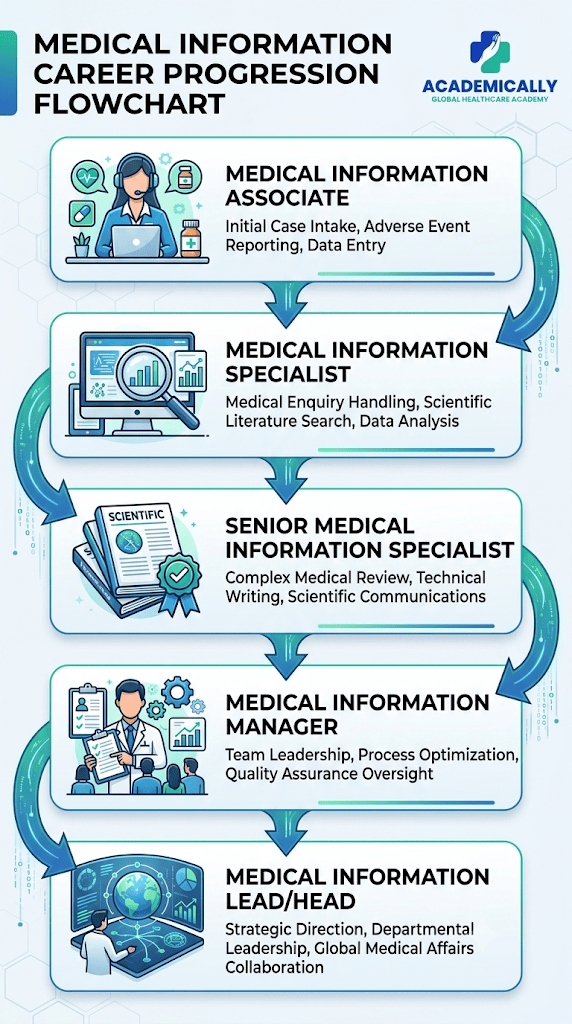
Medical Information Career Path
Medical Information careers can progress in various ways depending on the individual and the employer. The typical progression for a Medical Information role would be:
Medical Information Associate → Medical Information Specialist → Senior Medical Information Specialist → Medical Information Manager → Medical Information Lead/Head
Medical Information professionals may also consider other career paths within the pharmaceutical industry once they have gained the relevant experience and exposure to the pertinent areas.
Medical Affairs:
Medical Information can offer an insight into products, therapeutic areas, scientific exchange and evidence which can be useful to someone considering a career in Medical Affairs.
Medical Writing:
Medical Information Specialists often have excellent scientific writing and literature evaluation skills which are often transferable to Medical Writing, Medical Communications and Publications roles.
Pharmacovigilance:
Medical Information roles often involve the day-to-day processing and management of drug safety information and cases. This can be beneficial to anybody considering a career in Pharmacovigilance either in the area of case processing or in the area of safety science depending on the individual’s qualification and experience.
Regulatory Affairs:
Medical Information specialists deal with a vast amount of product information and supporting documentation which can provide a thorough understanding of the pharmaceutical industry which is beneficial to somebody considering a career in Regulatory Affairs.
Medical Review:
Medical Information specialises in reviewing scientific content, this can be a good progression for somebody with more experience who wishes to enter a more generic content and material review field.
It is important to note that Medical Information can provide a good insight into the pharmaceutical industry and the lifecycle of a product within the commercial and medical sphere.
How to Make a Medical Information Resume
A resume for Medical Information should show that the person has education in healthcare and the right skills. The person applying might want to include the sections:
Scientific knowledge: pharmacology, therapeutics, disease-area, medical terminology
Research: literature searches, evidence synthesis, clinical research projects, systematic reading of scientific publications
Communication: scientific writing, presentations, patient communication, academic documentation
Technical skills: MS Office, reference-management tools, literature databases, documentation systems and other software relevant to the position.
Industry knowledge: Medical Affairs, Medical Information, pharmacovigilance, clinical development, regulatory concepts and compliance.
A clinical professional could also include their experience in a way that shows skills, like reviewing patient histories, interpreting clinical information, documenting cases, presenting scientific topics and communicating complex information clearly.
Target your applications precisely
Learning about Medical Information becomes more useful when candidates can link that knowledge to real job opportunities.
Generic job boards bury specialist pharma roles under unrelated listings. A healthcare-specific platform filters far more efficiently.
Jobslly offers a healthcare job search platform where professionals can look for roles in the pharmaceutical sector, work in Medical Affairs, in pharmacovigilance and in other non‑clinical functions. Candidates can search for jobs by keywords, by location, by category and by job type.
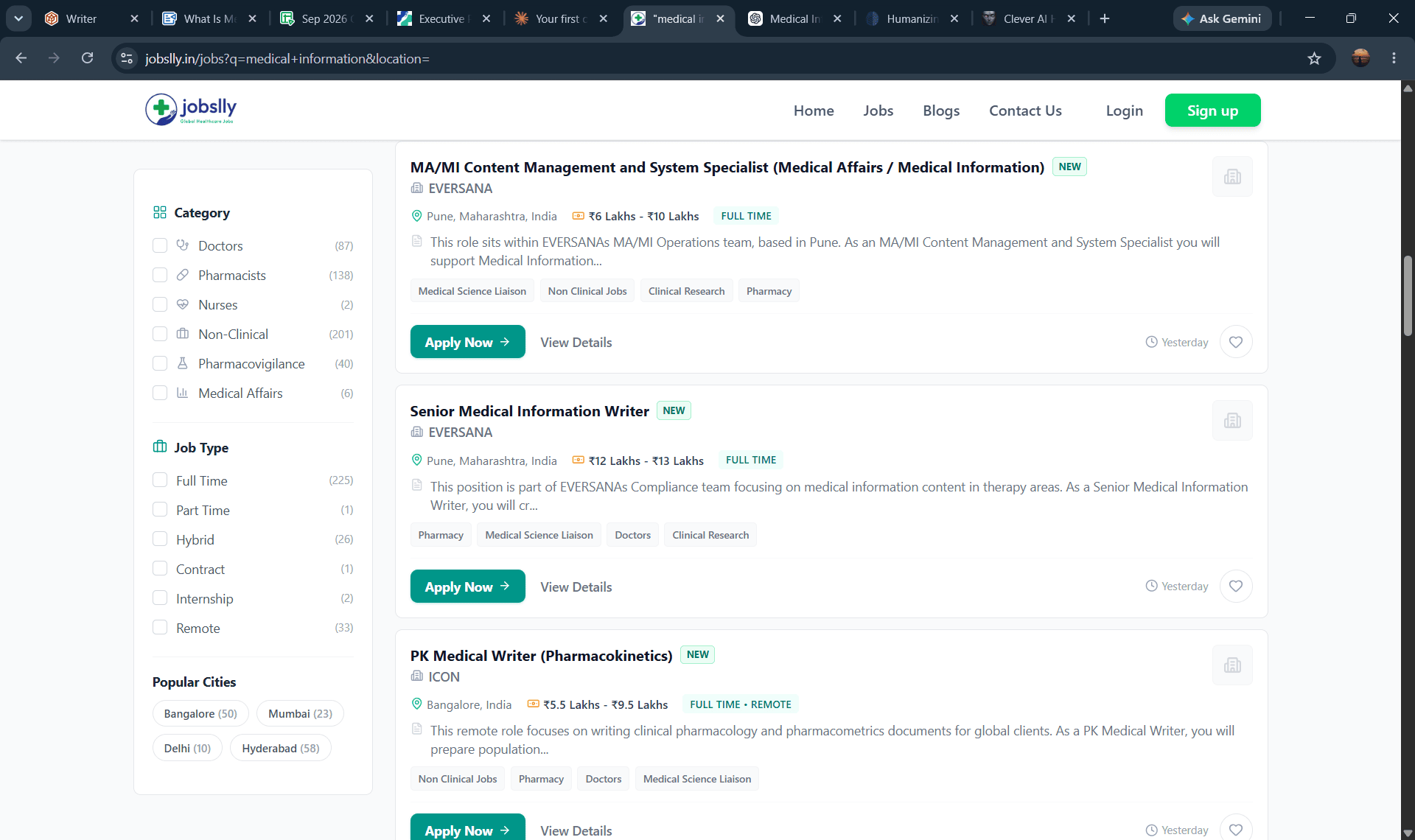
Those looking specifically for Medical Information can use the Medical Information search on Jobslly. Then broaden their search with related terms such as:
- Medical Information Associate
- Medical Information Specialist
- Medical Affairs Associate
- Scientific Communications Associate
- Medical Writer
- Medical Reviewer
- Drug Information Specialist
- Medical Affairs Executive
The Jobslly listings also show that there are healthcare roles that span full‑time, hybrid, remote, contract and internship positions depending on current vacancies.
A focused search strategy is more useful, than looking for "non‑clinical jobs”. Candidates can compare job descriptions spot the requirements adjust their resumes to fit those requirements and choose roles that match their educational background.
Conclusion
Is Medical Information a good non‑clinical career option?
Medical Information can be a fit for healthcare professionals who enjoy research, writing, structure and communication of scientific information but want to pursue a different career path.
Medical Information is not an alternative to practice. Instead it is an application of medical expertise that often needs a similar level of clinical knowledge.
Transitioning into Medical Information usually requires three elements:
Healthcare foundation + pharmaceutical‑industry knowledge + job‑market expertise
While the right education and experience can supply the second element you must build the third element—job‑market specific skills and experience—by creating a portfolio and applying for jobs.
Those looking into a career in Medical Information would benefit from learning more about the role. They should research what Medical Information pharma means, review Medical Information job descriptions, identify gaps in their skill set, prepare evidence‑based work samples and search for relevant opportunities on healthcare job boards such, as Jobslly.