What Is Veeva Vault CTMS?
Veeva CTMS is an enterprise Clinical Trial Management System designed to support the management and monitoring of clinical trials from an operational perspective.
CTMS is a system providing end-to-end study management and monitoring capabilities for both insourced and outsourced trials.
The platform includes dashboards and reports for indicators such as enrollment and study milestones, monitoring visit workflows, issue and protocol-deviation management, and automated clinical data transfer between CROs and sponsors.
Think of a CTMS as an operational control center for a clinical trial.
A clinical trial involves much more than collecting patient data. Teams also have to know:
- Which sites are active?
- How quickly are sites recruiting?
- Which monitoring visits have been completed?
- Are there unresolved issues?
- Are protocol deviations being tracked?
- Are milestones on schedule?
- What activities are being performed by a CRO?
- Where does the study need attention?
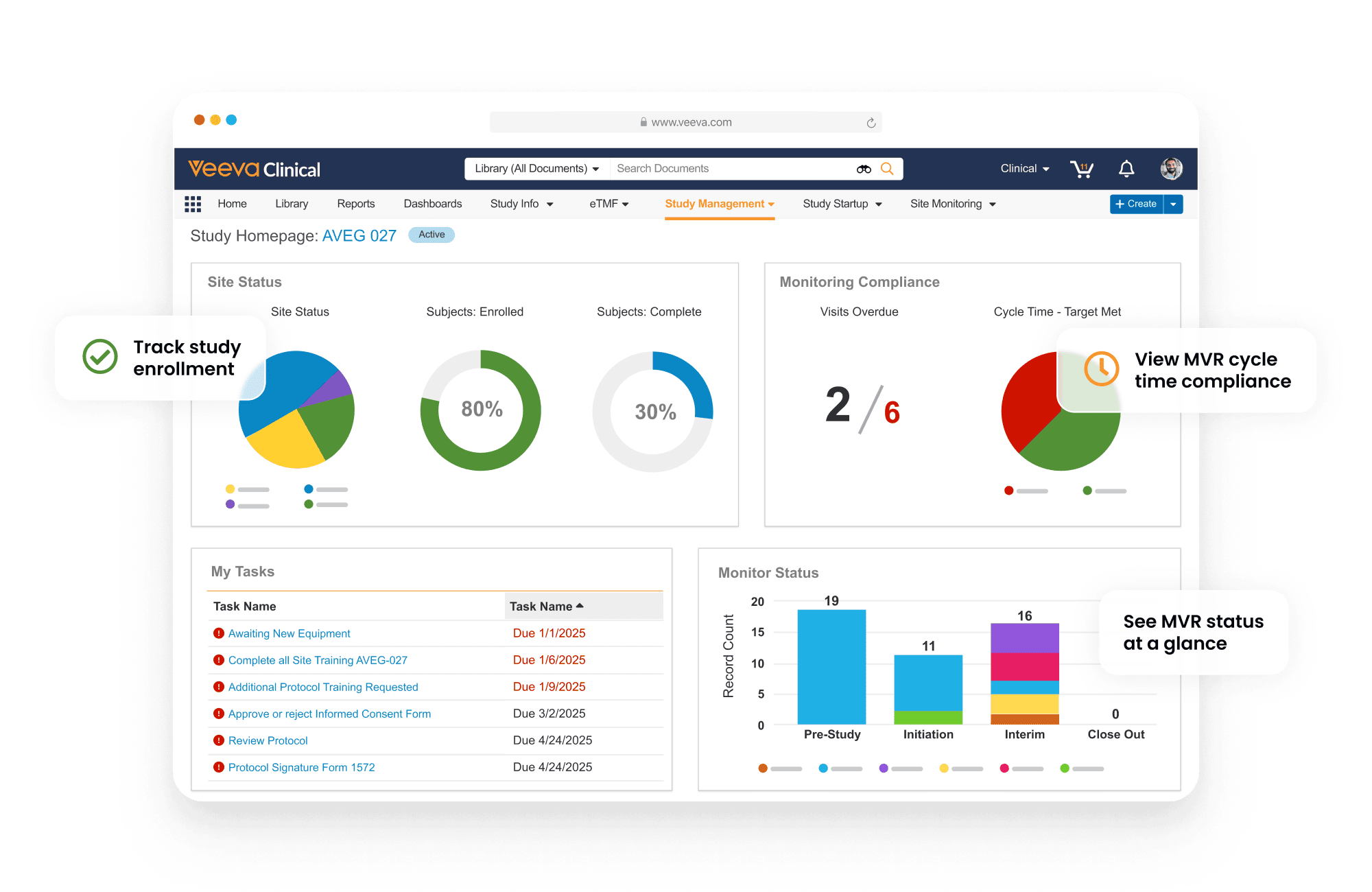
Veeva CTMS is designed to bring these operational activities into a connected environment rather than leaving teams dependent on disconnected spreadsheets, emails and separate systems.
Why Do Clinical Research Teams Need a CTMS?
Clinical trials involve multiple stakeholders working across countries, sites and organizations.
For a sponsor, for example, the study team may need visibility into hundreds of sites. A CRO may be responsible for operational execution. CRAs may be conducting monitoring visits. Study managers may be tracking milestones, enrollment and issues. Other functions may depend on study information for documentation, payments, quality or data management.
Without a structured system, this information can become fragmented.
Veeva specifically positions CTMS around several operational needs:
| Clinical trial challenge | CTMS function |
| Tracking study progress | Study and milestone management |
| Slow or inconsistent recruitment | Recruitment and enrollment tracking |
| Monitoring visit workload | Site monitoring and visit management |
| Unresolved issues | Issue and follow-up management |
| Protocol deviations | Deviation tracking and workflows |
| Limited operational visibility | Dashboards and reports |
| Sponsor-CRO data silos | Clinical Transfer and connected workflows |
| Multiple clinical systems | Connections with applications such as EDC and eTMF |
What Skills Do You Need to Work With Veeva CTMS?
A clinical research professional should first understand the process the technology is supporting, apart from knowing the software.
Core clinical research knowledge
You should be comfortable with:
- Clinical trial phases and workflows
- GCP principles
- Protocol requirements
- Site management
- Monitoring
- Protocol deviations
- Issue management
- Enrollment and recruitment
- Study milestones
- Trial documentation
CTMS-related skills
You should also develop familiarity with:
- Study and site records
- Monitoring workflows
- Visit reports
- Dashboard interpretation
- Operational metrics
- Issue workflows
- Data entry and data quality
- Role-based workflows
- Cross-system navigation
- Sponsor-CRO data exchange
Analytical and professional skills
Strong CTMS users also benefit from:
- Attention to detail
- Structured documentation
- Data interpretation
- Problem-solving
- Communication
- Follow-up discipline
- Understanding of operational risk
How Does Veeva CTMS Help a Clinical Research Associate?
A Clinical Research Associate interacts with CTMS for several parts of the monitoring workflow.
The exact responsibilities vary by organization and study, but CTMS knowledge may be relevant to:
- Before a monitoring visit- Review site information, enrollment information, outstanding issues and relevant study activities.
- During study execution- Document monitoring-related activities and identify issues or follow-up items.
- After the visit- Complete monitoring documentation, track action items and ensure appropriate follow-up.
That means CTMS knowledge can complement, rather than replace, core CRA knowledge such as GCP, protocol compliance, source documentation and monitoring methodology.
How Does Veeva CTMS Fit Into the Clinical Trial Technology Ecosystem?
One of the most important things to understand about Veeva CTMS is that it does not operate in isolation.
Veeva Clinical Operations brings together applications including Veeva CTMS, Veeva eTMF, Veeva Payments, Veeva Site Connect, Veeva Study Training and Veeva Study Startup, while Veeva's broader Clinical Platform also includes clinical data applications such as Veeva EDC.
| System | Primary purpose |
| Veeva CTMS | Trial management, operational oversight and monitoring |
| Veeva eTMF | Trial master file and essential study documentation |
| Veeva EDC | Collection, review and processing of site-reported patient trial data |
| Veeva Payments | Site payment and financial management |
| Veeva Site Connect | Information exchange between sponsors and research sites |
| Veeva Study Startup | Study startup and site activation processes |
| Veeva Study Training | Clinical study training management |
| Veeva RTSM | Randomization and trial supply management |
CTMS manages clinical trial operations, while other applications manage specialized data and content workflows.
Who Uses Veeva CTMS?
The exact user permissions depend on an organization's implementation, but CTMS is relevant to multiple clinical operations stakeholders.
| Role | How CTMS may be used |
| Clinical Research Associate (CRA) | Monitoring visits, site information, follow-up and reports |
| Clinical Trial Manager | Study oversight, milestones, site performance and issues |
| Study Manager | Operational tracking and study coordination |
| Clinical Operations Team | Study-level oversight, dashboards and workflows |
| CRO Teams | Trial execution and sponsor collaboration |
| Sponsor Teams | Portfolio and study oversight |
| System Administrators | Configuration, access and system management |
| Implementation Consultants | Requirements, configuration, validation and deployment |
The last two categories are more technology-oriented. Veeva's education services distinguishes clinical operations business users and process owners from technical leads, system administrators and configuration specialists.
Do You Need to Be a Technical Expert to Learn Veeva CTMS?
No. The depth of knowledge required depends on the role.
Mastering Clinical Trial Management System (CTMS) software, whether it is industry standards like Veeva Vault, Oracle Siebel, or Medidata, is essential for anyone aiming to build a successful career in clinical research, as these platforms all operate on the exact same fundamental clinical workflows and regulatory principles. Acquiring a firm grasp of these core processes allows professionals to transition between different software environments without a steep learning curve seamlessly.
Academically’s Clinical Drug Development Program provides precisely this critical foundation. By thoroughly covering CTMS operational frameworks, regulatory documentation standards, and end-to-end trial workflows, the program equips students with the exact practical knowledge and industry-ready skills that pharmaceutical companies, CROs, and clinical sites actively look for in top candidates.
How to Learn Veeva CTMS
Your learning sequence can look like this:
Clinical Research Fundamentals |
Want to Build a Career in Clinical Research?
Mastering CTMS software is pivotal for accelerating your clinical research career, as it bridge the gap between theoretical knowledge and real-world operations. Systems like Veeva Vault, Oracle Siebel, and Medidata power modern trial workflows, managing everything from site monitoring to compliance documentation. Demonstrating CTMS proficiency signals to employers that you can hit the ground running with minimal training.
To explore tailored career opportunities, head over to Jobslly, a dedicated job platform for healthcare professionals featuring a specialized category for Clinical Research and Pharmacovigilance (PV) jobs.
Are you looking to explore similar clinical management applications like Veeva Vault? If you are ready to take the next step and want personalized guidance tailored to your career goals, connect with us for expert insights.