Regulatory Affairs (RA) has become one of the most important non-clinical role in the pharmaceutical, biotechnology, medical device and healthcare industries. Companies need professionals who understand regulations, prepare submissions, work with teams and keep products compliant over their entire lifecycle, as companies keep developing products for multiple countries.
Healthcare professionals thinking about this career path, knowing about US FDA vs EMA vs CDSCO is a place to start. These three agencies shape some of the largest pharmaceutical markets in the world but they do not work in the same way.
The US Food and Drug Administration (FDA), European Medicines Agency (EMA) and India’s Central Drugs Standard Control Organization (CDSCO) each have their laws, approval methods, rules, documentation needs and market systems. Simultaneously, RA professionals can develop transferable skills that apply across all three places, it helps to know the differences.
This guide breaks down what makes each regulator unique and gives a roadmap for healthcare graduates, pharmacists, doctors, dentists, life-science students and others who want to begin a global regulatory affairs career.
What Does a Regulatory Affairs Professional Do?
Regulatory Affairs professionals connect companies, internal teams and government regulators.
Depending on the company and job level an RA professional might work on:
- Preparing applications and supporting documents
- Reviewing dossiers to check completeness and compliance
- Tracking changes in rules and guidelines
- Responding to questions from regulators
- Managing product registrations and renewals
- Helping with trial and marketing authorisation applications
- Assessing how product changes affect safety or effectiveness
- Keeping records and updating regulatory databases
- Working with quality, safety, chemistry manufacturing controls (CMC), medical writing and manufacturing teams.
The job is much more than paperwork. Regulatory professionals help decide whether a medicine, medical device or health product can enter a market, and stay there safely.
US FDA vs EMA vs CDSCO: What Is the Difference?
The easiest way to understand US FDA vs EMA vs CDSCO is to look at each one in the context of its market.
| Regulatory Authority | Primary Market | Key regulatory focus | Common RA exposure |
| US FDA | United states | Drugs, biologics, medical devices and other regulated products | IND, NDA, BLA, ANDA, 505(b)(2), supplements, lifecycle management |
| EMA | European Union/EEA | Medicines for human and veterinary use | Centralised marketing authorisation, regulatory procedures, variations, scientific advice |
| CDSCO | India | Drugs, clinical trials, medical devices and related products | New drug approvals, clinical trials, imports, manufacturing, registrations, post-approval activities |
These agencies are not just different names for the same system. They operate differently. Serve distinct markets.
US FDA Regulatory Affairs
The US FDA oversees medicines through a development and review process. Drug development moves from discovery and lab testing to clinical research then FDA evaluation and ongoing safety monitoring after the product launches.
A Regulatory Affairs professional working on US submissions will often deal with pathways such as:
IND: Investigational New Drug application used during clinical development
NDA: New Drug Application for getting approval of a new drug
BLA: Biologics License Application for biological products
ANDA: Abbreviated New Drug Application used for generic drugs
505(b)(2): A route that allows reliance on data from studies other than applicant's own full safety and effectiveness investigation.
In August 2026 FDA released draft guidance asking sponsors to decide whether to file an ANDA or a 505(b)(2) application. This shows how important choosing the pathway is for success in the US market.
FDA review teams look at safety, effectiveness, labelling and manufacturing controls.For an RA professional this means understanding both the submission process and the strategy behind it.
The US market offers exposure to submission preparation, regulatory planning, CMC, publishing, labelling and managing a product’s full lifecycle.

EMA Regulatory Affairs
The European regulatory system works differently from the US setup.
The EMA conducts reviews but it does not legally approve medicines on its own. Under the centralised procedure, companies submit one marketing authorisation application to EMA, scientific committees evaluate it and the European Commission makes the final legal decision.
A centralised approval gives access to all EU Member States and the EEA countries-Iceland, Liechtenstein and Norway.
This procedure is required for biotech-based medicines, advanced therapy medicinal products and certain treatments for serious diseases.
This creates opportunities for RA professionals in areas like:
- Centralised marketing authorisation applications
- Regulatory strategy
- Scientific advice
- Variations and lifecycle management
- Regulatory procedures
- Orphan drugs and advanced therapies
- Pharmacovigilance-related tasks
- Regulatory intelligence
Professionals aiming for European Regulatory Affairs must understand both the science behind the evaluation and the procedures that lead to market authorisation.

CDSCO Regulatory Affairs in India
CDSCO is India’s authority for drugs and medical devices operating under the Ministry of Health and Family Welfare.
Its New Drugs Division handles applications for drugs and clinical trials under the New Drugs and Clinical Trials Rules, 2019.
The Investigational New Drug division processes requests related to trials importing drugs or manufacturing them through the SUGAM portal.
This makes Indian Regulatory Affairs especially relevant for professionals working on:
- Drug applications
- Clinical trial submissions
- Drug imports and manufacturing
- Product registrations
- Post-approval changes
- Regulatory Compliance
- CMC documentation
- Regulatory intelligence
- Medical device submissions
India's regulatory environment also includes medical devices. Devices fall under the Drugs & Cosmetics Act, 1940 and Medical Devices Rules, 2017.
This opens another career path for those in medical-device Regulatory Affairs.

FDA vs EMA vs CDSCO: Which Regulatory System Should a Fresher Learn?
The better approach is to build a foundation in regulatory basics and then focus on the market you want to target.
If someone is based in India learning CDSCO may be easier because many local jobs involve submissions or support international teams. Knowing about FDA and EMA makes a candidate more competitive for global roles.
Healthcare professionals moving from clinical practice into Regulatory Affairs often understand medicine but lack exposure to pharmaceutical development and regulatory workflows.
Academically's Non-Clinical Courses can help bridge that gap by exposing healthcare professionals to industry-oriented functions and concepts. Its Clinical Drug Development programme, for example, covers areas including Phase I–IV trial design and regulatory strategy, including IND, NDA and CTA submissions.
This type of structured learning can be particularly useful for doctors, dentists, pharmacists, and life-science graduates who understand clinical science but want to demonstrate familiarity with the healthcare industry's non-clinical ecosystem.
The objective should not be to collect certificates. It should be to develop job-relevant knowledge that can be demonstrated during interviews.
So, the best plan is this:
Learn industry-oriented functions and concepts with Academically→ Start with CDSCO knowledge → Learn ICH and CTD standards → Gain exposure to FDA and EMA → Specialise in your chosen function
ICH knowledge is especially valuable because many global pharmaceutical companies work across regions. Professionals who understand technical principles and scientific standards. Along with local requirements. Are highly sought after.
The Common Language: CTD and eCTD
One of the most useful skills in FDA vs EMA vs CDSCO Regulatory Affairs is mastering the Common Technical Document.
CTD knowledge helps professionals organise information into modules covering things like:
- Quality of the product
- Non-clinical data
- Clinical data
- Summaries and information
eCTD adds structure, lifecycle management, electronic publishing and submission tools needed for regulatory operations.
The FDA requires eCTD format for electronic submissions, including NDA, ANDA and BLA applications. For a beginner learning CTD/eCTD is more helpful than memorising hundreds of regulatory terms.
Someone who can explain the journey. From product development to submission response to regulator queries, approval and post-approval changes. Shows real understanding and readiness.
FDA vs EMA vs CDSCO: Regulatory Affairs Career Roadmap
| Career stage | US FDA | EMA / EU | CDSCO / India |
| Market focus | United States | European Union / EEA | India |
| Regulatory authority | US FDA | EMA + European Commission + national competent authorities | CDSCO + State Drug Control authorities |
| Best starting knowledge | US drug-development framework, FDA guidance, IND/NDA/ANDA/BLA | EU pharmaceutical legislation, centralised procedure, MAA, variations | Drugs & Cosmetics framework, NDCTR 2019, CDSCO procedures |
| Clinical-development exposure | IND and clinical development requirements | Clinical trial / EU regulatory framework and marketing authorisation pathway | Clinical trial permissions and new-drug applications under NDCTR 2019 |
| Major marketing pathway | NDA, ANDA, BLA depending on product | Centralised Marketing Authorisation Application for eligible medicines | New drug approval / permission pathways applicable in India |
| Electronic submissions | eCTD is the accepted electronic format for major FDA drug submissions including IND, NDA, ANDA and BLA | EU eSubmission/eCTD environment | Increasing use of electronic regulatory submissions, including SUGAM for relevant CDSCO applications |
| Important skills | FDA guidance interpretation, submission strategy, eCTD, regulatory correspondence, lifecycle management | EU procedures, MAA, regulatory strategy, variations, EU regulatory intelligence | CDSCO regulations, SUGAM, applications, clinical-trial/new-drug requirements, post-approval changes |
| Typical fresher roles | Regulatory Affairs Associate, Regulatory Operations Associate, Submission Associate | Regulatory Affairs Associate, Regulatory Operations Associate, EU Regulatory Associate | Regulatory Affairs Associate, Regulatory Executive, Regulatory Operations Associate |
| Useful specialisations later | US submissions, CMC, biologics, generics, regulatory strategy | Global/EU strategy, variations, advanced therapies, pharmacovigilance-regulatory interface | India submissions, CMC, clinical regulatory, medical devices, compliance |
| Difficulty for an India-based fresher | Higher if the role demands direct US submission experience. | Higher because EU procedures and market structures require specialised knowledge | Generally the most accessible starting point |
| Best use in a roadmap | Global-market specialisation | Global/EU specialisation | Foundation and first RA experience |
| Long-term advantage | Strong global pharmaceutical exposure | Strong multinational regulatory exposure | Strong foundation for Indian and global regulatory operations |
1. Start with CDSCO if the professional is entering RA in India
CDSCO is usually the most practical starting point for an Indian based fresher, because the regulatory environment is directly relevant to India-based employers.
A beginner roadmap can therefore be:
B.Pharm/PharmD/MBBS/BDS/Life Sciences → CDSCO fundamentals → NDCTR 2019 → CTD/eCTD → regulatory documentation → RA internship/associate role → global regulatory exposure
The first objective should be learning how regulatory requirements affect actual submissions rather than memorising legislation.
2. Add FDA knowledge to become globally employable
The FDA pathway is particularly valuable once the professional understands the basics of regulatory affairs.
FDA's drug-development ecosystem exposes professionals to pathways such as IND, NDA, ANDA and BLA. FDA also uses eCTD as the accepted electronic format for major drug submissions, including INDs, NDAs, ANDAs and BLAs.
A professional progressing toward US Regulatory Affairs can build this sequence:
CDSCO basics → ICH/CTD → FDA terminology → IND/NDA/ANDA/BLA → eCTD → US regulatory strategy → global submissions
This is particularly useful for professionals targeting multinational pharmaceutical companies, CROs, regulatory consulting organisations, and global regulatory operations.
3. Learn EMA when targeting European or global RA
EMA requires a different mindset because the European regulatory framework is not simply a copy of the US system.
Under the centralised procedure, there is a single application and scientific evaluation, followed by a single EU authorisation; the marketing authorisation is granted through the European Commission process and applies across the Union market.
An EMA-focused roadmap therefore looks like:
EU regulatory framework → centralised procedure → MAA → scientific evaluation → regulatory procedures → variations → lifecycle management → EU/global regulatory strategy
This becomes especially relevant for professionals interested in multinational companies with European portfolios.
The Best Career Strategy Is Not “FDA OR EMA OR CDSCO”
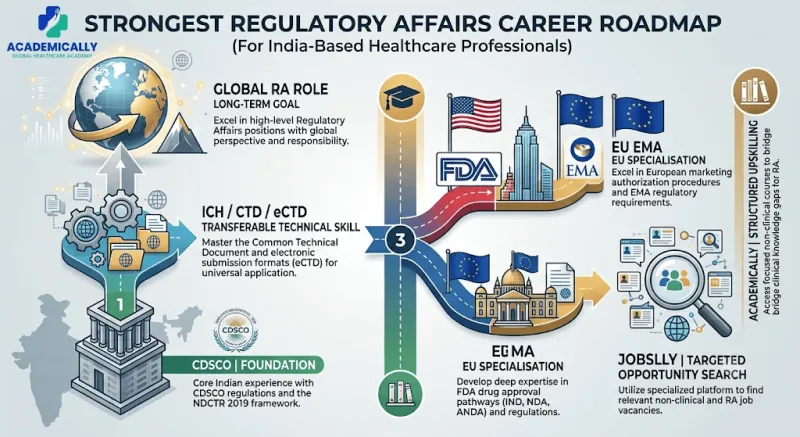
The stronger career strategy is:
CDSCO → ICH/CTD/eCTD → FDA + EMA → specialisation → global regulatory affairs
Why?
Because the underlying regulatory work is transferable.
A professional may begin by working on Indian submissions and later move into global regulatory operations. Once the person understands dossier structure, submission lifecycle, regulatory intelligence, scientific writing, document management, and authority communication, learning another jurisdiction becomes considerably easier.
Start with the right role
Looking beyond standard job descriptions increases your chances of finding the right fit. Especially when starting out.
Regulatory Affairs Associate, Regulatory Operations Associate, Regulatory Publishing Associate, Regulatory CMC Associate, Regulatory Specialist, Regulatory Submissions Associate, Regulatory Intelligence Associate and Medical Device Regulatory Affairs Associate.
The Jobslly healthcare jobs platform currently lists Regulatory Affairs roles side by side with -clinical positions. Users can use filters for experience, location, job type and work arrangement. This makes Jobslly a valuable part of the job search process. Of relying only on broad job boards candidates can look specifically for healthcare and non-clinical opportunities. They can find roles that match their qualifications and background.
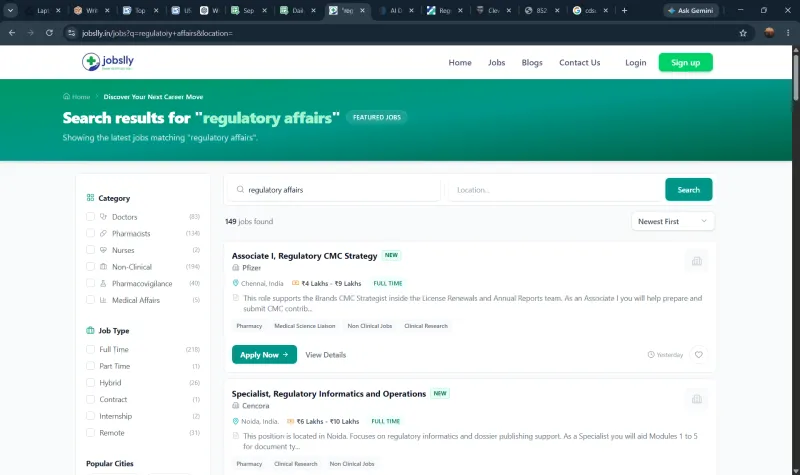
Current Jobslly listings show the variety of opportunities. For example there is a Regulatory role with Bristol Myers Squibb in Hyderabad. This role involves submissions, document organisation, regulatory intelligence and compliance. Another example is a Regulatory Affairs position with Masimo. That job focuses on India filings and international regulatory coordination. There is also a Regulatory Affairs Operations role with Genpact.
A Practical 12-Month Regulatory Affairs Roadmap
| Timeline | What to learn | Career action |
| Months 1–2 | Pharmaceutical development + RA fundamentals | Understand RA functions |
| Months 3–4 | CDSCO + NDCTR 2019 | Learn Indian regulatory pathway |
| Months 5–6 | CTD/eCTD + ICH | Build a global foundation |
| Months 7–8 | FDA: IND/NDA/ANDA/BLA | Develop US-market knowledge |
| Months 9–10 | EMA: MAA/centralised procedure/variations | Develop EU knowledge |
| Months 11–12 | Regulatory projects + interview preparation | Apply to RA roles |
Final Takeaway
Understanding FDA vs EMA vs CDSCO can help healthcare professionals shift from an interest in Regulatory Affairs to a focused career plan.
FDA offers experience in the US drug development and approval process. EMA provides insight into the regulatory system, including centralised authorisation. CDSCO is relevant to India's growing pharmaceutical, research, biotechnology and medical device sectors.
For professionals the winning strategy is not to memorise regulations. It is to understand pathways learn CTD and eCTD principles develop submission and documentation skills gain practical experience and then build market-specific expertise.
Academically Global can support the upskilling phase through their clinical learning ecosystem. Jobslly can support the job search phase by helping healthcare professionals find non-clinical and Regulatory Affairs vacancies.
The result is a career pathway:
Healthcare degree → regulatory upskilling → practical portfolio → targeted job search → entry-level RA role → global regulatory expertise.
Regulatory Affairs is no longer limited to people who started their careers in companies. Doctors, dentists, pharmacists and life-science professionals, with backgrounds can build successful non-clinical careers. They just need the regulatory knowledge. They need to learn how to turn science into compliance and market access.