The Australian healthcare system is highly regulated to ensure maximum patient safety and professional accountability. Under Section 39 of the Health Practitioner Regulation National Law Act 2009, all physiotherapists practicing in Australia must hold continuous Professional Indemnity Insurance. This is a non-negotiable prerequisite for registration.
When configuring your policy, the Physiotherapy Board of Australia does not dictate a flat, universal dollar amount for every practitioner. Instead, you and your insurance broker must determine a level of cover that matches the specific risks of your clinical environment, patient demographic, and treatment modalities.
Core AHPRA Requirements
To be considered compliant by the Board, your PII arrangement must satisfy several strict criteria:
- Civil Liability Coverage: Your policy must explicitly cover legal costs, defense expenses, and financial damages arising from claims of clinical negligence, errors, or omissions during your practice.
- Appropriate Risk Levels: The Board considers it the individual physiotherapist’s responsibility to assess the risk involved in their specific practice. For instance, a neurological physiotherapist conducting intensive gait rehabilitation with high-fall-risk patients post-stroke has a different risk profile compared to a musculoskeletal (MSK) physiotherapist focusing on preventative sports taping. Your cover must reflect your reality.
- Run-off Cover (The Most Critical Element): Legal claims in healthcare rarely happen immediately. A patient might decide to sue months or even years after a treatment session, claiming a delayed onset of complications. Ahpra strictly requires your policy to include "run-off cover." This protects you against claims made after you cease practice, take maternity leave, or change careers, provided the alleged incident occurred while you were actively practicing and insured.
- Continuous Currency: You are required to declare your PII status every year during your Ahpra registration renewal (due annually by November 30th). You must keep your Certificate of Currency securely on file, as the Board conducts random, stringent audits every year.
Professional Indemnity vs. Public & Products Liability
When purchasing insurance through major brokers like Aon, Express Insurance, or BMS, policies are often bundled into "Business Packs" or "Allied Health Professional Packs." It is vital to understand the distinction between your clinical liabilities and general commercial liabilities, as confusing the two can leave you exposed.
Professional Indemnity Insurance (PII)
PII exclusively covers your clinical decisions, professional advice, and treatment outcomes.
- The Scenario: A patient claims that a prescribed spinal mobilization technique worsened their existing disc herniation, resulting in surgery and a loss of income. PII covers your legal defense, court costs, and any potential compensation payouts ordered by a judge.
- Ahpra Status: Legally Mandatory.
Public Liability Insurance
Public Liability covers physical accidents and property damage that are entirely unrelated to your clinical advice or treatment.
- The Scenario: A patient slips on a wet floor in your clinic's waiting room, or trips over a carelessly placed resistance band on the gym floor, fracturing their wrist. Public Liability handles the financial fallout from these environmental hazards.
- Ahpra Status: Not explicitly mandated by the Board for individual registration, but practically mandatory for business survival if you own a private practice, rent a clinic room, or operate as an independent contractor.
Products Liability Insurance
Products Liability covers harm caused by physical products you sell, supply, or prescribe to a patient.
- The Scenario: You sell a defective heat pack to a patient for home use. The pack ruptures during microwave heating and causes a severe burn. Products Liability covers the resulting injury claim.
- Ahpra Status: Highly recommended for any practitioner who retails braces, tapes, therapeutic tools, or rehabilitation equipment.
Employer Coverage vs. Private Insurance
A common and highly dangerous pitfall for employed physiotherapists is assuming that their hospital or private clinic's blanket insurance policy covers their entire professional life. While employer-provided PII covers the duties explicitly defined in your employment contract, it rarely extends beyond the clinic doors.
If a physiotherapist is found to have practiced physiotherapy without PII arrangements in place (even accidentally), the Board will consider appropriate disciplinary action, which can include suspension of your license.
Where Does Your Employer Cover End?
| Practice Scenario | Covered by Employer PII? | Action Required by the Physiotherapist |
| Routine clinical shifts at your workplace | Yes | Keep any PII documentation issued by your employer safely filed. |
| Off-site CPD workshops with a practical component | Usually No | Check with your employer. If unapproved, you must secure private cover for the weekend. |
| Volunteering for a local sports club | No | You need a private PII policy. Paid or voluntary, Ahpra requires cover for all physical therapy services. |
| Specialist exams in another state | No | Examining colleges generally do not provide cover; secure private PII for the exam dates. |
| Treating family or friends at home | No | Unless billed and documented through your fully insured private clinic, informal treatment is a massive liability risk. |
| Emergency "Good Samaritan" first aid | N/A | Specific PII is not required for unexpected, on-the-spot medical emergencies. |
Changing Jobs Mid-Year: If you change employers during your Ahpra registration period, you must verify that your new employer has active PII arrangements for you on day one of your new role. If there is any gap between employment dates where you might still be doing private consulting, you must either arrange private PII or cease practicing entirely during that window.
International Physiotherapists: Navigating APEP, FLYR, and Insurance
If you are an overseas qualified physiotherapist aiming for Australian registration, navigating the insurance landscape from abroad can feel overwhelming. Fortunately, the Australian Physiotherapy Council (APC) and the Australian Physiotherapy Association (APA) have streamlined this process to remove the financial and administrative burden from candidates.
Candidates undertaking the Australian Physiotherapy Entry Pathway (APEP), the FLYR Pathway, or the Express FLYR Pathway are eligible for a free Associate Membership with the APA.
The APEP Insurance Process Step-by-Step
Overseas candidates cannot participate in practical exams without proof of insurance. Here is how the safety net works:
- Receive Your Interim Certificate: Once you pass the initial eligibility and written assessments (the multiple-choice exams) with the APC, you are issued an Interim Certificate.
- Opt-In for APA Membership: During your initial application, the APC asks if you want to share your details. Unless you explicitly opt out, the APC forwards your contact information to the APA.
- Activate Free Insurance: You receive an APA Associate Membership (Category M10) valid until December 31st of the current year. This automatically grants you comprehensive professional indemnity alongside public and product liability cover through their broker partner, BMS.
- Generate Your Certificate of Currency: Before you are allowed to commence any session of your mandatory APEP Clinical Workshops, you will be asked to present a Certificate of Currency proving you hold a minimum of $5 million in PII cover. Your free APA policy easily satisfies this requirement (it typically provides up to $20 million).
Crucial Restriction: This free insurance exclusively covers activities directly associated with your APC assessment process or while practicing strictly under the direct supervision of an Australian registered physiotherapist. It does not cover you to open an independent private practice or work unsupervised before your general registration is granted.
What Does a Modern PII Policy Actually Cover?
Standard PII has evolved significantly from basic malpractice coverage. In Australia, the APA partners with BMS Risk Solutions to provide a comprehensive, tailor-made policy for physiotherapists. Competitors like Aon and Express Insurance offer similar tailored packages.
Understanding the "sub-limits" of these modern policies reveals exactly where your contemporary risks lie. An industry-standard policy should include:
- High Limit of Indemnity: Most top-tier policies offer $20,000,000 per claim for Professional Indemnity, Public Liability, and Products Liability. This heavily exceeds the baseline requirements for both independent practice and clinical workshops.
- Medicare and Ahpra Audit Protection: If Medicare audits your billing practices to check for over-servicing, or Ahpra investigates a patient complaint, specialized policies cover the exorbitant legal costs of responding to these inquiries and defending your license.
- Breach of Privacy and Confidentiality: If your clinic management software (like Cliniko or Halaxy) is hacked, or you accidentally misplace a patient's medical file, this clause covers the legal fallout, IT forensic costs, and patient notification costs of the data breach.
- Abuse and Sexual Misconduct Inquiries: Policies often include specific sub-limits (e.g., $100,000 - $250,000) to support legal representation during investigations relating to allegations of abuse, ensuring you have a defense lawyer present during Ahpra tribunals.
- Defamation, Libel, and Slander: Protects you if a professional comment you make is alleged to have damaged the reputation of another healthcare practitioner or business.
- Intellectual Property Infringement: Protection against claims that your clinic's marketing materials, educational blogs, or website content infringed on another entity's copyrights.
The Rise of Telehealth and Worldwide Cover
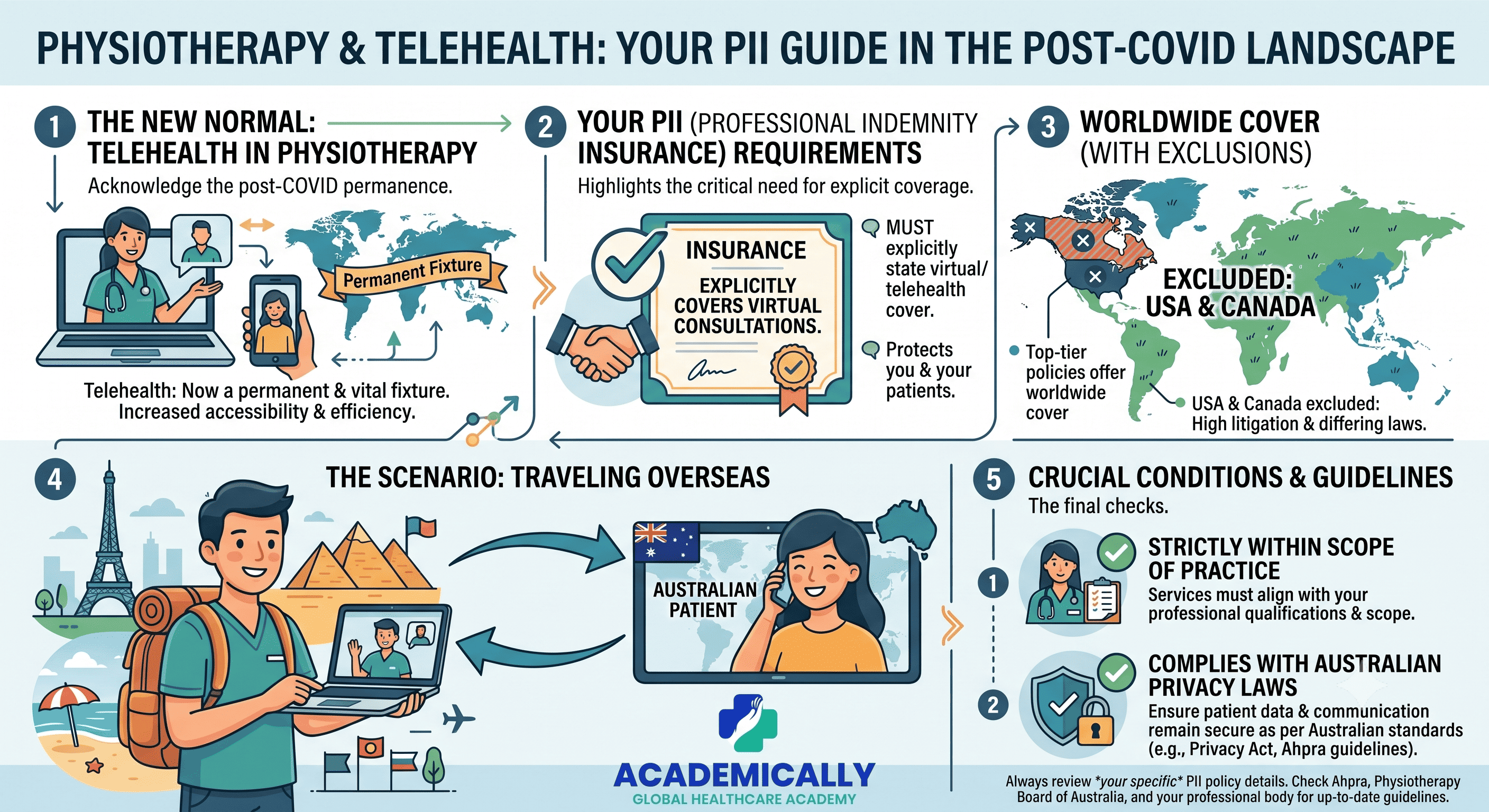
The post-COVID healthcare landscape cemented telehealth as a permanent fixture in physiotherapy. Your PII must explicitly cover virtual consultations. Top-tier policies offer worldwide cover (excluding the USA and Canada due to their highly litigious environments and differing jurisdictional laws).
This means you can legally and safely conduct telehealth consultations with your Australian patients while you are traveling overseas, provided the service remains strictly within your scope of practice and complies with Australian privacy laws.
Specialized Scope of Practice Risks
Your insurance is only valid if you are operating within your recognized scope of practice. However, physiotherapy is an incredibly broad profession, and standard policies do not automatically cover high-risk interventions.
If you utilize specialized modalities, you must ensure your broker explicitly lists these on your policy schedule:
- Neurological Rehabilitation: Working with severe spinal cord injuries, traumatic brain injuries, or progressive neurological conditions carries high inherent risks related to patient falls, manual handling injuries, and complex comorbidities.
- Women's Health and Pelvic Floor: Internal pelvic floor examinations require explicit informed consent and carry a higher risk profile for misconduct allegations. Your policy must reflect this specialized clinical area.
- Dry Needling and Acupuncture: Invasive techniques carry risks of pneumothorax, nerve damage, and infection. Insurers require proof of specific dry needling CPD qualifications to validate this cover.
- Animal Physiotherapy: Treating animals requires a specific notation on your policy (e.g., the APA Animal group policy), as standard human malpractice parameters do not apply to veterinary overlap.
- Digital Health Content Creation: If you are a medical content writer developing educational video scripts, publishing clinical articles, or generating clinical infographics for digital health platforms, your policy should cover content liability. This ensures that readers who misinterpret your public health communication cannot successfully sue you for damages.
Business Structures: Sole Trader vs. Pty Ltd (Entity Insurance)
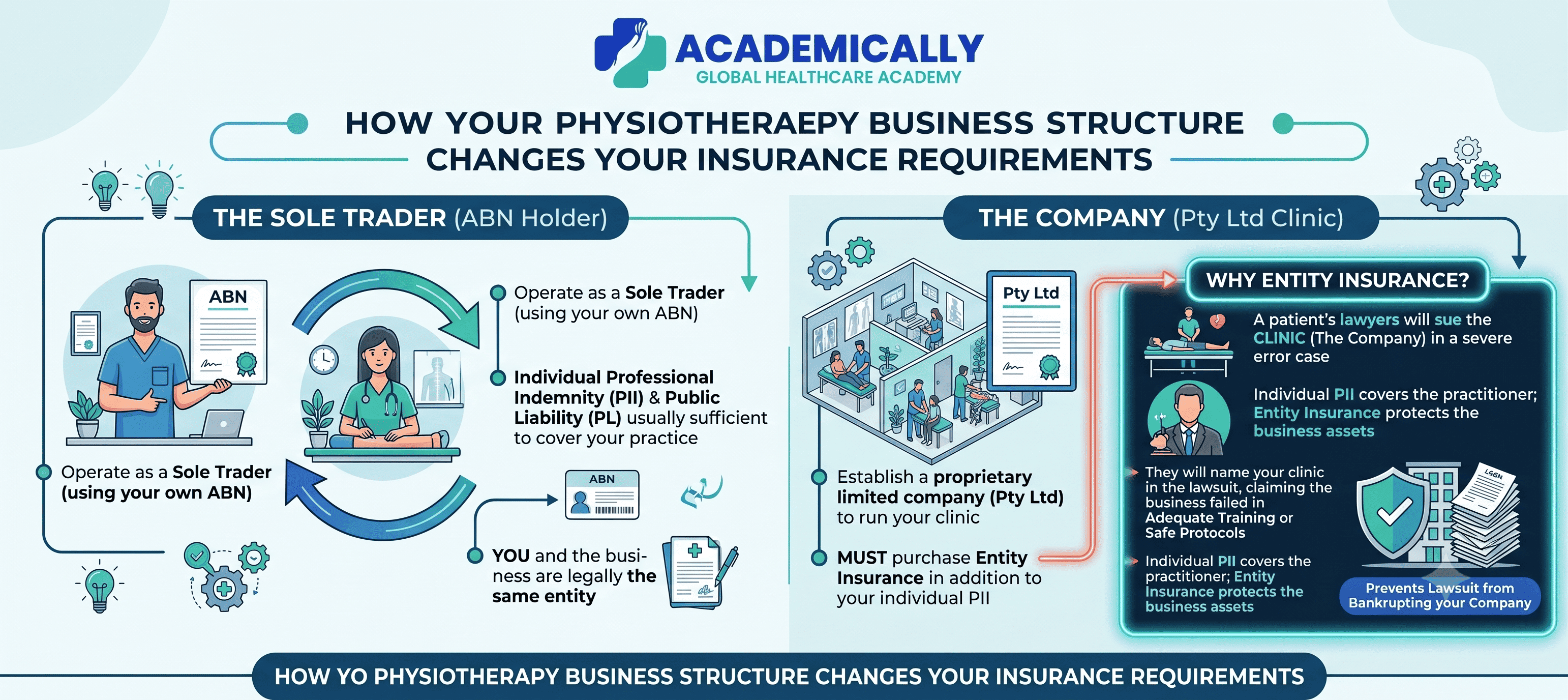
How you structure your physiotherapy business fundamentally changes your insurance requirements.
The Sole Trader
If you operate as a Sole Trader (using your own ABN), your individual Professional Indemnity and Public Liability policies are usually sufficient to cover your practice, as you and the business are legally the same entity.
The Company (Pty Ltd)
If you establish a proprietary limited company (Pty Ltd) to run your clinic, you must purchase Entity Insurance in addition to your individual PII.
Why? If a clinician in your practice makes a severe error and is sued by a patient, the patient's lawyers will not just sue the individual physiotherapist—they will name your clinic (the company) in the lawsuit, claiming the business failed to provide adequate training or safe protocols. Individual PII covers the practitioner; Entity Insurance protects the business assets, preventing the lawsuit from bankrupting your company.
Cost Breakdown: What Should You Expect to Pay?
The cost of Professional Indemnity Insurance in Australia is highly dependent on your employment type, annual revenue, modalities used, and previous claims history.
Based on market data from major Australian brokers:
- Sole Traders & Independent Contractors: The median cost for an independent allied health professional sits between $750 and $1,250 annually (roughly $70 to $120 per month).
- High-Revenue Clinics: Clinic owners with multiple staff members and higher turnovers will pay significantly more, scaling with their annual revenue and the addition of Entity Insurance and cyber liability add-ons.
- APA Bundled Memberships: For many practitioners, purchasing an APA membership that includes BMS insurance is the most cost-effective route. The massive group buying power of the association drastically lowers the premium compared to buying an individual policy on the open market.
- Excess / Deductibles: Choosing a higher voluntary excess (e.g., $1,000 or $2,500) will typically reduce the cost of your annual premium. However, this is the out-of-pocket amount you must pay immediately to your legal team if a claim is lodged.
Tax Benefits: PII premiums are generally a fully tax-deductible business expense for Australian companies, sole traders, and contractors, which softens the financial impact at the end of the financial year.
The Claims Process: A Survival Guide
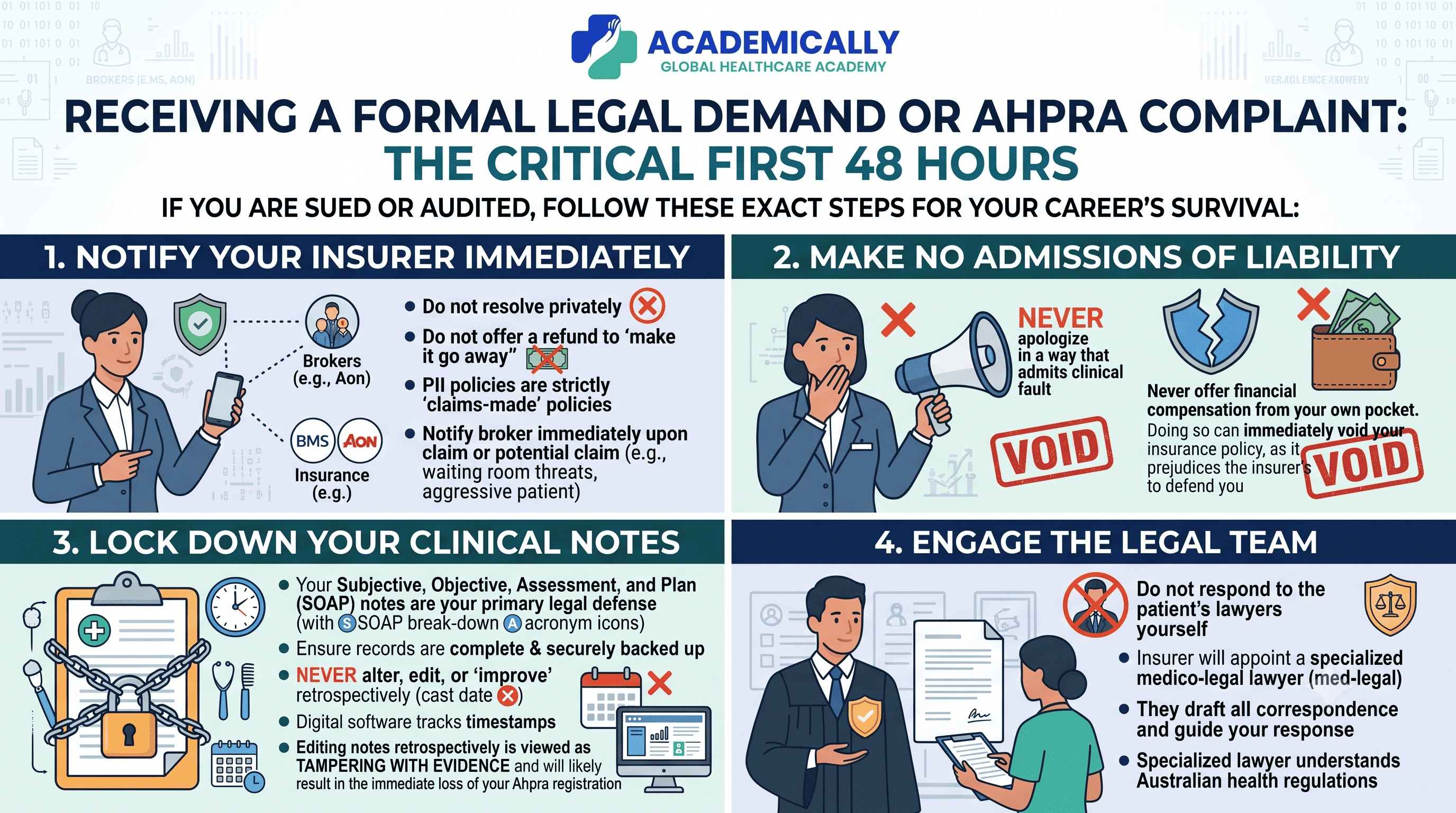
Receiving a legal letter of demand or a notification of a formal complaint from Ahpra is incredibly stressful. How you react in the first 48 hours is critical to the survival of your career and the validity of your insurance policy.
If you are sued or audited, follow these exact steps:
- Notify Your Insurer Immediately: Do not try to resolve a formal legal complaint privately or offer a refund to "make it go away." PII policies are strictly "claims-made" policies. You must notify your broker (e.g., BMS or Aon) as soon as you are aware of a claim, or even a potential claim (e.g., a patient aggressively threatening legal action in the waiting room).
- Make No Admissions of Liability: Never apologize in a way that admits clinical fault, and never offer financial compensation out of your own pocket. Doing so can immediately void your insurance policy, as you have prejudiced the insurer's ability to legally defend you.
- Lock Down Your Clinical Notes: Your Subjective, Objective, Assessment, and Plan (SOAP) notes are your primary legal defense. Ensure your records are complete and securely backed up. Never, under any circumstances, go back and alter, edit, or "improve" previous medical records once a statement of claim has been received. Digital software tracks timestamps. Editing notes retrospectively is viewed as tampering with evidence and will likely result in the immediate loss of your Ahpra registration.
- Engage the Legal Team: Do not respond to the patient's lawyers yourself. Your insurer will appoint a specialized medico-legal lawyer who understands Australian health regulations to draft all correspondence and guide your response.
Maintaining Continuous Cover During Career Changes
Because standard PII is a "claims-made" policy, the insurance must be active at the time the claim is reported, not just when the incident occurred. This creates unique challenges during career transitions.
Taking Maternity or Paternity Leave
If you step away from clinical practice to have a child, you cannot simply cancel your insurance to save money. You remain legally liable for every patient you treated prior to your leave. You must maintain run-off cover to protect yourself from historical claims. The APA offers specific membership categories for practitioners on parental leave to maintain this coverage at a drastically reduced premium.
Retiring from Practice
Similar to parental leave, retiring physiotherapists must maintain run-off cover. Most high-quality policies (like those offered through BMS) include unlimited run-off cover for retiring practitioners at no extra cost, provided they have been insured with the provider for a consecutive number of years prior to retirement.
Switching Insurers
If you switch insurers (for example, moving from a private broker to the APA/BMS program to save money), any claims, complaints, or incidents that you are already aware of must be reported to and handled by your previous insurer before the policy expires. Your new policy will only cover new incidents moving forward. Never let your policy lapse for even a single day during the transition.
Navigating AHPRA regulations, securing the right level of Professional Indemnity Insurance, and managing your visa requirements are only half the battle when migrating your physiotherapy career. For internationally qualified practitioners, the most significant hurdle is completing the Australian Physiotherapy Council’s (APC) mandatory assessment pathways.
Whether you are aiming to bypass stages via the Express FLYR pathway or you are preparing for the rigorous five-stage Australian Physiotherapy Entry Pathway (APEP)—including the Written Assessment, the remote Capability Assessment, and the final face-to-face Clinical Workshop in Melbourne—attempting to tackle the APC framework without expert guidance can lead to costly delays and exam resits.
You do not have to navigate this transition alone. Getting the right preparation for your APEP exams ensures you understand exactly what Australian examiners are looking for in clinical reasoning, patient safety, and ethical practice.