With its scenic landscapes, high standard of living, and progressive healthcare system, New Zealand is a top-tier destination for international physiotherapists. Unlike many countries where foreign-trained healthcare workers face multi-year temporary visa transitions, New Zealand treats physiotherapy as a critical shortage profession under Tier 1 of its Green List.
As an overseas clinician, you can practice as an autonomous, first-contact primary healthcare provider. Patients can consult you directly for acute musculoskeletal injuries under the government’s unique universal accident scheme, the Accident Compensation Corporation (ACC).
Below is your complete, step-by-step 2026 roadmap covering regulatory registration, examination pathways, costs, visa options, and job placement strategies.
The Regulatory Framework: PBNZ & The Annual Practising Certificate
Physiotherapy is a legally protected title under the Health Practitioners Competence Assurance Act 2003 (HPCA Act). To practice in New Zealand, you must fulfill two mandatory statutory requirements:
PBNZ Registration: Confirms that your primary physiotherapy qualification and clinical competence meet the entry-level standards of New Zealand. Once granted, registration does not expire.
Annual Practising Certificate (APC): The active legal license required to practice, assess patients, and bill under ACC or Te Whatu Ora. It is renewed annually and includes a statutory disciplinary levy.
PBNZ Registration Pathways for Overseas Physiotherapists
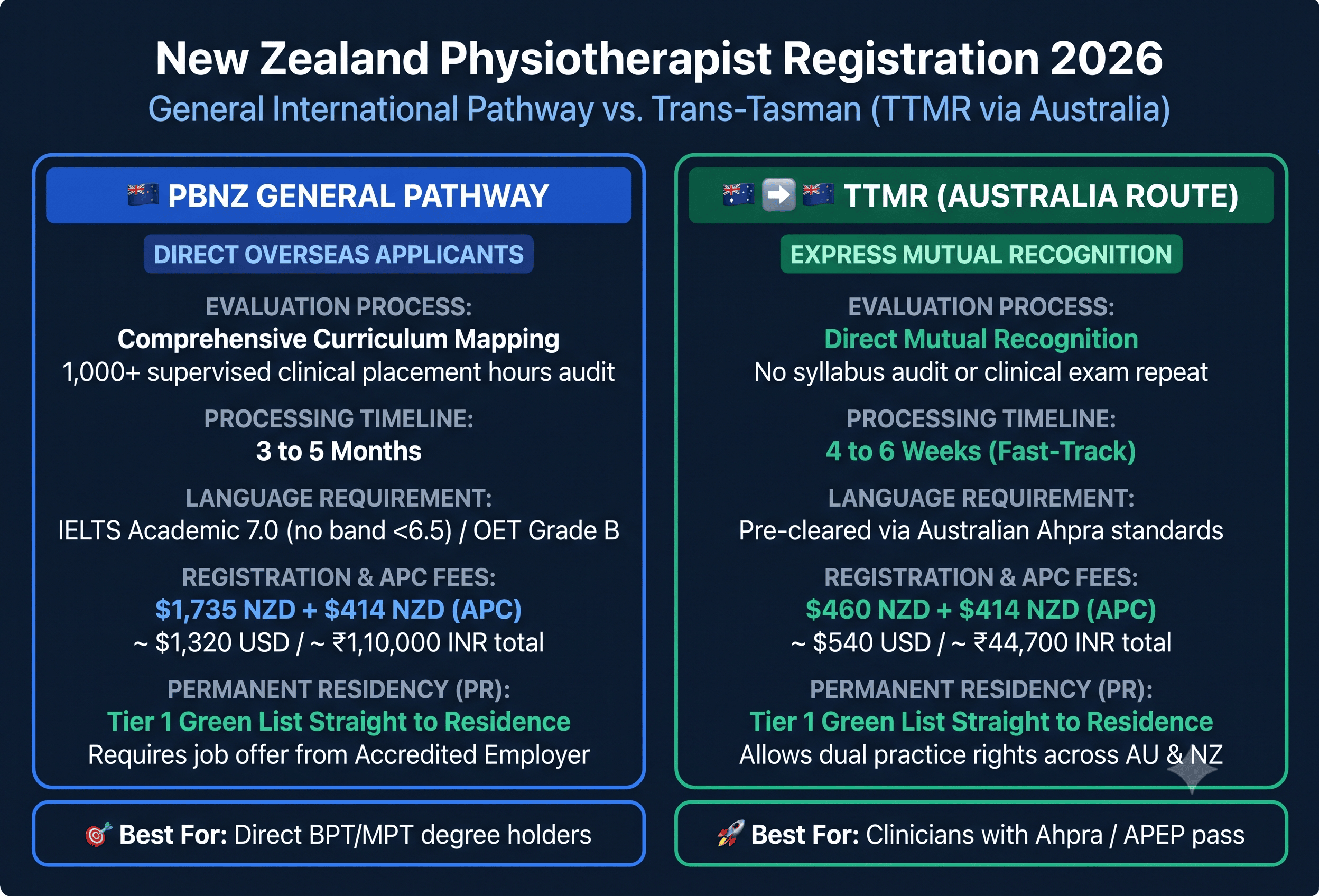
The Physiotherapy Board of New Zealand provides two distinct registration routes for international applicants:
1. International General Pathway (Overseas Graduates)
This pathway is designed for physiotherapists who completed their Bachelor’s or Master’s degrees in countries like India, the UK, the Philippines, or South Africa without holding Australian registration.
Eligibility & Documentation:
- Certified copies of academic degree certificates and complete university transcripts.
- Comprehensive course descriptors/syllabus documentation detailing theoretical and practical credit hours.
- Evidence of at least 1,000+ supervised clinical placement hours across core domains: Musculoskeletal, Neurological, and Cardiorespiratory.
- Certificate of Good Standing from your home regulatory council (issued within the last 3 months).
Evidence of identity and certified criminal background checks.
Competency Assessment: Your curriculum is benchmarked against the Physiotherapy Practice Thresholds in Australia and Aotearoa New Zealand. You must also demonstrate an understanding of cultural safety and the principles of Te Tiriti o Waitangi (The Treaty of Waitangi).
Language Benchmark: IELTS Academic (minimum overall score of 7.0 with no individual band below 6.5) or OET (Grade B in all sub-tests).
2. Trans-Tasman Mutual Recognition (TTMR / Express Pathway)
If you have already cleared your Australian licensing exams (such as the APEP pathway) and hold current General Registration with AHPRA in Australia, you are entitled to mutual recognition under the Trans-Tasman Mutual Recognition Act 1997.
Why This Is the Preferred Route: You bypass the extensive General Pathway syllabus audit. Your Australian registration is recognized directly by PBNZ, allowing you to secure New Zealand registration in approximately 4 to 6 weeks.
Process: Submit your active AHPRA registration certificate, identity documents, and standard statutory application forms to PBNZ.
2026 Fee Schedule (NZD, USD, INR)
Overseas Graduate Registration Fee (General Pathway): $1,735 NZD (~$1,065 USD / ~₹89,000 INR)
Express / TTMR Pathway Registration Fee: $460 NZD (~$285 USD / ~₹23,500 INR)
Initial Annual Practising Certificate (APC) with Disciplinary Levy: $414 NZD (~$255 USD / ~₹21,200 INR)
New Zealand Qualifications Authority (NZQA) Assessment (if required for visa): ~$745 NZD (~$460 USD / ~₹38,000 INR)
Visa Pathways: Fast-Track to Permanent Residency
Immigration New Zealand prioritizes registered healthcare practitioners through multiple visa streams:
1. Tier 1 Green List: Straight to Residence Visa
Because Physiotherapists are listed under Tier 1 of the Green List, you do not need to work on a temporary visa for years before applying for permanent residency.
Key Requirement: A genuine, full-time job offer (or current employment) from an Accredited Employer in New Zealand.
Remuneration Rule: Employment must be paid at or above the national median wage benchmark ($35.00 NZD per hour or ~$72,800 NZD/year).
Outcome: Direct grant of New Zealand Permanent Residence for you, your partner, and dependent children under 24 years old.
2. Accredited Employer Work Visa (AEWV)
A temporary work visa allowing you to relocate and begin working immediately while your Straight to Residence application is processed.
Salary Structure & Major Clinical Sectors in New Zealand
Physiotherapists in New Zealand enjoy strong compensation packages with standard public hospital collective bargaining scales and uncapped commission incentives in private ACC clinics.
- Junior / Rotational Physiotherapist: $72,000 – $82,000 NZD (~$44,000 – $50,500 USD / ~₹37 Lakhs – ₹42 Lakhs INR)
- Experienced / Specialist Physiotherapist: $85,000 – $105,000+ NZD (~$52,000 – $64,500 USD / ~₹43.5 Lakhs – ₹54 Lakhs INR)
- Private Practice Clinic Directors / Contractors: $110,000 – $130,000+ NZD (~$67,500 – $80,000 USD / ~₹56 Lakhs – ₹66.5 Lakhs INR)
High-Demand Clinical Settings:
Private Musculoskeletal & Sports Clinics (ACC Accredited): The largest sector in New Zealand. Clinics treat acute sprains, spinal pain, and athletic injuries funded directly through ACC co-payments.
Te Whatu Ora (Public Health New Zealand): District hospital networks recruiting for acute rotational posts across surgical wards, ICUs, stroke rehabilitation, and pediatrics.
Community & Residential Aged Care: Supporting older adults in restorative care, falls prevention, and mobility preservation.
Step-by-Step Roadmap to Relocate in 2026
1. Complete Document Authentication & English Testing
Secure your official university transcripts, syllabus documents, and clinical placement logs. Achieve your target IELTS 7.0 or OET Grade B.
2. Submit PBNZ Application
Apply for registration via the General Pathway or leverage your Australian Ahpra registration via TTMR.
3. Connect with Accredited Employers
Once PBNZ issues your registration eligibility or certificate, apply to accredited clinics and hospital networks. You can use platforms like Jobslly to access verified job openings directly.
4. Apply for Your Annual Practising Certificate & Visa
Finalize your job offer, activate your APC, and submit your Straight to Residence Visa application through Immigration New Zealand.
Conclusion
New Zealand provides an exceptional blend of career autonomy, competitive salaries, and swift permanent residency for overseas physiotherapists. Whether you apply directly through the PBNZ General Pathway or use the Australia APEP/TTMR mutual recognition route, preparing your clinical documentation and regulatory requirements early ensures a seamless transition to practicing in Aotearoa.