Completing the Australian Physiotherapy Entry Pathway (APEP) administered by the Australian Physiotherapy Council (APC) marks a major career transition.Clearing the Written Assessment, the remote Capability Assessment, and the Melbourne Clinical Workshop proves that your clinical reasoning matches entry-level Australian standards.
Yet, when stepping into an Australian clinic whether under Limited Registration for Supervised Practice with an Interim Certificate or moving into unrestricted registration with the Physiotherapy Board of Australia / AHPRA many overseas practitioners encounter an unexpected hurdle: the administrative and software ecosystem.
In Australia, your clinical notes serve as more than a personal consultation reminder. They are legally audited medical records tied directly to Medicare Chronic Disease Management (CDM) plans, WorkCover state compensation schemes, private health funds (via Tyro/HICAPS), and the National Disability Insurance Scheme (NDIS).
Below is an operational guide to the primary practice management and documentation platforms in Australia, how they function, and the legal charting rules you need to follow from day one.
Australian Practice Management Systems
AUSTRALIAN PRACTICE MANAGEMENT ECOSYSTEM
│
┌──────────────────┬───────────────┴───────────────┬──────────────────┐
▼ ▼ ▼ ▼
CLINIKO NOOKAL SPLOSE BEST PRACTICE
Private Physio Multi-Discipline NDIS & Community Medical Centers /
& Sports Clinics & Fast-Paced Sports Allied Health GP Super-Clinics
Cliniko: The Australian Private Practice Gold Standard
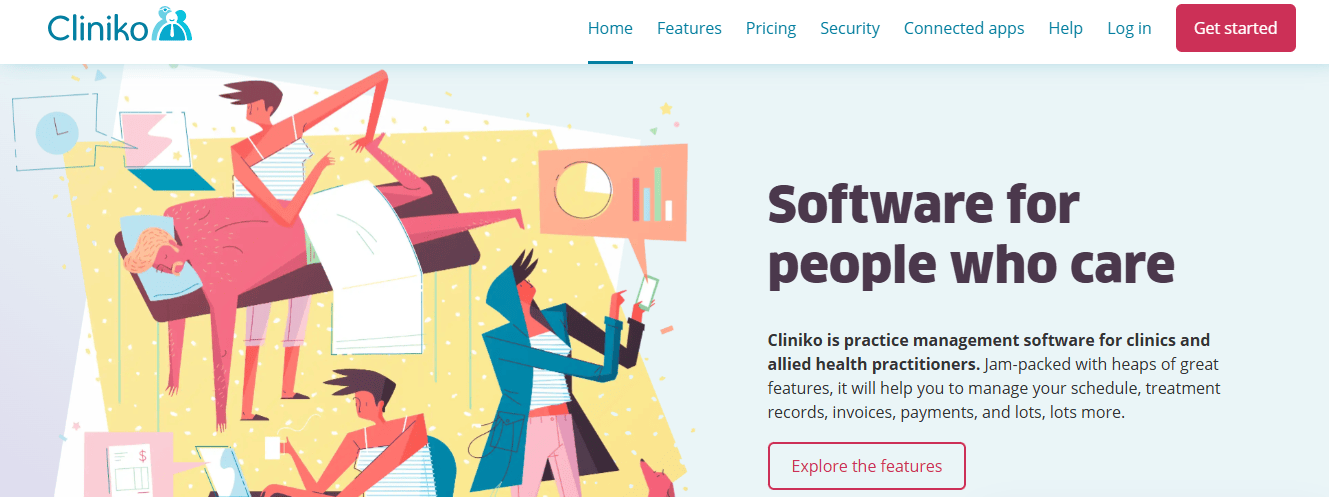
Built in Melbourne specifically for allied health professionals, Cliniko is the software most private musculoskeletal and sports practices use. Prominent clinics—such as Melbourne’s Performance Medicine, which treats high-performance performing arts athletes and private clients—rely on Cliniko to coordinate high-volume daily appointment diaries and note workflows without delays.
- Documentation: Highly customizable SOAP templates with interactive anatomical body charts. You can highlight trigger points, joint dysfunctions, and neural symptom paths directly on touchscreen tablets.
- Integrations: Direct API links to Tyro Health (cardless digital claiming for Medicare and health funds), physical Tyro/HICAPS counter terminals, and exercise platforms like Physitrack and Wibbi.
- GP Communication: Built-in dynamic merge fields generate GP reporting letters that auto-populate patient demographics, functional goals, and referral dates.
Best Practice (Bp Premier): The GP & Multidisciplinary Choice
Best Practice (Bp) is a staple across Australian general practice clinics. You will primarily use Bp if you work in an integrated primary health network, medical super-clinic, or hospital-adjacent center.
- Documentation: Text-heavy, medical-style records aligned with standard GP consultations rather than allied health movement assessments.
- Clinical Visibility: Direct access to GP treatment records, pathology results, and diagnostic imaging reports (X-rays, ultrasound, MRI) within the same file.
- Secure Messaging: Native links into HealthLink, Medical-Objects, and Argus secure messaging networks, eliminating unencrypted email exchanges.
Nookal: Built for Multidisciplinary Teams
Popular in high-volume clinics housing physiotherapists, exercise physiologists, podiatrists, and massage therapists together.
- Clinical Macros: Pre-programmed shorthand blocks that populate standardized objective tests (e.g., knee stability clusters, lumbar radiculopathy screens) in one click.
- Multi-Discipline Profiles: Keeps physical therapy, hydrotherapy, and rehabilitation files cleanly segregated under a single unified billing chart.
- Statutory Billing: Direct invoice exports matching the specifications of state injury bodies like WorkSafe Victoria, SIRA NSW, and WorkCover Queensland.
Splose: The NDIS & Community Health Leader
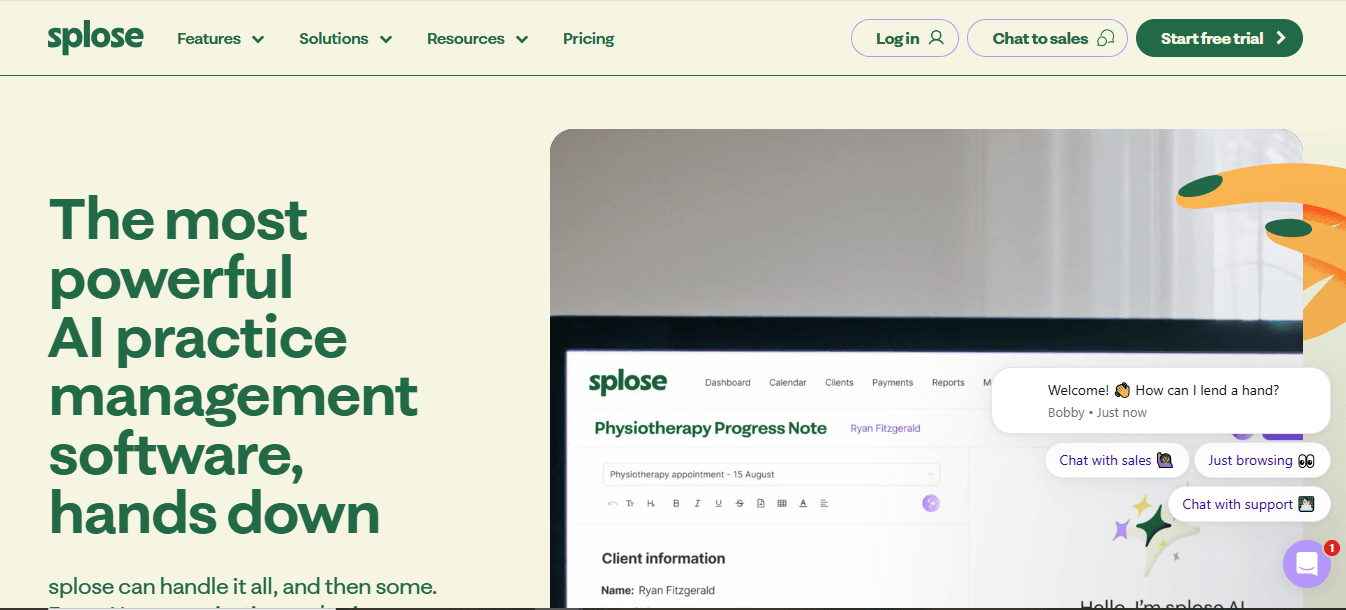
With a substantial number of overseas physiotherapists beginning their Australian careers within community health or disability services, Splose has become an important tool in the market.
- Direct PRODA API: Bulk-claims directly through the Australian Government Services Australia portal, eliminating manual invoicing for NDIS plan managers.
- Participant Goal Tracking: Structures clinical progress notes around formal NDIS functional outcomes and SMART goals rather than isolated symptoms.
- Allied Health Assistant (AHA) Coordination: Allows supervising physiotherapists to assign treatment tasks to assistants and review their progress notes within a single view.
Core Feature Comparison
| Feature | Cliniko | Best Practice (Bp) | Nookal | Splose |
| System Architecture | 100% Cloud | Cloud or Server-based | 100% Cloud | 100% Cloud |
| Best Suited For | Private Musculoskeletal & Sports | Medical Centers / GP Co-location | Multidisciplinary Teams | NDIS & Community Physio |
| Body Chart Tools | Interactive point/draw canvas | Basic image attachment | Integrated body maps | Custom template uploads |
| Claiming Channels | Tyro Health, HICAPS, Medicare | Direct Medicare/DVA, HICAPS | Tyro, Medicare, WorkCover | Direct NDIS PRODA API, Tyro |
| Exercise App Sync | Physitrack, Wibbi | Limited / Manual export | Physitrack | Physitrack |
| Pricing Structure | Monthly tier per practitioner | License fee / Cloud subscription | Monthly tier per practitioner | Monthly tier per user |
AI Scribes in Australian Clinics
A recent operational shift in Australian allied health documentation is the adoption of ambient AI clinical scribes, such as Heidi Health and Lyrebird Health.
Australian physiotherapists use these platforms alongside systems like Cliniko or Nookal:
- Patient Consent: The clinician obtains verbal or written consent, logging that an ambient scribe is being used.
- Audio Processing: The system securely processes the consultation audio and structures the conversation into an Australian SOAP note format.
- Integration: The clinician reviews the drafted summary, checks for accuracy, and transfers the text into the clinical PMS note window.
These tools save 5–8 minutes per consultation, helping practitioners meet Australian documentation requirements without spending late evenings catching up on administrative work.
Anatomy of an Australian SOAP Note
Under the Physiotherapy Board of Australia's Code of Conduct, clinical documentation must be completed promptly after each session, maintain legible records, and demonstrate defensible clinical reasoning.
Below is an example of an audit-compliant Australian initial assessment note:
PATIENT: Smith, John | DOB: 14/05/1984 | REF GP: Dr. R. Taylor (CDM Plan - Item 10960)
[SUBJECTIVE]
- Primary Complaint: 3-week history of sharp L shoulder pain following overhead painting.
- Aggravating Factors: Abduction > 90°, reaching into back seat of car, sleeping on L side.
- Easing Factors: Rest, ice packs, oral Paracetamol (as needed).
- 24-Hour Pattern: Mild morning stiffness (<10 mins), throbbing ache after active days.
- Red Flags Screen: Denies night sweats, unprovoked weight loss, chest pain, SOB, or neurological signs into the hand.
- Goals: Return to weekend swimming (500m freestyle) and pain-free overhead working.
- Consent: Informed verbal consent obtained for objective assessment, active movement testing, and passive mobilization.
[OBJECTIVE]
- Posture: Mod anterior carriage of cervical spine, L scapular anterior tilt.
- Active Range of Motion:
* L Shoulder Flexion: 155° (pain at end-range 6/10) vs R 175° (pain-free).
* L Shoulder Abduction: Painful arc present between 70° and 110°.
* L External Rotation (at 0°): 60° (symmetrical, pain-free).
- Palpation: Focal tenderness over L supraspinatus insertion at greater tubercle.
- Orthopaedic Tests:
* Hawkins-Kennedy: Positive (L).
* Empty Can (Jobe's) Test: Weakness and pain (4/5) (L).
* Belly-Press Test: Negative bilaterally.
* Cervical Screen (Spurling's & Quadrant): Clear, no radicular reproduction.
[ASSESSMENT]
- 41yo male presenting with clinical signs consistent with L rotator cuff-related shoulder pain (RCRSP) / subacromial pain syndrome.
- Primary impairment: Rotator cuff fatigue, functional impingement under subacromial space, and reduced eccentric scapular control.
- Prognosis: Favorable. Estimated 6–8 weeks of active rehabilitation to regain symptom-free overhead reaching.
[PLAN]
1. Education: Reassured patient regarding structural stability; discussed load management and avoiding provocative overhead fatigue.
2. In-Clinic Therapy: Manual therapy applied to L posterior capsule and thoracic spine extension mobilization (Grade III) for pain modulation.
3. Home Exercise Program (Prescribed via Physitrack):
- Side-lying external rotation (1kg dumbbell): 3 sets of 10 reps, once daily.
- Scapular setting against wall: 3 sets of 8 reps with a 5-sec hold.
4. Compliance & Safety: Advised patient to keep exercise-related pain below 3/10 and report any neuro signs or sudden weakness immediately.
5. GP Reporting: Initial CDM report generated in Cliniko and sent to Dr. Taylor via secure digital messaging.
6. Review: 45-minute follow-up scheduled in 7 days to assess baseline exercise tolerance.
I still distinctly remember my 3rd year in the Bachelor of Physiotherapy program. It was the first time our clinical tutors taught us the SOAP (Subjective, Objective, Assessment, Plan) format into our daily hospital rounds. We use to write by hand , spending exhausting hours scribbling pages of range-of-motion measurements, drawing crude stick-figure body charts in blue ink, and manually drafting home exercise plans on loose sheets of paper.
While researching and writing this blog, getting to dive deep into today's Australian clinic software is genuinely interesting. Seeing how modern platforms like Cliniko, Nookal, and Splose integrate smart templates, touch-friendly anatomical body charts, and automated billing makes me realize, these tools literally cut documentation effort in half.
Mastering clinical software and Australian documentation standards is often the final puzzle piece after clearing your qualification pathway. Once you have the technical foundation down, the next step is stepping into a supportive clinic environment where you can build your practical experience, fulfill supervised practice requirements, and grow your clinical career.
Connect directly with hiring clinics and verified healthcare employers across Australia.
Essential Compliance Rules for Overseas Practitioners
AUSTRALIAN STATUTORY RULES
│
┌───────────────────────────────┼──────────────────────-─────────┐
▼ ▼ ▼
MEDICARE CDM INFORMED CONSENT EXERCISE EXPORT
Item 10960: Formal reports Explicitly note verbal Digital copy from apps
required to the GP on consent for physical tests like Physitrack must be
Visits 1 and 5. and manual treatments. saved to client PMS.
Medicare CDM (Item 10960) Reporting Loop
If a patient consults you under a GP Chronic Disease Management Plan, Australian law requires written correspondence back to the referring general practitioner after Treatment 1 (initial assessment) and after Treatment 5 (discharge or plan conclusion). Using Cliniko or Nookal dynamic letter tags helps streamline this task.
Documenting Patient Consent
Australian healthcare places heavy emphasis on informed decision-making. Your documentation must record that the patient was informed of the risks, assessment benefits, and alternate treatment options, followed by their explicit verbal consent—particularly for manual therapy, dry needling, or cervical manipulations.
Digitally Prescribed Home Exercise Plans (HEP)
Relying on hand-drawn exercises on scrap paper does not meet documentation standards in Australian clinics. Modern practices integrate their PMS with Physitrack or Wibbi. Prescribed exercises sync directly back to the patient's timeline, confirming specific loads, tempos, and sets were formally advised.
Mastering software like Cliniko or Nookal helps you move from the structured cases of the APEP pathway especially in Capability Assessment to managing the workflow of private healthcare in Australia.
Before your first day in a clinic:
- Set up a free trial account on Cliniko or Nookal to practice creating patient files in their sandbox modes.
- Build standard SOAP templates customized to your focus area (musculoskeletal, neuro, or cardiopulmonary).
- Familiarize yourself with Medicare CDM guidelines and HICAPS terminal claiming procedures.
Looking to complete the qualification process or optimize your practice under supervision?