A patient has completed six weeks of physiotherapy. Their walking distance has improved, pain has reduced and they can perform most daily activities independently. Does that mean they are ready for discharge? Not necessarily.
The next physiotherapist, GP or rehabilitation team needs to know more than whether treatment was successful. They need to understand the patient's functional progress, remaining limitations, safety concerns and what should happen next.
This is where a physiotherapy discharge summary becomes important. In Australia, physiotherapists working in hospitals, private practices, rehabilitation centres and community healthcare settings must communicate clinical findings and ongoing care requirements clearly. Although documentation formats differ between services, the purpose remains the same: ensure continuity of care when one episode of treatment ends or responsibility transfers to another provider.
In this blog, we have entailed about how to write a physiotherapy discharge summary in Australia, the information to include, the iSoBAR handover framework, common documentation mistakes and practical examples you can learn from.
What is a physiotherapy discharge summary?
A physiotherapy discharge summary is a clinical document prepared when a patient completes an episode of physiotherapy, stops treatment or transfers to another healthcare provider.
It provides a consolidated account of the patient's presenting condition, assessment findings, treatment provided, response to interventions and functional status at discharge.
It also communicates whether the patient has achieved their treatment goals or requires further rehabilitation, monitoring or support. The intended recipient may include:
- A general practitioner (GP).
- Another physiotherapist.
- A rehabilitation specialist.
- A hospital or community healthcare team.
- An aged-care facility.
- The patient or their authorised carer.
A discharge summary is different from routine physiotherapy progress notes. Progress notes record developments during individual consultations, whereas discharge documentation brings together the clinically relevant information needed to understand the patient's journey and continue their care.
What Australian guidelines should physiotherapists follow in 2027?
There is no single discharge-summary template applicable to every Australian physiotherapy workplace. Physiotherapists must consider their professional responsibilities, applicable privacy and health-record requirements, workplace policies and the documentation expectations of the healthcare service. Three important references are:
| Australian reference | What physiotherapists should understand |
| Physiotherapy Board of Australia and Ahpra | The shared Code of conduct establishes expectations around professional communication, accurate records, confidentiality and patient-centred care. |
| Australian Commission on Safety and Quality in Health Care | The NSQHS Communicating for Safety Standard addresses effective communication during transitions of care. |
| Australian Physiotherapy Association (APA) | Its Guidance for Writing Clinical Notes explains clinical documentation, handovers, discharge notes, outcome measures and professional accountability. |
The APA guidance specifically identifies four important elements of discharge documentation:
- A summary of the presenting condition, treatment course and response.
- A comparison between the patient's initial and final status.
- The reason for discharge or discontinuation.
- A follow-up plan or referral to other support.
These principles are particularly useful when preparing a physiotherapy discharge summary for another clinician.
What is changing?
The Australian Commission is developing national standards for hospital discharge information under the National Health Reform Agreement 2026–31, with completion scheduled by 30 June 2027. These developments should not be mistaken for an already implemented national physiotherapy discharge-summary template.
The Commission also highlights the consequences of incomplete discharge communication. Its published material reports that up to one in three patients discharged to residential aged care miss prescribed medicine doses during the first 24–72 hours. This illustrates the broader importance of accurate transitions of care, although the statistic is not specific to physiotherapy.
When should a physiotherapist write a discharge summary?
A physiotherapy discharge summary is appropriate when:
- The patient has achieved the agreed treatment goals.
- The patient is transitioning from hospital to community rehabilitation.
- The patient is transferring to another physiotherapy service.
- Further physiotherapy is no longer clinically indicated.
- Treatment is ending because of a plateau in progress.
- The patient chooses to discontinue treatment.
- Ongoing care requires communication with another clinician.
Discharge does not always mean complete recovery. A patient may still experience pain, reduced mobility or functional limitations but be ready to continue with a different form of care.
This is why physiotherapy discharge planning should consider the patient's needs before the final appointment.
How to write a physiotherapy discharge summary: The 8 essential steps
1. Include patient and practitioner details
Begin with the information required to identify the patient and the professionals involved.
| Information | Details to include |
| Patient identification | Full name, date of birth and relevant medical record number |
| Discharge information | Date of discharge and treating service |
| Referral details | Referring clinician or organisation |
| Treating practitioner | Physiotherapist's name and professional details |
| Recipient | GP, receiving physiotherapist or healthcare service |
Always verify the intended recipient and follow your organisation's approved procedures for sharing clinical information.
2. Explain the presenting condition and relevant history
Briefly explain why the patient was referred and what the physiotherapy episode addressed. Include relevant information such as:
- Presenting symptoms and functional difficulties.
- Confirmed diagnosis or clinical impression.
- Relevant medical and surgical history.
- Date of injury or procedure, where applicable.
- Precautions or restrictions affecting treatment.
- Relevant social circumstances, including living arrangements and available support.
Avoid including unrelated medical information. The purpose is to help the receiving clinician understand the patient's clinical background without having to search through multiple records.
3. Compare initial and final functional status
This is one of the most important parts of a physiotherapy discharge summary.
Rather than writing that the patient has improved, demonstrate the improvement using relevant clinical measurements. Depending on the patient's condition, these may include:
- Range of motion.
- Muscle strength.
- Walking distance and gait speed.
- Balance and falls-risk assessment.
- Transfer ability.
- Pain scores.
- Exercise tolerance.
- Activities of daily living.
Example:
| Functional measure | Initial assessment | Discharge assessment |
| Walking distance | 20 metres | 100 metres |
| Walking aid | Four-wheel walker | Four-wheel walker |
| Assistance | One-person assistance | Independent indoors |
| Pain score | 7/10 | 3/10 |
| Sit-to-stand | Required arm support | Independent |
Note: The figures above are illustrative. This comparison makes the patient's progress immediately understandable. It also prevents subjective statements from replacing measurable clinical findings.
4. Summarise the interventions provided
The receiving clinician needs to understand what treatment the patient has already received. Instead of listing every appointment separately, group the interventions into clinically meaningful categories. For example:
| Intervention | What to document |
| Therapeutic exercises | Strengthening, flexibility and mobility exercises |
| Gait training | Walking practice, walking aids and assistance required |
| Balance training | Static and dynamic balance activities |
| Functional training | Transfers, stairs and activities of daily living |
| Patient education | Pacing, precautions and self-management |
| Equipment advice | Walking aids, braces or other assistive devices |
Also mention the patient's response to treatment and any modifications made because of pain, fatigue or other clinical considerations.
5. Record treatment goals and outcomes
The Australian Physiotherapy Association recommends documenting person-centred goals developed collaboratively with the patient. The SMART framework can help physiotherapists establish meaningful goals.
The SMART framework
| Element | Meaning | Physiotherapy example |
| S | Specific | Return to walking in the local park |
| M | Measurable | Walk continuously for 20 minutes |
| A | Achievable | Appropriate to current functional ability |
| R | Relevant | Supports the patient's social and recreational interests |
| T | Time-limited | Achieve within eight weeks |
The APA guidelines also describe the Goal Attainment Scale (GAS), which can help evaluate individualised treatment goals. At discharge, identify whether each goal was achieved, partly achieved or remains unmet. This gives the next clinician a better understanding of what the patient still wants or needs to accomplish.
6. Document risks and unresolved concerns
A patient may demonstrate substantial functional improvement while continuing to experience problems that affect their safety. Document relevant concerns, including:
- Falls risk.
- Persistent pain or swelling.
- Reduced balance.
- Cognitive or communication difficulties.
- Post-operative precautions.
- Weight-bearing restrictions.
- Need for assistance with mobility.
- Exercise intolerance.
- Unresolved neurological or respiratory symptoms.
Explain what needs monitoring and whether further assessment or escalation is required.
7. Specify the ongoing management and follow-up plan
A useful physiotherapy discharge summary should make the next steps clear.
Include the home exercise programme, equipment requirements, referral arrangements, precautions and recommended follow-up.
Avoid vague instructions such as "continue physiotherapy" or "review if necessary".
Instead, explain what needs to happen, who is responsible and whether the arrangement has been confirmed.
8. Complete the handover and authenticate the report
Before sending the document, verify that the information is accurate and complete.
Include the physiotherapist's name, date, professional details and approved signature or electronic authentication.
Document relevant communication with the patient, carer and receiving clinician. Where the patient's clinical complexity or safety risks warrant it, supplement the written report with direct communication.
Understanding this framework is also important for overseas-qualified physiotherapists preparing to practise in Australia. Clinical documentation is not simply about recording what happened during a consultation; it involves demonstrating sound clinical reasoning, clear communication and an understanding of professional responsibilities. These are relevant areas of preparation for the Australian Physiotherapy Council (APC) written assessment. The APC Written Assessment Preparation Course can help candidates build their knowledge of Australian physiotherapy practice and prepare for the assessment.
Use the iSoBAR framework to structure a physiotherapy handover
The Australian Physiotherapy Association's Guidance for Writing Clinical Notes (2018) describes the iSoBAR framework as a useful approach to clinical handover.
It helps physiotherapists organise information so that the receiving clinician can understand the patient's condition, current status, clinical findings and recommended actions.
| iSoBAR component | What it means | Information to include |
| I: Identification | Identify the patient | Patient details and relevant identifiers |
| S: Situation and status | Explain the current situation | Presenting condition, functional status and immediate concerns |
| O: Observation | Present clinical findings | Assessment results, pain scores, mobility and outcome measures |
| B: Background and history | Provide relevant context | Medical history, previous treatment and progress |
| A: Assessment and actions | Explain clinical reasoning | Current assessment, response to treatment and decisions |
| R: Recommendation | Establish next steps | Follow-up, referrals, responsibilities and risks |
The framework is particularly useful when a patient moves from an inpatient rehabilitation service to community care.
Case study: Physiotherapy discharge summary for a complex inpatient
The following example demonstrates how a physiotherapist can organise clinical findings, functional progress and follow-up recommendations into a structured handover.
Patient and treating physiotherapist details
| Field | Details |
| Patient name | Mr Ahmed Polat |
| Age | 86 years |
| Gender | Male |
| Medical record number | Withheld |
| Treating physiotherapist | Sarah Mitchell (illustrative name) |
| Treating department | Inpatient Physiotherapy |
| Primary diagnosis | Right patellar fracture |
| Date of injury | Approximately one week before assessment |
| Relevant medical history | Parkinson's disease, left-sided cerebrovascular accident six months earlier and right Colles' fracture in 2015 |
| Living situation | Lives alone |
| Communication considerations | Limited English proficiency; Turkish is his primary language |
| Additional considerations | Newly diagnosed dementia and low mood |
1. Reason for admission and clinical background
Mr Polat was receiving inpatient physiotherapy following a right patellar fracture. His medical history included Parkinson's disease and a previous left-sided cerebrovascular accident (CVA), which had contributed to right-sided weakness. These impairments affected his balance, transfers and mobility.
He lived alone and had recently been diagnosed with dementia. His cognitive and communication needs, combined with reduced mobility, required further assessment before a safe return home could be considered.
2. Initial functional assessment
| Assessment area | Findings |
| Bed-to-chair transfers | Independent |
| Other transfers | Required assistance from one person |
| Walking ability | Mobilised with a four-wheel walker and supervision |
| Knee support | Used a Zimmer knee splint |
| Pain | 4/10 on the Visual Analogue Scale |
| Neurological findings | Right-hand and right-foot weakness with mild hypertonicity |
| Balance and safety | Right-leg weakness affected balance and mobility safety |
3. Physiotherapy interventions
The treatment programme included bed-based exercises for the upper and lower limbs, performed twice daily. Physiotherapy sessions focused on improving mobility and supporting functional recovery.
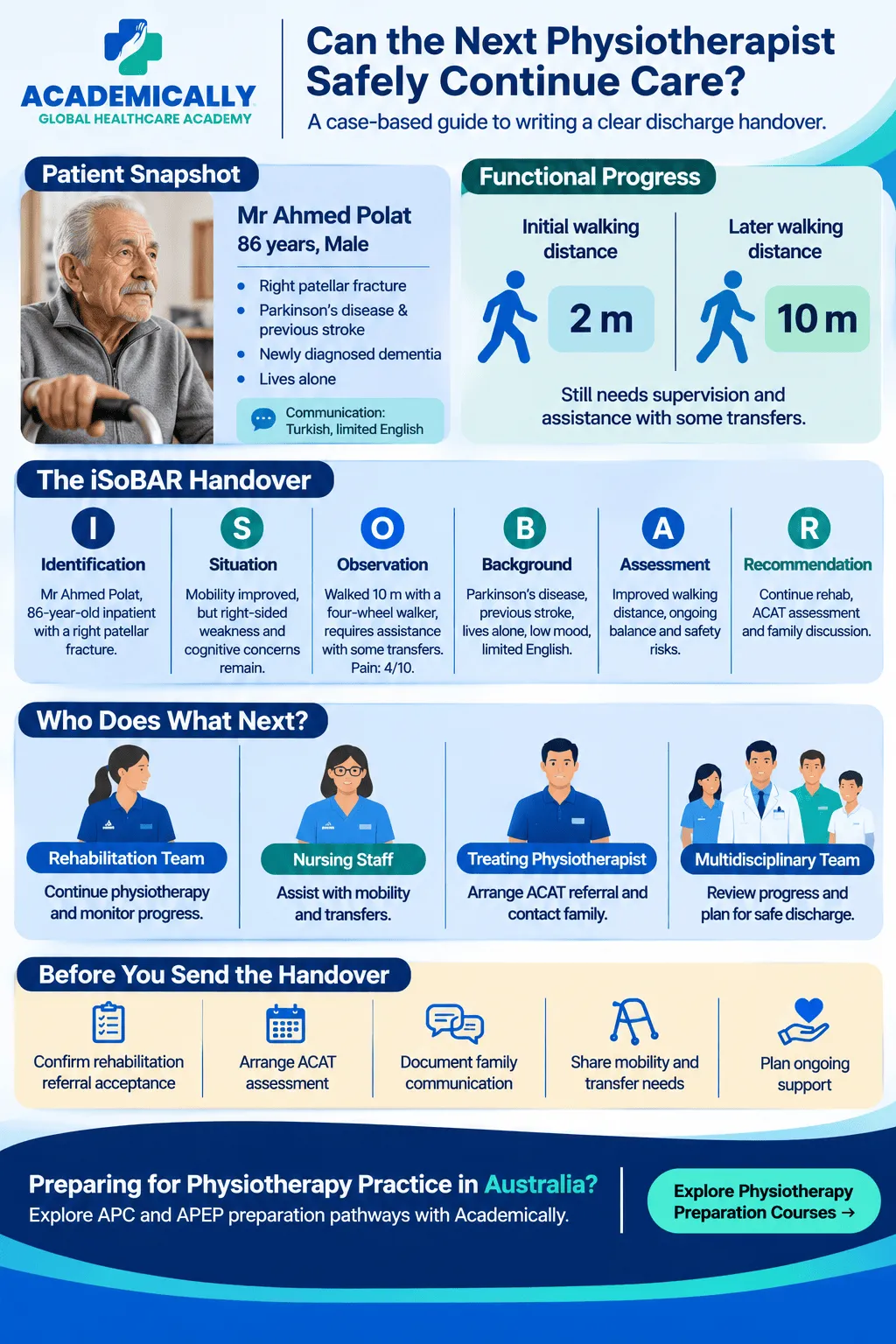
His walking distance improved from approximately 2 metres initially to 10 metres along the corridor, using a four-wheel walker with supervision and the prescribed knee splint.
4. Progress and response to treatment
Although Mr Polat demonstrated measurable improvement in walking distance, his overall progression remained slow. His mood was low, and he sometimes declined physiotherapy sessions.
Nursing staff were advised to assist him when walking to the toilet and part of the way to the sitting room. Daily physiotherapy input was recommended to continue addressing his mobility and functional limitations.
5. Discharge assessment and recommendations
A direct return home was not considered appropriate without further rehabilitation and assessment of his support needs. The proposed plan included:
- Transfer to Mount Thomas rehabilitation for access to gym-based therapy and community activities.
- Continued physiotherapy to address mobility, balance and functional independence.
- Nursing assistance with mobility and toileting as required.
- Referral for an Aged Care Assessment Team (ACAT) assessment to evaluate his suitability for returning home.
- Contact with family to discuss care arrangements and support.
How the physiotherapist could document the handover
The treating physiotherapist could use the iSoBAR framework to communicate the patient's condition, functional progress, clinical assessment and ongoing care requirements.
I of Identification: Mr Ahmed Polat, an 86-year-old inpatient recovering from a right patellar fracture, with a medical history of Parkinson's disease and a previous left-sided cerebrovascular accident.
S of Situation: Mobility has improved during physiotherapy. However, residual right-sided weakness, balance difficulties and cognitive concerns continue to affect functional safety. The patient lives alone and requires further assessment before returning home.
O of Observation: Independent with bed-to-chair transfers. Requires assistance from one person for other transfers. Walking distance has increased from approximately 2 metres to 10 metres using a four-wheel walker, with supervision and a Zimmer knee splint. Reports pain of 4/10 on the Visual Analogue Scale. Right-hand and right-foot weakness with mild hypertonicity were also noted.
B of Background: The patient has a history of Parkinson's disease, a previous stroke and a right Colles' fracture. He lives alone, has recently been diagnosed with dementia and has limited English proficiency, speaking primarily Turkish. His mood has been low, and he has sometimes declined physiotherapy sessions. Treatment has included bed-based upper- and lower-limb exercises twice daily.
A of Assessment: Walking distance has improved, but the patient continues to need supervision when walking and assistance with some transfers. Right-sided weakness following the previous stroke affects balance and mobility. His cognitive concerns, living situation and current functional limitations mean that returning home without additional support may not be appropriate at this stage.
R of Recommendation: Further inpatient rehabilitation is recommended to continue mobility and functional training. Arrange an ACAT assessment to evaluate the patient's suitability for returning home. Contact family to discuss support arrangements, following appropriate consent and communication procedures. Consider interpreter assistance when communicating important clinical information.
6. Handover and follow-up responsibilities
| Responsible person or team | Recommended action |
| Receiving rehabilitation team | Continue physiotherapy and monitor functional progress, mobility and transfer ability |
| Nursing staff | Assist with mobility and transfers according to the documented support requirements |
| Treating physiotherapist | Arrange the ACAT referral and contact the patient's family |
| Multidisciplinary team | Review rehabilitation progress and assess suitability for a future return home |
Outstanding actions before handover:
- Confirm the rehabilitation referral and receiving team's acceptance.
- Establish arrangements for the ACAT assessment.
- Document communication with the family and any agreed support arrangements.
- Ensure the receiving team understands the patient's mobility and transfer assistance requirements.
Treating physiotherapist: Sarah Mitchell (illustrative name)
Department: Inpatient Physiotherapy
Document type: Physiotherapy discharge handover
Note: This is an adapted educational example based on the Australian Physiotherapy Association's published iSoBAR case study. The treating physiotherapist's name is illustrative. It is not a completed clinical record or a substitute for a facility-specific discharge template.
The case also illustrates why physiotherapists need to explain the reasoning behind their clinical decisions, rather than simply list assessments and interventions. They must interpret functional findings, recognise risks, justify ongoing care and communicate appropriate recommendations. These capabilities are relevant to the Australian Physiotherapy Entry Pathway (APEP), particularly its capability assessment. Overseas-qualified physiotherapists preparing for this stage can explore the APEP Capability Assessment Preparation Course to strengthen their approach to demonstrating clinical competence in an Australian practice context.
Who is responsible for what after discharge?
One common problem during transitions of care is uncertainty about who should complete the next action. A physiotherapist may recommend community rehabilitation, for example, but the receiving service may not have accepted the referral yet.
The Monash Health rapid literature review, Informing Best Practice in Writing Discharge Summaries, highlights the importance of communicating follow-up arrangements and ensuring that discharge documentation contains adequate, accurate information.
A responsibility matrix can help prevent important actions from being overlooked.
| Required action | Responsible person or team | What to document |
| Further mobility rehabilitation | Receiving physiotherapy team | Recommended rehabilitation goals and current assistance requirements |
| Medical review | GP or treating medical team | Reason for review and outstanding concerns |
| Equipment arrangement | Relevant rehabilitation or equipment service | Equipment required and whether arrangements are confirmed |
| Home safety assessment | Appropriate community service | Assessment requested and next action |
| Home exercise programme | Patient, with support where necessary | Exercises, frequency and precautions |
| Family or carer communication | Discharging team | Information shared and any outstanding discussion |
It is equally important to distinguish between different stages of an arrangement.
| Status | Example of appropriate documentation |
| Requested | Referral submitted for community physiotherapy. |
| Planned | Community physiotherapy assessment planned following discharge. |
| Confirmed | Receiving service has accepted the referral and confirmed the appointment. |
| Pending | Equipment assessment requested; confirmation is awaited. |
| Completed | Patient and carer received the home exercise instructions. |
A physiotherapy discharge summary should never suggest that a referral has been accepted or equipment arranged when these actions are still pending.
Weak vs strong clinical documentation
A discharge summary does not need complicated medical language to demonstrate clinical competence.
The Monash Health review recommends clear language, correct grammar and a structured format. It specifically advises against unnecessary repetition, unexplained abbreviations, jargon and vague expressions.
Consider these examples:
| Avoid writing | Write instead |
| Patient is doing better. | Walking distance increased from 20 metres to 80 metres using a four-wheel walker, with supervision. |
| Continue exercises at home. | Continue the prescribed quadriceps strengthening and sit-to-stand programme at the reviewed dosage, within the agreed symptom limits. |
| Patient is independent. | Independent with bed mobility and sit-to-stand transfers; requires supervision when negotiating stairs. |
| Physiotherapy completed. | Six outpatient physiotherapy sessions completed. The patient achieved the agreed transfer and indoor mobility goals and is suitable for discharge to the self-management programme. |
| Follow up with GP. | GP review recommended for persistent knee swelling and pain. The patient was advised to contact the practice to arrange an appointment. |
Note: These are illustrative examples, not mandatory clinical phrases. The actual documentation must reflect the patient's assessment and the decisions made during treatment. The objective is not to write more. It is to make each sentence more useful to the person reading it.
Physiotherapy discharge planning: A practical workflow
Discharge planning should not begin at the final appointment. It should develop throughout the patient's treatment, particularly when the patient requires ongoing rehabilitation, mobility assistance or equipment. The following workflow brings the main stages together.
The discharge planning process
Initial assessment
Establish baseline function, presenting problems and patient goals.
Treatment and reassessment
Monitor response to interventions and changes in functional ability.
Review of goals
Determine which goals have been achieved and what remains outstanding.
Discharge decision
Decide whether self-management, continued treatment or transfer is appropriate.
Risk and support assessment
Review precautions, equipment, mobility assistance and support requirements.
Handover and follow-up
Allocate responsibilities, communicate recommendations and send the discharge summary.
A structured process helps ensure that discharge is based on the patient's clinical needs rather than simply the number of appointments completed.
What should you check before sending the summary?
Use this checklist to review the document before finalising it.
- Patient and practitioner details are accurate.
- The reason for referral and relevant history are documented.
- Initial and final functional status are compared.
- Treatment and patient response are summarised.
- Goals and outcomes are recorded.
- Risks, precautions and unresolved concerns are identified.
- Equipment and home exercise instructions are included where relevant.
- Follow-up actions and responsible people are identified.
- Referral status is accurately documented.
- The patient or carer has received relevant instructions.
- The report is dated, authenticated and sent securely to the intended recipient.
How does the discharge summary differ across Australian healthcare settings?
The clinical information required depends on the patient's circumstances, receiving service and workplace documentation policy.
| Healthcare setting | Important discharge information |
| Public hospitals | Functional status, rehabilitation progress, precautions, equipment and communication with the receiving team |
| Private physiotherapy clinics | Treatment outcomes, remaining limitations, home exercise advice and recommendations to the GP or next clinician |
| Community rehabilitation | Mobility, transfer ability, home safety, available support and ongoing rehabilitation needs |
| Aged-care facilities | Falls risk, mobility assistance, equipment, functional ability and ongoing exercise requirements |
For example, an inpatient transferring to community rehabilitation may need a detailed handover of mobility assistance and precautions. A private-practice patient who has achieved their goals may only need a concise report outlining treatment outcomes and self-management recommendations.
Ritambhara, an APEP-qualified candidate describes her preparation style as "clinical." In her first attempt, she studied like an academic student. She spoke with Dr. Akram Ahmad (International Healthcare Career Coach, Ph.D from the University of Sydney) about this. Academically's mentors changed how she viewed a case.
They taught her to read clinically. Developing a clinical style involves three habits. First is immediate red-flag screening. This means scanning for non-musculoskeletal or emergent conditions.
Examples include cauda equina syndrome or undiagnosed fractures. Second is safety before efficacy. This means choosing safe interventions first. Then, you decide which modality is most effective. Third is individualised patient goals. You select discharge plans tailored to the patient's lifestyle. You avoid textbook generalities. By trusting Academically's educators, her performance improved. Her practice test results transformed within weeks.
NSW Health's Patient Discharge Documentation guideline is a useful reference for public-hospital documentation in NSW. It distinguishes the integrated inpatient discharge summary from separate allied health discharge reports where additional discipline-specific information is required.
Conclusion
A good physiotherapy discharge summary does more than confirm that treatment has ended. It gives the next healthcare professional a clear understanding of the patient's condition, functional progress, remaining limitations and recommended next steps.
Whether you work in a hospital, private clinic, rehabilitation centre or community healthcare setting, focus on three things: accurate clinical information, measurable outcomes and clear follow-up responsibilities.
Ultimately, the quality of a discharge summary is reflected in how effectively another clinician can use it to continue the patient's care.