The Indian Physiotherapy Degree Structure
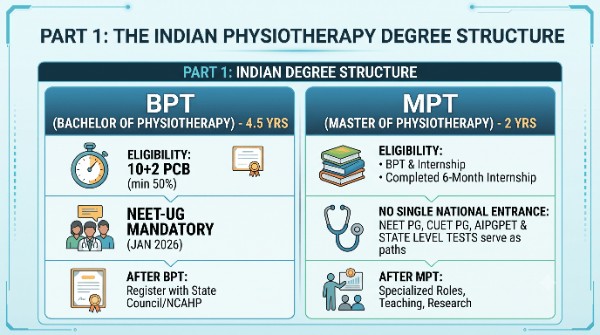
BPT (Bachelor of Physiotherapy)
BPT is a 4-year undergraduate program followed by a mandatory 6-month rotatory internship — a 4.5-year commitment in total, and the entry-level qualification for practicing physiotherapy in India.
Eligibility:
- 10+2 with Physics, Chemistry, and Biology (PCB) as compulsory subjects
- Minimum 50% aggregate (45% for reserved categories, per most institutional norms)
- NEET-UG is now mandatory for BPT admission, following guidelines announced by the National Commission for Allied and Healthcare Professions (NCAHP) in January 2026 — this is a genuine 2026 change; older content describing BPT admission as purely merit- or institute-exam-based is now out of date for most institutions.
Core syllabus areas:
Biochemistry, Pathology & Microbiology, Pharmacology, Biomechanics, Exercise Therapy, Electrotherapy, General Medicine & Surgery, Orthopedics, Neurological Physiotherapy, Cardiorespiratory Physiotherapy, Community Medicine & Rehabilitation, Research Methodology & Biostatistics, and Ethics & Professional Practice.
Career outcomes at BPT level:
Entry-level clinical roles in hospitals, orthopedic and neuro clinics, sports rehabilitation centers, and corporate wellness programs. Common starting positions include Junior Physiotherapist, Rehabilitation Therapist, and Home-Care Physiotherapist. This is also the level at which most physiotherapists first consider non-clinical or hybrid paths — medical writing, health content, clinical research coordination as a BPT alone qualifies you for many entry-level non-clinical healthcare roles without needing a postgraduate degree first.
After BPT: most graduates register with their State Physiotherapy Council or the NCAHP before practicing — registration, not just the degree, is what legally permits you to use the title "Physiotherapist" in most Indian states.
MPT (Master of Physiotherapy)
MPT is a 2-year postgraduate program for BPT graduates who want to specialize or move into advanced clinical, teaching, or research roles.
Eligibility:
- BPT degree from a UGC-recognized institution, minimum 50% marks (45% for reserved categories)
- Completion of the mandatory 6-month internship — this is a hard requirement, not optional, at most universities
- Registration with NCAHP or the relevant state council
- Admission via entrance exam — this varies more than most guides suggest. Options include NEET PG, CUET PG, AIPGPET (All India Post Graduate Physiotherapy Entrance Examination), and state-level tests (Karnataka MPT Exam, MHT CET, KCET, among others). Some universities also offer direct/merit-based admission — there's no single national standard the way there is for MBBS, so check your target university's specific route.
Common specializations:
Orthopedics, Neurology, Sports Physiotherapy, Cardiopulmonary, Pediatrics, and Gynecology & Obstetrics — the exact list varies by university.
Career outcomes at MPT level:
Senior clinical roles, specialty-specific practice (sports teams, neuro-rehab units, cardiopulmonary ICUs), academic/teaching positions in physiotherapy colleges, and eligibility for research or PhD tracks. An MPT specialization also meaningfully strengthens applications for advanced international roles — Consultant-tier classification in Saudi Arabia's SCFHS system, for instance, explicitly favors postgraduate qualifications over a bachelor's alone
BPT vs. MPT: At a Glance
| BPT | MPT | |
| Level | Undergraduate | Postgraduate |
| Duration | 4 years + 6-month internship | 2 years |
| Entry | 10+2 (PCB) + NEET-UG | BPT + internship + entrance exam |
| Focus | Broad foundational training | Specialization in one clinical area |
| Typical outcome | Entry-level clinical roles | Advanced clinical, teaching, or research roles |
"Not sure which MPT specialization fits your career goals?
How Global Regulators Actually Evaluate a Foreign Physiotherapy Degree
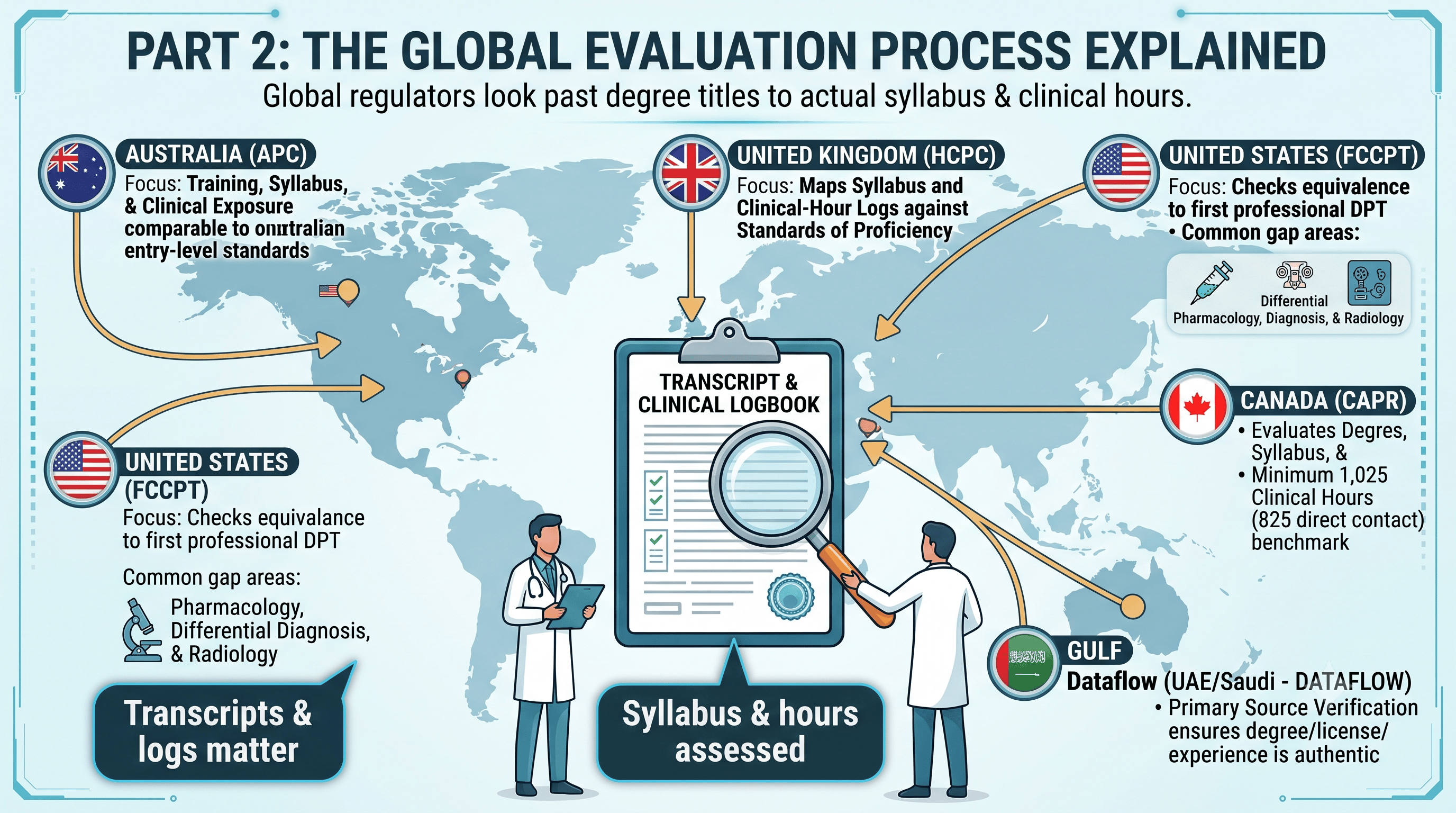
This is the part most India-focused guides skip — and it's the part that matters once you're thinking about practicing abroad. Every regulator answers a version of the same question ("Is this degree equivalent to what we require locally?"), but they answer it differently, and the differences are worth understanding before you assume your BPT or MPT will simply transfer.
Australia: The Australian Physiotherapy Council (APC) doesn't ask whether your degree matches an Australian one credit-for-credit, it evaluates whether your training, syllabus, and clinical exposure are broadly comparable to Australian entry-level standards, then tests the gap directly through APEP's written and oral clinical-reasoning assessments. A BPT is generally accepted as a starting point for eligibility assessment; an MPT doesn't exempt you from any APEP stage.
Prepare for the written and oral stages: APEP Written Assessment Preparation Course
United Kingdom: HCPC maps your course syllabus and clinical-hour logs against the UK's Standards of Proficiency for Physiotherapists, a document-based comparison rather than a credit-count. A BPT can qualify for scrutiny-based registration if your syllabus demonstrates equivalent breadth; gaps typically result in a request for supplementary evidence or an adaptation period, not automatic rejection.
United States: FCCPT's evaluation is often misunderstood as requiring your degree to match a DPT (Doctor of Physical Therapy) specifically, it doesn't. It assesses whether your education is substantially equivalent to the first professional physical therapy degree in the US, using the FSBPT's Coursework Tool (CWT).
A 4-year BPT can have real credit gaps against this standard, bridge programs built specifically for foreign-trained physiotherapists (offered by several US universities) consistently target pharmacology, differential diagnosis, and radiology as the coursework areas most commonly needing supplementation, since these are weighted more heavily in the US first-professional-degree model than in most BPT curricula.
An MPT can help close specific gaps but doesn't automatically satisfy the evaluation on its own and FCCPT's own data shows applicants who complete its comprehensive Type 1 review are substantially more likely to pass the NPTE on their first attempt than those using other evaluators, which is worth knowing before choosing a credentialing route.
Canada: CAPR's credentialing process evaluates your degree, syllabus, and clinical hours, Canadian programs require a minimum of 1,025 clinical hours (825 of them direct patient contact), and CAPR checks your training against that benchmark, not just your degree title. This is a specific threshold in a way several other countries' standards aren't.
Gulf (UAE/Saudi): Data Flow's Primary Source Verification doesn't evaluate curriculum equivalence at all. It verifies that your degree, license, and experience documents are authentic, confirmed directly with your university and licensing council. The actual competency bar is set separately, by the Pro metric exam itself, not by a syllabus comparison. This is a structurally different model from the Western pathways above: it's verification-then-test, not evaluation-then-test.
Clear the CBT on your first attempt. Prepare well with DHA, DOH & Saudi Prometric Physiotherapy Courses
The one thing that's consistent across all of them: none of these regulators treat "BPT" or "MPT" as a checkbox. Every one of them looks past the degree title to the actual syllabus, clinical hours, and (in the US and Canada's case) specific competency benchmarks underneath it. If you're planning to practice abroad, the practical implication is that your transcript and clinical logbook matter more than your degree certificate. Keep them detailed and available, because credential evaluators ask for exactly that level of detail, not just proof that you graduated.
Want to know exactly how your BPT or MPT stacks up against international standards?
Conclusion
BPT and MPT are well-defined, NCAHP-regulated pathways within India — but "well-defined at home" and "automatically recognized abroad" are two different things. Every major destination re-evaluates your training against its own standard, using your actual syllabus and clinical hours rather than your degree title alone. Understanding that distinction early and keeping your academic records detailed saves real time later, whatever pathway you eventually pursue.