Ireland is facing a shortage of qualified pharmacists in community pharmacies, public hospitals and pharmaceutical research centres.
In response to this growing demand, some Irish healthcare businesses are advertising beginning wages of between €60,000 and €85,000 per annum and fast-tracked Critical Skills Employment Permits for trained abroad specialists.
The Pharmaceutical Society of Ireland (PSI), the regulatory body for pharmacy in Ireland under the Pharmacy Act 2007, manages the Third Country Qualification Recognition (TCQR) procedure.
This complete guide specifies the degree qualifying criteria, explains the TCQR process, answers key issues for overseas graduates, and describes how planned preparation guarantees registration success.
The PSI Framework for Overseas Pharmacists
The Pharmaceutical Society of Ireland (PSI) is the statutory authority for pharmacy profession in Ireland. Its principal purpose is to ensure that qualifications presented by pharmacists seeking to practise in Ireland meet the standards required under Irish and EU law.
If you acquired your pharmacy qualification outside the European Union (EU) or European Economic Area (EEA) such as India, Pakistan, Nigeria, the Philippines, Egypt or the US then you cannot register directly. Instead, you first have to go through the PSI Third Country Qualification Recognition (TCQR) process.
Is a PharmD eligible in Ireland?
Yes, a PharmD can be submitted for consideration through the TCQR process when it is a pharmacist qualification obtained outside the EU/EEA and the applicant meets PSI's eligibility requirements.
PSI's current July 2026 guide states that an applicant must have:
- obtained a pharmacist qualification from a non-EU/EEA country;
- successfully completed the full education and training requirements in the qualifying jurisdiction;
- been recognised there as a pharmacist; and
- be eligible to practise pharmacy in the country where the qualification was obtained.
The applicant does not have to be currently registered or practising in that country. However, eligibility to practise must be confirmed in writing by the relevant competent authority or equivalent.
PharmD eligibility checklist
| Requirement | What you should show |
| Overseas pharmacist qualification | Qualification obtained outside the EU/EEA |
| Education and training | Full requirements completed |
| Practice eligibility | Eligible to practise where you qualified |
| Authority evidence | Written confirmation of status or eligibility |
| Academic evidence | Degree, transcript and programme syllabus |
| Practical training | Internship or placement evidence, where undertaken |
| NARIC evidence | Statement of Comparability for the PSI application |
What Does NARIC Ireland Do?
NARIC Ireland, hosted by Quality and Qualifications Ireland (QQI), provides academic comparability information for foreign qualifications. A NARIC comparability statement explains how a foreign qualification compares with an Irish qualification type and level on the National Framework of Qualifications (NFQ), where possible.
However, NARIC does not make the professional recognition decision for regulated professions. That decision is made by the relevant Irish professional authority, for pharmacists, the PSI.
For India, the current NARIC Ireland database lists Doctor of Pharmacy (Pharm.D) as a five-year qualification with an additional one-year internship and compares it with an Irish Honours Bachelor Degree at NFQ Level 8.
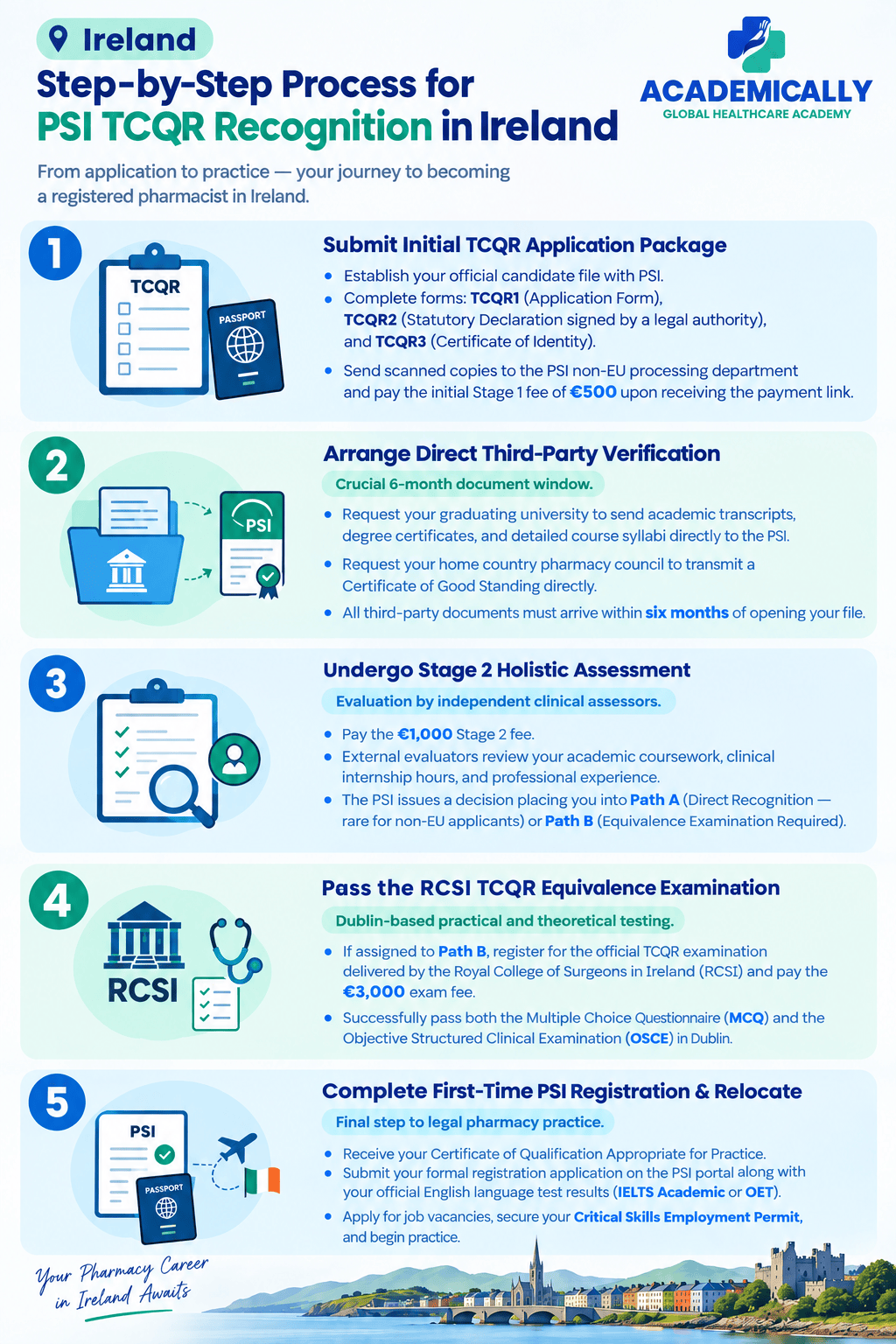
How does the PSI TCQR pathway work?
Overseas pharmacy qualification |
What does the holistic assessment consider?
The Stage 2 assessment considers three broad areas:
| Assessment area | What PSI considers |
| Input | Your pharmacist qualification and in-service/practical training |
| Quality | The quality-assurance components of the regulatory system in the country where you obtained your qualification |
| Output | Relevant post-graduate education, work experience and continuing professional development |
PSI first considers the Input and Quality components. If these demonstrate equivalence with the Irish standard, you can proceed through Path A without an examination.
If deficiencies are identified, PSI then considers the relevant Output evidence. If the qualification still does not meet the required standard, you proceed through Path B and must complete the required examination component or components.
The PSI TCQR Recognition Pathway
| TCQR stage | What happens |
| Stage 1: Internal Review | PSI checks eligibility, completeness and required documentation |
| Stage 2: Holistic Assessment | PSI assesses qualification, practical training, regulatory quality and relevant supporting professional evidence |
| Stage 3A: Path A | If the qualification is considered appropriate for practice, PSI issues the relevant certificate and you can proceed to registration |
| Stage 3B: Path B | If deficiencies remain after the holistic assessment, you may need to complete the required examination component or components |
| Registration | After qualification recognition, you submit a separate first-time registration application and meet registration requirements |
PSI's current guide identifies the examination route as Stage 3B, while the certificate following successful completion is described under the Stage 3A/Stage 3B certification stage. Registration follows qualification recognition as a separate step.
Current TCQR Fees
| Process | Current fee |
| Stage 1 – Application fee | €500 |
| Stage 2 – Holistic assessment fee | €1,000 |
| Stage 2 appeal | €300 |
| Stage 3 – Examination fee | €3,000 |
These are the current PSI fees from 1 May 2026.
Path A vs Path B: what changes for you?
| Path | PSI decision | Next step |
| Path A | Qualification meets the Irish standard | Receive the appropriate-for-practice certificate and move to registration |
| Path B | Deficiencies identified | Complete the required examination component or components |
The TCQR examination can include an MCQ and an OSCE.
- The MCQ covers pharmaceutical calculations and applied pharmacy practice, with each part passed independently.
The OSCE assesses clinical and professional skills through structured scenarios.
PSI decides whether you need one component or both. The RCSI is the current examination provider.
The examination fee depends on the component or components you are required to take:
| Examination requirement | Fee |
| MCQ only | €2,250 |
| OSCE only | €2,750 |
| MCQ + OSCE | €3,000 |
What Is the TCQR Examination?
The TCQR examination is delivered by the Royal College of Surgeons in Ireland (RCSI) on behalf of the PSI.
It has two components:
Part 1 – Multiple Choice Examination
The MCQ has two parts:
- Part A: Pharmaceutical calculations
- Part B: Applied pharmacy practice
Each part must be passed independently.
Part 2 – OSCE
The Objective Structured Clinical Examination (OSCE) assesses clinical and professional skills through structured, practice-based scenarios.
Depending on the outcome of your holistic assessment, PSI may require you to complete one component or both.
If both components are required, each must be passed independently; there is no compensation scoring between the MCQ and OSCE.
Current Application Processing Time
| Stage | Approximate current time frame |
| Stage 1 – application submission/internal review | 4–6 months |
| Stage 2 – holistic assessment | 6 months |
| Stage 3B – examinations | Up to 12 months |
This is the approximate time. Application volumes can create waiting periods.
What documents does a PharmD graduate need?
Prepare your evidence before submitting. PSI requires mandatory documents and asks universities and competent authorities to send several records directly.
Core document checklist
| Document | Who provides it? |
| NARIC Statement of Comparability | Applicant |
| TCQR1 application form | Applicant |
| TCQR2 Statutory Declaration | Applicant |
| TCQR3 Certificate of Identity | Applicant |
| Birth certificate | Applicant |
| Current valid passport – all pages | Applicant |
| CV | Applicant |
| Evidence of formal pharmacist qualification | Applicant |
| Certificate of Professional Status | Competent authority |
| TCQR4 Regulatory Data Form | Competent authority |
| Academic transcript | University/education institution directly to PSI |
| Programme syllabus | University/education institution directly to PSI |
| Internship/practical-training certification, where applicable | University/education institution or competent authority |
| Certified English translations, where required | Qualified translator |
Important Third-Party Document Rule
PSI states that applicants are responsible for requesting third-party documents, but the documents themselves must be issued directly to PSI by the relevant university, education institution or competent authority.
For example:
- your university should send the academic transcript directly to PSI;
- your university should send the relevant programme syllabus directly to PSI;
- the competent authority should send the Certificate of Professional Status directly to PSI;
- the competent authority should complete and send the TCQR4 Regulatory Data Form directly to PSI.
| Important Note: The latest July 2026 guide specifies noneuroute@psi.ie for these submissions. |
Internship and Practical Training
The Pharmaceutical Society of Irelandstates that an internship or practical training placement is not a mandatory prerequisite for submitting a TCQR application. However, practical training is considered as part of the holistic assessment, and PSI's document guide requests internship certification/letters where such training was undertaken.
Postgraduate Education, CPD and Work Experience
Post-qualification education, training, CPD and work experience can be submitted as supporting evidence for the holistic assessment.
However, PSI distinguishes these from the mandatory documents needed to make an application valid. If you provide information about your post-qualification education, CPD or work experience but do not provide supporting evidence, PSI may assess your application based only on the evidence it has received.
Is IELTS required for PSI qualification recognition?
No. English-language evidence is not required at the qualification-recognition stage.
Evidence of English-language competence is required when you apply for first-time registration after your qualification has been recognised.
| Test | Current PSI minimum |
| IELTS | Overall 7; Listening, Reading and Speaking 7; Writing 6.5 |
| TOEFL iBT | Total 95; Speaking 25; Writing 21; Reading 24; Listening 22 |
| OET Pharmacy | Listening 350; Reading 350; Speaking 350; Writing 300 |
| Cambridge C1 Advanced | 180 in each listed component, overall C1 |
If you need to meet the English-language requirements for registration, Academically’s English Proficiency Courses can help you prepare across Listening, Reading, Writing and Speaking through live training, mock exams, question banks and trainer feedback.
Important English-Test Rules
PSI states that:
- test results are valid for two years from the test date;
- the PSI does not accept one-skill retakes;
- test components generally need to be attempted at the same sitting;
- super-scoring is permitted for two examinations of the same format taken within six months, subject to the required base scores.
There has also been an important 2026 change: from 1 June 2026, PSI no longer accepts a university letter stating that your pharmacy course was taught in English as proof of language competence.
Navigating The Application
PharmD Recognition Pathway: Quick Checklist
Before submitting your TCQR application, check:
| ☐ PharmD obtained outside the EU/EEA ☐ Full pharmacy education and training completed ☐ Eligible to practise pharmacy in the qualifying country ☐ Written confirmation available from the relevant authority ☐ NARIC Statement of Comparability obtained ☐ NARIC statement identifies the qualification as a pharmacy qualification ☐ TCQR1 completed ☐ TCQR2 correctly witnessed ☐ TCQR3 correctly witnessed ☐ Birth certificate ready ☐ Current passport, including all pages, ready ☐ CV prepared ☐ Degree/qualification evidence ready ☐ University transcript requested directly to PSI ☐ Official programme syllabus requested directly to PSI ☐ Internship/practical-training evidence requested where applicable ☐ Professional status/good-standing certificate requested ☐ TCQR4 sent to the competent authority ☐ Certified English translations arranged where required ☐ Supporting evidence for postgraduate education, CPD and work experience prepared where relevant |
Important Note: Remember that PSI allows six months for an application to become complete. If mandatory documentation is not received within this period, the application can be closed and a new application may be required.
How Academically Empowers Overseas Pharmacists
The intricacies of Irish pharmacy law, handling overseas regulatory submissions and preparing for high stakes clinical exams can be daunting.
Academically offers specialised, end-to-end support for overseas pharmacy graduates wishing to practice in Ireland.
The complete preparation program provides applicants access to:
Document Vetting: expert advice on how to fill in the forms TCQR1-3 correctly, to avoid costly document rejections or delays.
Calculations Masterclass: The programme is designed to support structured preparation for the relevant TCQR examination components.
Clinical & Law Curriculum: Complete coverage of Irish medication healthcare regulation, over-the-counter protocols and clinical pharmacology.
OSCE Practice Live: Virtual mock clinical stations to help you gain confidence in communicating with patients and making clinical decisions.