I still remember sitting in a career counselling session years ago, completely torn between two paths that everyone in the pharma industry kept mentioning: pharmacovigilance and clinical data management. Both sounded impressive on paper. Both promised stable careers in the life sciences sector. But nobody could give me a straight answer about which one actually paid better or which one would suit my personality and skill set.
If you're going through the same dilemma right now, trying to decide between pharmacovigilance vs clinical data management, I want to walk you through everything I wish someone had explained to me back then, the real differences, the actual salary numbers, the day-to-day work, and how to figure out which path fits you.
Both pharmacovigilance and clinical data management are parts of the pharmaceutical and clinical industries. Both fields welcome graduates from healthcare and life‑science backgrounds. Both are highly regulated, require documentation, use technology and demand a sharp eye for detail. Their everyday work is quite different.
Pharmacovigilance vs Clinical Data Management: What Is the Difference?
| Pharmacovigilance | Clinical Data Management |
| Focus: Drug safety | Focus: Clinical-trial data |
| Adverse-event reporting | Data collection & validation |
| Case processing | Data review & cleaning |
| MedDRA & safety databases | EDC & clinical databases |
| Safety surveillance | Data quality & integrity |
| Patient safety focused | Trial-data focused |
What Does a Pharmacovigilance Professional Actually Do?
A pharmacovigilance professional may handle adverse‑event reports individual case safety reports, medical narratives, safety databases, coding and safety surveillance.
A typical workflow can involve:
- reviewing a suspected drug reaction
- checking the medical details
- coding the event with a standard system like MedDRA
- making sure the information is complete and
- confirming that the case follows the required reporting steps and deadlines.
With experience a pharmacovigilance professional can move into signal detection, aggregate safety reporting, risk management, safety surveillance or safety leadership.
The work has a direct connection to patient safety. That is one reason PV appealed to me when I first started learning about non-clinical careers. A dentist or doctor may leave daily patient consultations, but the medical knowledge can still be applied when interpreting clinical information and understanding possible safety concerns.
For example, the FDA’s pharmacovigilance teams use adverse‑event reports, scientific literature and clinical and pharmacological knowledge to spot safety signals and evaluate safety problems.
What Does a Clinical Data Management Professional Do?
Clinical data management sits near the trial‑data side of developing a drug.
Roles and responsibilities of CDM professional may involve:
- Maintain electronic data‑capture systems
- Review clinical data
- Create or manage edit checks
- Spot discrepancies
- Help manage queries
- Reconcile information and
- Produce high‑quality datasets for analysis.
Accuracy is an important factor here.
So CDM is not simply about working on Excel sheets. It is a structured clinical‑trial role that uses systems, databases, documentation, quality checks and teamwork across different areas.
Pharmacovigilance vs Clinical Data Management: Which Pays More?
This is where many career articles oversimplify the answer. There is no universal salary winner, because job title, experience, company, therapeutic area, technical skills and location can change compensation significantly. Current salary data does show an interesting pattern.
| Qualification | Experience | Predicted CTC |
| MBBS (Indian) | Fresher | Around 10 LPA |
| 2 to 4 years | 10 to 12 LPA | |
| 5 to 8 years | 12 to 16 LPA | |
| >10 years | 16 to 24 LPA | |
| MBBS (FMG) | Fresher | 6 to 8 LPA |
| 2 to 4 years | 8 to 10 LPA | |
| 5 to 8 years | 10 to 12 LPA | |
| >10 years | 12 to 15 LPA | |
| BDS | Fresher | 3 to 6.5 LPA |
| 2 to 4 years | 4 to 7 LPA | |
| >5 years | 5 to 8 LPA | |
| Pharm. D/ M. Pharm | Fresher | 3 to 5 LPA |
| 2 to 4 years | 4 to 6 LPA | |
| > 5 years | 5 to 8 LPA | |
| B. Pharm | Fresher | 2.5 to 5 LPA |
| BAMS | Fresher | 2.5 to 5 LPA |
| > 2 years | 4 to 6 LPA | |
| BHMS | Fresher | 2.5 to 5 LPA |
| > 2 years | 4 to 6 LPA |
My main point is that entry-level salaries for Pharmacovigilance and Clinical Data Management overlap a lot but specialised and managerial Clinical Data Management positions have a chance of higher pay. Pharmacovigilance can also become very profitable when a professional moves into safety, signal detection, medical or leadership roles.
Indicative Salary Ranges in India
| Experience level | Pharmacovigilance | Clinical Data Management |
| Entry-Level | ₹2.1–6 LPA | ₹3–5 LPA |
| Experienced roles | ₹3–13 LPA | ₹8–14 LPA* |
Which Field Has Better Career Growth
I would divide growth into different directions rather than simply calling one field “better.”
Pharmacovigilance career path
A pharmacovigilance career path may look like:
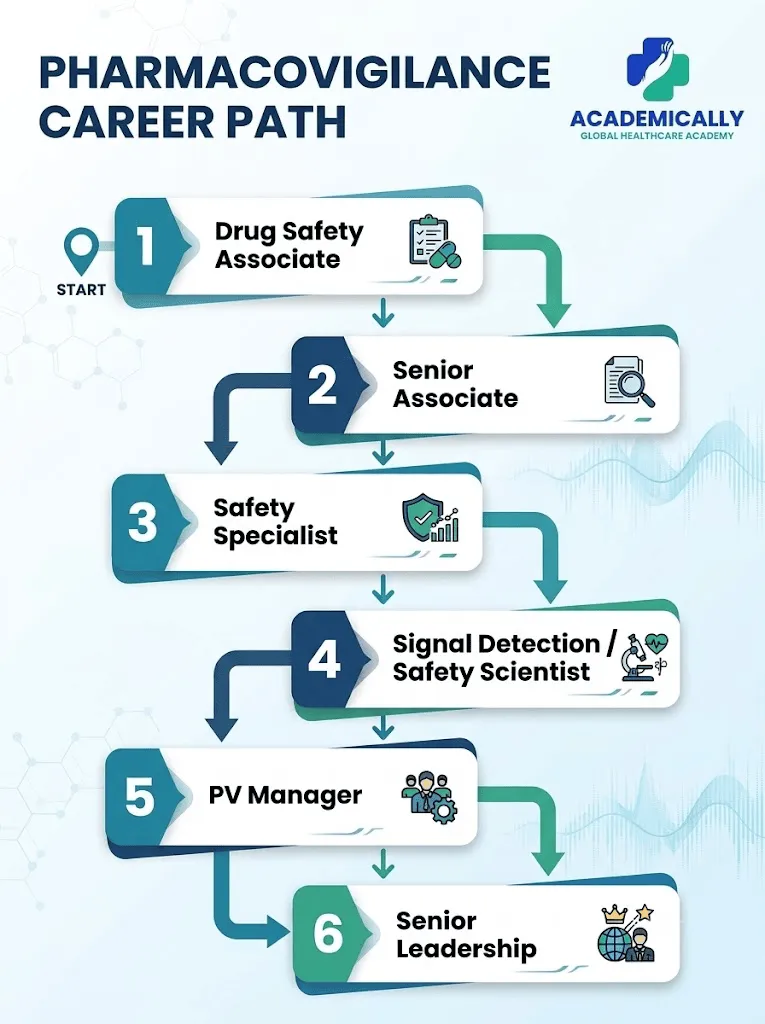
Professionals can also move into areas like:
- regulatory affairs
- medical writing
- risk management and
- safety surveillance.
The biggest advantage of Pharmacovigilance is the variety of safety‑related work. Once a person has understood case processing and safety databases, that person can gradually specialise instead of staying in one kind of task.
Clinical Data Management career path
A Clinical Data Management route may look like:
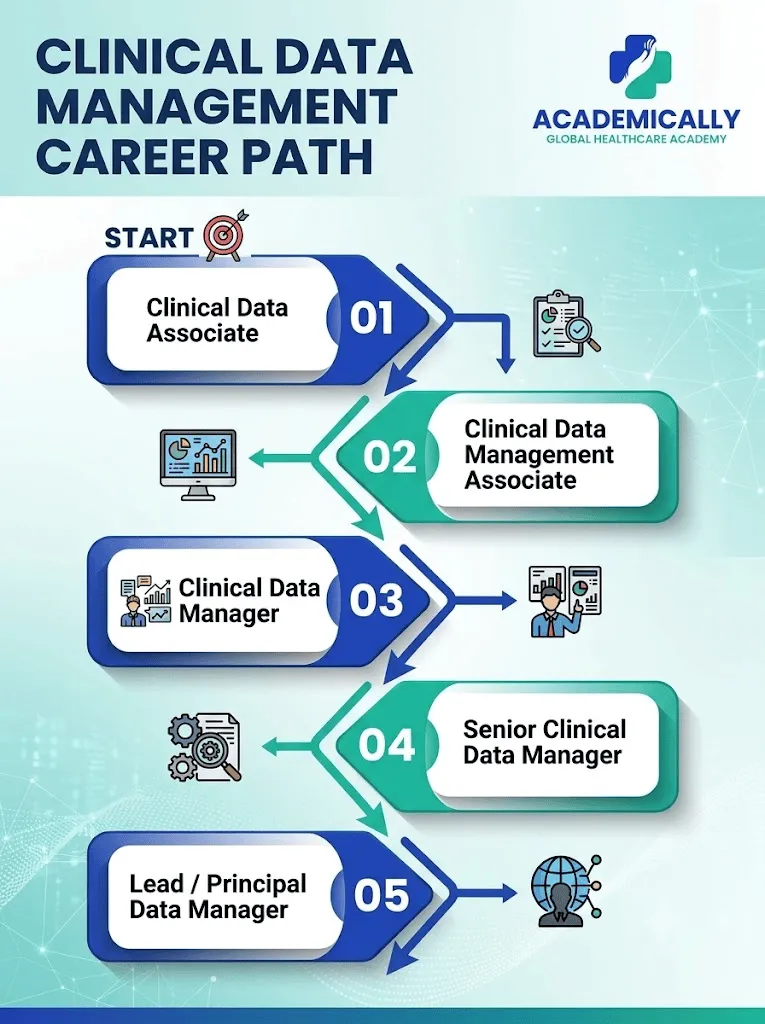
Later stages can involve leading studies, managing vendors, setting data strategy using technology and handling complex clinical programme responsibilities.
Which Career Suits You Better?
This is the question I would ask before checking salary.
Choose Pharmacovigilance if you enjoy:
✓ Medical information
✓ Adverse-event analysis
✓ Patient safety
✓ Documentation
✓ Regulatory processes
✓ Structured workflows
A background in pharmacy, medicine or another healthcare discipline gives clinical context when a person enters Pharmacovigilance.
Choose Clinical Data Management if you enjoy:
✓ Data analysis
✓ Databases
✓ Finding inconsistencies
✓ Clinical-trial processes
✓ Technology
✓ Structured problem-solving
Your Clinical Background Can Transfer to Non-Clinical Careers
This part is important to me. As a BDS graduate I first linked healthcare careers, only with patient treatment. Over time, I realised that my dental education had already trained me in transferable skills.
BDS / MBBS / PharmD / Nursing / Allied Health
↓
Medical Terminology
Disease Understanding
Clinical Documentation
Patient History Interpretation
Evidence-Based Thinking
↓
Pharmacovigilance
Clinical Data Management
Medical Writing
Clinical Research
Medical Affairs
The gap was not my healthcare knowledge. The gap was understanding how the pharmaceutical and clinical research industry really works.
That is why I would not advise dentists, doctors or pharmacists to apply to hundreds of random " jobs" without first understanding the role. A targeted transition makes more sense.
Skills You Need Before Applying for PV Or CDM
| Pharmacovigilance Skills | Clinical Data Management Skills |
| Pharmacovigilance basics | Clinical-trial fundamentals |
| ICSR case processing | EDC concepts |
| MedDRA | Data validation |
| Safety databases | Query management |
| Regulatory concepts | Database basics |
| Medical terminology | GCP/ data integrity |
Common skills:
- GCP
- Clinical Research
- Medical terminology
- Documentation
- Regulatory Awareness
One path I found useful is Academically’s Executive Programme in Clinical Drug Development. The programme covers both Pharmacovigilance and Drug Safety and Clinical Data Management, along with clinical trials, regulatory affairs, biostatistics, medical writing, GCP, real-world evidence and other areas of drug development.
Instead of choosing a career based only on a job title, you can understand where pharmacovigilance and clinical data management sit within the complete drug-development lifecycle.
The programme also includes practical coursework, capstone projects, industry-focused learning, interview preparation, resume support and job assistance.
I especially like the idea of exposure because a certificate alone does not show a recruiter what you can actually do.
A Real Example: From Clinical Practice to Pharmacovigilance
While researching non-clinical career paths, I came across Dr. Shruti, a Pharmacovigilance Service Specialist, working at Accenture with package of 21 Lakh per annum, whose transition particularly stood out to me.
After graduating from SRTR Medical College, Ambejogai, in 2010, Dr. Shruti spent 15 years working as a family physician, caring for patients and their families. As her career progressed, she began looking for an opportunity that would offer better balance between her professional responsibilities and family life.
Her transition shows that moving into pharmacovigilance does not necessarily mean starting your career from zero. Her clinical experience became the foundation for understanding drug safety and making the shift into a non-clinical healthcare role.
Dr. Shruti discovered pharmacovigilance through Academically and enrolled in its Drug Safety Physician and Pharmacovigilance course, where expert mentorship helped her understand the field and build confidence during the transition. She graduated as a Pharmacovigilance Specialist and described her clinical career as the foundation for a new beginning.
As a dentist exploring non-clinical healthcare careers myself, I find stories like Dr. Shruti’s reassuring because they show that moving beyond clinical practice does not mean leaving my healthcare knowledge behind.
How To Find the Right Pharmacovigilance And Clinical Data Management Role
Another problem I noticed when looking into non-clinical careers is that knowing what to learn is only half the issue. The second problem is finding right job openings.
That is where Jobslly can be useful.
Jobslly currently lists healthcare positions in pharmacovigilance, clinical research, clinical data management, medical affairs and other non-clinical roles. Its platform offers filters based on categories, job types and cities and it currently displays positions such as Clinical Data Manager, Data Management Associate and pharmacovigilance jobs.
A recent Jobslly listing for instance shows a Clinical Data Manager I position at Excelya in Bengaluru with compensation of ₹4.2–6.1 LPA.

Jobslly also lists a position of Sr. Associate Pharmacovigilance Operations at Amgen in Hyderabad with compensation of ₹10.6- 11.7 LPA.

That gives candidates something valuable: a way to compare the skills that employers are really asking for instead of learning blindly.
I would use job portals not only when I am ready to apply, but also while I am preparing. Looking at ten or twenty job descriptions can show you which skills keep showing up in pharmacovigilance and clinical data management openings.
A Practical Decision Matrix
| Career factor | Pharmacovigilance | Clinical Data Management |
| Core focus | Drug and patient safety | Clinical-trial data quality |
| Typical work | Safety cases, narratives, coding, surveillance | Data review, queries, databases, edit checks |
| Strong fit for | Detail-oriented medical thinkers | Analytical, organised, data-oriented professionals |
| Entry salary in India | Often around ₹2.1-6 LPA | Often around ₹3–5 LPA |
| Experienced potential | Strong in specialised safety and leadership roles | Strong in senior/managerial data roles |
| Technical emphasis | Safety systems, MedDRA, regulatory workflows | EDC systems, data review, database processes |
| Clinical knowledge | Highly useful | Useful, especially for understanding study data |
| Career mobility | PV, signal detection, regulatory, safety | Data management, data science, clinical operations |
| Work style | Structured, documentation-heavy | Structured, data- and system-heavy |
The salary figures are indicative rather than guaranteed and come from different datasets and job titles, so they should not be treated as direct like-for-like compensation comparisons.
Final Conclusion
When I compare pharmacovigilance vs clinical data management, I would not decide only on the question, "Which pays more?”
Rather, I would ask:
Do I enjoy safety and medical-event analysis more or do I enjoy data, systems and accuracy more?
Pharmacovigilance can be a choice when your interest is medicines, adverse events and patient safety.
Clinical data management can be a choice when your interest is clinical trials, data quality, systems and analytical processes.
Salary can become attractive in both paths. Your first job should be seen as the start of a skill-building journey rather than the final earning level.
My approach is simple:
- understand both domains
- look at job descriptions
- build the missing industry skills
- finish practical projects and
- target the roles that match my strengths.
A non-clinical career does not mean leaving healthcare behind. From my perspective, as a dentist it can mean taking the knowledge I already spent years building and applying it to a different part of the healthcare system.