In a landmark decision that has stirred excitement across global pharmacy communities, the Pharmacy Examining Board of Canada (PEBC) has officially removed the Evaluating Exam requirement for pharmacy graduates from ACPE and CCAPP-accredited institutions.
This update is a breakthrough in the evolving journey toward Canadian pharmacist licensure, especially for thousands of international graduates aiming to enter the Canadian workforce faster.
“We’ve restructured the pathway to better reflect global academic standards. This makes it easier for competent, internationally trained pharmacists to begin practice in Canada,” stated a PEBC spokesperson during the April press briefing in Ottawa.
But what does this mean for pharmacy graduates in India, the Middle East, or the United States? Let’s break it down.
What Exactly Has Changed?
In the past, all international pharmacy graduates, regardless of their alma mater, were required to pass the PEBC Pharmacist Evaluating Examination (EE) as a mandatory step before qualifying for the Pharmacist Qualifying Examination Part I (MCQ).
That’s now history.
Pharmacy graduates from ACPE or CCAPP-accredited universities can now bypass the prolonged Evaluating Exam. Instead, you can directly apply for the PEBC Qualifying Exam MCQ. This big change makes the path to become a registered pharmacist in Canada much seamless.
This decision reflects Canada's growing confidence in internationally accredited institutions and eases the burden on qualified pharmacists, both financially and logistically.
Dr. Akram Ahmad, Founder & CEO, Academically Global, says, “It is a welcoming change in the world of pharmacy to see such a seamless change happening to benefit our future pharmacists. This change will open doors of opportunities to budding pharmacists from across the globe and encourage them to pursue their dreams without any hesitation.”
Who's Eligible Under the New PEBC Rules?
If you’re wondering whether you qualify for this direct entry, here's an easy-to-follow process given below:
Pathway 1: ACPE/CCAPP Accredited Graduates
You are eligible for the direct PEBC MCQ exam if you meet the following:
- Graduated from a programme accredited by ACPE (U.S.) or CCAPP (Canada)
- Your graduation year is the same as or later than your college’s accreditation year
- Your college was accredited at the time of graduation
Institutions like JSS College of Pharmacy (India) fall under this category.
PEBC Document Evaluation Process 2026: Still Mandatory
Even though the EE has been waived for many, the PEBC Document Evaluation remains a non-negotiable first step.
Before applying, candidates must:
- Submit educational transcripts
- Verify pharmacy degree credentials
- Provide licensing proof (if applicable)
This is critical because PEBC still needs to ensure academic equivalency before allowing applicants to proceed to the Qualifying Exam.
What If You’re Not from an Accredited Programme?
Don't worry, PEBC has introduced Pathway 2 for candidates whose colleges aren’t accredited by ACPE or CCAPP.
To qualify under this stream, you must either:
a) Hold a pharmacy degree from:
- Australia
- New Zealand
- Ireland
- United Kingdom
- South Africa
OR
b) Meet the following:
- Possess a full, unrestricted pharmacy license in one of the countries above or the USA
- Have at least 1 year of direct patient care experience within the last 3 years
Canada continues to rely heavily on internationally educated pharmacists. According to the Canadian Institute for Health Information (CIHI), internationally educated pharmacists accounted for 35.0% of Canada's pharmacist workforce (12,992 pharmacists) in 2024, with their numbers growing at an average annual rate of 2.8% since 2020. Ontario alone reports that nearly half (49.1%) of its pharmacist supply is internationally educated, reflecting Canada's continued dependence on overseas-trained pharmacy professionals.
Pharmacist Salary in Canada 2026: Is the Move Worth It?
Absolutely. Canada continues to offer excellent earning potential, strong job security, and multiple permanent residency pathways for internationally trained pharmacists. An ageing population, expanding pharmacist scope of practice, and ongoing workforce shortages across several provinces continue to drive demand for licensed pharmacists.
| Pharmacist Role | Average Annual Salary (2026) | Approx. Salary in INR* | Career Outlook |
| Community Pharmacist | CAD $95,000–$120,000 | ₹58–73 LPA | High |
| Clinical/Hospital Pharmacist | CAD $105,000–$130,000 | ₹64–79 LPA | Very High |
| Consultant/Specialist Pharmacist | CAD $120,000–$145,000+ | ₹73–88+ LPA | Excellent |
*Approximate conversion based on 1 CAD ≈ ₹61 (2026).
Pharmacists working in Ontario, British Columbia, Alberta, Saskatchewan, and Nova Scotia often command higher salaries, particularly in hospitals, rural communities, oncology, geriatrics, primary care, and collaborative healthcare settings where demand remains strong. Additional earnings through shift premiums, bonuses, overtime, and expanded prescribing authority can further increase annual income.
Bonus: Pharmacists remain eligible for Canadian permanent residence through several immigration pathways, including Express Entry, Provincial Nominee Programmes (PNPs), and province-specific healthcare recruitment initiatives, provided they meet provincial licensing and immigration requirements.
Is Canada Good for Indian Pharmacy Graduates?
We, at Academically, highly recommend moving to Canada if you are an Indian pharmacy graduate. It is literally the golden hour.
With the Pharmacy Evaluating Exam removed, Indian PharmD and BPharm graduates from accredited colleges now enjoy a faster, more affordable, and less complicated route to Canadian licensure.
Especially with PEBC now allowing direct PEBC Qualifying Exam for international graduates, it’s never been easier to transition from academia to high-demand pharmacy jobs in Canada.
Step-by-Step: PEBC Pathway for ACPE Graduates in 2026
If you're from an ACPE-accredited U.S. college or a CCAPP-recognised Indian college like JSS, your journey to Canada pharmacist licensure is now quicker and more predictable than ever before.
Let’s break it down:
Step 1: Check Accreditation Status
- Confirm if your college is listed under ACPE or CCAPP accreditation.
- Double-check that your graduation year matches or is later than your college’s accreditation date.
Step 2: Apply for PEBC Document Evaluation
- This is mandatory for all candidates, whether you’re skipping the EE or not.
- Submit your degree certificates, transcripts, syllabus (if required), and proof of pharmacy registration in your home country.
Step 3: Get Your Documents Approved
- The PEBC will evaluate and verify your academic credentials.
- You’ll receive confirmation in 8 to 12 weeks if everything checks out.
Step 4: Apply for the Qualifying Exam Part I (MCQ)
- Once you get approval, you're eligible to apply for the PEBC Qualifying Exam MCQ.
- The next exam will occur in November 2025, with applications opening in late May.
Step 5: Prepare for the Exam (MCQ + OSCE)
- After passing the MCQ, you’ll take the Qualifying Exam Part II – OSCE (Objective Structured Clinical Examination).
- This tests your clinical judgment, communication skills, and real-world application of pharmaceutical care.
A new life is always as stressful as it is rewarding. We, at Academically, will help you not just in preparing for the exam, but also throughout your entire journey. Talk to our expert advisors if you want more details on the PEBC pathway, documentation and more.
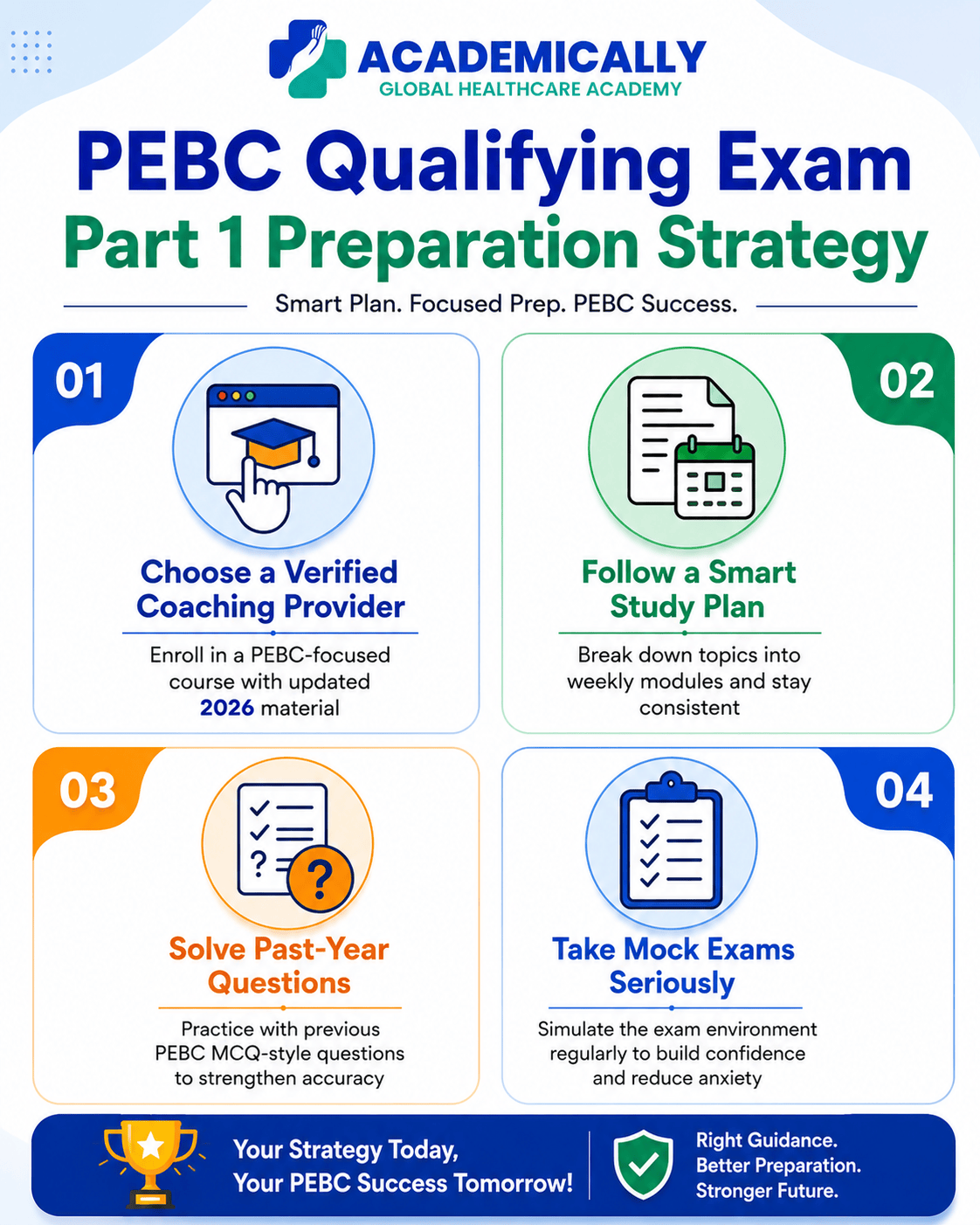
PEBC Qualifying Exam Part 1 Preparation Strategy
While you’ve bypassed the Evaluating Exam, the Qualifying Exam (MCQ) is no walk in the park.
Here are expert-approved preparation strategies:
Canada Pharmacy Jobs for Indian PharmD: What’s in Demand?
Canadian healthcare is rapidly evolving, and pharmacists are playing a bigger role than ever before, especially those trained in clinical settings like Indian PharmD programmes.
Here’s what’s trending:
High-Demand Roles | Description |
| Clinical Pharmacist | Hospital-based roles with a focus on therapy optimisation, medication management |
| Pharmacovigilance Associate | Involved in adverse drug reaction reporting and safety evaluations |
| Pharmacy Manager | Leads community pharmacies, manages inventory and staff |
| Remote Telepharmacist | Offers consultations via virtual platforms |
| Research Coordinator | Supports clinical trials and pharmaceutical research |
The outlook for clinical pharmacists in Canada remains highly favourable in 2026. Health Canada estimates the country currently needs around 1,700 additional pharmacists, while provinces continue expanding pharmacists' prescribing authority and integrating them into team-based primary care to address ongoing healthcare workforce shortages.
Canada Pharmacist Licensing Process After PharmD
Here’s how the registration process works:
- Complete PharmD from an accredited college
- Apply for the PEBC document evaluation
- Directly sit for the MCQ if eligible
- Clear the OSCE
- Register with the provincial pharmacy board (e.g., OCP in Ontario, CPBC in BC)
- Apply for work authorisation or PR if not already done
- Start practising under a Canadian license.
Immigration Pathway: From Exam to Residency
Passing the PEBC exams isn't just a professional milestone, it’s your gateway to Permanent Residency (PR).
Here are your options:
Express Entry: Federal Skilled Worker Programme
- Pharmacists are listed under NOC 31120
- Requires a good CRS score, proof of education, and language proficiency (IELTS)
Provincial Nominee Programmes (PNPs)
- Alberta, Manitoba, Saskatchewan, and Nova Scotia have lucrative job opportunities for healthcare professionals.
- Some offer job-offer-based nominations and speed up PR applications.
Post-Graduate Work Permit (PGWP)
- If you’re in Canada on a student visa, you may transition into work status after completing your pharmacy degree or a bridging programme.
Tip: After your PEBC success, apply for a Canadian work visa or PR while waiting for OSCE or registration steps.
Best PEBC Coaching Options
Here’s why Academically is the top PEBC exam coaching in India and online:
- We have tailored MCQ and OSCE prep for PharmD and BPharm grads
- Get access to live classes and self-paced modules.
- Expert guidance and 1-on-1 doubt-clearing sessions from academicians with 12+ experience and who have cleared PEBC exams themselves
- Support with document evaluation, application process, and exam prep
- Excellent track record of 1,500+ successful Canadian pharmacists worldwide who have taken services from Academically
- Experienced faculty who’ve cleared PEBC exams themselves, registered pharmacists in Canada, settled and working there
- Mock exams that simulate real-time MCQ and OSCE environments
- Peer discussion forums, feedback loops, and personal mentorship
Enrol in our affordable PEBC coaching classes online and carve out a rewarding career path in pharmacy.
Canada has significantly simplified its pharmacist licensing pathway by removing the PEBC Evaluating Exam requirement for graduates of ACPE and CCAPP-accredited pharmacy programmes. This policy change reduces both the time and cost involved in becoming a licensed pharmacist while maintaining mandatory document verification and competency assessment through the PEBC Qualifying Examination. The reform particularly benefits internationally trained pharmacists from accredited institutions in India, the United States, and Canada. Combined with Canada's ongoing pharmacist shortages, competitive salaries ranging from CAD $95,000 to CAD $145,000+, expanding clinical responsibilities, and multiple permanent residency pathways, the updated PEBC process makes Canada one of the most attractive destinations for internationally educated pharmacists seeking long-term career growth and immigration opportunities.
The PEBC’s reform isn’t just a procedural update; it’s a life-changing opportunity for qualified international pharmacy graduates. With the Pharmacy Evaluating Exam removed, your path to a respected, well-paid, and stable career in Canada just became simpler. Whether you're from India, the U.S., or anywhere in between, if your college is ACPE/CCAPP-accredited, you have a real shot at building your future in Canadian healthcare.