When I think about building a career in healthcare without staying in a patient-facing role, Singapore stands out for one important reason: it is not only a healthcare market but also a major pharmaceutical, biotechnology, research and manufacturing hub in Asia.
This makes non-clinical pharma jobs in Singapore an interesting career option for Indian BPharm, MPharm, Pharm D and life-science graduates looking to utilise their knowledge outside pharmacy or hospital pharmacy departments.
Singapore's biopharmaceutical sector is substantial. Biopharmaceutical manufacturing contributed S$12.1 billion to Singapore’s economy in 2024 and employed over 9,000 professionals and the city hosts the manufacturing bases of eight of the world’s ten biopharmaceutical companies. The good news is that there are several non-clinical pathways worth exploring.
Why Singapore Is Becoming Interesting for Indian Pharma Graduates
I would not approach Singapore simply as another country where I can search for a pharmaceutical job. I would look at it as a market where pharmaceutical development, manufacturing, clinical research, regulatory science and healthcare innovation come together.
Singapore has manufacturing clusters like Biopolis and biomedical manufacturing districts that host multinational pharmaceutical companies, biotech firms, research institutes and healthcare organisations that form the backbone of its biopharma ecosystem. This creates an employment base beyond hospital or community pharmacies.

An Indian graduate could potentially build a career around:
- Pharmacovigilance and drug safety
- Medical affairs
- Medical information
- Regulatory affairs
- Clinical research
- Clinical operations
- Medical writing
- Clinical data management
- Quality assurance/compliance
- Market access/health economics
- Pharmaceutical commercial/scientific roles
- Biopharmaceutical manufacturing/quality functions
The choice depends on what you want to do and the skills you possess or are willing to learn.
1. Pharmacovigilance and Drug Safety
If you are a pharmacy graduate with the basics of pharmacovigilance I would advise you to consider pharmacovigilance/drug-safety jobs very seriously.
The work can range from processing adverse-event case reports to review and narrative safety signals, aggregate reporting, literature surveillance and risk-management activities.
Singapore's Health Sciences Authority (HSA) requires that marketing-authorisation holders report all adverse events to HSA, with initial reports of serious adverse events being generally expected to be reported as soon as possible and no later than 15 calendar days after awareness of the event.
This makes pharmacovigilance knowledge crucial not only for drug-safety roles in Singapore but also for pharmaceutical careers in general.
A candidate targeting pharmacovigilance jobs should be familiar with terminology:
- MedDRA
- ICSR processing
- Causality assessment
- Seriousness and expectedness evaluation
- Signal detection
- ICH guidelines and
- Risk-management planning.
The valuable lesson to learn here is that while a BPharm or PharmD will get you a job, additional skills in pharmacovigilance will make you eligible for jobs.
2. Medical Affairs
Medical Affairs is another specialisation for pharmacy graduates especially for those with a Doctor of Pharmacy degree.
Medical Affairs teams operate at the intersection of commercial domains and are involved in a wide range of activities including scientific communication, medical strategy, evidence generation and publication planning as well as medical information and professional engagement.
Unlike sales representatives, medical affairs professionals engage in a variety of scientific communication activities while being bound by legal and regulatory guidelines.
I would consider this route particularly suitable for graduates who enjoy reading research papers and explaining complex medical information clearly.
The key skills for medical affairs include:
- clinical research
- scientific writing
- presentation skills
- evidence evaluation
- pharmaceutical product knowledge and
- understanding of medical compliance.
Given Singapore’s presence as a biopharma manufacturing and R&D hub medical affairs can be a career option because you get the opportunity to work with multinational companies instead of being confined to a single organisation.
3. Regulatory Affairs
Regulatory Affairs is another area that Indian pharmacy graduates should not overlook.
It is a function that supports the development and commercialisation of pharmaceutical products by guiding them through the regulatory maze and ensuring compliance with applicable regulations.
A regulatory affairs professional may be involved in:
- Regulatory submissions
- Product registration
- Product variations
- Regulatory documentation
- Labelling and
- Communication with regulatory authorities.
Singapore's HSA oversees therapeutic-product registration, licensing, post-market surveillance and other pharmaceutical-regulatory matters. Therapeutic products require registration with HSA before they can be placed on the market with requirements depending on the application category and route of administration.
That means regulatory professionals need more than textbook knowledge.
I would build familiarity with Singapore HSA requirements alongside broader international frameworks such as ICH, particularly when targeting multinational organisations.
A good command of writing, documentation and submission processes will put you in a better position than someone with just a BPharm or MPharm.
4. Clinical Research and Clinical Operations
Clinical research provides another bridge between healthcare education and the pharmaceutical industry.
Singapore has a clinical-trials regulatory environment, with HSA regulating clinical trials of therapeutic products and other health products. Trials must be conducted in accordance with regulations, Good Clinical Practice and standard operating procedures.
Indian graduates can explore roles such as:
- Clinical trial assistant
- Clinical research associate
- Clinical research coordinator
- Clinical operations associate
- Clinical trial associate
A basic understanding of GCP, informed consent, protocol, essential documents, trial monitoring, safety reporting and site management will be helpful.
One mistake I would avoid is applying only to "Clinical Research Associate" positions as a fresher. Many candidates search for one title instead of understanding the wider clinical-operations ecosystem.
A better approach is to search multiple related job titles and identify the entry-level roles that match your existing experience.
5. Medical Writing/Medical Communications
Medical writing is an excellent field for healthcare graduates, especially those interested in transforming complex medical information into simplified documents.
The medical writer's work can include:
- Scientific articles
- Clinical documents
- Medical education material
- Regulatory documents
- Literature summaries
- Manuscripts
- Medical information responses
- Pharmaceutical communication material
The advantage of targeting medical writing jobs is that you can leverage your healthcare-graduate status to prepare documents and presentations while developing additional skills in writing, research and communication.
I personally view medical writing as one of the most transferable non-clinical skills. Once you learn how to interpret evidence and communicate it accurately, that skill can be used across pharmaceutical, CRO, healthcare technology and medical communications environments.
6. Clinical Data Management And Research Support
If you are a pharmacy graduate with an interest in systems, documentation and data management this could be a viable career option.
Clinical data management professionals help ensure clinical-study data is collected, reviewed, cleaned and managed according to predefined standards.
Useful skills can include:
- EDC systems
- Data cleaning
- Query management
- Database concepts
- CDISC awareness
- Documentation and
- Data integrity.
Clinical data management is an option for those who are interested in working with computers and managing data. Additional training will give you an edge over others as knowledge of how clinical trials work is essential for this designation.
7. Quality, Compliance and Pharmaceutical Manufacturing
Not every non-clinical pharmaceutical career involves working at a desk in Medical Affairs or Pharmacovigilance.
Singapore’s biopharma manufacturing industry presents career opportunities in:
- Quality assurance
- Quality control
- GMP compliance
- Validation
- Manufacturing operations
- Documentation and
- Supply chain functions.
As mentioned earlier, eight of the world’s ten biopharmaceutical companies have manufacturing facilities in Singapore. This underlines the need for professionals to support the industry’s quality-assurance and pharmaceutical-manufacturing needs.
If you are interested in this pathway you should consider gaining knowledge of:
- GMP
- Deviations
- CAPA
- Change control
- SOPs
- Audit readiness and
- Quality systems.
Do Indian Pharmacy Graduates Need A Singapore Pharmacy Licence?
This is one question I would clarify before starting the job search.
A non-clinical pharmaceutical position is not the same as practising as a pharmacist. Many industry roles do not involve dispensing medicines or practising as a registered pharmacist. However, individual job descriptions can have their own qualification and registration requirements, so applicants should always check the employer's criteria.
The career strategy changes considerably when the target role is industry-based rather than patient-facing.
That distinction can save candidates months of preparing for the wrong pathway.
What About The Singapore Work Pass?
You should be aware of the work-pass requirements before you begin your job search.
An Employment Pass application requires the candidate to meet the qualifying salary and, unless exempt, pass the points-based COMPASS framework. The employer or its appointed employment agent applies on the candidate's behalf.
An S Pass is another work-pass route, subject to its own eligibility conditions, salary requirements and other employer-level considerations
Therefore, I think it is unwise to apply for a job on the basis of an attractive job description. The job title, salary, qualifications, employer and work-pass eligibility are all parameters that you should consider.
How Can An Indian Graduate Become Job-Ready?
This is where I believe many candidates need to change their strategy.
A degree alone may tell an employer what you studied. Your CV needs to demonstrate what you can actually do.
In my opinion, you should focus on three areas while positioning yourself as a competitive candidate.
Layer 1: Use Your Existing Degree
Start with your strongest foundation:
- Pharmacy
- Pharmacology
- Therapeutics
- Microbiology
- Clinical knowledge
- Drug mechanisms and
- Healthcare terminologies.
Do not attempt to hide your degree because it provides a foundation for a career, in the pharmaceutical industry.
Layer 2: Add One Industry Specialisation
Choose one pathway rather than collecting random certificates.
Someone interested in drug safety can build PV expertise.
Someone interested in scientific communication can build medical-writing skills.
Someone interested in pharmaceutical strategy can explore Medical Affairs.
Someone who enjoys research and operational coordination can focus on clinical research.
Academically’s Non-Clinical Courses can be extremely helpful in gaining the skill set to transition from a clinical to a non-clinical career. The courses are aimed at helping healthcare professionals gain the skills to pursue a career in Medical Affairs, Pharmacovigilance, Clinical Research and other non-clinical functions.
Successful completion of its non-clinical programme provides 180 CPD points.
I would use a course like this as a bridge to transition myself into non-clinical field.
The stronger strategy is:
Degree → specialised training → projects/work samples → relevant experience → targeted international applications.
That sequence creates a much more convincing profile.
Layer 3: Create Evidence Of Your Skills
This is the important step, in my opinion.
You can highlight your capabilities by:
- Creating work samples, such as adverse-event narratives
- Write a literature review summary
- Prepare a mock medical-information response
- Create a regulatory-document exercise
- Build a clinical-trial synopsis
- Develop a medical-writing portfolio.
These work samples can be used to create a portfolio that highlights your strengths and indicates to employers what you are capable of.
I believe a work sample will get you response faster than your qualification and years of experience.
How to build a targeted job search
The biggest challenge I see with graduates trying to find non-clinical jobs in Singapore is the lack of clarity regarding job sources. Searching job sites for "pharma jobs" may give you hundreds of irrelevant results.
Jobslly is a jobs portal focused on healthcare careers. It covers pharmacovigilance, Medical Affairs medical writing and other non-clinical designations. The portal covers a range of designations from doctors and pharmacists to non-clinical healthcare jobs.
Therefore I think you should make use of portals such as Jobslly when transitioning from a clinical to a non-clinical career.
You can use Jobslly to understand what designations are available, what skills are required for these designations, what experience you need to apply for specific jobs. You can utilise Jobslly to gain the experience before you look to transition to multinational pharmaceutical companies in Singapore.
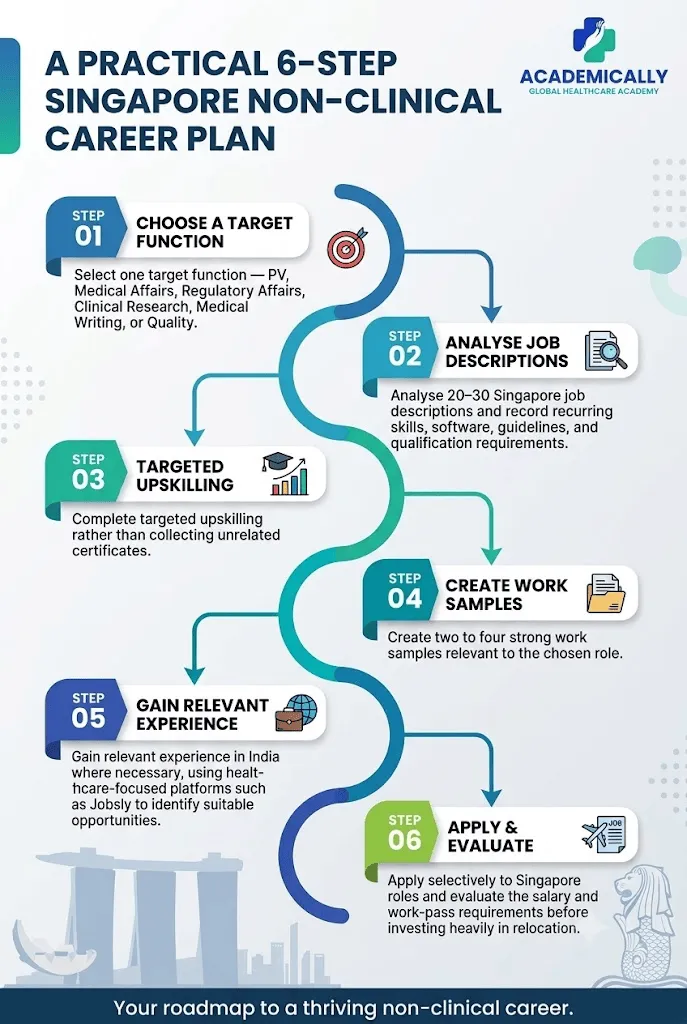
A Practical 6-Step Singapore Career Plan
Based on the discussion here is my 6-step career plan for people interested in pursuing non-clinical jobs in Singapore:
Final Thoughts
I believe you should view non-clinical pharma jobs in Singapore as an opportunity to leverage your pharmaceutical knowledge and not as an option to get away from pharmacy.
Singapore offers a strong pharmaceutical and biomedical ecosystem, but international candidates still need a realistic strategy. The combination that matters is not simply Indian degree + Singapore application.
It is relevant degree + specialised industry skills + demonstrable work + targeted applications + work-pass awareness.
That is the mindset I would carry into the Singapore job search. Your pharmacy degree can open the door. Your specialised skills, portfolio, experience and ability to understand the industry's expectations are what can help you move through it.