Healthcare is no longer limited to hospitals, clinics, and direct patient care. With the growth of pharmaceutical companies, clinical research organizations (CROs), health-tech companies, consulting firms, and global capability centres (GCCs), healthcare professionals can now build successful careers outside clinical practice.
For doctors, dentists, pharmacists, life-science graduates, and other healthcare professionals, one important question is: How much can you earn in non-clinical healthcare jobs in India compared with abroad?
The answer depends on several factors, including job role, experience, location, qualifications, employer, specialisation, and cost of living. While countries such as the USA, UK, and Australia generally offer higher salaries in absolute terms, India offers a growing life-sciences industry, lower living costs, and increasing opportunities in global organizations.
This guide compares non clinical jobs salary in India vs abroad in 2026, covering popular career options, salary ranges, influencing factors, and career opportunities.
Note: Salary figures are indicative of 2026 market ranges. Actual compensation can vary depending on the organization, experience, location, qualifications, specialisation, and benefits.
What Are Non-Clinical Healthcare Jobs?
Non-clinical healthcare jobs allow professionals to use their medical, scientific, or healthcare knowledge without primarily providing direct patient care.
Some popular non-clinical career options include:
- Medical Writing
- Pharmacovigilance
- Clinical Research
- Clinical Data Management
- Medical Affairs
- Regulatory Affairs
- Medical Science Liaison (MSL)
- Healthcare Operations
- Healthcare Consulting
- Medical Education
- Scientific Communications
- Public Health
- Health-Tech
These careers are particularly attractive to healthcare professionals who want to move away from routine clinical practice while continuing to use their healthcare expertise.
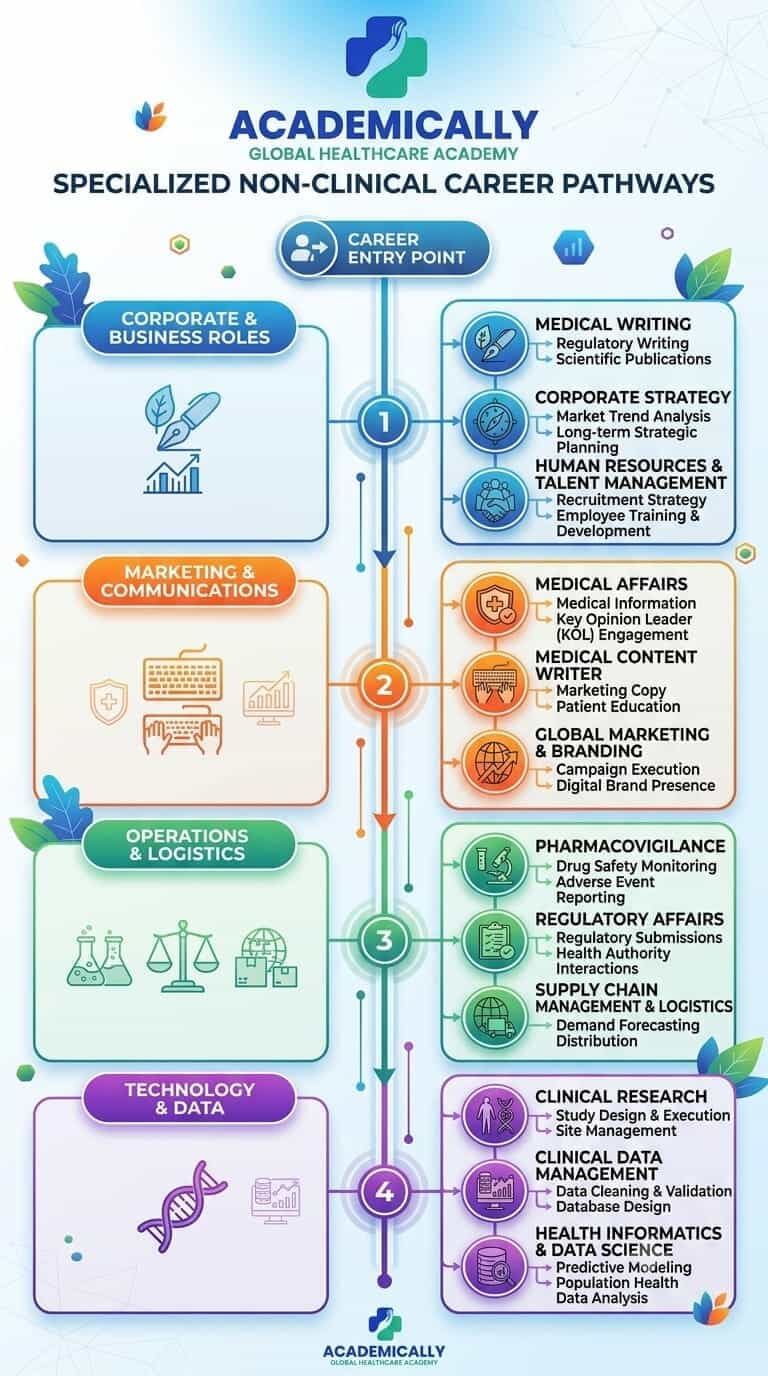
Non Clinical Jobs Salary in India vs Abroad
The salary gap between India and other countries can be substantial. However, a direct currency conversion does not provide a complete picture because living expenses, taxation, healthcare costs, and housing expenses differ considerably.
Non Clinical Jobs Salary in India
India's pharmaceutical, CRO, biotechnology, and healthcare technology sectors are expanding rapidly. Cities such as Pune, Bengaluru, Hyderabad, Mumbai, Gurugram, and Chennai have become important hubs for healthcare and life-sciences companies.
For entry-level professionals, non-clinical salaries may generally range between ₹3 lakh and ₹8 lakh per year, depending on the role and educational background.
With 3–5 years of experience, professionals can often move into the ₹7 lakh–₹18 lakh per year range. Specialized and managerial roles can exceed ₹20 lakh–₹30 lakh annually, with senior leadership positions potentially earning considerably more.
Non Clinical Jobs Salary in the USA
The USA is one of the highest-paying markets for specialized healthcare and life-sciences careers.
For example, Salary.com reported an average Clinical Data Manager salary of approximately $144,612 annually in August 2026, although compensation varies according to experience, location, and employer.
Technical writing can also provide a useful benchmark for medical-writing careers. The U.S. Bureau of Labor Statistics reports a median annual wage of $91,670 for technical writers in May 2024.
Specialized healthcare professionals with industry experience can therefore access significantly higher nominal salaries than comparable entry-level professionals in India.
Non Clinical Jobs Salary in the UK
The UK has an established pharmaceutical, clinical research, regulatory, and medical communications industry.
Indicative 2026 medical-writing salary ranges include:
| Experience | Approximate Salary (GBP) | Approx. Salary (USD) | Approx. Salary (INR) |
| Junior Medical Writer | £35,000–£45,000 | $47,744–$61,385 | ₹45.71–₹58.76 lakh |
| Medical Writer | £45,000–£60,000 | $61,385–$81,846 | ₹58.76–₹78.35 lakh |
| Senior Medical Writer | £60,000–£80,000 | $81,846–$109,128 | ₹78.35 lakh–₹1.04 crore |
| Lead/Manager | £80,000–£100,000 | $109,128–$136,410 | ₹1.04–₹1.31 crore |
| Principal/Director | £100,000–£140,000+ | $136,410–$190,974+ | ₹1.31–₹1.83 crore+ |
Actual compensation varies according to specialization, agency versus pharmaceutical employment, location, and experience.
Non Clinical Jobs Salary in Australia
Australia also offers opportunities in clinical research, healthcare management, medical writing, public health, health information management, pharmaceutical companies, and health technology.
Although salaries can be considerably higher than Indian salaries when converted into rupees, professionals should consider Australia's relatively high cost of living, particularly housing and transportation.
India vs Abroad: Non Clinical Healthcare Salary Comparison
The following table provides an indicative comparison of annual salary ranges.
| Job Role | India | USA | UK |
| Medical Writer | ₹4–15 LPA | $65K–$120K+ | £35K–£80K+ |
| Clinical Research | ₹4–15 LPA | $65K–$110K+ | £35K–£70K+ |
| Clinical Data Management | ₹4–20 LPA+ | $90K–$165K+ | £45K–£85K+ |
| Pharmacovigilance | ₹4–18 LPA | $70K–$120K+ | £40K–£80K+ |
| Regulatory Affairs | ₹5–20 LPA+ | $75K–$140K+ | £45K–£90K+ |
| Medical Affairs | ₹8–30 LPA+ | $100K–$180K+ | £60K–£120K+ |
| Medical Science Liaison | ₹12–35 LPA+ | $120K–$180K+ | £60K–£100K+ |
| Healthcare Consulting | ₹6–30 LPA+ | $80K–$170K+ | £50K–£110K+ |
Important: These figures are broad indicative ranges rather than standardized salary bands. The same job title can have very different responsibilities and compensation across organizations and countries.
Highest-Paying Non-Clinical Healthcare Jobs
1. Medical Affairs
Medical affairs is one of the attractive career paths for healthcare professionals interested in scientific communication, strategy, evidence generation, and collaboration with healthcare professionals.
Career growth may include:
Medical Advisor → Medical Affairs Manager → Senior Manager → Medical Director → Medical Affairs Director
As professionals gain therapeutic-area expertise and leadership experience, compensation can increase substantially.
2. Clinical Data Management
Clinical data management combines healthcare knowledge with data, technology, and clinical-trial processes.
Professionals may work on:
- Clinical database development
- Data validation
- Data cleaning
- Query management
- Clinical data review
- Database lock
- Regulatory-compliant data processes
Strong technical skills and knowledge of clinical data standards can improve career opportunities.
3. Medical Writing
Medical writing is a popular option for healthcare professionals who enjoy research and scientific communication.
Career areas include:
- Regulatory writing
- Clinical writing
- Publication writing
- Medical communications
- Scientific content
- Pharmacovigilance writing
- Medical education
Professionals who develop expertise in specialized forms of medical writing can progress from entry-level writer positions to senior, lead, and managerial roles.
4. Pharmacovigilance
Pharmacovigilance focuses on identifying, assessing, understanding, and preventing adverse effects and other safety-related problems associated with medicines.
Career progression can include:
Drug Safety Associate → Senior Associate → Specialist → Team Lead → Manager → Senior Manager
Specialization in areas such as signal detection, aggregate reporting, risk management, and safety surveillance can improve earning potential.
5. Regulatory Affairs
Regulatory professionals help pharmaceutical and healthcare organizations navigate regulatory requirements for medicines, medical devices, and other healthcare products.
Experience with regulatory submissions, compliance, and international regulatory frameworks can create opportunities with multinational organizations.
6. Healthcare Consulting
Healthcare consultants combine healthcare knowledge with business, analytical, and strategic skills.
They may work on:
- Market access
- Healthcare strategy
- Pharmaceutical commercialization
- Business development
- Healthcare operations
- Digital health
- Market research
An MBA, analytics skills, or consulting experience can strengthen career prospects.
Why Are Non Clinical Salaries Higher Abroad?
Several factors contribute to higher nominal salaries in countries such as the USA, UK, and Australia.
Higher Cost of Living
Higher salaries partly compensate for higher housing, transportation, insurance, and everyday expenses.
Mature Life-Sciences Markets
Countries with established pharmaceutical, biotechnology, clinical research, and healthcare industries have a large demand for specialized professionals.
Greater Industry Specialization
International organizations often have highly specialized positions requiring advanced technical and therapeutic expertise.
Higher Compensation Benchmarks
Multinational companies generally have different compensation structures based on local labor markets.
Does Higher Salary Abroad Mean Higher Savings?
Not always.
Suppose a professional earns ₹12 lakh annually in India while another earns the equivalent of ₹60 lakh abroad. It may initially appear that the international professional is earning five times more.
However, the second professional may have significantly higher:
- Rent or mortgage payments
- Income taxes
- Transportation costs
- Health insurance expenses
- Childcare expenses
- Food and utility costs
Therefore, professionals should compare net income and purchasing power, rather than simply converting foreign currency into Indian rupees.
Factors That Affect Non Clinical Jobs Salary
Experience
Experience remains one of the most important factors influencing salary. Fresh graduates typically start at lower salary levels, while professionals with specialized experience can move into higher-paying positions.
Educational Qualification
Degrees such as MBBS, BDS, PharmD, MPharm, MSc, MPH, MBA, and PhD can support different career pathways.
However, qualifications alone do not determine salary. Relevant experience and industry skills are equally important.
Specialization
Specialized skills can make professionals more competitive.
Examples include:
- Regulatory writing
- Clinical data standards
- SAS, R, or Python
- Pharmacovigilance
- Medical affairs
- Biostatistics
- Regulatory strategy
- Health economics
- Clinical trial management
Employer
Large pharmaceutical companies, multinational CROs, GCCs, consulting firms, and established health-tech companies may offer different salary structures compared with smaller organizations.
Location
Salary can vary significantly between cities within the same country.
In India, major life-sciences hubs include Pune, Bengaluru, Hyderabad, Mumbai, Gurugram, and Chennai.
Similarly, salaries abroad vary according to city and region.
India vs Abroad: Which Is Better for a Non-Clinical Career?
There is no single answer.
India may be better if you:
- Are beginning your non-clinical career.
- Want to gain industry experience.
- Prefer relatively lower living expenses.
- Want to remain close to family.
- Are targeting pharmaceutical companies, CROs, or GCCs.
- Want to transition from clinical practice without relocating internationally.
Abroad may be better if you:
- Already have specialized industry experience.
- Want access to mature global healthcare markets.
- Have the required qualifications and work authorization.
- Are comfortable with higher living expenses.
- Want international exposure and global career opportunities.
- Have a long-term plan to build an overseas career.
How Can You Increase Your Non Clinical Healthcare Salary?
Regardless of location, salary growth depends largely on the value of your skills.
Build Specialized Expertise
Instead of remaining a generalist, develop expertise in a specific area such as regulatory writing, clinical data management, pharmacovigilance, medical affairs, or health economics.
Develop Digital Skills
Healthcare is becoming increasingly data-driven. Skills in analytics, AI tools, data visualization, and relevant software can strengthen your profile.
Gain Industry Experience
Even one to three years of relevant industry experience can make a significant difference when applying for higher-level positions.
Improve Communication Skills
Strong written and verbal communication is particularly important in medical writing, medical affairs, consulting, clinical research, and regulatory roles.
Work With Global Teams
Experience collaborating with international teams can strengthen your profile for global positions and multinational organizations.
Consider Certifications
Relevant certifications in clinical research, pharmacovigilance, medical writing, regulatory affairs, data management, or project management can complement your healthcare degree.
Can Indian Doctors and Dentists Get Non-Clinical Jobs Abroad?
Yes. Healthcare professionals such as doctors and dentists can transition into non-clinical international roles, but the requirements depend on the position and country.
One advantage of non-clinical careers is that many positions do not require the same clinical licensing pathway as practicing medicine or dentistry. However, employers may still require relevant industry experience, academic qualifications, communication skills, work authorization, or knowledge of local regulations.
Potential international roles include:
- Medical Writer
- Clinical Research Associate
- Medical Affairs Professional
- Pharmacovigilance Specialist
- Regulatory Affairs Professional
- Clinical Data Professional
- Medical Communications Specialist
- Healthcare Consultant
- Public Health Professional
For professionals transitioning from clinical practice, building relevant non-clinical experience before applying internationally can be a practical strategy.
A Practical Career Path From India to Abroad
Healthcare professionals who want an international non-clinical career can consider the following pathway:
Healthcare degree → Entry-level non-clinical role → Build specialized expertise → Gain 2–5 years of experience → Work with global teams → Apply for international opportunities
This approach can help professionals understand industry workflows while developing a stronger international profile.
Conclusion
The growing demand for healthcare expertise outside hospitals and clinics is creating more opportunities for professionals who want to explore non-clinical careers. When comparing non clinical jobs salary in India vs abroad, international markets generally have an advantage in terms of nominal compensation. However, India's lower cost of living, expanding pharmaceutical and life-sciences ecosystem, and increasing number of global healthcare organizations make it an attractive starting point for many professionals. The most important factor is not simply where you work, but what specialized skills you develop. Whether your goal is medical writing, pharmacovigilance, clinical research, clinical data management, regulatory affairs, medical affairs, or healthcare consulting, investing in industry knowledge and transferable skills can help you build a sustainable and financially rewarding non-clinical healthcare career in 2026 and beyond.