A PhD in Pharmacology or Pharmaceutical Sciences often requires years of experiments, literature reviews, data interpretation, presentations, publications and problem solving. Yet after the thesis is submitted, one question can become surprisingly hard: "What can I actually do with this degree outside academia?”
I understand that uncertainty can come from a different perspective. I come from a healthcare background, and my own move to non-clinical healthcare work taught me that leaving a traditional path does not mean leaving healthcare behind. It means learning where my existing knowledge is useful in a way.
That is how I think about non-clinical jobs after a PhD in pharmacology. Your doctorate is not the end of your career options; it can be the foundation for roles across pharma, biotech, CROs, medical communications, drug safety, regulatory functions, evidence generation and healthcare consulting.
The important part is understanding how to translate PhD skills into industry skills.
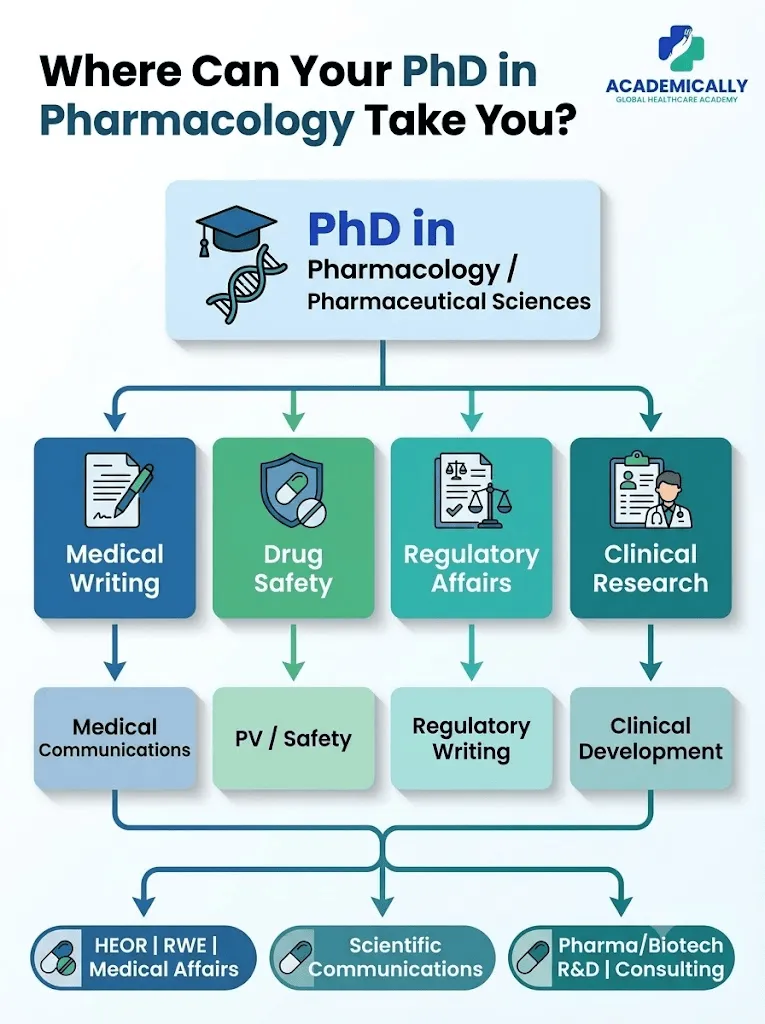
Why consider a non-clinical career after a PhD?
Academic research and industry work overlap, but they are not identical. A PhD may teach you how to design experiments, critically evaluate evidence, analyse data and defend scientific conclusions. A pharma employer may additionally expect you to require knowledge of:
- GCP
- regulatory documentation
- safety workflows
- medical communication
- stakeholder management or
- commercial priorities.
I would treat this as a positioning exercise: identify the function that matches your strengths then add the industry knowledge that the role demands.
Top non-clinical jobs after a PhD in Pharmacology or Pharma Sciences
1. Medical Writing and Scientific Writing
Medical writing is one of the clearest paths if you enjoy reading papers, interpreting scientific data and translating complex information into clear documents.
Depending on the employer, work can include:
- clinical study reports
- manuscripts
- scientific publications
- literature summaries
- regulatory documents
- educational content and
- other evidence-based communications.
One of the recent job listings of medical writing role at Syneos Health accept degrees in life sciences, pharmacy or medicine and value the ability to interpret clinical-trial data and understand standards such as ICH-GCP.

Your PhD can give you an advantage in scientific reasoning but writing samples still matters. I would build a small portfolio rather than assume the doctorate will speak for itself.
2. Pharmacovigilance and Drug Safety
A pharmacovigilance career allows you to work with medicines during and after development without providing direct patient care.
Roles can include:
- case processing
- adverse-event review
- literature monitoring
- signal detection
- aggregate reports
- safety surveillance and
- related compliance activities.
Sr. Associate, Pharmacovigilance Operations role at Amgen, Hyderabad lists key responsibilities such as:
- Conduct peer quality checks on authored safety sections.
- Coordinate Amgen review, resolve comments, and initiate approval workflows.
A pharmacology PhD is particularly valuable when the work becomes more scientifically interpretive. Knowledge of pharmacology, toxicology, mechanisms of action and adverse drug reactions can be useful while MedDRA, safety databases, SOPs and global regulations can make the profile more industry-ready.
3. Medical Affairs and Medical Science Liaison
Medical Affairs sits at the intersection of science, medicine and business. Depending on the position, you might contribute to:
- scientific strategy
- literature review
- medical content
- external expert engagement
- congress activities or
- evidence communication.
MSL roles can involve interaction with healthcare professionals and key opinion leaders so this route is ideal for those who enjoy scientific discussion rather than only desk-based research.
A Medical Science Liaison Oncology role at Takeda, Kolkata is a field based role connects with key opinion leaders and shares fare scientific data on Takeda Oncology products.

4. Clinical Research and Clinical Development
A PhD can also fit into roles supporting clinical development, particularly when the research background overlaps with pharmacology, biomarkers, translational science or a therapeutic area. Possible directions include:
- Clinical research
- study start-up
- clinical trial operations
- scientific project support
- clinical development and
- evidence-generation functions.
The research experience can help with protocol comprehension, scientific literature, data interpretation and documentation.
Jobslly lists Clinical Research Associate role at Sun Pharma, Mumbai where your duties will include site initiation, monitoring and close-out activities as well as training investigators on study protocols.

5. Regulatory Affairs and Regulatory Writing
Regulatory careers are built around accuracy, evidence and compliance which can align well with training.
Scientists may move into:
- regulatory strategy
- submissions support
- regulatory writing
- document authoring
- lifecycle management or
- regulatory intelligence.
Regulatory Publishing Specialist at Syneos Health. is currently a hybrid role is based in Gurugram or Hyderabad, focused on regulatory publishing for global submissions. As a Regulatory Publishing Specialist, you will perform assembler, publishing, and quality control tasks within electronic publishing systems.
This is something I often tell healthcare professionals: your degree may open the door, but role-specific skills determine whether you are ready to walk through it.
6. HEOR, Real-World Evidence and Market Access
If your interests are closer to data, evidence and healthcare decision‑making, explore Health Economics and Outcomes Research (HEOR), real‑world evidence and market‑access functions.
These teams may work with:
- literature reviews
- evidence synthesis
- outcomes data
- healthcare use
- economic models
- value communication and
- health‑technology‑assessment requirements.
An HEOR internship at Syneos Health listing explicitly accepts postgraduate degrees such as M.Pharm or a PhD in a discipline and includes database searches, systematic literature reviews and evidence‑report development.
This path can be particularly interesting for PhD holders who enjoy research but want their work to be more connected to real‑world healthcare decisions.
7. Medical Information and Scientific Communications
Medical Information professionals answer scientific questions using approved and evidence‑based sources. Scientific communications teams may support publications, congress materials, educational resources or internal scientific content.
These roles can suit PhD professionals who are strong at literature searching, evidence assessment and communication.
Jobslly’s current listings also show Global Consultant- Medical Affairs role at Inizio Ignite. As a Global Consultant you will collaborate with others to solve business problems for clients. You will look at data try out ideas and give guidance to senior client leaders. The role means helping clients put the suggestions you give into practice.
8. Pharma or Biotech R&D Beyond Academia
Non‑clinical does not have to mean "non‑research."
You can remain close to science through industry R&D roles in areas such as:
- drug discovery
- pharmacology
- toxicology
- assay development
- translational research
- formulation science
- bio analysis or
- preclinical research.
The exact fit depends heavily on your PhD subject, laboratory methods, publications, disease area and technical toolkit.
9. Consulting, Competitive Intelligence and Healthcare Analytics
A PhD can also translate into research-intensive consulting roles where the work involves market research, competitive intelligence, scientific landscape analysis, pipeline assessment or healthcare data.
I would consider this route when you enjoy answering strategic questions rather than running experiments yourself. Communication becomes just as important as scientific depth because your job is often to turn a large amount of information into a decision-ready insight.
Which Non-Clinical Career Fits Your PhD Profile?
| Career | Strongest PhD Skill | Typical Work | Best Suited If You Enjoy |
| Medical Writing | Scientific writing | Documents/content | Writing + literature |
| Pharmacovigilance | Pharmacology | Safety assessment | Drug safety |
| Medical Affairs | Scientific communication | Medical strategy | Networking |
| Clinical Research | Research methodology | Clinical studies | Trials |
| Regulatory Affairs | Documentation | Submissions/compliance | Precision |
| HEOR/RWE | Evidence synthesis | Outcomes research | Data + research |
| R&D | Experimental research | Drug discovery | Laboratory science |
| Consulting | Analytical thinking | Strategic research | Problem solving |
How to Choose the Right Non‑Clinical Path?
I find it easier to choose by asking what I would actually enjoy doing every day.
- If you love writing and literature review → explore scientific writing.
- If you enjoy reactions, medicine safety and structured case assessment → explore pharmacovigilance.
- If you enjoy conversations and external stakeholder interaction → explore Medical Affairs or MSL.
- If clinical‑trial methodology excites you → explore research or clinical development.
- If you naturally think about evidence outcomes and healthcare value → explore HEOR or real‑world evidence.
- If accuracy documentation and regulations appeal to you → explore affairs and regulatory writing.
- If you enjoy research but want to stay closer to laboratory science → explore pharma or biotech R&D.
What Skills to Add Before Applying for Non-Clinical Jobs?
I would build a “PhD + industry” profile rather than a “PhD only” profile.
Turn Your PhD Experience Into Industry-Ready Skills
| Academic Language | Industry Language |
| Literature review | Evidence Synthesis |
| Thesis research | Research project management |
| Experimental design | Protocol development |
| Data analysis | Scientific data interpretation |
| Publications | Scientific communication |
| Conference presentation | Stakeholder presentation |
| Research documentation | Regulatory/ quality documentation |
| Supervising juniors | Team coordination |
| Critical appraisal | Evidence-based decision making |
Building PhD+ Industry- based profile could mean:
- learning ICH‑GCP and clinical‑development fundamentals
- understanding pharmacovigilance workflows and MedDRA
- developing regulatory‑writing ability
- strengthening business communication or
- gaining exposure to literature‑review and evidence‑synthesis methods.
A focused certificate can help when it provides projects, mock interviews, mentor feedback and a better understanding of how the industry works.
Academically's Non‑Clinical Courses hub includes pathways such, as Medical Affairs/MSL, Clinical Drug Development, HEOR, Clinical Data Management, Medical Writing, Pharmacovigilance, Clinical Research and healthcare analytics. Its current programme information also states that eligible programmes provide job assistance and 180 CPD points upon completion.
From Clinical Pharmacy and Research to Pharmacovigilance: Salman Junaid’s Journey
Salman Junaid’s journey is a useful example of how healthcare professionals can redirect their scientific experience towards a non-clinical career. After exploring clinical pharmacy, clinical research and gaining international experience, he was looking for greater clarity about his next career move.
As Salman puts it, “After years of exploring different career paths across clinical pharmacy, clinical research, and international experience, I finally found the clarity I was searching for.”
His transition became more structured with support from Academically. Expert guidance, mock interviews and a practical capstone project helped him strengthen his skills and approach industry opportunities with greater confidence.
Within 30 days, Salman secured an offer as a Pharmacovigilance Associate at Oviya Medsafe with an 8 LPA package.
What stands out to me about Salman’s story is that his transition was not about starting from zero. His previous exposure to pharmacy and clinical research gave him a scientific foundation; targeted upskilling helped him connect that foundation to the requirements of an industry role.
For PhD professionals considering pharmacovigilance, this is an important takeaway: your academic and scientific background can be the starting point, but focused industry preparation can help translate that expertise into an employable profile.
How To Make Your PhD CV Industry‑Ready ?
This is one area where I would make a change.
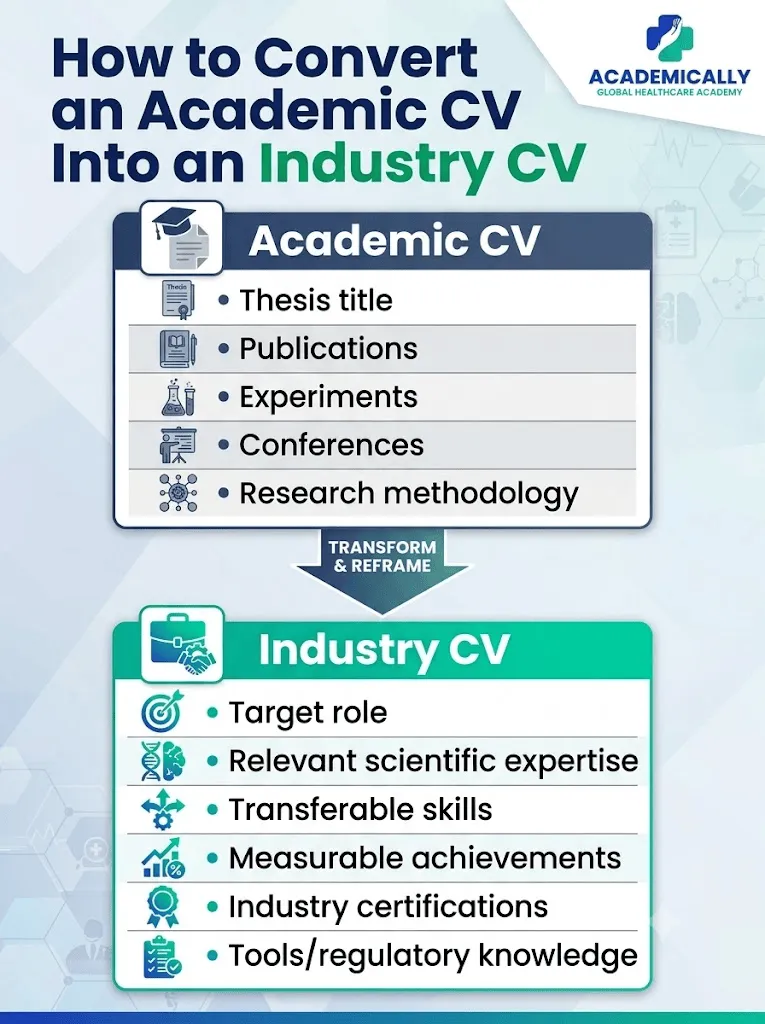
Do not describe your PhD only as thesis work. Reframe it around transferable outcomes.
| DO THIS | AVOID THIS |
| Designed and executed research protocols | Conducted experiments |
| Performed structured literature reviews and synthesised evidence | Read papers |
| Communicated scientific findings to technical audiences | Presented at conferences |
| Planned milestones, maintained documentation and coordinated research activities | Managed a project |
Keep publications, patents, techniques and therapeutic expertise. Tie them to the business or functional skills that the target role needs.
How To Find Right Non-Clinical Jobs?
Once you decide on your target function, the next challenge is to find job listings instead of applying for random jobs.
Jobslly is a healthcare‑focused job platform that gathers roles from pharma, CROs, health‑tech, Medical Affairs, pharmacovigilance, clinical research and other healthcare fields. Its current non‑clinical jobs section offers filters by category, job type and location while its listings cover roles in Medical Affairs, Pharmacovigilance and Clinical Data Management.
I would use the platform strategically: search by function first, then check qualifications, experience, location, work model and exact responsibilities before applying.
PhD Background
↓
Choose Career Path
↓
Identify Skill Gaps
↓
Academically Upskilling
↓
Build CV + Portfolio
↓
Search Relevant Roles
↓
Jobslly
↓
Apply + Network
↓
Interview Prep
↓
Non-Clinical Career
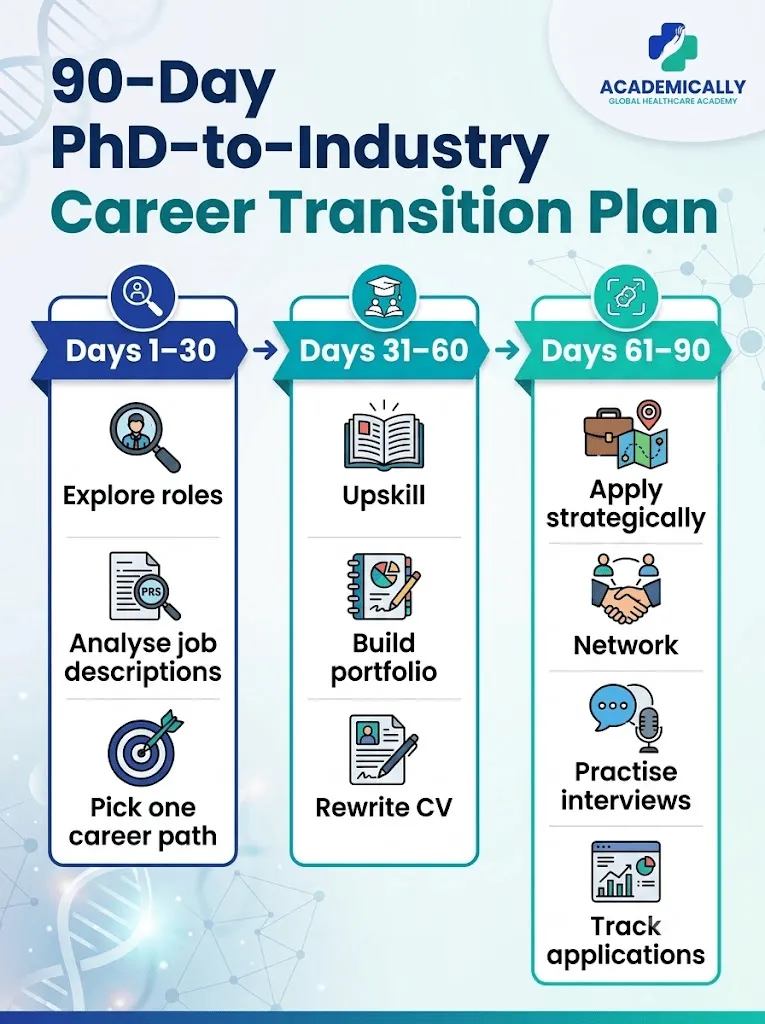
90 Day PhD to Industry Career Transition Pathway
To Conclude With...
A PhD in Pharmacology or Pharma Sciences is a deep scientific credential but it does not lock you into a university laboratory. Your expertise can go into:
- drug safety
- medical writing
- medical affairs
- clinical development
- regulatory affairs
- HEOR
- scientific communications
- R&D and healthcare strategy.
My own healthcare career transition taught me that leaving a path does not mean leaving healthcare behind. It means learning where your current knowledge is useful in a way. That is the mindset I would bring into a PhD‑to‑industry transition.
Do not ask only "What jobs can I get with my PhD?" Ask, "Which problems can my scientific training help a company solve and what extra skills will prove that I can solve them?”
That question will lead you closer, to a career path that matches your scientific strengths and the kind of work you really want to do.