New Zealand has unveiled one of its biggest dental registration reforms in years, introducing three new registration pathways for eligible foreign dentists from 1 November 2026. The announcement has generated significant buzz across netizens and healthcare professionals across the globe, with many claiming it has created a direct route for all international dentists to practise in New Zealand. But is that really the case? If you're an Indian BDS or MDS graduate planning an international dental career, understanding what has changed and what hasn't/could save you years of time, effort and unnecessary expenses.
In this blog, we'll break down New Zealand's three new registration pathways, explain who is actually eligible, clarify the common misconceptions circulating online, and know what these reforms mean for dentists aspiring to build a career in New Zealand.
Why Has New Zealand Introduced New Dental Registration Pathways?
Like many developed healthcare systems, New Zealand is experiencing persistent workforce shortages in dentistry, particularly outside major urban centres. According to Health New Zealand's 2024 Health Workforce Plan, the country currently has a shortage of approximately 380 dentists and dental or oral surgeons. It is equivalent to 15.1% of its workforce need and is projected to face a further shortage of 280 dentists by 2033 if current workforce trends continue.
At the same time, the Dental Council recognised that many internationally trained dentists who had already demonstrated competence within highly regulated healthcare systems were required to undergo lengthy registration processes before practising in New Zealand.
To address this, the Council conducted a public consultation on proposed registration reforms and, following stakeholder feedback, approved three new registration pathways that strike a balance between improving workforce mobility and maintaining patient safety.
These pathways will officially open for applications on 1 November 2026, with online application systems becoming available from that date. Unlike traditional examination-based routes, these pathways recognise professional registration and clinical experience already gained in jurisdictions with comparable regulatory standards.
However, eligibility remains carefully controlled to ensure practitioners entering the New Zealand healthcare system continue to meet the country's professional and ethical standards.
At a Glance: New Changes for Dental Registration Pathways in New Zealand
From November 2026, overseas-trained dental professionals may become eligible through one of three newly introduced registration pathways:
| Registration Pathway | Who It Is Designed For | Independent Clinical Practice? |
| Competent Authority Registration Pathway | Dentists and oral health practitioners already fully registered with recognised competent authorities | Yes (after meeting oversight requirements) |
| Comparable Health System Pathway | General dentists registered in recognised comparable healthcare systems | Yes (after supervised practice requirements) |
| Teaching and Research Scope of Practice | Overseas academics employed by New Zealand tertiary institutions | No – limited to teaching and research |
Each pathway has different eligibility criteria, registration conditions and supervision requirements, making it important for applicants to understand which route best matches their qualifications and professional experience.
Understanding the Three New Dental Registration Pathways of New Zealand
1. Competent Authority Registration Pathway
The Competent Authority pathway is expected to be the most important reform for internationally qualified dentists already practising in countries with highly developed regulatory systems.
Rather than requiring eligible practitioners to repeat extensive competency assessments, the Dental Council recognises that certain overseas regulators already maintain professional standards comparable to New Zealand. This pathway applies to practitioners who:
- Hold current, full, unrestricted and unconditional registration with a recognised competent authority.
- Meet the required clinical practice experience.
- Apply within a recognised scope of practice.
Importantly, this pathway is available for more than just general dentists. It also covers several oral health professions, including recognised dental specialists, oral health therapists, dental hygienists, dental therapists, dental technicians, clinical dental technicians and orthodontic auxiliaries, subject to profession-specific eligibility criteria.
Recognised Competent Authorities
The Dental Council currently recognises registration authorities from:
- Australia (Australian Health Practitioner Regulation Agency- AHPRA and Dental Board of Australia- DBA)
- United Kingdom (General Dental Council)
- Ireland (Dental Council of Ireland)
- Canada (Commission on Dental Accreditation of Canada, Canadian provincial regulators and NDEB)
- United States (Commission on Dental Accreditation and State Dental Boards)
These regulators have been recognised because their accreditation systems, professional standards, competence assessments and ongoing regulatory oversight closely align with New Zealand's expectations.
Clinical Practice Requirements
Holding registration alone is not enough. Applicants must also demonstrate recent clinical practice. For general dentists, the Council requires:
- at least 33 months of clinical practice,
- working 20 hours or more per week,
- completed within the 48 months immediately before applying.
Specialists and other oral health practitioners have different experience requirements depending on their scope of practice.
2. Comparable Health System Registration Pathway
The second pathway expands eligibility to dentists registered in healthcare systems that, while not classified as competent authorities, have healthcare infrastructure and regulatory frameworks considered comparable to New Zealand. Unlike the Competent Authority pathway, this route currently applies specifically to general dentistry.
Applicants must hold:
- full and unconditional general dentistry registration,
- recent clinical experience,
- registration from a recognised comparable health system.
Recognised Comparable Health Systems
The current list includes countries such as:
- Austria
- Belgium
- Czech Republic
- Denmark
- Finland
- France
- Germany
- Greece
- Hong Kong
- Iceland
- Israel
- Italy
- Japan
- Netherlands
- Norway
- Portugal
- Republic of Korea
- Singapore
- Spain
- Sweden
- Switzerland
These countries have been assessed by the Dental Council as having healthcare infrastructure, regulatory oversight and professional standards comparable to New Zealand's system.
Applicants under this pathway must also complete 33 months of clinical practice (20 hours or more per week) during the previous 48 months before submitting their application. Practice experience gained under a recognised Competent Authority may also count towards this requirement where applicable.
3. Teaching and Research Scope of Practice
The third pathway has a very different purpose. Rather than supporting clinical workforce recruitment, it enables overseas dental academics to contribute to New Zealand's education sector. Under this pathway, practitioners may receive limited registration if they:
- hold recognised overseas registration,
- receive a confirmed employment offer from a New Zealand tertiary education institution,
- will deliver clinical teaching, learning or research for accredited oral health programmes.
However, there is one critical limitation. Practitioners registered through this route cannot independently manage patients or establish their own clinical practice. Their registration remains restricted to teaching and research activities under institutional supervision.
For universities seeking experienced international faculty, this pathway provides greater flexibility while ensuring public safety remains protected.
What Do These Changes Mean for Indian BDS and MDS Graduates?
This is perhaps the most important question and unfortunately, it's also where most of the misinformation online begins.
Since the announcement of New Zealand's new registration pathways, many social media posts have implied that Indian BDS graduates can now directly register and work as dentists in New Zealand. While this interpretation has generated excitement, it is not supported by the Dental Council's eligibility criteria.
The Competent Authority Registration Pathway is specifically designed for practitioners who already hold full, unrestricted and unconditional registration with a recognised competent authority such as Australia, the UK, Ireland, Canada or the United States.
Similarly, the Comparable Health System Pathway is only available to dentists registered in countries that the Dental Council has formally recognised as having comparable healthcare and regulatory systems. India is not included in the current list of recognised comparable health systems.
The Teaching and Research Pathway also does not provide a direct route to independent clinical practice. Applicants must already hold recognised overseas registration and secure employment with a New Zealand tertiary education institution. Even then, they are restricted to teaching and research activities and cannot manage their own patients.
This distinction noting that these reforms are not new doors for fresh BDS graduates, but rather streamlined pathways for dentists who are already registered and practising in recognised jurisdictions. In simple terms, if you are registered only in India today, these three new pathways do not provide immediate eligibility for registration in New Zealand. That may sound disappointing initially, but it leads to an even more valuable opportunity.
One License, Two Countries: How Australia Meddles in Between?
While the reforms do not create a direct pathway for Indian dentists, they significantly strengthen an already popular international career strategy.
For many foreign dentists, especially those from India, Australia has long been one of the preferred destinations because of its structured licensing system, high demand for dentists, attractive salaries and long-term career opportunities.
Now, thanks to New Zealand's Competent Authority pathway, Australian registration may also become the foundation for practising in New Zealand. A long-term pathway could look like this:
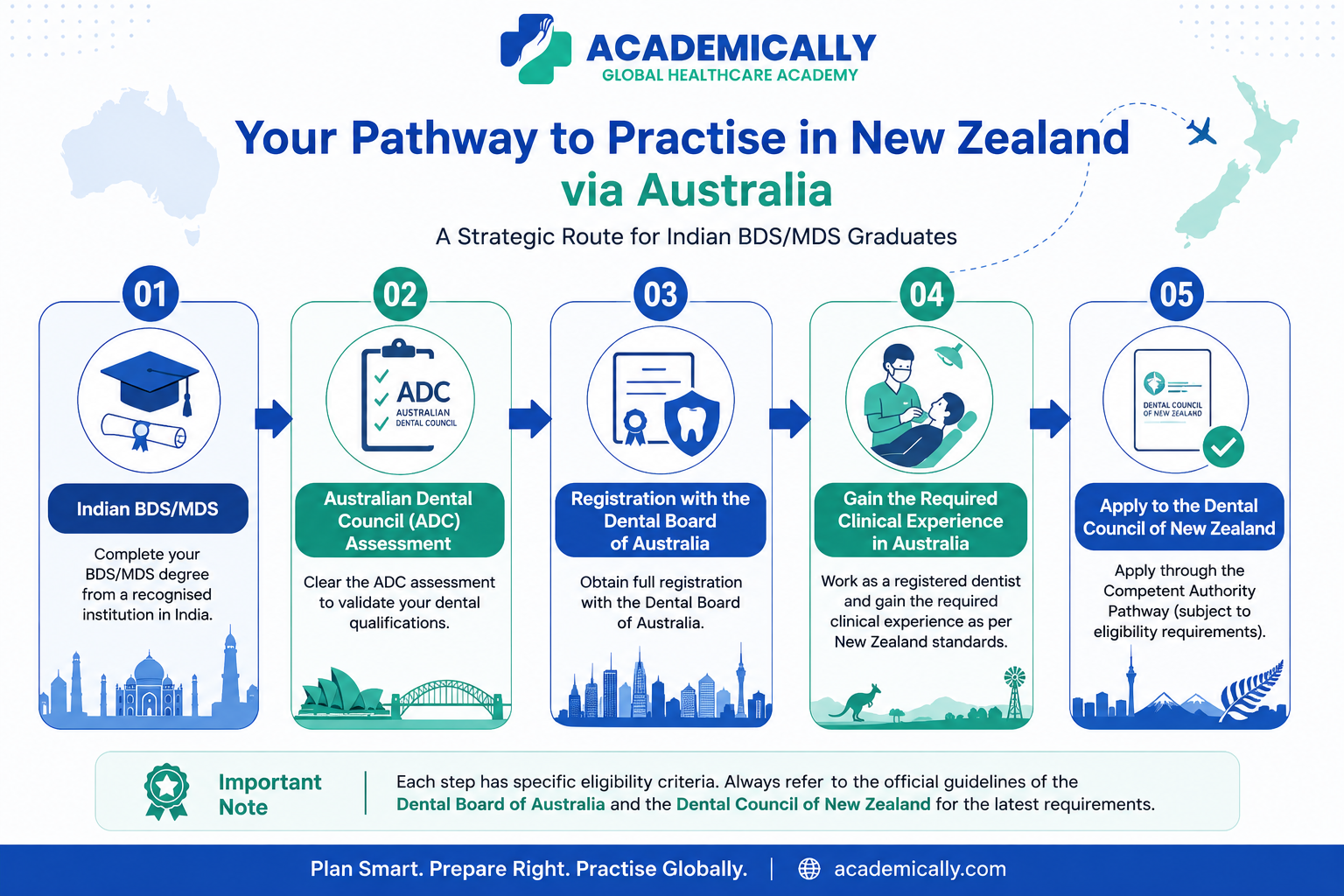
This is one of the most significant practical implications of the 2026 reforms. Instead of viewing Australia and New Zealand as two completely separate licensing journeys, eligible dentists can now plan a more integrated international career.
As Dr. Akram Ahmad (International Healthcare Career Coach, Founder & CEO, Academically) explains, Australia has effectively become a gateway to two countries instead of one, provided applicants satisfy New Zealand's practice experience requirements. This update adds considerable long-term value to their investment in Australian registration for Indian dentists who are already preparing for the Australian Dental Council (ADC) examinations.
Requirements for Independent Dental Practice for Overseas BDS/MDS Graduates and Professional Dentists
Another important aspect often overlooked in social media discussions is that successful registration under these pathways comes with transition requirements. The Dental Council has introduced structured oversight and supervision programmes to ensure overseas practitioners become familiar with New Zealand's healthcare system, clinical standards and regulatory expectations. Under the Competent Authority Pathway, practitioners must complete:
- A Dental Practice in New Zealand orientation module.
- Six months of practice under the oversight of a Council-approved practitioner.
- Regular oversight reports.
- A final recommendation confirming satisfactory completion of the programme.
Once these requirements have been successfully completed and approved by the Council, the registration conditions may be removed.
Under the Comparable Health System Pathway, applicants must complete:
- The same orientation programme.
- Twelve months of direct onsite supervision.
- Monthly supervisor reports.
- A final recommendation before practising independently.
These requirements demonstrate that while the pathways are streamlined, they are by no means automatic. Patient safety remains at the centre of New Zealand's registration framework.
Benefits of New Changes of Dental Registration Pathways
The reforms are particularly advantageous for dentists who have already established careers in recognised jurisdictions. This includes:
- Australian-registered dentists
- UK General Dental Council (GDC) registrants
- Canadian dentists registered through recognised provincial regulators
- Dentists licensed in the United States
- Irish-registered dentists
- Eligible dental specialists and allied oral health professionals meeting the Council's experience requirements
For these practitioners, the new pathways reduce unnecessary duplication in competency assessments while recognising existing professional experience.
Common Misconceptions About the New Registration Pathways
Myth 1: Every overseas dentist can now register directly in New Zealand.
Reality: Eligibility depends on recognised overseas registration, professional standing and clinical experience. These pathways are not open to every internationally qualified dentist.
Myth 2: Indian BDS registration is now accepted.
Reality: Registration with the Dental Council of India alone does not satisfy the eligibility requirements for either the Competent Authority or Comparable Health System pathways.
Myth 3: No clinical experience is required.
Reality: Both major registration pathways require substantial recent clinical practice before an application can be considered.
Myth 4: Teaching and Research registration allows private clinical practice.
Reality: This pathway does not permit independent patient care and remains limited to teaching and research within approved institutions.
When is the Best Time to Move to New Zealand and Practice as a Dentist?
The biggest lesson from New Zealand's latest reforms is that career planning should be based on long-term strategy, not just viral news headlines.
If your ultimate goal is to practise in New Zealand, the most efficient pathway may involve building recognised registration in another jurisdiction first. For many internationally qualified dentists, Australia continues to be one of the most practical and structured options because it offers a transparent licensing process through the Australian Dental Council (ADC), strong employment prospects and, following these reforms, the potential to become a recognised stepping stone towards New Zealand registration.
Rather than asking, "Can I move directly to New Zealand?", a better question is:
"Which registration pathway today will create the greatest opportunities for my career over the next five to ten years?"
Thinking strategically can save significant time, cost and unnecessary examination attempts while opening doors across multiple healthcare systems.
How a Structured Preparation Can Help You Become a Dentist in New Zealand
Successfully navigating international dental registration requires more than simply passing an examination. It requires choosing the right pathway from the very beginning.
Academically's Australian Dental Council (ADC) Exam Preparation Programme is designed to help dental candidates prepare confidently for every stage of the ADC assessment process. The programme includes online classes by ADC-qualified, AHPRA registered faculties, structured study plans, mock assessments, mentorship and personalised guidance from experienced faculty familiar with international licensing requirements.
Beyond exam preparation, Academically also provides one-to-one career counselling, helping dentists evaluate their eligibility, compare international licensing pathways and develop personalised career roadmaps based on their long-term goals. Whether your destination is Australia or New Zealand, having the right guidance can help you avoid costly mistakes and make informed decisions at every stage of your journey.
To Conclude with...
The introduction of three new registration pathways from 1 November 2026 marks an important evolution in New Zealand's approach to recognising experienced overseas dental professionals. By acknowledging registration and clinical experience gained in trusted healthcare systems, the Dental Council has created more efficient pathways while maintaining high standards of patient safety and professional competence.
For internationally qualified dentists, the announcement should be seen as an opportunity, but also as a reminder that eligibility matters. These reforms are not a shortcut to registration for every overseas graduate. Instead, they reward dentists who have already established themselves within recognised regulatory systems.
For Indian BDS, MDS graduates, the update reinforces the importance of strategic career planning. Building recognised registration through pathways such as the Australian Dental Council (ADC) may now provide access not only to Australia's thriving dental workforce but also to future opportunities in New Zealand through the Competent Authority pathway, provided all registration and practice requirements are met.
As regulations continue to evolve, staying informed through official sources and seeking expert guidance will remain the best way to build a successful international dental career.