Why I keep getting this question
“Dr. Akram, I finished my BDS two years ago. I don't enjoy clinical practice. Can I really become an Medical Advisor or MSL, or is that only for MBBS, PharmD or PhD people?”
I receive some version of that message almost every week. Sometimes it is a fresh BDS graduate. Sometimes it is an MDS with a gold medal who has realised, quietly and a little guiltily, that the chair is not where they want to spend the next thirty years.
I want to answer it here properly, because most of the advice online is either falsely encouraging or dismissively negative. The truth is in between, and the truth is genuinely good news, provided you understand how the industry actually hires.
So this article is not a sales page. It is the answer I would give you if you called me.
What does a Medical Science Liaison actually do?
An MSL is a field-based scientific expert. You are not selling anything- that distinction is legal, cultural and absolute inside a pharmaceutical company. Your job is scientific exchange: meeting senior specialists (Key Opinion Leaders), discussing clinical evidence, understanding what the medical community is thinking, and carrying those insights back into the company.
A typical MSL week
- Two to three days in the field meeting clinicians, often across a region or state
- Presenting new clinical trial data and answering high-level scientific questions
- Capturing and documenting medical insights for the company's medical strategy
- Supporting investigator-initiated studies, advisory boards and conferences
- Internal calls with medical, regulatory and safety colleagues
An MSL is the scientific face of the company to the medical community. If you enjoyed explaining treatment options to patients and discussing cases with colleagues, this role uses exactly that muscle at a much higher scientific level.
What does a Medical Advisor do?
A Medical Advisor is the internal scientific authority for a brand or therapy area. Where the MSL is outward-facing, the Advisor is strategic and largely office-based: owning the medical plan, reviewing promotional and scientific material for accuracy and compliance, guiding evidence generation, and acting as the medical conscience of the commercial team.
A typical Medical Advisor week
- Building and executing the medical strategy for a product or therapy area
- Reviewing and approving promotional materials for scientific accuracy and compliance
- Designing and supporting evidence-generation activities and publications
- Training the field team on the science; answering escalated medical queries
- Working with regulatory, safety, market access and marketing colleagues
MSL vs Medical Advisor- which suits you?
| Factor | Medical Science Liaison (MSL) | Medical Advisor |
|---|---|---|
| Nature of work | Field-based, external, relationship-driven | Office/hybrid, internal, strategy-driven |
| Travel | High - often 40–60% of your time | Low to moderate |
| Core skill | Scientific communication and KOL engagement | Medical strategy, review and compliance |
| Entry point | Sometimes accessible after 1-3 yrs industry experience | Usually mid-level; rarely a first industry role |
| Personality fit | Outgoing, enjoys meeting specialists | Analytical, enjoys planning and detail |
| Indicative entry salary | ₹8–14 LPA | ₹10–16 LPA |
| Typical next step | Senior MSL → MSL Manager → Medical Affairs Lead | Senior Advisor → Medical Manager → Director |
If you loved chairside conversation and building rapport with patients and referring doctors, you will probably enjoy the MSL role. If you preferred the intellectual side- reading, planning treatment protocols, getting details exactly right, Medical Advisor will suit you better.
Can a BDS or MDS really get these roles? The honest answer
Yes, with three important qualifications that I would rather you hear from me now than discover after six months of rejected applications.
- In India, BDS is widely accepted. A large share of Indian MSL and Medical Affairs advertisements list BDS alongside MBBS, PharmD, M.Pharm and PhD. Your degree qualifies you on paper.
- These are usually not fresher roles. For specialised therapy areas- oncology, immunology, rare disease - many employers prefer MBBS, MD, PharmD or PhD. Dentists do get hired, but more often after building industry credibility first.
An MDS strengthens your case meaningfully - you have a recognised specialisation, a thesis, literature-review experience and usually presentation experience. Those map directly onto what Medical Affairs measures.
Where dentists actually enter the industry
This chart is the single most useful thing in this article. It shows the realistic first roles for dental graduates and why aiming straight at MSL is the most common strategic mistake I see.
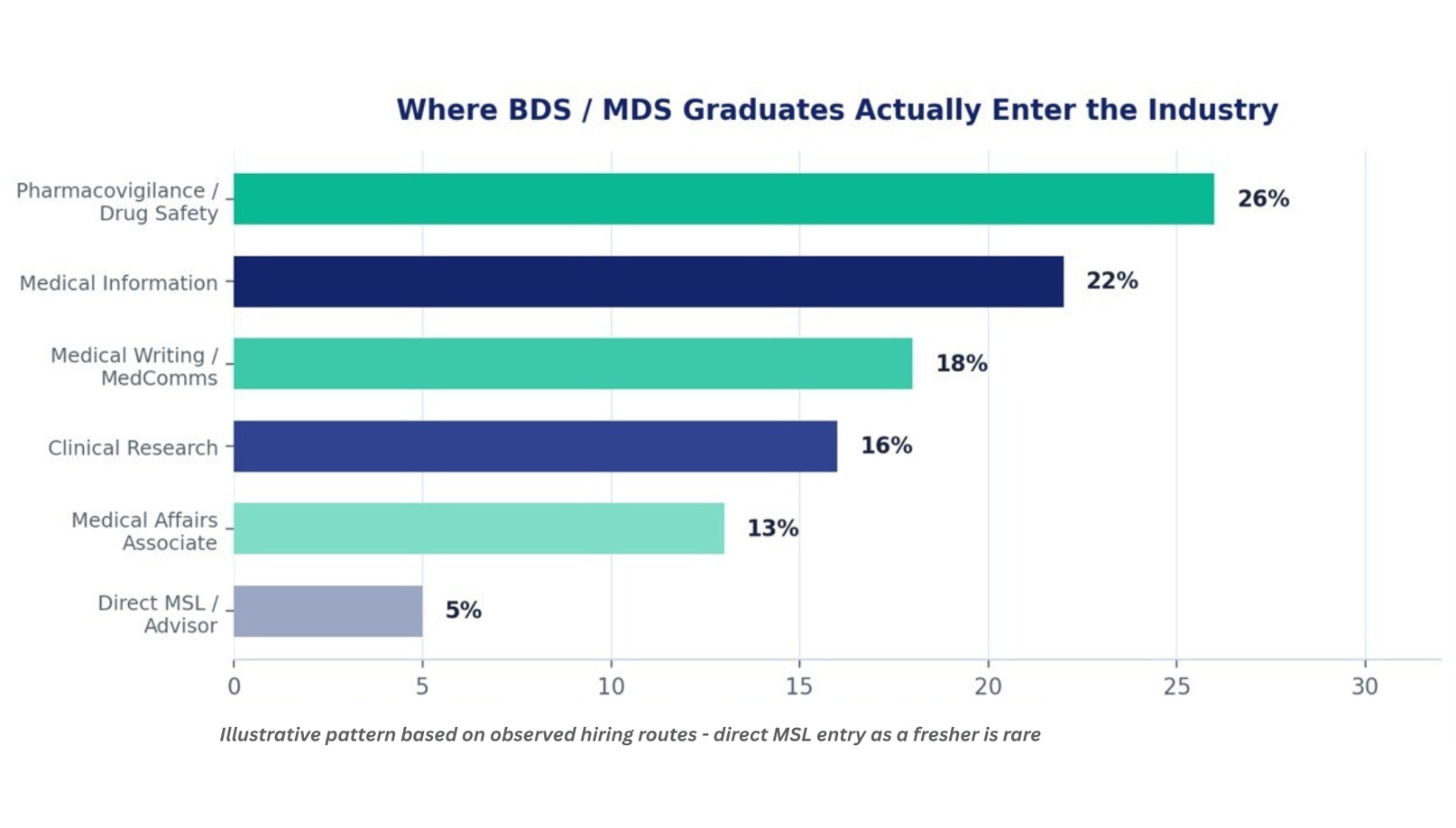
Direct MSL entry as a fresher accounts for a small minority of dental transitions. Most people arrive via another door.
Read that chart as a route map, not a rejection. Pharmacovigilance, medical information and medical writing are not consolation prizes, they are the on-ramps. Once you are inside the industry with a therapy area and a track record, the MSL conversation becomes a completely different one.
Salary and growth potential
Let us talk about money honestly, with ranges rather than headline numbers.
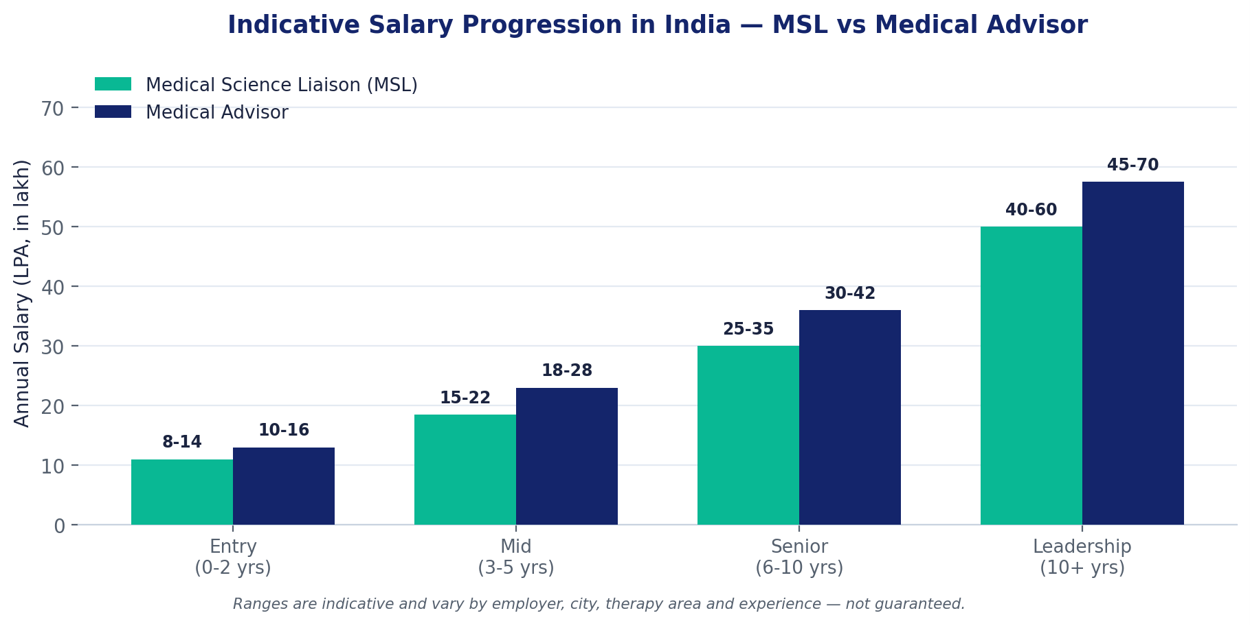
Indicative salary progression in India. Figures vary widely by employer, city, therapy area and experience.
Detailed salary table (India, indicative)
| Experience | MSL | Medical Advisor | Notes |
|---|---|---|---|
| Entry (0–2 yrs) | ₹8–14 LPA | ₹10–16 LPA | Usually after prior industry exposure |
| Mid (3–5 yrs) | ₹15–22 LPA | ₹18–28 LPA | Therapy-area specialisation begins to pay |
| Senior (6–10 yrs) | ₹25–35 LPA | ₹30–42 LPA | Senior MSL / Medical Manager |
| Leadership (10+ yrs) | ₹40–60 LPA | ₹45–70 LPA | MSL Lead, Medical Affairs Head |
⚠ Please treat these as indicative ranges, not promises. I have seen genuine offers above and below every band here. Anyone guaranteeing a fresher a fixed ₹20 LPA package is selling you something, not advising you.
Global snapshot (mid-level, indicative)
| Country | Typical mid-level range | Note for dentists |
|---|---|---|
| India | ₹15–28 LPA | BDS widely accepted for MSL roles |
| UAE / Gulf | AED 180,000–350,000 | Growing Medical Affairs market |
| Australia | AUD 110,000–170,000 | MSL often expects advanced degree |
| United Kingdom | £45,000–75,000 | MD / PharmD / PhD frequently preferred |
| United States | US$110,000–170,000 | PharmD / MD / PhD usually required |
| Singapore | SGD 90,000–150,000 | Regional hub roles |
| Saudi Arabia | SAR 200,000–380,000 | Expanding pharma presence |
Overseas figures depend heavily on visa status, local qualification requirements and the specific employer. Use them for direction, not for planning a move.
The career ladder, what growth actually looks like
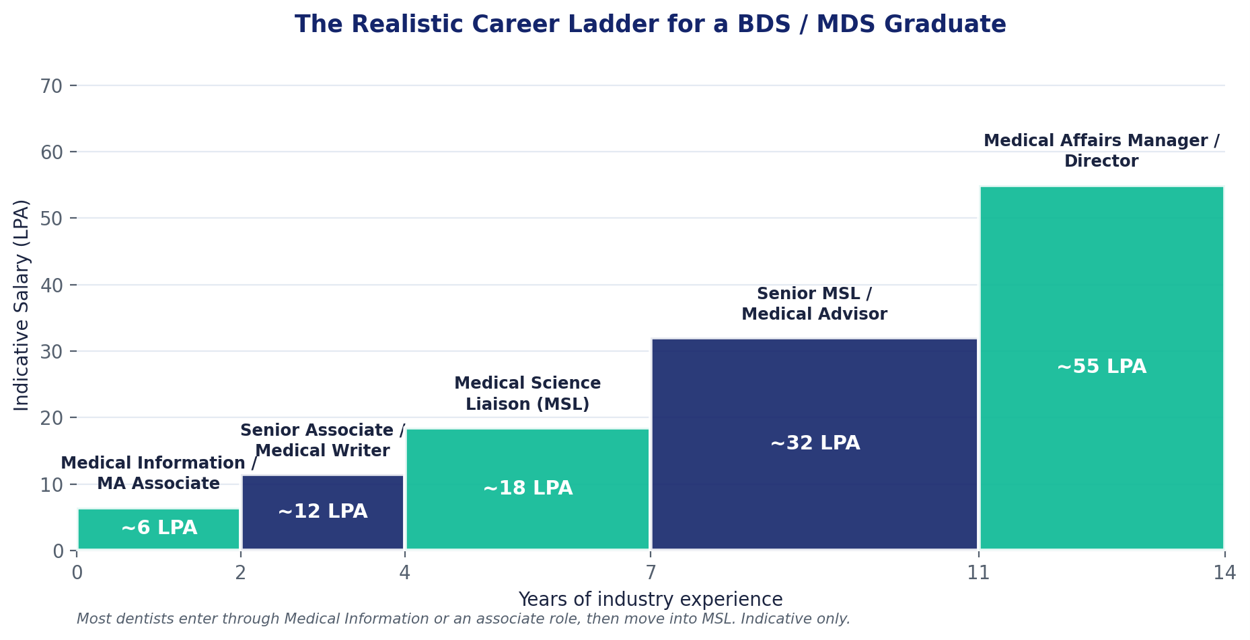
A realistic ten-year trajectory. The early steps matter more than they look - they buy you the therapy-area credibility that unlocks everything after.
Notice the shape of that curve. The first two years look modest, and that is precisely where most people give up or never start. But the slope from year four onward is steep, and it is steep because of what you built in those first two years: industry vocabulary, a therapy area, a network and a track record.
The skills that decide selection
| Skill | Why it decides the outcome |
|---|---|
| Scientific communication | You must explain complex clinical data clearly to a specialist who knows more than you about their field |
| Literature evaluation | Study design, endpoints, statistics literacy and critical appraisal |
| Therapy-area depth | Employers hire for a therapy area, not a generic ‘Medical Affairs’ profile |
| KOL engagement | Planning, conducting and documenting scientific exchange - professionally and compliantly |
| Clinical trials & ICH-GCP | The vocabulary of evidence generation |
| Compliance awareness | Knowing precisely where the line between medical and promotional activity sits |
| Industry tools | Veeva Vault, MedDRA and Argus - named in a large share of job descriptions |
| Presentation & presence | You will present to senior clinicians; confidence is assessed in the interview itself |
Why clinically excellent dentists get rejected
I have sat on the other side of the table for a lot of these interviews. Almost nobody is rejected for lack of clinical knowledge. Here is what actually goes wrong:
- A clinical CV. A document listing extractions, RCTs and OPD numbers means nothing to a pharma recruiter — and an applicant tracking system will filter it out before any human reads it.
- A LinkedIn profile that just says ‘Dentist’. A great deal of Medical Affairs recruitment starts with a LinkedIn keyword search. If your profile does not contain the words, you do not exist.
- Confusing an MSL with a medical representative. This is the fastest rejection in the industry. If you cannot articulate why an MSL is non-promotional, the interview is effectively over.
- No therapy area. ‘I am interested in Medical Affairs’ is not a candidacy. ‘I have built depth in pain and inflammation’ is.
- Untrained interview performance. Corporate interviews test structured thinking and scenario handling. Dental school never taught you that, and it shows unless you practise.
- No network. A large share of these roles move through referrals. Cold applications alone are the slowest possible route.
Knowledge gets you shortlisted. Preparation gets you hired. That gap is the whole game.
Do you need a course? My honest position
No. There is no legal or mandatory certification required to work as an MSL or Medical Advisor. Companies hire on competence, communication and scientific judgement. If you already work in the pharmaceutical industry, you may do not need a programme at all.
If you are a fresher or coming straight from clinical practice, my answer is usually different - not because of the certificate, but because of what structured preparation forces you to build: the vocabulary, a rewritten CV, an optimised profile, a therapy area, and rehearsed interview performance.
And I will say the uncomfortable part plainly: a certificate alone will not get you a job. If a programme offers recorded lectures and a PDF at the end, it will not close the gap that is actually costing you interviews. Judge any programme - mine or anyone else's - on industry-led faculty, real case studies, resume and LinkedIn work, mock interviews, mentoring and genuine placement support.
Your roadmap: BDS to MSL in three moves
| Phase | Timeline | What you do |
|---|---|---|
| 1. Get in | Months 0–6 | Pick a realistic entry role (medical information, drug safety, medical writing). Learn the tools. Rewrite your CV in industry language. Rebuild LinkedIn. Prepare and practise interviews. |
| 2. Build depth | Years 1–3 | Choose a therapy area and go deep. Take on scientific writing, literature reviews, cross-functional projects. Build internal visibility and a genuine network. |
| 3. Make the move | Years 2–4 | Apply internally first - most MSL hires come from within. Use your therapy-area credibility. Target Medical Advisor next, or grow the MSL track. |
Therapy areas that suit dentists particularly well: pain and inflammation, anti-infectives, oral health, bone health and maxillofacial. Starting where your clinical credibility is real makes your first conversation far more convincing.
Who hires MSLs and Medical Advisors in India
| Category | Examples |
|---|---|
| Multinational pharma | GSK, Pfizer, Novartis, AstraZeneca, Sanofi, MSD, Novo Nordisk |
| Indian pharma | Sun Pharma, Cipla, Dr. Reddy's, Lupin, Torrent, Alkem, Mankind |
| Biotech & specialty | Biocon, Intas, Emcure and similar organisations |
| CROs & medcomms | IQVIA, Indegene, ICON, Parexel and medical communications agencies |
| Medical device & oral care | Dental, implant and oral-care companies - where a dental degree is a direct advantage |
These names illustrate the categories that hire Medical Affairs talent. They do not imply endorsement or any current vacancy.
A closing word
If you are a dentist reading this at the end of a long clinical day, wondering whether you have wasted five or eight years - you have not. Your degree is the reason the industry will consider you at all. What you are missing is not knowledge. It is translation: turning what you already know into the language that recruiters, hiring managers and Key Opinion Leaders speak.
That is a learnable, finite gap. I have watched a lot of people close it.
Your first industry job is not the finish line. It is the beginning of your professional journey.
Where to go next
If Medical Affairs and MSL roles are where you want to be, look at the Executive Programme in Medical Affairs / Medical Science Liaison at Academically built around industry-led teaching, real case studies, resume and LinkedIn work, mock interviews, mentoring and placement assistance. If drug safety or clinical research feels like the better first door, the Executive Programme in Clinical Drug Development is the more relevant route. And whichever path you choose, browse live non-clinical roles on Jobslly to see exactly what employers are asking for right now.
⚠ An honest note I will always repeat: no ethical organisation can guarantee you a job. What good preparation can do is substantially improve your readiness, visibility and confidence, which is what actually decides outcomes.