Healthcare professionals who want to move from roles into the pharmaceutical and life sciences industry often hear the terms Medical Information and Medical Affairs. The names sound alike. Both involve science, medicine, evidence and communication but they are not the same. Knowing the difference between medical information and medical affairs is important when choosing a career path that fits your skills and interests.
Medical Information mainly focuses on giving science-based answers to medical and scientific questions. Medical Affairs is a wider function. It includes strategy, education, scientific communication, field activities, stakeholder engagement and of course medical information.
One key point to remember is that someone looking for a Medical Information Associate job will need a skill set and career plan than someone aiming for roles like MSL, Medical Affairs Associate, Medical Advisor or Medical Manager.
This guide helps clarify the difference between medical information and medical affairs. It covers their similarities and differences, job duties, required skills, career paths, qualifications and practical steps for healthcare professionals preparing to enter these fields.
Medical Information vs Medical Affairs at a Glance Table
| Factor | Medical Information | Medical Affairs |
| Primary focus | Answering medical and scientific questions | Broader scientific and medical strategy |
| Typical approach | Primarily responsive | Responsive and strategic |
| Core work | Literature research, evidence evaluation, scientific responses | Medical strategy, scientific exchange, evidence generation, education, insights |
| Main stakeholders | HCPs, patients, caregivers, internal teams and other stakeholders | HCPs, KOLs, researchers, internal cross-functional teams and other healthcare stakeholders |
| Common roles | Medical Information Associate, Specialist, Medical Information Writer | MSL, Medical Affairs Associate, Medical Advisor, Medical Manager, Medical Director |
| Work style | Often structured, research- and response-oriented | Often broader, collaborative and strategy-oriented |
| Key skills | Scientific research, literature appraisal, writing, accuracy, communication | Scientific expertise, strategic thinking, communication, stakeholder engagement, evidence interpretation |
| Career scope | Specialized functional pathway with opportunities to move into related medical functions | Broad function with multiple specialized career tracks |
Medical Affairs is a wide industry function. It shares data to help healthcare professionals, payers and policymakers make informed choices. Medical Information, on the other hand, focuses more on preparing balanced evidence-based responses to medical and scientific questions.
What Is Medical Information?
Medical Information is a field that helps healthcare professionals and others get accurate, relevant, balanced and evidence-based information about medicines, diseases, clinical data, safety and other medical topics.
A Medical Information professional might receive a question like:
- What evidence supports using a medicine in a patient group?
- What clinical data exist about a specific treatment outcome?
- What side effects have been seen?
- What does the approved product information say?
- Is published data about a certain drug interaction or clinical situation?
The professional must search scientific sources, assess their relevance, understand the approved product, label where needed and write a clear scientifically correct response.
Medical information is not simply searching online. It requires evaluating evidence, interpreting science, documenting findings and sharing information in a way. Medical Information teams act as resources that prepare answers to current or expected questions and provide non-promotional balanced scientifically based information.
Typical Medical Information Responsibilities
A Medical Information Associate or Specialist may do the following:
- Medical query management
- Literature research
- Response document development
- Evidence evaluation
- Content maintenance
- Quality and compliance activities
- Cross-functional collaboration
This shows that Medical Information includes not only science but also content systems and management.
What Is Medical Affairs?
Medical Affairs is a broader function within pharmaceutical, biotech, healthcare and medical technology companies.
It goes beyond answering scientific questions. A Medical Affairs professional works where science, clinical practice evidence, healthcare stakeholders and company goals meet.
Medical Affairs creates and shares data to help healthcare professionals, payers, policymakers and others make decisions.
Depending on the company and role, Medical Affairs professionals may contribute to:
- Medical strategy
- Scientific exchange
- Medical education
- KOL engagement
- Evidence generation
- Clinical development support
- Real-world evidence
- Publications
- Communications
- Medical review
- Field insights
- Medical Information
- Cross-functional collaboration
That’s why saying "I want to work in Medical Affairs" doesn’t mean one specific job. Medical Affairs includes different career paths.
Common Medical Affairs Roles
Medical Science Liaison (MSL)
MSLs speak with healthcare professionals and key opinion leaders. They gather insights. Share relevant scientific data.
Medical Affairs Associate
This role supports strategy, scientific content, educational programs, evidence-generation projects and teamwork across departments.
Medical Advisor
Medical Advisors help with strategy, medical planning, interpreting evidence engaging stakeholders and managing product-related medical work.
Medical Manager
Medical Managers often oversee strategy, coordinate with teams, lead groups and manage activities in a specific therapeutic area.
Medical Director
This is a leadership role. It includes guiding direction, overseeing medical evidence and helping with company decisions.
Medical Information Specialist
This role is a function that can be part of or related to Medical Affairs. The position varies by company.
Medical Information vs Medical Affairs: The Biggest Difference
The way to see the difference between medical information and medical affairs is to look at scope and purpose.
Medical Information is primarily responsive
The starting point is often a question.
A healthcare professional, patient, caregiver or other stakeholder asks something. The Medical Information team searches for evidence, gives an accurate, well-referenced answer.
The work usually follows a set process:
Question → Research → Evidence evaluation → Response development → Quality review → Response
Accuracy and scientific balance are key.
Medical Affairs is broader and more strategic
Medical Affairs can also answer scientific questions but it goes far beyond that.
A Medical Affairs professional may ask:
- What unmet needs exist in this treatment area?
- What new scientific findings are coming from conversations with doctors?
- What evidence needs to be created?
- How should the company share clinical data?
- Who should we talk to about this?
- What kind of education is needed?
- What field insights should guide future medical plans?
The workflow is often like:
Evidence + Insights → Scientific interpretation → Strategy → Stakeholder engagement → Evidence generation → Medical impact
This wider role is why Medical Affairs has become a strategic function rather than simply a support activity.
Are Medical Information and Medical Affairs the Same?
No, but they are closely connected.
A common mistake is to think Medical Information and Medical Affairs are discrete career worlds. In reality their work overlaps and how these teams are organized varies from one company to another.
In some companies, Medical Information sits inside Medical Affairs. In others it’s a related function.
The link becomes clear when you look at communication. Medical Information focuses on giving specific answers to scientific questions. Medical Affairs includes a range of activities—medical strategy, evidence, stakeholder engagement and healthcare needs.
This overlap allows professionals to move between roles as they grow in experience.
Which Backgrounds Can Enter These Careers?
People with healthcare and life-science backgrounds can consider both fields. However, eligibility varies by employer and the level of the position.
Common backgrounds include:
- MBBS/MD/MS
- BDS/MDS
- PharmD
- MPharm/BPharm
- PhD
- Biotechnology
- Biochemistry
- Microbiology
- Related life-science disciplines
A clinical degree gives a solid scientific base. Employers also look for skills that are relevant to the specific job and real-world experience.
For example, a doctor or dentist moving into Medical Information may need to show they can assess evidence write scientifically and understand the pharmaceutical industry.
For someone aiming for a Medical Affairs role additional skills like thinking communicating with stakeholders, knowledge of therapeutic areas and understanding how medical functions work in a life-sciences company are important.
Medical Information vs Medical Affairs: Skills You Need
Skills for Medical Information
People in Medical Information should build these skills:
- Scientific literature searching
- Critical appraisal
- Scientific writing
- Attention to detail
- Communication skills
- Process discipline
Skills for Medical Affairs
Medical Affairs needs the scientific base but expands into more areas:
- Medical and therapeutic-area expertise
- Scientific communication
- Stakeholder engagement
- Strategic thinking
- Clinical evidence interpretation
- KOL relationship management
- Presentation skills
- Cross-functional collaboration
- Project management
- Understanding of evidence generation
- Business awareness
The successful careers in Medical Affairs often demand a mix of scientific, technical, business, leadership and interpersonal skills. The exact combination depends on the role.
How to develop skills for Medical Information and Medical Affairs roles
Many healthcare professionals have clinical knowledge but lack exposure to how Medical Affairs and Medical Information functions in pharma companies.
Academically’s Medical Affairs Certification Course is designed for healthcare and life-science professionals exploring non-clinical careers in the pharmaceutical sector. It covers Medical Affairs basics, clinical trials and evidence generation, health technology assessment, Medical Information and scientific communication, KOL management, insights generation and publication/ writing.
The programme also includes hands-on learning, such as capstone projects and mentoring. Examples of work include KOL engagement plans, publication strategies and clinical insights reports.
This can be beneficial when your qualification shows knowledge but your resume does not yet show industry-relevant Medical Affairs skills.
A structured programme helps bridge that gap by helping you build knowledge in these areas:
Clinical evidence → Medical strategy → Scientific communication → Stakeholder engagement → Industry application
The course is suitable for professionals with backgrounds like MBBS, BDS, MPharm, PharmD, PhD and other healthcare or life-science disciplines subject to programme eligibility.
This medical affairs course is led by Dr. Akram Ahmad, Founder and CEO, PhD from the University of Sydney, Australia. A globally recognised healthcare and academic leader with 20+ years of experience across India, Malaysia, and Australia. He is supported by a distinguished international panel of experts from academia, pharma, medical, and consulting backgrounds, delivering real-world insights and hands-on learning to make you job-ready for global MSL roles and medical affairs jobs in India.
Career Growth: Medical Information vs Medical Affairs
Medical Information can provide a path into broader medical and scientific roles.
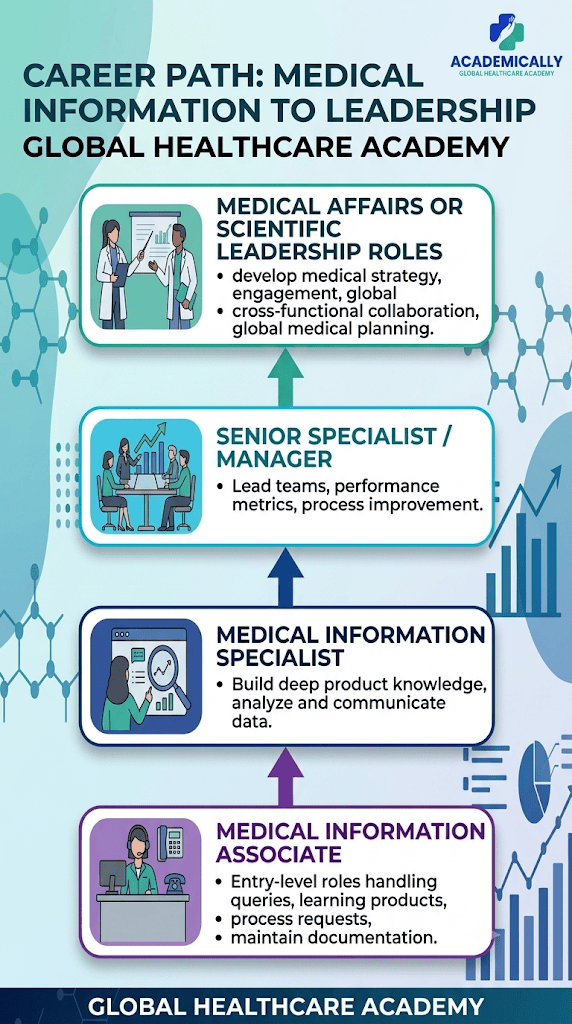
A possible career path might look like this:
Medical Information Associate → Medical Information Specialist → Senior Specialist/Manager → Medical Affairs or Scientific Leadership roles
progression depends on the company and individual experience.
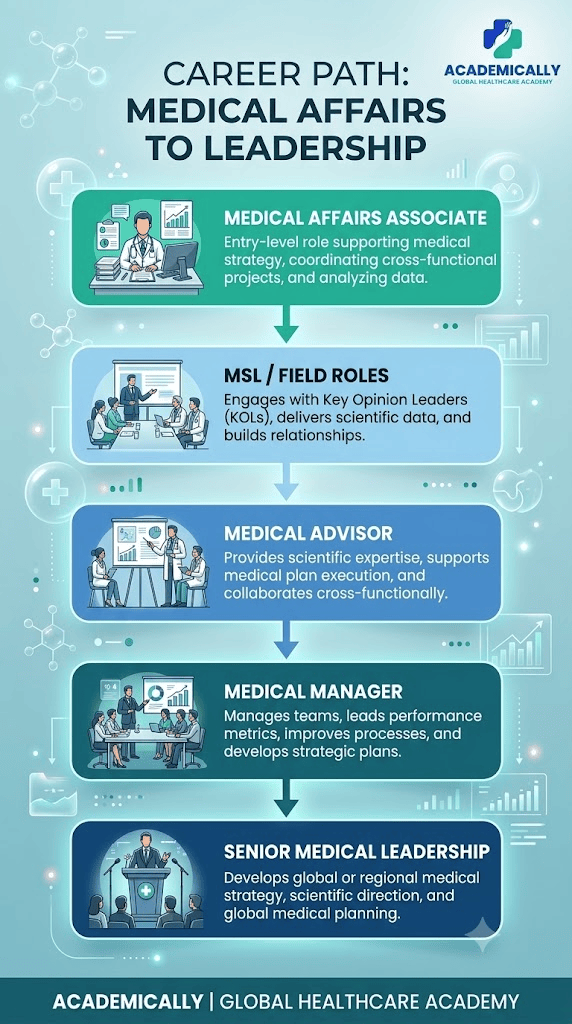
Medical Affairs offers diverse career options.
The path may include:
Medical Affairs Associate → MSL/Field roles → Medical Advisor → Medical Manager → Senior Medical Leadership
Other directions include Medical Communications, Scientific Writing, Evidence Generation, Medical Excellence, Publications and related functions.
Which Path Is More Suitable for You?
There is no right choice because the two paths focus on different types of work.
Medical Information may suit you if you enjoy:
- Medical research
- Literature searching
- Evaluating evidence in detail
- Structured workflows
- Scientific writing
- Answering focused medical questions
- Accuracy and documentation
- Working closely with medical information
Medical Affairs may suit you if you enjoy:
- Broader scientific strategy
- Talking with healthcare professionals
- Presentations and scientific exchange
- Engaging with opinion leaders (KOLs)
- Medical education
- Generating evidence
- Working on -functional projects
- Turning scientific insights into real-world plans
Some professionals may enjoy both. This is especially true because Medical Information gives you exposure to products, scientific evidence, stakeholder needs and how the pharmaceutical industry works.
Where to find the right job opportunities?
Learning about the profession is part of the journey. The next step is finding the jobs.
Jobslly helps healthcare professionals search specifically for healthcare and non-clinical roles. It avoids searches like "pharma jobs" or "non-clinical jobs.”
Its current listings include Medical Information-related roles such as Senior Medical Information Writer and MA/MI Content Management and System Specialist.
Good search terms to try include:
- Medical Information Associate
- Medical Information Specialist
- Medical Information Writer
- Drug Information Specialist
- Medical Information Executive
- MA/MI Specialist
Reading job descriptions is helpful because it shows the actual skills employers want.
Medical Affairs is a broad field. So job searches should go beyond the phrase "Medical Affairs.”
Possible search terms include:
- Medical Affairs Associate
- Medical Affairs Specialist
- Medical Advisor
- Medical Science Liaison
- MSL
- Field Medical Associate
- Medical Manager
- Medical Excellence
- Medical Communications
Jobslly currently organises Medical Affairs opportunities. Shows related pharmaceutical and non-clinical positions across Indian cities and remote work options.
A smart strategy is to compare five to ten job descriptions and create a skills matrix.
Highlight skills that appear often. Then check which skills you already have and which ones you need to develop.
Medical Information vs Medical Affairs: How to Choose Your Career Direction
The choice becomes clearer when you stop focusing on job titles and start looking at the work.
Someone who likes evidence research, scientific writing, medical questions, documentation and structured processes may find Medical Information more appealing.
Someone who enjoys strategy talking with healthcare professionals, presentations, KOL relationships, evidence generation and cross-functional work may prefer Medical Affairs.
There is no need to see the two paths as separate. The pharmaceutical industry is connected. Professionals can move between roles as their experience grows their therapeutic knowledge expands, their communication skills improve and their industry exposure increases.
Final Takeaway
The key distinction in medical information vs medical affairs is scope.
Medical Information focuses on researching and providing balanced answers to medical and scientific questions.
Medical Affairs is a strategic function. It includes communication, evidence generation, stakeholder engagement, medical education, field medical activities, insights, Medical Information and other activities that connect pharmaceutical science with healthcare practice.
Both paths are relevant for doctors, dentists, pharmacists, researchers and life-science professionals who want to move beyond clinical roles.
Your next step should be based on the kind of work you want to do—not the job title that sounds good. Build a scientific foundation learn industry terms develop practical skills tailor your resume and search for jobs using specific job titles instead of broad keywords. That combination can make a transition, from healthcare education to a -clinical pharmaceutical career much more structured and realistic.