If you are here, reading this, you’ve been thinking about a career change for a while.
You know you don't want your future to look exactly like your present.
Perhaps you want less patient-facing work. Perhaps the long hours are becoming difficult to manage. Maybe you want a career that gives you more flexibility. Or perhaps you discovered that clinical practice isn't where you see yourself long-term.
If burnout, rigid hours, or a desire for flexibility has you considering leaving patient-facing care, the sheer volume of non-clinical options can quickly become overwhelming.
To simplify your search, let's compare two distinct paths that utilize healthcare knowledge in fundamentally different ways:
Your ideal direction comes down to whether your strengths lie in auditing technical records or synthesizing and explaining information.
Medical Coding: What Does a Medical Coder Actually Do?
Let's start with this simple question.
Think of medical coding as turning healthcare information into a standard language that different parts of the healthcare system can understand.
When a patient receives a diagnosis, treatment, or procedure, that information needs to be recorded consistently.
Medical coders review health records and assign the appropriate codes to diagnoses and procedures. These codes can then support activities such as billing, reimbursement, record-keeping, and healthcare data analysis.
You don't need to think of it as “just entering codes.”
A good medical coder has to understand what the medical record is saying, identify the relevant information, and apply the correct coding rules.
What Might Your Day Look Like?
You, as a medical coder, could spend your day:
- Reviewing patient records
- Looking for diagnoses and procedures
- Checking whether the documentation supports the information being coded
- Assigning the appropriate codes
- Checking your work for errors
- Resolving questions about unclear documentation
- Following coding guidelines and updates
If you naturally notice details that most people overlook, enjoy organized work, and don't mind following established processes, medical coding could be worth exploring.
What Skills Do You Need for Medical Coding?
Here's where your existing healthcare background can help.
You already understand medical terminology, diseases, treatments, and procedures. But knowing medicine and knowing how to code are not the same thing. You still need to learn how the coding system works and how to apply its rules correctly.
You need three things:
1. Medical knowledge- You need to understand what you're reading.
2. Coding knowledge- You need to know how that information should be represented using the relevant coding system.
3. Attention to detail- You need to spot differences, missing information and errors.
Think about it this way:
- Medical knowledge tells you what happened.
- Coding knowledge tells you how to record it correctly.
Is Medical Coding a Good Non-Clinical Career?
It can be for the right candidate!
Don't choose it simply because someone told you that “coding has scope.”
If you enjoy predictable processes and solving small information-based problems, you may find coding satisfying.
If you become frustrated by repetitive tasks, strict rules, or spending a significant part of your day reviewing records, you may find it less appealing.
No career should be chosen because you expect it to remain unchanged.
Technology is changing healthcare work, including coding. Building strong fundamentals and learning how technology fits into the profession can therefore be more useful than simply learning to perform repetitive tasks.
What Are The Growth Opportunities In Medical Coding?
Medical coding doesn't necessarily mean doing the same job forever. So if you're worried that choosing coding means locking yourself into one narrow job, that's not the case.
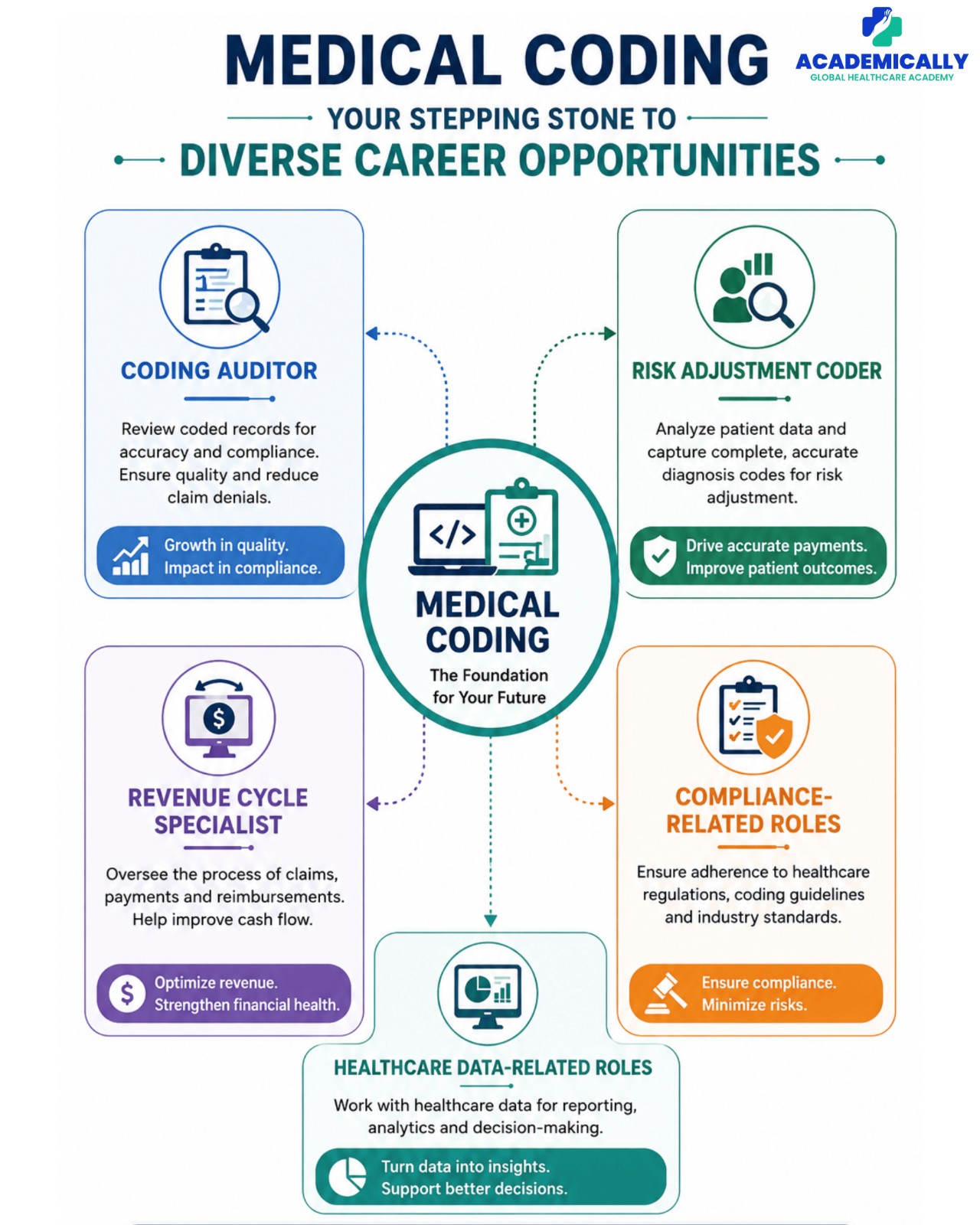
Your first role can become a starting point.
What Should You Do Next?
Think medical coding could suit you?
You don't have to decide based on a job description alone.
Before investing your time in a new career, it helps to understand what the role actually requires, where your current skills fit, and what you still need to learn such as non-clinical courses. Explore the path first. Then decide if it's right for you.
You can also speak with our team through a call to understand your options before deciding whether medical coding is the right direction for you.
Medical Writing: What If You'd Rather Work With Words?
Now let's see the other side.
Maybe the idea of spending your day reviewing medical records doesn't excite you.
Maybe you enjoy researching about different topics, and explaining it in a simpler language.
If that sounds more like you, medical writing may be worth exploring.
What Exactly Is Medical Writing?
Most simply, medical writing means: Taking medical or scientific information and communicating it clearly to a particular audience.
That audience could be another healthcare professional, a researcher, a patient, a pharmaceutical company, a regulatory organization, or the general public.
That's why “medical writing” isn't just one job.
A medical writer may work on scientific articles, research documents, educational materials, patient information, healthcare communications and other types of medical content.
So when someone says: “I want to become a medical writer.”
A useful follow-up question is: “What kind of medical writing?”
What Does a Medical Writer Actually Do?
Your day could involve very different tasks depending on your role.
You might:
- Research a medical topic
- Read scientific papers
- Summarize research findings
- Write educational healthcare content
- Edit existing medical material
- Prepare scientific documents
- Write content for patients
- Create information for healthcare professionals
- Work on research publications
- Support pharmaceutical or healthcare communication
The common thread is communication.
“But i know medicine. Isn't that enough?”
This is one of the biggest misconceptions about medical writing.
Your healthcare background can give you an advantage, but it doesn't automatically make you a medical writer.
Think about it.
You may know exactly what a disease is.
But can you explain it to:
- A patient with no medical background?
- A researcher?
- A healthcare professional?
- A pharmaceutical company?
- Someone reading a health article online?
Each audience needs a different approach.
That's the skill you develop as a medical writer.
You learn not only what to say, but how to say it.
What Skills Do You Need for Medical Writing?
The good news is you don't have to become a completely different person.
You must build on what you already know.
- Research skills- You need to know how to find reliable medical information and understand what you're reading.
- Writing skills- You need to communicate clearly without making every sentence unnecessarily complicated.
- Editing skills- Good writing is rarely perfect on the first attempt. You need to identify unclear, repetitive or inaccurate sections.
- Attention to detail- Medical writing isn't creative writing where you can simply make something up. Information must be supported by reliable evidence and communicated responsibly.
- Audience awareness- The same medical topic may need to be written differently for a doctor and a patient. That ability to adjust your writing is one of the most valuable skills you can develop.
What Are The Different Domains In Medical Writing?
Medical writing can include scientific publications, clinical research documents, regulatory material, educational resources, and healthcare communication.
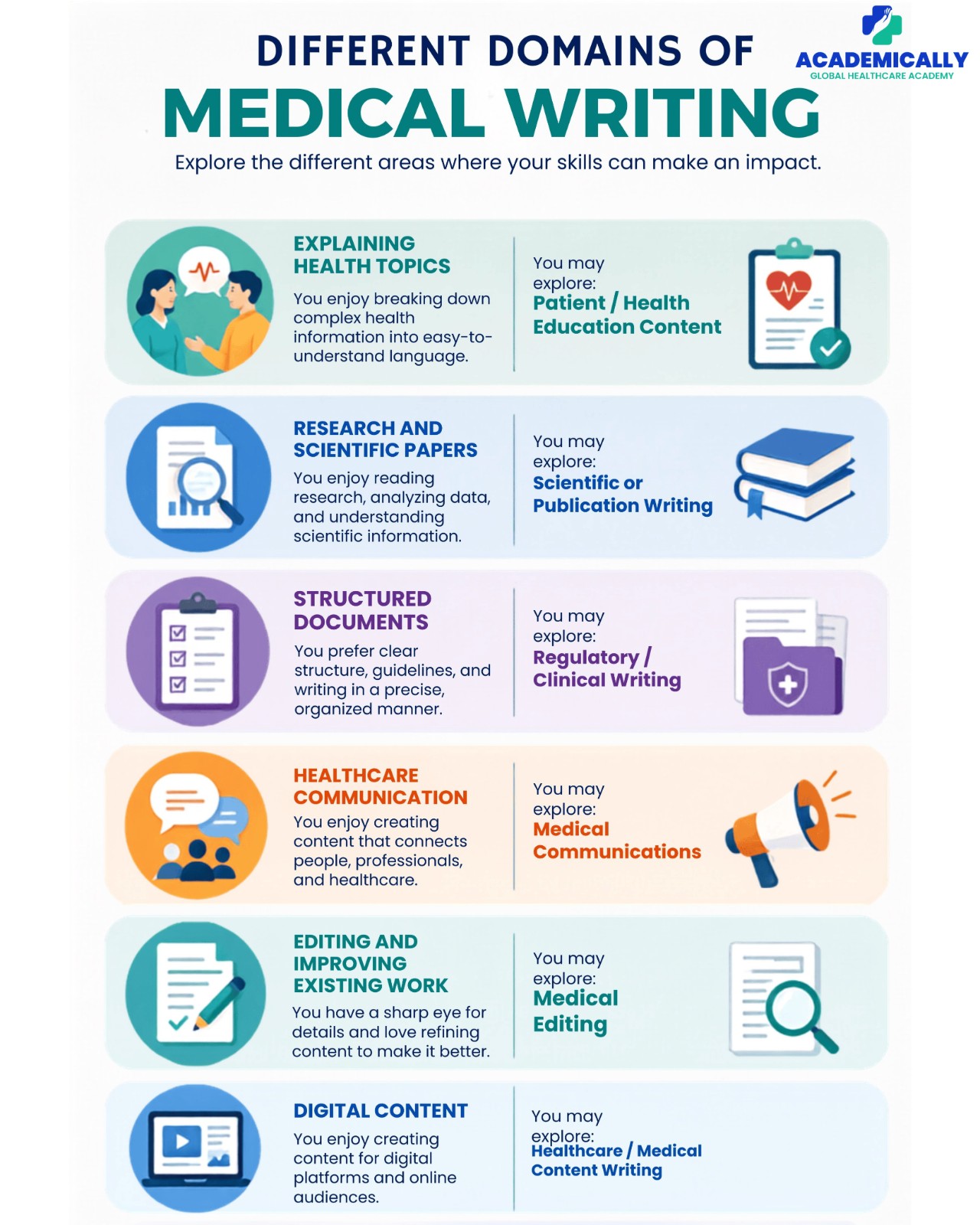
This variety is one of the biggest differences between medical writing and medical coding.
Coding generally revolves around a defined process.
Medical writing can take you into several different forms of communication.
What Should You Do Next?
Do you enjoy medicine and also enjoy writing?
Then don't dismiss medical writing simply because you haven't worked as a writer before.
Writing is a skill. It can be learned, practiced and improved.
What matters is understanding what the industry expects and building evidence that you can do the work.
Academically's Medical Writing Course covers areas such as scientific writing, clinical research, regulatory writing, publication writing, medical communications, editing and career development.
You don't have to decide immediately.
Start by understanding the field, identify your skill gaps, and then decide whether structured training makes sense for your career goals.
Side-by-Side: Which Fits Your Goals?
When you set aside the titles and look at the daily reality of these two careers, the contrast becomes clear:
| FACTOR | Medical Coding | Medical Writing |
| Main focus | Recording healthcare information correctly | Communicating healthcare information clearly |
| Typical work | Reviewing records and assigning codes | Researching, writing and editing |
| Work style | Structured and process-based | Flexible and project-based |
| Creativity | Usually lower | Usually higher |
| Writing | Helpful | Central to the job |
| Medical Knowledge | Important | Important |
| Attention to detail | Extremely important | Extremely important |
| Research | Some | Often significant |
| Variety of work | Moderate | High |
| Best suited to | People who like structure | People who like communication |
| Learning curve | Learn coding rules and systems | Develop writing, research and communication |
| Potential directions | Coding, auditing, compliance, data | Scientific, regulatory, publication, communications |
The table gives you the basic overview.
However, the most important question remains the same: Which Career Matches Your Goals?
Instead of asking, “Which career pays more?”, begin with: “What kind of work do I actually enjoy doing?”
Because a career that looks excellent on paper can become frustrating if the day-to-day work doesn't suit you.
A Simple Career-Fit Scorecard
Reflect on what genuinely excites you during a workday. Give yourself 1 point for every statement that feels authentic to your personality:
| STATEMENT | CODING | WRITING |
| I enjoy highly organized work. | ✓ | |
| I notice small mistakes easily. | ✓ | ✓ |
| I don't mind repetitive tasks. | ✓ | |
| I enjoy following clear rules. | ✓ | |
| I enjoy researching new topics. | ✓ | |
| I enjoy writing. | ✓ | |
| I like simplifying difficult topics. | ✓ | |
| I want variety in my work. | ✓ | |
| I enjoy reading research. | ✓ | |
| I prefer accuracy over creativity. | ✓ | |
| I enjoy communicating ideas. | ✓ | |
| I like solving information-based problems. | ✓ | ✓ |
- If your tally leans toward Coding: You find comfort in clear parameters, data integrity, and methodical problem-solving.
- If your tally leans toward Writing: You are energized by exploration, narrative flow, and translating complex science into human terms.
- If your score is evenly split: Do not rush the verdict. Consider which daily activity you would prefer doing for eight hours straight: auditing documentation or drafting original prose.
Remember, this isn't a scientific career assessment. It's simply a way to start thinking about your preferences.
The Realistic Picture: Growth, Compensation, and AI
When clinicians consider leaving patient care, two lingering anxieties often surface:
Will I be replaced by an AI? and Will I have to sacrifice my earning potential?
Neither field has a rigid salary ceiling.
Entry-level roles provide a stable starting floor, while specialized expertise such as senior regulatory writing for global clinical trials or principal compliance auditing for major hospital systems, commands premium compensation. Yes, we are talking big bucks!
Regarding technology: artificial intelligence can draft simple summaries and suggest preliminary code matches, but it lacks clinical judgment.
It cannot contextualize patient histories, identify subtle nuances in medical ethics, or tailor an empathetic message to a vulnerable reader.
Building your career on critical thinking, clinical literacy, and high-level evaluation ensures long-term professional relevance in both fields.
What If You're Good at Both?
Then you have an interesting problem.
It's a good problem to have.
You don't necessarily need to choose based on the skills you already possess.
Think about the skills you want to use daily.
- You could be an excellent writer but dislike writing for hours.
- You could be extremely detail-oriented but dislike repetitive work.
- You could enjoy medicine but not want to spend your entire day reading clinical documentation.
Your career should match your work preferences, not just your CV.
5 Things To Do Before You Make The Switch-
1. Understand the actual job: Look beyond surface-level job titles. Read job descriptions and day-in-the-life accounts to understand what each role demands from 9 to 5.
2. Identify your strengths and skill gaps: Recognize what your healthcare background already provides—pathology, terminology, clinical workflows—and isolate the specific trade tools you need to learn.
3. Run a Personal Micro-Experiment: Test the waters directly. Try coding a sample anonymized operative note using an ICD-10 manual, or take a complex peer-reviewed study and write a 400-word patient-friendly summary. Notice which task sparks genuine focus and which feels like a chore.
4.Talk to someone who has been through a similar career path: Connect with clinicians who have successfully transitioned to gain unfiltered insight into their daily routines and career trajectories.
5. Choose targeted, practical upskilling: Seek training that bridges your specific skill gaps and equips you with demonstrable portfolio pieces or recognized credentials. Don't buy a course simply because the title sounds impressive.
How Academically Can Help You Take the Next Step
You know you want a change but aren't sure where to begin, that's exactly where career guidance can become useful.
Recognizing that you need a change is one thing; figuring out how to actually cross the bridge without stumbling is another.
In college, you were trained with clear protocols and proven pathways, but when it comes to pivoting your career, there is rarely a handbook waiting for you.
Academically was built to help healthcare professionals transform their clinical background into thriving non-clinical careers.
Rather than leaving you to guess your way through endless job boards, Academically provides the structured mentorship, skill assessments, and industry-aligned training needed to make a seamless transition.
Whether you are looking to master the precision of healthcare documentation or want to dive into specialized training such as a comprehensive Medical Writing Program covering regulatory writing, clinical research, publication strategy, and medical communications; the focus is on turning what you already know into high-value, marketable expertise.
You don't need to have an answer today. Talk to someone before making the decision.
Ask yourself one final question:
What would I rather spend most of my workday doing?
Reviewing and organizing medical information → Medical Coding
Researching and explaining medical information → Medical Writing
If your answer is still: “I don't know.”