The five things doctors actually struggle with
Before comparing courses, let us name the real problems. If you recognise yourself in these, this article is written for you.
| Your problem | What actually causes it |
|---|---|
| “I don't want clinical practice, but I don't know what else I can do.” | Medical college never teaches you that a whole industry hires doctors for non-clinical work. |
| “I applied to many jobs and got no reply.” | Your CV is written in clinical language. An applicant tracking system filters it before a human reads it. |
| “I don't know how to write a resume, cover letter or professional email.” | Nobody taught you. These are corporate skills, not medical ones and they decide who gets called. |
| “I freeze in corporate interviews.” | Clinical vivas and competency-based corporate interviews are completely different skills. |
| “Recruiters never find me.” | Most industry hiring starts with a LinkedIn keyword search. If your profile says only ‘MBBS’ ‘BDS’ or PharmD, you are invisible. |
Notice something important: not one of these problems is solved by studying more theory. They are all readiness problems and that is exactly where the two options in this article differ most.
| Not sure which path fits you? Speak to an Academically career counsellor for a free, honest assessment of your profile no pressure, no obligation. Scholarships are available for eligible candidates: [SCHOLARSHIP LINK] |
What is an MBA?
A Master of Business Administration is a two-year postgraduate degree in general management. You study finance, marketing, operations, strategy and human resources. It is taught mainly by university professors, and the learning is broad and theoretical by design, that is what a general degree is meant to be.
It is genuinely valuable if you want business leadership, hospital administration, healthcare consulting or entrepreneurship. I would never call an MBA a waste.
But there are four things you should know
- Top colleges are hard to get into. IIMs, and other leading schools want a strong CAT or GMAT score and a distinctive profile, and they usually prefer candidates who already have work experience. A fresh MBBS or BDS graduate with no industry background is at a disadvantage.
- The college decides the outcome. A top-tier MBA can open excellent doors. An average one often does not and you have still spent two years and a large fee.
- It does not use your medical degree. In an MBA classroom your MBBS is background, not an asset. You compete with engineers and commerce graduates on their subject, not yours.
- Specialised healthcare MBAs sound perfect but check what is included. MBA in Healthcare Management, Pharma Management or Hospital Management are popular, and many universities now offer them online or part-time. The concern is not the syllabus. It is what happens after.
The difference nobody talks about: job support
This is the most important section of this article, so let me be direct.
Most MBA programmes - especially the online, part-time and distance versions, give you a degree. That is all. There is usually no help with:
- Writing an ATS-friendly resume for a specific role
- Writing cover letters and professional emails
- Optimising your LinkedIn profile so recruiters can find you
- Mock interviews and corporate interview preparation
- Finding and applying to the right job openings
- Salary negotiation and evaluating an offer
So you finish with a qualification and are left to work out the hardest part alone, the part that actually decides whether you get hired.
A degree proves you studied. Job support is what gets you employed. Most programmes give you the first and leave you to figure out the second.
This is precisely why so many capable doctors send fifty applications and hear nothing. It was never a knowledge problem.
What is Medical Affairs?
Medical Affairs is a department inside every pharmaceutical company. It is the scientific voice of the organisation — the team that discusses clinical evidence with senior doctors, shapes medical strategy, answers scientific questions and ensures everything the company says about a medicine is accurate and compliant.
It is not sales. It is a scientific role, and it exists because companies need medically trained people.
The roles you can enter
- Medical Affairs Associate: a common entry point supporting medical strategy and projects.
- Medical Science Liaison (MSL): a field-based scientific expert engaging with Key Opinion Leaders. One of the best-paid non-clinical roles.
- Medical Advisor: owns the medical strategy for a brand or therapy area. Usually the step after MSL or associate experience.
Here your MBBS, BDS or PharmD is the whole reason you are hired. You are not competing outside your field, you are valued for the training you already have.
The comparison at a glance
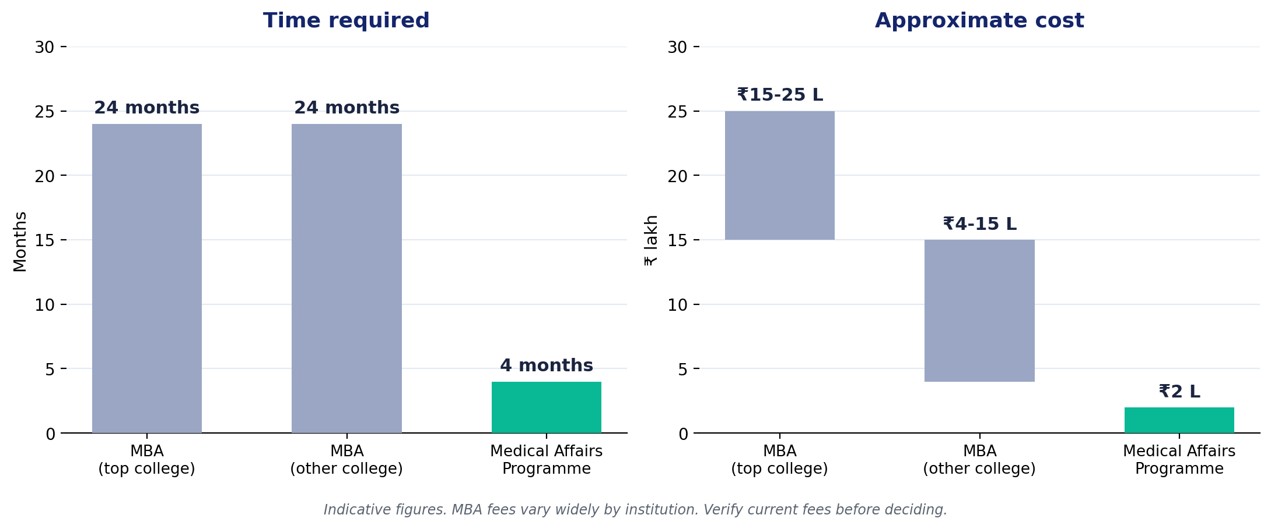
Indicative figures. MBA fees vary widely by institution - verify current fees before deciding.
Side-by-side comparison
| MBA (including online / part-time) | Medical Affairs Certification | |
|---|---|---|
| Duration | 2 years | 4 months, flexible - keep working while you study |
| Cost | ₹4–25 lakh depending on college | About ₹2 lakh |
| Entry | CAT/GMAT, strong profile; work experience often preferred | Open to MBBS, BDS, PharmD and other healthcare graduates |
| Who teaches | University professors | Doctors (MBBS/MD) and professionals working in pharma and CROs today |
| What you learn | Broad business theory | One field in depth - Medical Affairs, clinical trials, medical strategy |
| Uses your medical degree | Indirectly | Directly, it is why you are hired |
| Industry tools | Rarely covered | Hands-on Veeva Vault, Argus, MedDRA |
| Resume & LinkedIn help | Usually none | Built with you, ATS-optimised |
| Interview preparation | Usually none | 1:1 mock interviews, HR and technical |
| Job applications | You are on your own | Openings shared, profile referred to recruiters |
| CPD points | Not applicable | 180 CPD points on completion |
| Class size | Large batches | Limited cohort of 30, with 1:1 attention |
| Typical outcome | A general management role, varies by college | A specific role: MSL, Medical Affairs Associate, Medical Advisor/ Medical Information Specialist/medical writer |
The cost most people forget
When doctors compare these options, they compare the fees. That is only half the picture.
A full-time MBA usually means leaving your job for two years, so the real cost is the fee plus the salary you do not earn. A Medical Affairs programme runs alongside your current work, so you keep earning while you study.
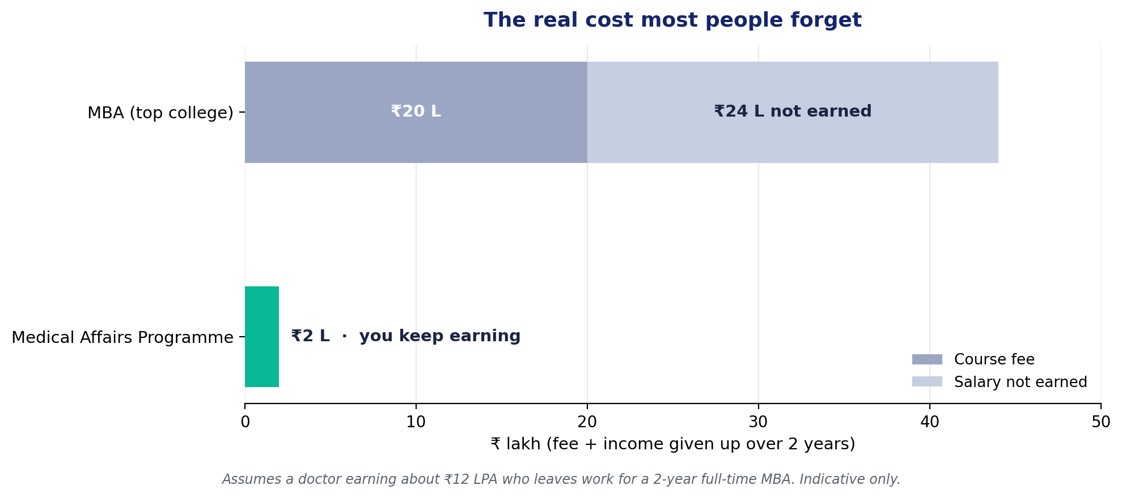
Assumes a doctor earning about ₹12 LPA who stops working for a two-year full-time MBA. Indicative only.
For many doctors this single point decides the question. Two years is a long time to earn nothing, especially early in a career.
| Want to keep earning while you switch careers? The Executive Programme in Medical Affairs runs online over four months, designed around clinical duties. Explore the programme and check your scholarship eligibility: [SCHOLARSHIP LINK] |
Which one actually gets you a job in pharma?
An MBA prepares you for many possible business careers. That breadth is its strength and its weakness. When you apply for a Medical Affairs role, the hiring manager tests one thing: do you understand this function, and can you do this job?
A Medical Affairs programme is built backwards from that interview. You learn what the role involves, practise with the tools named in job descriptions, work on real case studies, and rehearse the questions you will actually be asked.
An MBA teaches you business. A Medical Affairs programme teaches you the job.
There is another practical point. Many pharmaceutical companies hire MBAs into commercial and marketing roles, not into Medical Affairs. Medical Affairs positions usually go to people with a medical or pharmacy background who understand the science. Your degree already gives you that, you only need the industry layer on top.
The smarter sequence: Medical Affairs first, MBA later
Here is something worth thinking about carefully, because it changes the whole decision.
Top MBA colleges prefer candidates with real work experience. A fresh MBBS graduate applying straight to a tier-1 programme is competing at a disadvantage. But a doctor who has spent three or four years as an MSL or Medical Advisor in a multinational pharmaceutical company is exactly the profile those schools value.
So consider this order:
- Complete a Medical Affairs certification (4 months). Enter the industry as a Medical Affairs Associate or MSL.
- Work and grow for 3–4 years. Earn a salary, build a track record, move toward Medical Advisor.
- Then apply for an MBA from a tier-1 college if you still want one. Now you have the experience they prefer and often your employer will sponsor it, or you can fund it from your own salary.
This sequence costs less, risks less, and improves your MBA application at the same time. You are not choosing between the two, you are simply putting them in the order that works.
Salary: what can you expect?
Salaries depend on employer, city and experience, so treat these as indicative ranges rather than promises.
| Stage | Medical Affairs / MSL | Typical roles |
|---|---|---|
| Entry (0–2 years) | ₹8–16 LPA | Medical Affairs Associate, MSL, Medical Information |
| Mid (3–6 years) | ₹15–28 LPA | Senior MSL, Medical Advisor |
| Senior (7+ years) | ₹30–50 LPA | Medical Affairs Manager, Head of Medical Affairs |
⚠ MBA salaries vary far too much by college to state a single honest range. A top-tier MBA can pay very well; an average one may not. That variability is itself part of the decision.
So which should you choose?
| Choose an MBA if… | Choose Medical Affairs if… |
|---|---|
| You want a broad business or management career | You want to stay close to medicine and science |
| You can invest two years and a large fee | You want to start earning in the new field quickly |
| You can get into a strong, well-known college | You want your medical degree to be the main asset |
| You are aiming at hospital administration or consulting | You are aiming at MSL, Medical Advisor or Medical Affairs roles |
| You are comfortable competing outside your subject | You want structured job support, not just a qualification |
How the Academically programme works
The Executive Programme in Medical Affairs / Medical Science Liaison was built for exactly this transition — and specifically to solve the five problems listed at the start of this article.
Taught by people who do the job
Our faculty are not only academics. They include doctors, MBBS and MD qualified - who now lead teams in major pharmaceutical companies and CROs. They tell you what recruiters are asking for this quarter, not what a syllabus approved three years ago says.
A limited cohort of 30, with 1:1 attention
We deliberately keep each batch small. Not everyone who applies is selected, because the format only works with genuine individual attention. In a cohort of 30 we can identify each person's specific weakness, communication, scientific presentation, interview nerves, a weak CV and work on it directly, one to one, so you start your career sooner rather than drifting.
Career preparation from day one
- ATS-friendly resume, customised for each role you target
- Cover letters, professional emails and statement of purpose
- LinkedIn profile optimisation so recruiters can find you
- HR and technical interview preparation, with 1:1 mock interviews
- Relevant job openings shared, and your profile referred to recruiters where applicable
- Salary negotiation and offer guidance
- Continued support even after you are placed, including your next move
Hands-on with the tools employers name
Practical training in Veeva Vault, Argus and MedDRA, plus real industry case studies and a capstone project you can discuss confidently in an interview.
180 CPD points on completion
The programme carries 180 CPD points, so the four months you invest also count towards your continuing professional development record. It is a small detail, but a useful one: you are building recognised professional credit at the same time as building a new career.
⚠ We will always say this plainly: no honest organisation can guarantee you a job. “Job assistance” means genuine assistance, training, preparation and placement support not a guaranteed placement. What good preparation reliably improves is your readiness, your visibility and your confidence.
Final thoughts
There is no universally correct answer, and anyone who tells you otherwise is selling something.
But after mentoring hundreds of doctors through this decision, I can tell you that most people asking this question do not actually want a general business degree. They want out of clinical practice and into a respected, well-paid industry role and the MBA was simply the only route they had heard of.
If that describes you, a four-month, industry-taught programme that uses the degree you already hold, and that helps you with the CV, the LinkedIn profile and the interview, will get you there faster and with far less risk. And if you still want the MBA afterwards, you will be a stronger candidate for it.
Choose the tool that matches the goal, not the one that sounds most impressive.